Green Smoothies- What Does the Science Say
Posted: September 8, 2015 Filed under: Food and it's Impact on Our Health, In The Kitchen with Millie- How To's | Tags: #BeyondPaleo, #greensmoothies, #jacksonville, #smoothies Leave a comment
I’ve posted before about green smoothies and the fact that it is far better to put your greens in a smoothie than in juices.
I found this great article on NutritionFacts.com;
Transcript: Green Smoothies: What Does the Science Say?
As I’ve explored previously, drinking sugar water is bad for you. If you have people drink a glass of water with three tablespoons of table sugar in it, which is like a can of soda, this is the big spike in blood sugar they get within the first hour. The body freaks out, and releases so much insulin we actually overshoot, and by the second hour we’re relatively hypoglycemic, dropping our blood sugar below where it was when we started fasting. In response, our body dumps fat into our blood stream as if we’re starving, because our blood sugars just dropped so suddenly. And the same thing happens after drinking apple juice.
Here’s what happens to your blood sugar in the three hours after eating four and a half cups of apple slices: it goes up and comes down. But if you eat the same amount of sugar in apple juice form, about two cups, your body overreacts, releasing too much insulin, and you end up dipping below where you started. The removal of fiber in the production of fruit juice can enhance the insulin response and result in this “rebound hypoglycemia.” What would happen though, if you stuck those four and a half cups of sliced apples in a blender with some water and pureed them into an apple smoothie? It would still have all it’s fiber, yet still cause that hypoglycemic dip. The rebound fall in blood sugars, which occurred during the second and third hours after juice and puree, was in striking contrast to the practically steady level after apples. This finding not only indicates how important the presence of fiber is, but also, perhaps whether or not the fiber is physically disrupted, as happens in the blender.
Let’s play devil’s advocate, though. Eating four and a half cups of apples took 17 minutes, but to drink four and a half cups of apples in smoothie form only took about six minutes, and you can down two cups of juice in like 90 seconds. So maybe these dramatic differences have more to do with how fast the fruit entered in our system rather than the physical form. If it’s just the speed we could just sip the smoothie over 17 minutes and the result would be the same, so they put it to the test. Fast juice was drinking it in 90 seconds, but what if you instead sipped the juice over 17 minutes? Same problem—so it wasn’t the speed, it was the lack of fiber. What if you disrupt that fiber with blending, but sip it as slowly as the apple eating? A little better, but not as good as just eating the apple. So eating apples is better than drinking apple smoothies, but who drinks apple smoothies? What about bananas, mangoes, or berries?
There was a study that compared whole bananas to blended bananas and didn’t see any difference, but they only looked for an hour, and it was while they were exercising. Bananas in general though may actually improve blood sugars over time. The same thing with mangoes—and this was with powdered mango—can’t get any more fiber disrupted than that. It may be due to a phytonutrient called mangiferin, which may slow sugar absorption through the intestinal wall.
Berries help control blood sugar so well they can counter the effects of sugar water even when they’re pureed in a blender. Add blended berries in addition to the sugar water, and you don’t get the hypoglycemic dip; you don’t get that burst of fat in the blood. Drinking blended berries isn’t just neutral, but improves blood sugar control. Again, thought to be due to special phytonutrients that may slow sugar uptake into the bloodstream. Indeed, six weeks of blueberry smoothie consumption may actually improve whole body insulin sensitivity.
So while apple smoothies may be questionable, a recipe like Mayo’s basic green smoothie recipe, packed with berries and greens, would be expected to deliver the best of both worlds, maximum nutrient absorption without risking overly rapid sugar absorption.
Gut Health
Posted: August 18, 2015 Filed under: Food and it's Impact on Our Health, Going Green; How and Why..., In The Kitchen with Millie- How To's, Products | Tags: #Beyond-Paleo, #BeyondPaleo, #Kombucha, Paleo Leave a comment
Most Americans have a compromised Immune System. Most also have leaky gut. If you have allergies, get frequent colds, ear infections, are overweight, have arthritis..you have leaky gut.
Healing a leaky gut means following a nutritional protocol to enable it to heal. Replenishing gut bacteria is crucial; to heal the lining of the stomach, to properly digest foods so that you can actually absorb the nutrients…in order to repair the immune system and enjoy optimal health.
One way to do this is to take probiotics, but they are very pricy and do not really survive the stomach acids to get into the colon where they will do you the most good.
So what should you do?
Eat fermented foods! Sauerkraut, wine, pickles, coconut milk yogurt (you should avoid dairy in all forms for optimal health), and Kombucha tea are great ways to do this.
I began fermenting Kombucha tea about a year ago, it is easy and fun to make…and is very inexpensive. I also now make my own organic Apple Cider Vinegar.
Beginning next week I will begin selling Kombucha tea with my other Culinary Items. I make a mild, very slightly sweet Raspberry Kombucha. It will be on the menu each week.
Beef Burgers with Cabernet Onion Jam
Posted: August 12, 2015 Filed under: Recipes | Tags: #Beyond-Paleo, Paleo Leave a comment
Serving Size : 4
1 tablespoon butter
3 cups very thinly sliced red onion (from 2 medium red onions)
2 tablespoons coconut date sugar
3/4 teaspoon salt — divided
2/3 cup Cabernet Sauvignon wine
1 tablespoon balsamic vinegar
2 pounds lean ground beef
1/2 teaspoon salt
1/4 teaspoon black pepper
Heat the butter in a large skillet over medium heat. Add the onion, sugar, and 1/4 teaspoon of the salt and cook, stirring occasionally, until the onion is very soft, about 15 minutes. Add the wine and vinegar and cook until the liquid is nearly gone, 12 to 14 minutes longer (25 to 30 minutes total). Cover and set aside
Mix the beef, remaining 1/2 teaspoon salt, and pepper with a fork; form into four 3/4-inch-thick patties. Press your thumb in the center of each burger to form an indentation. Grill the patties 4 to 5 minutes, turn and grill another 4 minutes, and top with the cheese. Cook until the cheese is melted and the burger is cooked to desired degree of doneness (160° for medium).
Top burger with the onion jam.
Berries with Orange Sabayon
Posted: July 31, 2015 Filed under: Recipes | Tags: #BeyondPaleo, #healthy desserts, #jacksonville, #MillieBarnes, #Primaldiet Leave a comment
Berries with Orange Sabayon
Serving Size : 4
Mixed berries- I use blueberries, raspberries and strawberries.
3 tablespoons sugar
7 whole egg yolks
2 tablespoons orange juice
1 teaspoon lemon juice
1 teaspoon orange zest
1 teaspoon lemon zest
2 tablespoons orange liqueur — such as Grand Marnier OR a few drops of orange extract
Whisk the sugar and egg yolks in a large metal mixing bowl until frothy. Set the bowl over a pot of simmering water (to create a double-boiler) and whisk until the yolks become pale yellow in color.
Continue to whisk over low to medium heat until the mixture begins to thicken, about 10 minutes. Add the juices and zests and continue to whisk so the sauce thickens back up again. Add the liqueur and whisk until incorporated and the sabayon is light, fluffy and has good volume, 2 minutes longer.
Carrot Dogs with Grilled Onions
Posted: July 13, 2015 Filed under: Recipes | Tags: #beyond, #carrots, #cleaneating, Paleo Leave a comment
Carrot Dogs with Grilled Onions
4 large carrots
2 medium onions
1 cup white wine
1/2 cup Coconut Amino Acids
1 Tablespoon toasted sesame oil
1 Tablespoon dried dill
1) Place wine, aminos, dill and oil in a shallow pan. Marinade carrots for about an hour.
2) Grilled carrots and onions until tender and browned.
3) Serve with mustard, ketchup.
Caribbean Tenderloin With Mango Salsa
Posted: July 13, 2015 Filed under: Recipes | Tags: #BeyondPaleo, #CaribbeanCooking, #cleaneating, #pork, Paleo Leave a comment
Caribbean Tenderloin With Mango Salsa
Serving Size : 4
1 large mango — chopped
2 whole scallions — chopped
2 tablespoons butter
1 tablespoon fresh lime juice
1/4 teaspoon crushed red pepper
1 teaspoon thyme
1/2 teaspoon garlic powder
1/2 teaspoon smoked paprika
1 teaspoon cumin
1 teaspoon kosher salt
2 1/2 pounds pork tenderloin
1 teaspoon ground coriander
Heat broiler. In a medium bowl, combine the mango, scallions, cumin, paprika, garlic powder, thyme, 1 tablespoon butter, lime juice, crushed red pepper, and 1/4 teaspoon salt. Set aside.
Rub the pork with the remaining 1 teaspoon oil. Season with the coriander and cumin and 1/2 teaspoon salt.
Bake the tenderloin, turning occasionally, until cooked internal temp reaches 145.
Serve the pork with the salsa.
Burger with Portobello Bun and Grilled Onion with Salsa
Posted: July 13, 2015 Filed under: Recipes | Tags: #BeyondPaleo, #eatclean, #Portobello bun burger w/ roasted Caramelized onions, sautéed leeks & salsa Leave a comment
Serving Size : 4
2 pounds bison
2 1/2 large Vidalia onion — halved
4 large Portobello mushroom
2 large tomato
1 teaspoon garlic — minced
2 stalks celery
1 teaspoon basil
1) Form patties and push hole in the middle (this keeps the burgers from swelling up into that football shape. Salt and pepper burgers (I like to used smoked salt on burgers)
2) Brush portabellas, onion halves, celery with butter. Grill until done. At the same time grill the burgers.
3) Dice celery and 1/2 of onions, combine with garlic, basil, salt and pepper.
The Strange Link Between Junk Food and Depression
Posted: June 30, 2015 Filed under: Food and it's Impact on Our Health | Tags: #BeyondPaleo, #sugar, Paleo Leave a comment Elizabeth Renstrom for TIME
From Time Magazine
Some—but not all—sugars were associated with depressive disorders
Of our many modern diseases, one of the biggest burdens on society is an unexpected one: depression,according to the World Health Organization. And what we eat may be contributing, finds a new study published in the American Journal of Clinical Nutrition.
James E. Gangwisch, PhD, assistant professor at Columbia University in the department of psychiatry, wanted to find out whether foods with a higher glycemic index (GI)—a scale that ranks carbohydrate-containing foods by how much they raise your blood sugar—would be associated with greater odds of depression. “When I was a kid, I was almost like a candy junkie,” Gangwisch says. “I noticed for myself, if I eat a lot of sugar, it makes me feel down the next day.” Gangwisch says he stopped eating added sugar years ago but remained curious about whether a junk food diet could make people depressed.
He and a team of researchers looked at data from food questionnaires and a scale that measures symptoms of depressive disorders from postmenopausal women in the Women’s Health Initiative Observational Study. The data came from roughly 70,000 women, none of whom suffered from depression at the study’s start, who had baseline measurements taken between 1994 and 1998, and then again after a three-year follow-up.
Diets higher on the glycemic index, including those rich in refined grains and added sugar, were associated with greater odds of depression, the researchers found. But some aspects of diet had protective effects against developing depression, including fiber, whole grains, whole fruits, vegetables and lactose, a sugar that comes from dairy products and milk that sits low on the glycemic index.
Added sugars—but not total sugars or total carbohydrates—were strongly associated with depression.
Though the authors couldn’t pinpoint a mechanism from this study—it was associative—they note that one possibility is that the overconsumption of sugars and refined starches is a risk factor for inflammation and cardiovascular disease, both of which have been linked to the development of depression.This kind of diet could also lead insulin resistance, which has been linked to cognitive deficits similar to those found in people with major depression.
Further research is needed, Gangwisch says, and it’s not yet known whether the results would translate to a broader group of people, including men and younger women. But even now, diet may be worth discussing with people who suffer from depression, Gangwisch says—even though doing so may be difficult. “It’s hard enough to get the general public to avoid those kinds of foods, but it’s even harder to get someone who suffers from depression to avoid them and give them up,” he says. “You don’t want people to feel guilty either…to say, ‘Your diet’s bad and you should change it,’ would take kind of a soft sell approach.” Still, he believes the effort is worth it. “I think it’s important and I think it has a big effect on your mood and how you feel and your energy level,” he says. “If it’s something that people can change, they really would benefit from it.”
Chocolate Coconut Almond Bars
Posted: June 24, 2015 Filed under: Recipes | Tags: #BeyondPaleo, #Chocolate, #Paleo Dessert Leave a comment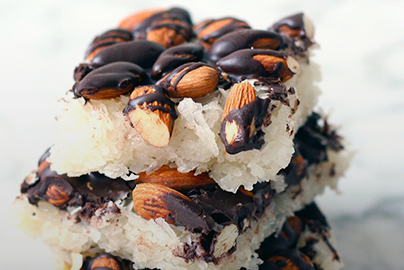
Serving Size : 12
5 egg whites
1/2 cup coconut sugar
1/4 teaspoon stevia
3/4 teaspoon pure vanilla extract
1/3 teaspoon almond extract
3/4 teaspoon salt
5 cups sweetened shredded coconut
1 3/4 cups whole almonds
1 3/8 cups chopped dark chocolate – melted
1) Preheat the oven to 325°F. Oil a 9-inch square baking dish with butter.
2) In the bowl of an electric mixer fitted with the whip attachment, whip the egg whites and sugar on medium speed until well incorporated and the sugar is nearly dissolved. Add the vanilla and almond extracts and salt; mix to combine.
3) Stir in the coconut by hand, then pour the mixture into the prepared baking dish. Press into an even layer.
4) Sprinkle the almonds over the coconut and press gently to secure.
5) Bake until the coconut begins to turn golden brown at the edges and the almonds are toasted, 20 to 25 minutes. Cool to room temperature.
6) When the coconut mixture is cool, drizzle the melted chocolate all over the surface. Transfer the pan to the refrigerator and chill until the chocolate is set.
7) Slice into 12 even squares. Store in an airtight container until ready to serve, up to three days.
Eating Chocolate Gets Another Thumbs-up for Heart Attack, Stroke Prevention
Posted: June 24, 2015 Filed under: Food and it's Impact on Our Health | Tags: #BeyondPaleo, #Chocolate Leave a comment
More good news for chocoholics: New research has found that devoted consumers of chocolate — including some who consume the equivalent of about two standard candy bars a day — are 11% less likely than those who eat little to no chocolate to have heart attacks and strokes, and 25% less likely to die of cardiovascular disease.
Chemists discover secret to dark chocolate’s health benefits
That news emerged from a long-running British study that tracked nearly 21,000 adults in and around Norfolk, England, for an average of 12 years, making frequent surveys of their consumption habits, lifestyles and health. Those in the top one-fifth of chocolate consumers owned up to eating the equivalent of about a half an American-sized candy bar; those whose chocolate consumption landed them in the bottom 20th percentile averaged a paltry 1.1 gram per day.
Those in the highest chocolate-consuming group not only had lower rates of heart attack and stroke, but they also had, on average, lower body-mass indexes, lower systolic blood pressure and inflammation, and lower rates of diabetes. They also tended to exercise more.
The study was published Monday in the BMJ journal Heart.
Those findings jibe with a welter of other “observational” studies, those that track people over lengthy periods and draw links between some factor or habit or input — in this case chocolate — and a specific outcome. Indeed, the authors of the Norfolk study also lashed together the findings of nine other such studies — a so-called meta-analysis reflecting the outcomes of 159,809 people — to undergird and provide further context for their findings.
That meta-analysis found that compared with chocolate abstainers, heavy chocolate consumers were 25% less likely to suffer a wide range of cardiovascular ills and 45% less likely to die of those ills.
But Dr. Farzaneh Aghdassi Sorond of Brigham and Women’s Hospital in Boston says it’s time for such observational studies to give way to trials that probe deeper questions: Is it chocolate, or something else that comes with a chocolate-eating life, that makes people healthier? And if it is chocolate, what is it specifically about this long-consumed bean that confers better health?
Studies like this one, Sorond says, can’t draw a clear line of cause and effect between eating chocolate and better health.
-
One shouldn’t jump to conclusions from observational studies without supporting data/studies. Hormone replacement therapy (HRT) was associated with lower risk of cardiovascular disease in observational studies, but when a randomized, blinded trial was finally done, it was found that HRT…
“Causality is the issue that remains unanswered and that’s going to have to be explored through clinical trials and interventions,” said Sorond, whose research has shown that when elderly people at high risk of stroke and dementia were given high quantities of cocoa to consume, the blood flow to their brains improved.
Sorond noted that in the current study, authors did little to distinguish grades of chocolate — and thus, the cocoa content of that chocolate — in their reckoning. Much of what was reported consumed appears to have been milk chocolate, which contains low levels of the plant flavonoids in cocoa that many researchers have focused on as chocolate’s beneficial ingredient.
That makes the findings all the more perplexing, she said, because “the brown stuff that is sweet doesn’t necessarily have any chocolate in it.”
“Are we really chasing the right thing focusing on the flavonols?” Sorond asked. “Or is there something else? Does chocolate consumption represent a socioeconomic status or some other kind of healthy factor? This paper underscores the issue we face.”
Such work is underway on a broad front, with scientists, confectioners and pharmaceutical companies all vying to play a role in chocolate’s next chapter.
Sorond says that may take four to five years to produce results, so it may be best to sit back, crack open a bar of dark chocolate and take heed of the advice dispensed by the authors of the latest research: “There does not appear to be any evidence to say that chocolate should be avoided in those who are concerned about cardiovascular risk.”


 Meal Delivery Service by Millie Barnes