How Soy Might Decimate the Health of Your Unborn Baby and the Fertility of Future Generations
Posted: July 31, 2012 Filed under: Food and it's Impact on Our Health Leave a comment
by Dr. Mercola
If you’re pregnant or thinking of having a baby, you might want to take a look at some new research on the effects of plant estrogens, such as that found in soy, on a developing fetus.
According to Medical News Today1, a paper published in Biology of Reproduction2 suggests that exposure to estrogenic chemicals in the womb or during childhood has the potential to negatively affect a woman’s fertility as an adult.
This coincides with earlier research on neonatal effects of exposure to plant or environmental estrogens. In studies with mice, researchers found that causes of infertility included:
- Failure to ovulate
- Reduced ability of the oviduct to support embryo development before ovulation, and
- Failure of the uterus to support effective implantation of blastocyst-stage embryos
According to Medical News Today:
“The team now reports that neonatal exposure to genistein changes the level of immune response in the mouse oviduct, known as mucosal immune response. Some of the immune response genes were altered beginning from the time of genistein treatment, while others were altered much later, when the mouse was in early pregnancy.
Together, those changes led to harmfully altered immune responses and to compromised oviduct support for preimplantation embryo development, both of which would likely contribute to infertility.”
Since human development of the reproductive tract continues through puberty, researchers believe that estrogenic chemical exposure to human females as a fetus, infant, child, and adolescent could have impacts on fertility. The authors suggested that minimizing the use of soy-based baby formula would be a step toward maintaining female reproductive health.
Earlier research has also found that the compound genistein impairs sperm as they swim toward the egg. Even tiny doses of the compound in the female tract could destroy sperm, which would impair your ability to conceive in the first place.
Do You Still Believe Soy is a Health Food?
Soybeans contain compounds called phytoestrogens or isoflavones, which have been found to produce a variety of mild hormonal actions within the human body by mimicking the sex hormone estrogen. An increased risk of breast cancer is another potential hazard, especially if you’re exposed to high amounts of estrogen-mimicking compounds from birth.
Making matters worse, unless you’re buying USDA 100% Organic soy products, chances are you’re consuming genetically engineered (GE) soy, or feeding it to your baby, and GE crops—soy in particular—has also been linked to serious fertility problems. Glyphosate, the active ingredient in Roundup, has similarly been implicated in causing miscarriages, and both conventional- and genetically engineered soy is typically treated with heavy doses of this herbicide.
All in all, the health hazards of unfermented soy products—particularly genetically engineered varieties—are so serious and numerous, I strongly suggest avoiding them altogether, whether you’re planning a pregnancy or not. But clearly, it’s of particular concern for pregnant women.
For an excellent summary of the many dangers of consuming unfermented soy, please see this previous article by The Weston A. Price Foundation.
Unfortunately, many Americans who are committed to healthy lifestyles have been hoodwinked and manipulated into believing that unfermented and processed soy products like soy milk, soy cheese, soy burgers and soy ice cream are good for them. This is a tragic case of shrewd marketing and outright lies, with the end result of producing large profits for the soy industry and impaired health for most who have been deceived into using unfermented soy long-term.
Americans are Starved for Fats
Posted: July 31, 2012 Filed under: Food and it's Impact on Our Health Leave a comment
"The country’s big low-fat message backfired. The overemphasis on reducing fat caused the consumption of carbohydrates and sugar in our diets to soar. That shift may be linked to the biggest health problems in America today. … Fat is not the problem."
What if what they call “Bad Fat” is actually Good For You?
It is!!!
By: Nina Teicholz Another great article from Men’s Health
For decades, Americans have been told that saturated fat clogs arteries and causes heart disease. But there’s just one problem: No one’s ever proved it!
Suppose you were forced to live on a diet of red meat and whole milk. A diet that, all told, was at least 60 percent fat — about half of it saturated. If your first thoughts are of statins and stents, you may want to consider the curious case of the Masai, a nomadic tribe in Kenya and Tanzania.
In the 1960s, a Vanderbilt University scientist named George Mann, M.D., found that Masai men consumed this very diet (supplemented with blood from the cattle they herded). Yet these nomads, who were also very lean, had some of the lowest levels of cholesterol ever measured and were virtually free of heart disease.
Scientists, confused by the finding, argued that the tribe must have certain genetic protections against developing high cholesterol. But when British researchers monitored a group of Masai men who moved to Nairobi and began consuming a more modern diet, they discovered that the men’s cholesterol subsequently skyrocketed.
Similar observations were made of the Samburu — another Kenyan tribe — as well as the Fulani of Nigeria. While the findings from these cultures seem to contradict the fact that eating saturated fat leads to heart disease, it may surprise you to know that this "fact" isn’t a fact at all. It is, more accurately, a hypothesis from the 1950s that’s never been proved.
The first scientific indictment of saturated fat came in 1953. That’s the year a physiologist named Ancel Keys, Ph.D., published a highly influential paper titled "Atherosclerosis, a Problem in Newer Public Health." Keys wrote that while the total death rate in the United States was declining, the number of deaths due to heart disease was steadily climbing. And to explain why, he presented a comparison of fat intake and heart disease mortality in six countries: the United States, Canada, Australia, England, Italy, and Japan.
The Americans ate the most fat and had the greatest number of deaths from heart disease; the Japanese ate the least fat and had the fewest deaths from heart disease. The other countries fell neatly in between. The higher the fat intake, according to national diet surveys, the higher the rate of heart disease. And vice versa. Keys called this correlation a "remarkable relationship" and began to publicly hypothesize that consumption of fat- causes heart disease. This became known as the diet-heart hypothesis.
At the time, plenty of scientists were skeptical of Keys’s assertions. One such critic was Jacob Yerushalmy, Ph.D., founder of the biostatistics graduate program at the University of California at Berkeley. In a 1957 paper, Yerushalmy pointed out that while data from the six countries Keys examined seemed to support the diet-heart hypothesis, statistics were actually available for 22 countries. And when all 22 were analyzed, the apparent link between fat consumption and heart disease disappeared. For example, the death rate from heart disease in Finland was 24 times that of Mexico, even though fat-consumption rates in the two nations were similar
The other salient criticism of Keys’s study was that he had observed only a correlation between two phenomena, not a clear causative link. So this left open the possibility that something else — unmeasured or unimagined — was leading to heart disease. After all, Americans did eat more fat than the Japanese, but perhaps they also consumed more sugar and white bread, and watched more television.
Despite the apparent flaws in Keys’s argument, the diet-heart hypothesis was compelling, and it was soon heavily promoted by the American Heart Association (AHA) and the media. It offered the worried public a highly educated guess as to why the country was in the midst of a heart-disease epidemic. "People should know the facts," Keys said in a 1961 interview with Time magazine, for which he appeared on the cover. " Then if they want to eat themselves to death, let them."
The seven-countries study, published in 1970, is considered Ancel Keys’s landmark achievement. It seemed to lend further credence to the diet-heart hypothesis. In this study, Keys reported that in the seven countries he selected — the United States, Japan, Italy, Greece, Yugoslavia, Finland, and the Netherlands — animal-fat intake was a strong predictor of heart attacks over a 5-year period. Just as important, he noted an association between total cholesterol and heart-disease mortality. This prompted him to conclude that the saturated fats in animal foods — and not other types of fat — raise cholesterol and ultimately lead to heart disease.
Naturally, proponents of the diet-heart hypothesis hailed the study as proof that eating saturated fat leads to heart attacks. But the data was far from rock solid. That’s because in three countries (Finland, Greece, and Yugoslavia), the correlation wasn’t seen. For example, eastern Finland had five times as many heart-attack fatalities and twice as much heart disease as western Finland, despite only small differences between the two regions in animal-fat intake and cholesterol levels. And while Keys provided that raw data in his report, he glossed over it as a finding. Perhaps a larger problem, though, was his assumption that saturated fat has an unhealthy effect on cholesterol levels.
Although more than a dozen types of saturated fat exist, humans predominantly consume three: stearic acid, palmitic acid, and lauric acid. This trio comprises almost 95 percent of the saturated fat in a hunk of prime rib, a slice of bacon, or a piece of chicken skin, and nearly 70 percent of that in butter and whole milk.
Today, it’s well established that stearic acid has no effect on cholesterol levels. In fact, stearic acid — which is found in high amounts in cocoa as well as animal fat –is converted to a monounsaturated fat called oleic acid in your liver. This is the same heart-healthy fat found in olive oil. As a result, scientists generally regard this saturated fatty acid as either benign or potentially beneficial to your health.
Palmitic and lauric acid, however, are known to raise total cholesterol. But here’s what’s rarely reported: Research shows that although both of these saturated fatty acids increase LDL ("bad") cholesterol, they raise HDL ("good") cholesterol just as much, if not more. And this lowers your risk of heart disease. That’s because it’s commonly believed that LDL cholesterol lays down plaque on your artery walls, while HDL removes it. So increasing both actually reduces the proportion of bad cholesterol in your blood to the good kind. This may explain why numerous studies have reported that this HDL/LDL ratio is a better predictor of future heart disease than LDL alone.
All of this muddies Keys’s claim of a clear connection between saturated-fat intake, cholesterol, and heart disease. If saturated fat doesn’t raise cholesterol in such a way that it increases heart-disease risk, then according to the scientific method, the diet-heart hypothesis must be rejected. However, in 1977 it was still a promising idea.
That was the year Congress made it government policy to recommend a low-fat diet, based primarily on the opinions of health experts who supported the diet-heart hypothesis. It was a decision met with much criticism from the scientific community, including the American Medical Association. After all, officially endorsing a low-fat diet could change the eating habits of millions of Americans, and the potential effects of this strategy were widely debated and certainly unproved.
We’ve spent billions of our tax dollars trying to prove the diet-heart hypothesis. Yet study after study has failed to provide definitive evidence that saturated-fat intake leads to heart disease. The most recent example is the Women’s Health Initiative, the governments largest and most expensive ($725 million) diet study yet. The results, published last year, show that a diet low in total fat and saturated fat had no impact in reducing heart-disease and stroke rates in some 20,000 women who had adhered to the regimen for an average of 8 years.
But this paper, like many others, plays down its own findings and instead points to four studies that, many years ago, apparently did find a link between saturated fat and heart disease. Because of this, it’s worth taking a closer look at each.
The Los Angeles VA Hospital Study (1969) This UCLA study of 850 men reported that those who replaced saturated fats with polyunsaturated fats were less likely to die of heart disease and stroke over a 5-year period than were men who didn’t alter their diets. However, more of those who changed their diets died of cancer, and the average age of death was the same in both groups. What’s more, "through an oversight," the study authors neglected to collect crucial data on smoking habits from about 100 men. They also reported that the men successfully adhered to the diet only half the time.
The Oslo Diet-Heart Study (1970) Two hundred men followed a diet low in saturated fat for 5 years while another group ate as they pleased. The dieters had fewer heart attacks, but there was no difference in total deaths between the two groups.
The Finnish Mental Hospital Study (1979). This trial took place from 1959 to 1971 and appeared to document a reduction in heart disease in psychiatric patients following a "cholesterol-lowering" diet. But the experiment was poorly controlled: Almost half of the 700 participants joined or left the study over its 12-year duration.
The St. Thomas’ Atherosclerosis Regression Study (1992) Only 74 men completed this 3-year study conducted at St. Thomas’ Hospital, in London. It found a reduction in cardiac events among men with heart disease who adopted a low-fat diet. There’s a major caveat, though: Their prescribed diets were also low in sugar.
These four studies, even though they have serious flaws and are tiny compared with the Women’s Health Initiative, are often cited as definitive proof that saturated fats cause heart disease. Many other more recent trials cast doubt on the diet-heart hypothesis. These studies should be considered in the context of all the other research.
In 2000, a respected international group of scientists called the Cochrane Collaboration conducted a "meta-analysis" of the scientific literature on cholesterol-lowering diets. After applying rigorous selection criteria (219 trials were excluded), the group examined 27 studies involving more than 18,000 participants. Although the authors concluded that cutting back on dietary fat may help reduce heart disease, their published data actually shows that diets low in saturated fats have no significant effect on mortality, or even on deaths due to heart attacks.
"I was disappointed that we didn’t find something more definitive," says Lee Hooper, Ph.D., who led the Cochrane review. If this exhaustive analysis didn’t provide evidence of the dangers of saturated fat, says Hooper, it was probably because the studies reviewed didn’t last long enough, or perhaps because the participants didn’t lower their saturated-fat intake enough. Of course, there is a third possibility, which Hooper doesn’t mention: The diet-heart hypothesis is incorrect.
Ronald Krauss, M.D., won’t say saturated fats are good for you. "But," he concedes, "we don’t have convincing evidence that they’re bad, either."
For 30 years, Dr. Krauss — an adjunct professor of nutritional sciences at the University of California at Berkeley — has been studying the effect of diet and blood lipids on cardiovascular disease. He points out that while some studies show that replacing saturated fats with unsaturated fats lowers heart-disease risk, this doesn’t mean that saturated fats lead to clogged arteries. "It may simply suggest that unsaturated fats are an even healthier option," he says.
But there’s more to this story: In 1980, Dr. Krauss and his colleagues discovered that LDL cholesterol is far from the simple "bad" particle it’s commonly thought to be. It actually comes in a series of different sizes, known as subfractions. Some LDL subfractions are large and fluffy. Others are small and dense. This distinction is important.
A decade ago, Canadian researchers reported that men with the highest number of small, dense LDL subfractions had four times the risk of developing clogged arteries than those with the fewest. Yet they found no such association for the large, fluffy particles. These findings were confirmed in subsequent studies.
Now here’s the saturated-fat connection: Dr. Krauss found that when people replace the carbohydrates in their diet with fat–saturated or unsaturated — the number of small, dense LDL particles decreases. This leads to the highly counterintuitive notion that replacing your breakfast cereal with eggs and bacon could actually reduce your risk of heart disease.
Men, more than women, are predisposed to having small, dense LDL. However, the propensity is highly flexible and, according to Dr. Krauss, can be switched on when people eat high-carb, low-fat diets or switched off when they reduce carbs and eat diets high in fat, including the saturated variety. "There’s a subgroup of people at high risk of heart disease who may respond well to diets low in fat," says Dr. Krauss. "But the majority of healthy people seem to derive very little benefit from these low-fat diets, in terms of heart-disease risk factors, unless they also lose weight and exercise. And if a low-fat diet is also loaded with carbs, it can actually result in adverse changes in blood lipids."
While Dr. Krauss is much published and highly respected — he has served twice as chairman of the writing committee of the AHA’s dietary guidelines — the far-reaching implications of his work have not been generally acknowledged. "Academic scientists believe saturated fat is bad for you," says Penny Kris-Etherton, Ph.D., a distinguished professor of nutritional studies at Penn State University, citing as evidence the "many studies" she believes show it to be true. But not everyone accepts those studies, and their proponents find it hard to be heard. Kris-Etherton acknowledges that "there’s a good deal of reluctance toward accepting evidence suggesting the contrary."
Take, for example, a 2004 Harvard University study of older women with heart disease. Researchers found that the more saturated fat these women consumed, the less likely it was their condition would worsen. Lead study author Dariush Mozaffarian, Ph.D., an assistant professor at Harvard’s school of public health, recalls that before the paper was published in the American Journal of Clinical Nutrition, he encountered formidable politics from other journals.
"In the nutrition field, it’s very difficult to get something published that goes against established dogma," says Mozaffarian. "The dogma says that saturated fat is harmful, but that is not based, to me, on unequivocal evidence." Mozaffarian says he believes it’s critical that scientists remain open minded. "Our finding was surprising to us. And when there’s a discovery that goes against what’s established, it shouldn’t be suppressed but rather disseminated and explored as much as possible."
Perhaps the apparent bias against saturated fat is most evident in studies on low-carbohydrate diets. Many versions of this approach are controversial because they place no limitations on saturated-fat intake. As a result, supporters of the diet-heart hypothesis have argued that low-carb diets will increase the risk of heart disease. But published research doesn’t show this to be the case. When people on low-carb diets have been compared head-to-head with those on low-fat diets, the low-carb dieters typically scored significantly better on markers of heart disease, including small, dense LDL cholesterol, HDL/LDL ratio, and triglycerides, which are a measure of the amount of fat circulating in your blood.
For example, in a new 12-week study, University of Connecticut scientists placed overweight men and women on either a low-carb or low-fat diet. Those who followed the low-carb diet consumed 36 grams of saturated fat per day (22 percent of total calories), which represented more than three times the amount in the low-fat diet. Yet despite this considerably greater intake of saturated fat, the low-carb dieters reduced both their number of small, dense LDL cholesterol and their HDL/LDL ratio to a greater degree than those who ate a low-fat diet. In addition, triglycerides decreased by 51 percent in the low-carb group–compared with 19 percent in the low-fat group.
This finding is worth noting, because even though cholesterol is the most commonly cited risk factor for heart disease, triglyceride levels may be equally relevant. In a 40-year study at the University of Hawaii, scientists found that low triglyceride levels at middle age best predicted "exceptional survival" — defined as living until age 85 without suffering from a major disease.
According to lead study author Jeff Volek, Ph.D., R.D., two factors influence the amount of fat coursing through your veins. The first, of course, is the amount of fat you eat. But the more important factor is less obvious. Turns out, your body makes fat from carbohydrates. It works like this: The carbs you eat (particularly starches and sugar) are absorbed into your bloodstream as sugar. As your carb intake rises, so does your blood sugar. This causes your body to release the hormone insulin. Insulin’s job is to return your blood sugar to normal, but it also signals your body to store fat. As a result, your liver starts converting excess blood sugar to triglycerides, or fat.
All of which helps explain why the low-carb dieters in Volek’s study had a greater loss of fat in their blood. Restricting carbs keeps insulin levels low, which lowers your internal production of fat and allows more of the fat you do eat to be burned for energy.
Yet even with this emerging data and the lack of scientific support for the diet-heart hypothesis, the latest AHA dietary guidelines have reduced the recommended amount of saturated fat from 10 percent of daily calories to 7 percent or less. "The idea was to encourage people to decrease their saturated-fat intake even further, because there’s a linear relationship between saturated-fat intake and LDL cholesterol," says Alice H. Lichtenstein, Ph.D., Sc.D., who led the AHA nutrition committee that wrote the recommendation.
What about Krauss’s findings that not all LDL is equal? Lichtenstein says that her committee didn’t address them, but that it might in the future.
It could be that it’s not bad foods that cause heart disease, it’s bad habits. After all, in Volek’s study, participants who followed the low-fat diet — which was high in carbs — also decreased their triglycerides. "The key factor is that they weren’t overeating," says Volek. "This allowed the carbohydrates to be used for energy rather than converted to fat." Perhaps this is the most important point of all. If you consistently consume more calories than you burn, and you gain weight, your risk of heart disease will increase — whether you favor eating saturated fats, carbs, or both.
But if you’re living a healthy lifestyle — you aren’t overweight, you don’t smoke, you exercise regularly — then the composition of your diet may matter much less. And, based on the research of Volek and Dr. Krauss, a weight-loss or maintenance diet in which some carbohydrates are replaced with fat — even if it’s saturated — will reduce markers of heart-disease risk more than if you followed a low-fat, high-carb diet.
"The message isn’t that you should gorge on butter, bacon, and cheese," says Volek. "It’s that there’s no scientific reason that natural foods containing saturated fat can’t, or shouldn’t, be part of a healthy diet."
Fat Food You SHOULD Eat
For years you’ve heard that eating saturated fat is like pouring superglue into your arteries. But the fact is, this forbidden fat actually increases your HDL (good) cholesterol, which helps remove plaque from your artery walls, decreasing your risk of heart disease. So quit depriving yourself and start eating these eight foods — without guilt.
Beef
Most people consider turkey, chicken, and fish healthy, yet think they should avoid red meat — or only choose very lean cuts — since they’ve always been told that it’s high in saturated fat.
But there are two problems in that thinking. The first problem is that almost half of the fat in beef is a monounsaturated fat called oleic acid — the same heart-healthy fat that’s found in olive oil. Second, most of the saturated fat in beef actually decreases your heart-disease risk — either by lowering LDL (bad) cholesterol, or by reducing your ratio of total cholesterol to HDL (good) cholesterol.
And besides being one of the most available sources of high-quality protein, beef also provides many important nutrients such as iron, zinc, and B vitamins. So the idea that beef is bad for you couldn’t be further from the truth.
However, you should always buy organic, grass-fed beef! Grass fed beef has 10 times the Vitamins A, D and E.
Poultry
I probably don’t have to sell you on the virtues of chicken and turkey. After all, nearly all experts agree that these foods are healthy sources of high-quality protein. But unlike most nutritionists, I also say go ahead and eat both the dark meat and the skin. Because both are composed of animal fat, their fat composition is very similar to that of beef. Meaning neither raises your risk for heart disease.
Remember, eating more fat — not less — is the key in helping you automatically reduce your calorie intake, without feeling deprived. Always buy organic, free range chicken.
Pork
It’s true: Pork really is the other white meat. Ounce for ounce, pork tenderloin has less fat than a chicken breast. And food scientists are finding ways to make it leaner and leaner every year.
Of course, the downside to this is that fat is what makes pork taste so good — which explains why ham and bacon are far more popular than leaner cuts. (As Emeril Lagasse says, "Pork fat rules.") But remember, there’s no reason to fear fat.
Not everyone has a taste for bacon, pancetta, and ham. But you can make your choice based simply on what you love without worrying about the fat in these foods. When you follow the TNT Diet, your health and body composition results will be every bit as impressive with these foods as without — so why deny your taste buds?
One caveat: Bacon and other cured meats often contain sodium and other preservatives, such as nitrates, that may raise blood pressure or increase your risk for cancer. To limit your risk, choose fresh meats or packaged products that contain no preservatives — typically labeled "all-natural" , free range and organic.
Eggs
Whole eggs contain more essential vitamins and minerals per calorie than virtually any other food. They’re also one of the best sources of choline, a substance your body requires to break down fat for energy. In addition, eggs provide lutein and zeaxanthin, antioxidants that help prevent macular degeneration and cataracts.
They may even be the perfect diet food: Saint Louis University scientists found that people who had eggs as part of their breakfast ate fewer calories the rest of the day than those who ate bagels instead. Even though both breakfasts contained the same number of calories, the egg eaters consumed 264 fewer calories for the entire day.
However, you’ve probably been told at one time or another to avoid eggs because they’re high in cholesterol and fat. This is the same thinking that led to low-fat diets — and a mindset that has probably made us a lot fatter over the past decade. It’s simply a leftover recommendation from the low-fat legacy that was never forgotten.
In a recent review of dozens of scientific studies, Wake Forest University researchers found no connection between egg consumption and heart disease.
Always buy cage-free, organic and free range eggs.
Butter
If this delicious dairy product were the star of a sitcom on the Health network, the show would probably be called "Everybody Hates Butter." The reason, of course, is that it contains a significant amount of saturated fat. But again, it’s animal fat, like the kind in beef, bacon, and chicken skin. This is a natural fat that men and women have eaten for thousands of years.
What’s more, fat, like that in butter, is necessary in order to help your body absorb many of the healthy nutrients found in vegetables. For instance, without fat, your body can’t absorb carotenoids — powerful disease-fighting antioxidants found in colorful vegetables — or fat-soluble vitamins, such as vitamins A, D, E, and K. So go ahead, eat butter, and do it without guilt. Always buy organic, or better yet, buy raw butter online.
Coconut
Ounce for ounce, coconut contains even more saturated fat than butter does. As a result, health experts have warned that it will clog your arteries. But even though coconut is packed with saturated fat, it too appears to have a beneficial effect on heart-disease risk factors.
One reason: More than 50 percent of its saturated-fat content is lauric acid. A recent analysis of 60 studies published in the American Journal of Clinical Nutrition reports that even though lauric acid raises LDL (bad) cholesterol, it boosts HDL (good) cholesterol even more. Overall, this means it decreases your risk of cardiovascular disease.
The rest of the saturated fat in a coconut is believed to have little or no effect on cholesterol levels.
We think coconut is highly underrated — if you like the taste, try it as snack, eating the unsweetened, shredded kind straight from the bag. (You’ll probably have to search the health food section of your grocery store to find it.)
|
Note from Millie; |
I follow the 50/30/20 way of eating. 50% calories from fat (75% of that is saturated), 30 proteins, 20% carbs (NOT bread and pasta). Remember that 95% of the calories in fruits and veggies are carbs, but they are not “empty” carbs. They are packed with vitamins, minerals, phytochemicals; enzymes and moisture that we need to obtain optimum nutrition.
Sunburst Zucchini Recipe
Posted: July 26, 2012 Filed under: Food and it's Impact on Our Health Leave a commentBrother Ron Pickarski’s Book, Friendly Foods, is one of the best vegetarian cookbook’s out there. While I do not advocate a vegetarian diet because it is not healthy, many veggie cookbooks are a great source of vegetable dishes.. Brother Ron Pickarski,is a professional chef who is also a Franciscan brother
His book is amazing, I have made every recipe in it and they are all awesome. I do not recommend the grain, tofu and tempeh recipes as soy and grains are highly toxic to humans…but all the veggie dishes are great.
Here is a summer squash recipe you will love!
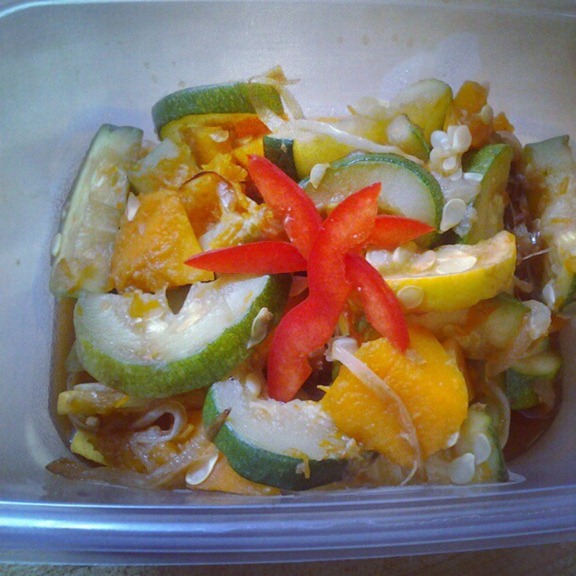
Sunburst Zucchini
1 Tablespoon butter
1 medium butternut squash- cut in one inch cubes
3 medium zucchini- cut in 1/2 inch thick half moons
2 medium yellow squash- cut in 1/2 in thick half moons
1/2 of a large Spanish onion- thin half moons
1 inch cube of fresh ginger- grated on a ginger grater, use juice and ginger
1/4 red pepper- used for garnish, cut in matchsticks
salt and pepper to taste
1) Sauté onions and ginger until onion is translucent.
2) Steam butternut squash until tender but not falling apart.
3) Steam zucchini and yellow squash just until tender.
4) Gently combine all ingredients. Adjust seasonings.
3) Garnish with strips of red pepper.
Posted: July 26, 2012 Filed under: Food and it's Impact on Our Health Leave a comment

Sunburst Zucchini (Taken with Instagram)
Eating Low Fat is Dangerous AND Causes You to Gain Weight!
Posted: July 25, 2012 Filed under: Food and it's Impact on Our Health Leave a commentThe most important nutrient in your diet is FAT! And I don’t mean olive oil…or any vegetable oils.
From Mark’s Daily Apple
I mean animal fat, butter, fat from meats, coconut oil…fats, not oils.
Saturated fats are stable at room temperature, and do not oxidize. They are safe to heat, to cook with…AND they give you vital nutrients that the body has to have to be healthy;
- Saturated fats are needed for energy, hormone production, cellular membranes and for organ padding.
- Saturated fatty acids are also needed for important signaling and stabilization processes in the body.
- Lack of saturated fatty acids in the lymphocytes is responsible for age-related declines in white blood cell function.
- Myristic acid is a very important fatty acid, found in coconut oil and butter, which the body uses to stabilize many different proteins, including proteins used in the immune system and to fight tumors. Lack of myristic acid from the diet can have unfortunate consequences, including cancer and immune system dysfunction.
- Saturated fats (butter AND fat from grass fed animals) gives us the depth of Vitamins A, D and E that we need in order to grow or repair an immune system. There is NO other way to get these nutrients. We are hard-wired to need them.
- Saturated fats are crucial to digestion; we cannot assimilate many of the nutrients in vegetables without the presence of fats in the gut at the same time.
- Saturated fats regulate the absorption of carbohydrates, slowing down their digestion and keeping the blood sugar stable.
- Without the depth of nutrients and calories we get from fats our body never gets the signal to stop eating. Without fats we fill up on carbs- a prescription for diabetes and weigh gain.
- Americans have become scared of protein. No one eats enough of it. Without enough fats to help you digest proteins we build up uric acid in the bloodstream and this leads to gout. This is why we are seeing gout on the rise again.
During the 1970s, researchers from Canada found that animals fed rapeseed oil and canola oil developed heart lesions. This problem was corrected when they added saturated fat to the animals diets. On the basis of this and other research, they ultimately determined that the diet should contain at least 75 percent of fat we take in as saturated fat. Among the food fats that they tested, the one found to have the best proportion of saturated fat was lard, the very fat we are told to avoid under all circumstances!
Another factor is consuming vegetable oils is that they oxidize immediately upon being removed from the foods they came in. Oxidation causes these oils to form high free radical production in the body. When these oils are heated it greatly speeds up this process. These oils also become sticky when heated. This causes accelerated aging, cancer, high blood pressure. Sticky blood lipids are what causes our cholesterol to clump together in the bloodstream. Cholesterol is our best friend, causes every biological function in the body to perform correctly. We DO NOT want less of it in our body. But we certainly do not want it to clump together and cause a stroke, high blood pressure or heart disease!
Eat vegetable oils in the foods they came in. Nature put these in great packages; olives, avocadoes, nuts and seeds…
Cook, bake and sauté regularly in butter, coconut oil, beef fat, chicken fat, duck fat. Just make sure they are all from organic and grass fed sources. You arteries will thank you.
MORE READING;
Cholesterol- Your Life Depends On It!
Heart Surgeon Speaks Out On What Really Causes Heart Disease
Demi Glace
Posted: July 20, 2012 Filed under: Food and it's Impact on Our Health Leave a commentThere is nothing better than to deglaze a pan that you have just cooked a steak in, with demi glace.

Demi Glace
10 lbs. veal bones
3 carrots, roughly chopped
2 onions, roughly chopped
1 white part of leek, roughly
chopped (optional)
1 Bouquet Garni
1 6-oz. can tomato paste
1. Roast the bones: Browning bones and vegetables in a roasting pan in the oven before combining them in a pot with water gives this stock a more pronounced flavor and deeper color. Veal bones have more collagen than beef bones; simmering the bones transforms the collagen into gelatin, which makes for a thicker, richer stock. Heat oven to 500°. Put bones into a roasting pan large enough to hold them in a single layer and roast until lightly browned, about 1–1 1⁄2 hours. Add carrots, onions, and leeks to the pan and spread them evenly around the bones. At Le Ferrandi and many French restaurants, they leave celery out of their stocks, as they believe it to be too assertive. Roast the bones and vegetables until they are deeply browned, about 45 minutes more.
2. Deglaze the pan: Transfer bones and vegetables to a 15–20-qt. stockpot. Place roasting pan over 2 burners on stove over medium heat. Add 3 cups water to pan; begin scraping up any browned bits from bottom of pan with a wooden spoon. These caramelized morsels of concentrated juice, called the fond—literally, the foundation—will enrich the stock. Simmer for 3 minutes; transfer liquid to pot of bones. Add bouquet garni and tomato paste. The paste will give the stock a deeper flavor and color. Cover bones with 6–8 qts. cold water; set pot over medium-high heat. Starting with cold water encourages the proteins and fats contained in bones to rise to the surface in large pieces, where they can be skimmed and discarded.
3. Simmer the stock: When the first bubbles begin to appear on the surface of the liquid, reduce heat to medium-low and maintain a very gentle simmer; a bubble should rise to the surface about once per second. Simmering slowly prevents the fat and impurities from being churned back into the stock and clouding it. The strength and concentration of your demi-glace will be determined by the length of time the stock simmers. For the minimum amount of extraction, it should simmer for at least 6–8 hours, but we recommend 12–24 hours for a richer, more gelatinous sauce. Check every few hours and add more cold water if necessary so that bones are always covered.
Pommes Frites
Posted: July 20, 2012 Filed under: Food and it's Impact on Our Health Leave a commentFrench Fries have sure gotten a bad rap in the last few decades.. BUT, what make French Fries unhealthy is when they are fried in vegetable oil. Yes, all those vegetarians who insisted that McDonald’s stop using beef fat were WRONG! Their fries are now soggy, no longer crisp. And heating vegetable oils is dangerous as the oils are then oxidized, making them highly carcinogenic.
BUT, it is crucial for you to use organic beef fat so that it is healthy. Never use or eat feed lot meat or fat…it is too toxic.
Beef fat gives us that nice crispiness that is the reason we love them!

7 cups beef fat from grass fed beef
4 large russet potatoes, cut lengthwise into 1/4"-thick batons
Kosher salt, to taste
1. Heat fat in a 6-qt. Dutch oven over medium-high heat until the fat starts to bubble and is just shy of smoking. Working in small batches, add potatoes and cook, turning occasionally until pale and tender, 10 to 12 minutes. Fries should be nice and browned.
2) Using a slotted spoon, transfer fries to a wire rack set over a baking sheet to drain.
Homemade Ketchup
Posted: July 20, 2012 Filed under: Food and it's Impact on Our Health Leave a commentIt’s getting almost impossible to find ketchup in a glass bottle. Even though Heinz now had a ketchup that has no high fructose corn syrup and Publix has a Greenwise Choice, they all come in plastic.

Westbrae has a ketchup that comes in a glass bottle available from the health food store…it tastes awful. Too much vinegar, it’s just not right.
So, I make my own. Here’s the recipe;
1 28-oz. can tomato purée
3 Tablespoons tomato paste
1 medium yellow onion, peeled and quartered
1 clove garlic, crushed and peeled
1/2 fresh chili, stemmed and seeded
5 tbsp. dark brown sugar
3/4 cup rice vinegar
1 1/2 teaspoon kosher salt
1 bay leaf
1/4 teaspoon allspice
Pinch cayenne
1/4 teaspoon celery salt
Pinch dry mustard
Pinch ground cloves
Pinch ground ginger
Freshly ground black pepper
Special tools needed: Mesh strainer, Cheesecloth, Kitchen twine
1) Wrap bay leaf, cinnamon, cloves, allspice, red pepper flakes and celery seeds in a double layer of cheesecloth or a triple layer of medical gauze. Tie into a bundle. (At this point, I had a lot of extra material, so I trimmed the extra off of the bundle.) Set aside.
2) Place tomatoes, onions, chili, garlic, vinegar, salt and brown sugar in a 4 quart saucepan. Add the spice bundle and cook over medium heat. Stir frequently while cooking, until onions and chili are very soft, approximately 45 minutes.
Remove the spice bundle and carefully puree the sauce in a blender or use an immersion blender in the hot pot. Puree the sauce until smooth. Strain the sauce through a medium size sieve. (This meant pressing the sauce through a metal sieve, using the back of a spatula. It takes me about 10 minutes to do this.) Place strained sauce back in a clean 4 quart pot and return to medium low heat.
Cook over medium low, stirring occasionally, until sauce is thickened, about 30 minutes. Transfer ketchup to a glass jar and set aside to cool. Refrigerate. Enjoy!
Salmon Fillets with Bacon
Posted: July 20, 2012 Filed under: Food and it's Impact on Our Health Leave a comment
SERVES 4
8 slices bacon, chopped (use more butter to sauté if using turkey bacon)
1 Teaspoon butter
4 8 oz. salmon filets
salt and pepper, to taste
6-8 large handfuls of salad greens
2 scallions, cut into rings
2-3 tbsp. fresh-squeezed lemon juice, or to taste
4 boiled eggs (optional)
INSTRUCTIONS
1. Fry bacon in a lightly buttered, heated frying pan. Cook until the bacon begins to go from crisp to hard brown, then remove and drain on a paper towel. Set aside.
2. Heat remaining butter, and immediately put salmon fillets in the pan, taking care not to overcrowd, and sear on each side, then continue to cook at lower heat for 1-2 minutes, or until desired doneness.
3. Combine salad greens and scallions in a large bowl and set aside. Transfer the salmon fillets to four plates.
4. Squeeze some lemon juice into the frying pan and pour the juices over the waiting undressed salad. Toss the salad, add the bacon bits and toss again, and add to the plate with the salmon.
5. If using boiled eggs, cut in half and add 2 halves to each plate. Serve warm.
The Whole Grain Lie – Looking Beyond Gluten
Posted: July 20, 2012 Filed under: Food and it's Impact on Our Health, Non-Toxic Choices Leave a commentFrom; The Gluten Free Society
 Photo from another Grain Free Site; My Life In a Pyramid
At the last Gluten Free Society meeting, I lectured on the detrimental properties of grain. So here it is – The Whole Grain Lie that’s slowly killing you…
Why do we assume that grain is such a healthy food?
The Food Guide Pyramid recommends large quantities of grain as a staple food in the diet. Why? Did you know that the U.S. Government mandated that processed grain products be fortified with vitamins and minerals in 1943? The reason? Processed grains caused nutritional diseases like Beri Beri and Pellagra (vitamin B1 and B3 deficiency respectively).
Detrimental Qualities of Grain (Including Whole Grain)
- The seeds are doused with chemical hormones and pesticides like atrazine to aid in growth. These chemicals mimic estrogen and cause hormone disruption in both men and women.
- Low in the essential fatty acids EPA and DHA (omega 3)
- Poor source of complete protein
- Contain enzyme inhibitors
- Contains addictive proteins that can alter behavior, mood, and contribute to mental dysfunction
- Contain anti nutrients that cause malabsorption of minerals
- Contain autoimmune inducing peptides and lectins
- Cause sodium and water retention
- Cause excessive insulin response leading to weight gain and diabetes.
But Our Children Eat Grain –
- Breakfast = cereal, donuts, bagels, cereal bars, tortillas, toast, kolaches, etc.
- Lunch = Sandwich and whole grain crackers
- Dinner = Pasta, pizza, breaded chicken fingers, hamburgers, etc
- Snacks = Goldfish, whole grain crackers, drinks and fruit snacks loaded with corn syrup (yes, corn is a grain – not a vegetable).
Our children are fatter and sicker than they have ever been. According to statistics and recent published studies, half of kids today are overweight.
What Can You Do?
- Get educated and make healthy diet changes for your children before it’s too late.
- Watch this video on how gluten affects children now.
Read More HERE…


 Meal Delivery Service by Millie Barnes