A Great Source for Floridians
Posted: July 17, 2011 Filed under: Food and it's Impact on Our Health, Gardening, Non-Toxic Choices Leave a commentHere is a wonderful site for seeing what grows best in Florida. I have used this site a lot lately to figure out what I can plant as far as flowers at my new house, while using very little water. One of my goals in moving was to find a house that didn’t have an expanse of grass in the yard. I am morally opposed to watering a normal yard. what a waste of water.
Plant Real Florida

My Favorite Websites and Blogs
Posted: July 16, 2011 Filed under: Food and it's Impact on Our Health, Gardening, Non-Toxic Choices, Skin Care 1 CommentI have had numerous requests for a list of the websites I love. Most of these I read daily;
 This site is one that I read every new post, every day. It’ll keep you abreast of new tech, software worth knowing about and TONS of tips and how-to’s. A must for anyone who wants to be more tech savvy.
 This website is a great source for all about gadgets and the newest tech.
EWG – Environmental Working Group
 This site a an incredible resource for learning about what’s toxic and how to help lower your bodies exposure. My favorite link in the site in SkinDeep; a resource for very personal care product you can imagine and how toxic it is, or isn’t..with the governments white paper on toxicity.
 This website explores the research of Weston Price who studied the effects on modern diets on humans and teaches how to follow a Traditional Human Diet. An amazing resource!
 This site will give you the REAL truth about cholesterol; why it’s your best friend and why yopur life depends on it.
 This is consistently, year after year, the ONLY website I pay to join; amazing recipes, how-to’s, product and equipment reviews AND America’s Test Kitchen..all in one site that is the definitive how to cook site!
 Home design, Tech, Green Living, How to decorate, ideas, inspiration..just plain fun…I explore this site consistently.
Yanko Design– Modern Industrial Design News
 Because I’m such a Nerd..I LOVE design, form…a look at how creative humans are…and how our minds work..
 Another Website that I NEVER miss a post. This site inspired me to begin growing my own food, to make high heat compost a priority, to install my outdoor solar shower…to realize my little bit of land could support me and feed me!
 I was a HUGE fan long before he published an article I wrote. This man inspired me to begin using a sawdust toilet, to really radicalize me environmentalism.. and I thought I was hard-core. But he nudged me .My kids thought I was crazy raising them without the use of paper towels or a dryer. But give up toilet paper…Read about he and his wife’s debate on this subject!
 You can learn about any aspects of growing most anything here; find the threads about your area of interest or area of the country…I love reading threads where people lend experience and wisdom, and have a bunch of different opinions. You can settle in and study and take the advice that resonates with you.
The Smart Gardener via Michael Pollen

here’s what Lifehacker had to say-
Smart Gardener is a free webapp that makes planning a garden really easy. The app lets you drag and drop garden beds to layout your garden and helps you find plants perfect for your location, then it generates an intelligent plan and even sends timely gardening reminders.
Smart Gardener may be helpful even for people without green thumbs, because it offers suggestions based on your specific location, time of year, and other details, even down to your garden’s orientation to the sun and how many adults and children are in your household. In addition to smart gardening plan, the app offers personalized advice for plant care and harvesting, with weekly email reminders if you wish. It seems almost foolproof..
These should keep ya busy a while. .To be continued……
Food Preservation, Sustaining life from Sustainable Gardens
Posted: July 15, 2011 Filed under: Gardening Leave a commentI found these beautiful old canning jars in a neighbors trash and could not believe my good luck! I had actually stopped because they had sat an old desk out by the road. I have been looking for one to use as a base for a potting bench I want to build but alas, it was particle board but there was a box of 12 beautiful jars..
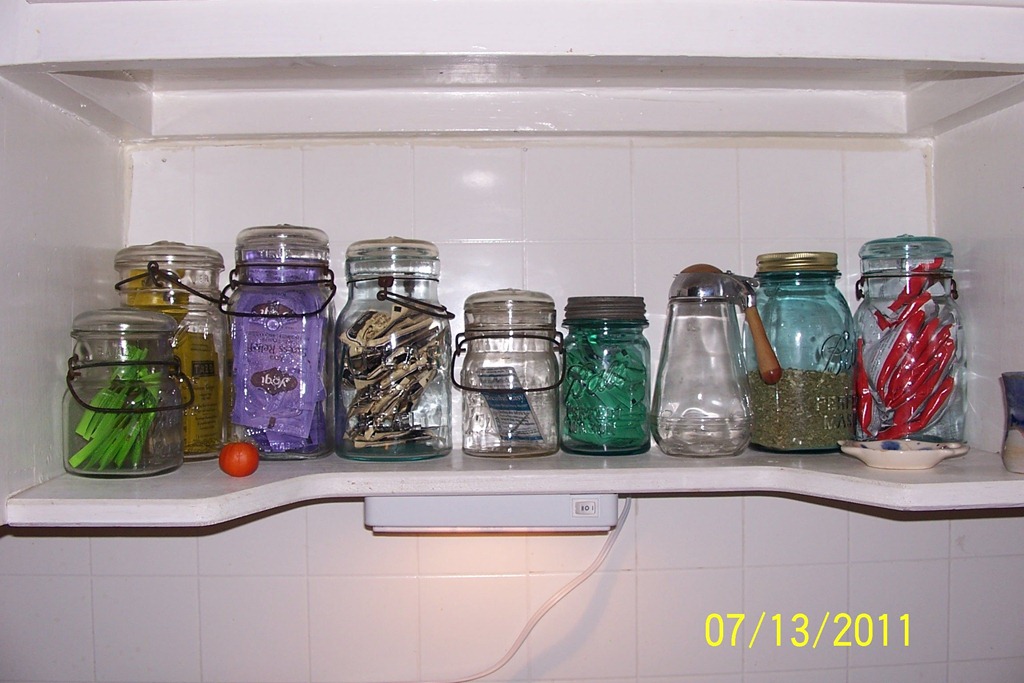
A Facebook friend commented and shared this article with me..
by Lee McDonald
As people moved from earliest times, they needed to feed themselves and the groups with which they associated. From hunter gatherers to farmers and developing civilizations, the technology of successful feeding has been a significant part of human history and the habitation of place. Food storage and preservation materials are on display at the Beaches Museum as a part of the present exhibit of Native and Cultivated Gardens of Florida. Lee McDonald, a resident of the Beaches community since 1989, curates the collection.
The food preservation section of the show illustrates the development of pottery and glassware which is known the world over. There are many similarities in the development of aboriginal pottery, food collection wares, tools, and utensils. Whether the piece is Geto-Dacian from Romania in the time of Alexander the Great or a northeastern Florida native pressed incised pottery decoration from 6,000 years ago. Design followed function and the need to protect and preserve food sources were important to Florida’s inhabitants.
In the United States, early red ware pottery was used as well as others like Salt Glazed and alkaline slip glazed pottery to store meats, grains and vegetables. Salt was used to cure food as well as were several smoking and drying methods. Home canning processes developed among pioneers in America and the use of sealing Home canning processes developed among pioneers in America and the use of sealing wax and a variety of engineered sealing techniques such as metal clamped seals were developed. Glassware for home canning could be observed on the American frontier from 1858 forward. Until this time, flat tin lids were used with wax for sealing preserved food. These were not reusable. John Mason, a tin smith from New York City, invented the Mason jar. He designed a machine that could cut threads into jar tops, which made it possible to screw-on a lid into a formed glass jar. At first the lids were made of zinc and rubber rings were used to affect the seal. This became a practical and affordable way for gardeners, homeowners, and settlers across the country to preserve food they had grown and to transport it across longer distances without spoilage. Mason lived until 1900, but he himself had sold off the patent he held and died a poor man.
Henry William Putnam a native of Vermont invented a fruit jar that used a glass lid and metal clamp to hold the lid in place in 1882. These were easy to open and reseal and were called “lightening jars” because they were quick as lightening to get into.
During the Civil War, foods were transported in crockery; some smaller crocks which were developed for home canning and on many of the major battle fields of the Civil War period, many fragments and, sometimes, entire crocks used to carry preserved foods can still be found. Keeping varmints (critters and insects as well as microbial bacteria) out of grains and food was important. Often these items were stored in designated areas which were cooler, either root cellars or “southern keeping rooms.” Jelly cupboards, pie safes and cabinets were also located in kitchen or food storage areas. I have a food storage cabinet circa 1820 that has mid 19th century repairs to what appear to have been a rat hole that was repaired with hand-forged nails and metals.
The Hazel-Atlas Glass Company was in business from the late 1800’s to 1964 and developed a jar with a lip for use with a metal clamp. These jars were called “strong shoulders” and addressed problems with the cracking which occurred with other forms of the metal clamped “lightening jars”.
William Charles Ball and his five brothers were in the business of manufacturing wood-jacketed tin cans for the storage of oil, lard, and paints. In 1883 they changed their focus to manufacturing glass containers and then, in 1886 when the Buffalo factory burned, they moved to Muncie, Indiana. The Muncie community offered them an incentive to move the business to Indiana by providing free gas and land. They aggressively purchased smaller glass companies and expanded quickly across the nation and became leaders in the industry.
In 1903, Alexander Kerr founded the Hermetic Fruit Jar Company. He developed some of the first wide-mouth jars which were easy to seal. Another inventor, Julius Landsberger, had developed a glass lid with a permanently attached gasket which Kerr used. However, one of the most significant developments occurred in 1915 when Kerr developed a flat metal disk which was held in place by a metal ring. This made it possible to inexpensively reuse glass containers with disposable metal rings.
The Duval County Extension Office offers information and maintains a canning center.
Consult with the following web site for information on various vegetables for home processing. http://okeechobee.ifas.ufl.edu/2010.MG.VegeTip.Sheet.pdf or http://www.uga.edu/nchfp/
How eating Organic and Healthy Saves You Money
Posted: July 12, 2011 Filed under: Food and it's Impact on Our Health, Gardening, In The Kitchen with Millie- How To's, Non-Toxic Choices Leave a comment People tell me all the time that they cannot afford to eat organic. My feeling is that no one can afford NOT TO!
It is true that in the past organic food was much more expensive than the other alternatives. However the demand for these foods and products are so high now that the cost is often the same or lower! Last week organic strawberries at Publix were cheaper than the regular ones!
Most people buy a lot of prepared foods, frozen foods, convenience foods. The cost of these foods is absurd, you are paying for other people to do the work for you. I put my food dollars toward high quality food sand o the labor myself. I make everything from scratch (yogurt, spice mixes, bone broths, desserts, tortillas. etc.) and everything I eat is organic. I grow a lot of my own green leafy vegetables in sub-irrigated containers I built out of 5 gallon buckets.
I know you must be says..yeah, she must stay home and do that full time. I do not. I work a 50 hour a week job, run a small business, maintain a blog, write prolifically. These things do not take a lot of time. Making the grow buckets 2 years ago did, Learning how to grow food did. Growing in buckets means way less watering, my water bill is very low. I do almost no weeding. I never buy many herbs, I never buy green veggies, lettuce, tomatoes, cucumbers. I make my own skin cleaner (it the best I have ever used and costs me about 20 bucks a year).
Bust eating organically also means better health. Eating whole food means great health. I eat only fat, meat, veggies and fruit. Nothing that needs a label to tell me what is in it. I don’t eat veggie based meals (too many carbs), I don’t eat bean based meals (not healthy).
I eat wonderful decadent grass fed meat or organic meat every meal. I have two to three eggs cooked in butter or coconut oil every morning with turkey bacon or skinless chicken sausage, blueberries or fruit in season, homemade coconut milk yogurt. A 700 calorie breakfast that is going to keep me going with very high energy for 5 or 6 hours. Last night I had a 9 ounce sirloin steak, a small sweet potato with 1 Tablespoon of butter, Swiss chard cooked with coconut oil, garlic and caramelized onions. 2 ounces of dark chocolate and 1/2 a mango later in the evening, a great lunch during the day…What more could a person ask for??
My food cost is about $50.00 a week. See my grocery list and plan for the week here.
Buy my Cookbook or Book on Optimum Nutrition here…or go to my blog and explore…
Michigan Woman Faces 93 Days in Jail for Planting a Vegetable Garden
Posted: July 11, 2011 Filed under: Gardening, Non-Toxic Choices Leave a comment Photo Credit: Julie Bass
It just doesn’t get more ridiculous than this.
Julie Bass of Oak Park, Michigan — a mother of 6, law-abiding citizen, and gardener — is facing 93 days in jail after being charged with a misdemeanor.
Her crime? Planting a vegetable garden in the front yard.
Bass says that she planted the garden after her front yard was torn up for some sewer repairs. Rather than wasting the opportunity to start with a clean slate by planting a lawn, she decided to really put the area to use, and plant a vegetable garden.
Her garden consists of 5 raised beds, where she grows a mix of squashes, corn, tomatoes, flowers, and other veggies. Bass received a warning from the city telling her to remove the vegetable garden, because it doesn’t adhere to city ordinances (more on that later.) When she refused, she was ticketed and charged with a misdemeanor. Her trial, before a jury, is set to begin on July 26th. If she is found guilty, she can be sentenced to up to 93 days in jail.
About the City Ordinance
Supposedly, Bass is in noncompliance with a city ordinance that states that only "suitable" plant material is allowed on the lawn area of residences. When local media asked city planner Kevin Rulkowski what that meant, he said suitable means "common:" lawn, nice shrubs, and flowers. However, the city ordinance does not specifically state that those are the only allowed plant materials.
About Oak Park
This is not some gated community with HOA regulations. This is an ordinary, working class neighborhood in Oakland County, Michigan. Like nearly every other city in my home state right now, Oak Park is facing financial issues. Here at home, people are amazed that a cash-strapped city has the resources to investigate, charge, and prosecute a resident for something as innocuous as planting a vegetable garden.
What’s Being Done
This story is gaining traction all over the web. Gawker covered it this morning. There are Facebook pages devoted to supporting Mrs. Bass and her family during this ordeal. Will social media help change the city’s mind? That’s what many of us are hoping. Local television affiliates for ABC and Fox news have already covered the story, and media attention continues to grow.
How to Help
If you want to help support a gardener’s right to grow food for her family (even if it is — gasp — in the front yard!) there are several things you can do:
1. Email or call officials for the city of Oak Park. Mrs. Bass has listed contact information for the mayor, city manager, and other city officials in the sidebar of her blog.
2. "Like" the Oak Park Hates Veggies Facebook Page.
3. Spread the word via Facebook and Twitter. By gaining attention to this particular issue, with this particular homeowner, the hope is that other cities will reconsider before they harass another homeowner for something like this.
Plants That Repel Mosquitoes
Posted: July 9, 2011 Filed under: Gardening, Non-Toxic Choices Leave a comment
From; Alderleaf Wilderness Society
By Jason Knight
There are a variety of both wild and cultivated plants that repel mosquitoes. Almost anywhere you go, it is reasonable to find several plant species that you can use to ward off these pesky critters. Plant-based mosquito repellents are especially useful for people who spend a great deal of time in the wilderness.
It is important to note that it is compounds found within the plants that do the repelling. These compounds need to be released from the plant to unlock the mosquito-repelling qualities. Depending on the species of plant, they can be released by either crushing, drying, or infusing the plant into an oil or alcohol base that can be applied to skin, clothing, or living spaces. Others are best used as as a smudge, which releases the compounds in a smoke. Just standing near living plants that repel mosquitoes is often not effective.
Below are separate lists of wild and cultivated plants that repel mosquitoes:
Cultivated Plants That Repel Mosquitoes
Citronella Grass (Cymbopogon nardus) is the most popular cultivated plant used for repelling mosquitoes. Its oil, citronella oil, is the primary ingredient in most natural insect repellents sold in stores. Products applied to the skin are most effective. It grows in tropical regions.
Floridata.com has great info about Citronella grass.
Catnip (Nepeta cataria) is a common garden plant that can be used to repel mosquitoes. The crushed plant can be applied directly to the skin or the dried plant can be infused in an oil, such as olive oil.
Additional cultivated plants that repel mosquitoes:
Peppermint (Mentha piperita)
Rosemary (Rosmarinus officinalis)
Marigolds (Tagetes spp.)
Lemon balm (Melissa officinalis)
Garlic (Allium sativum)
Clove (Syzygium aromaticum)
Eucalyptus (Eucalyptus spp.)
Tea tree (Melaleuca alternifolia)
Lavendar (Lavandula angustifolia )
The Case Against the American Front Lawn
Posted: July 8, 2011 Filed under: Gardening, Going Green; How and Why... Leave a comment
July 4th is a time when American families across the country congregate in their backyards for fireworks and burgers. Conspicuously absent from the revelry is the front yard. When you think about it, unless you’re on the local parade route, no one really hangs out in the front yard. And it’s not for lack of space.
The American suburban landscape is dominated by homes set far back off the sidewalk, separated by a front yard almost exclusively of grass, an ecologically barren monoculture devoid of flowerbeds or shrubs. (In lush places like Washington, there will be a few azaleas and a handful of trees, of course, but in newer developments even trees are a scarcity). And in most areas, people don’t seem to actually hang out or play on their front lawns; often, the only human activity you see is the homeowner or landscaper engaged in noisy and tedious lawn maintenance and mowing.
So why do Americans have such big front lawns?
In most municipalities, builders are actually required to adhere to rigid "setback” requirements and subdivision codes, meaning that residents are stuck with a big front lawn whether they want it or not. According to The Old Urbanist, $40 billion is spent on lawn care each year across 21 million acres of grass — that’s the size of Maine, by the way. That’s a lot of money for land you never actually use.
But America’s love affair with the front lawn has deeper cultural roots that reflect a tension in our national psyche between our desire to stand out as wealthy landowners and our penchant for cultural conformity and egalitarianism. New York Times journalist and author Michael Pollan in Why Mow? The Case Against Lawns, posits that it all began as a reaction to our English roots. In 19th century England, lawns were the exclusive domains of vast wealthy estates. Suburban planners and reformers responded by slicing the American landscape into quarter-acre bundles for the middle class. The front lawn was the stage upon which Americans could spotlight the ultimate symbol of democratic and economic success: the home. Everyone could have a mini-estate of sorts, set off grandly from the road. Yet, lawns also became a symbol of community and equality; with each yard carved out in a cookie cutter fashion to create a better communal tableau along the street.
This obsession with a neatly trimmed front lawn really took off in the post-War 1950s, when the American suburban dream of homeownership joined forces with new power mowers and a chemical trifurcate of pesticides, herbicides and fertilizers. This was when the front lawn became less about our national pride in economic mobility and more about a kind of coercive suburban conformity. According to Turf Grass Madness: Reasons to Reduce the Lawn in Your Landscape, “No longer a status symbol of the rich and famous, front lawns became the measure of a middle-class family’s ability to keep up with the Joneses.” Abraham Levitt (whose son William, creator of Levittown, NY, is considered the father of American suburbia) wrote that “A fine carpet of green grass stamps the inhabitants as good neighbors, as desirable citizens." Communities began mandating that every home maintain uniformly trimmed lawns; failure to do so was seen as subversive and anti-community. According to Pollan, there is a Puritanical basis to the homogenization of American lawns. The designer-reformers were "like Puritan ministers, laying down rigid conventions governing our relationship to the land.”
For members of the “anti-lawn” movement (yes, there is one), the American front lawn is not only boring and uninspired but an under-lamented environmental hazard, as lawns receive on average more pesticides and herbicides per acre than any other crop, according to Pollan. And a New Yorker article, Turf War, points out that these lawn chemicals, of course, end up in our streams and lakes, creating “dead zones”. And then there is the issue of water usage. The EPA estimates nearly a third of all residential water use in the country foes toward landscaping our lawns.
Anti-lawn crusaders advocate abolishing antiquated “setback” laws. They urge residents to plant trees, flowers and vegetables or simply ground cover on their grassy lawns. Ironically, perhaps we should cast our eyes back to the Old World for some inspiration. In most European towns and suburbs, homes are set much closer to the road, with a much smaller front garden dominated by functional patios, hedges and fences. In European yards, a grassy lawn is not the focus but merely a backdrop for flowerbeds, trees, lawn games and social gatherings. The spacious private yard lies in the rear, where families play, eat and socialize. The Old Urbanist illustrates through a series of photographs the dramatic difference between yards in European suburbs and American suburbs, making a compelling argument against the American lawn tradition.
For ways to make your lawn more aesthetically and environmentally robust, read Turf Grass Madness: Reasons to Reduce the Lawn in Your Landscape.
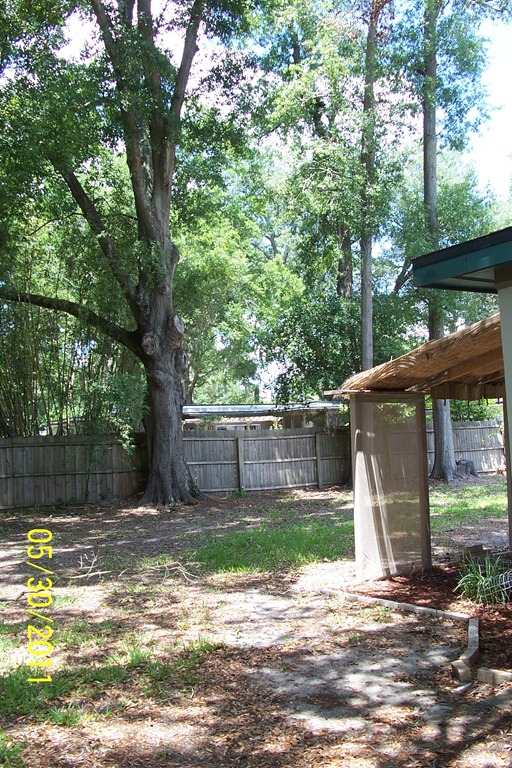
Millie- I recently moved to a new house, only about a block and a half away…but a big part of the decision to move was a very low maintenance yard. The back yard has huge oak trees with ground cover (Ivy, ferns) instead of grass… There is very little shrubbery. I have already planted low water flowers; lantana, Plumbago, Purple Queen. I moved my barrels with sweet potatoes from the other house…thank goodness I grow in self-watering containers that were easy to move. I have Swiss Chard going, Dill, tomatoes, lavender, cucumbers. I am sprouting onions and planting a kitchen herb garden…I’ll post pics soon….
Here’s the backyard;
Edible Gardens to Feed the Homeless
Posted: June 4, 2011 Filed under: Gardening, Going Green; How and Why... 1 Comment
Image credit: Grow Local Colorado
From TreeHugger
It’s always seemed strange to me that most parks grow only ornamental flowers and shrubs. Sure, it’s nice to have pretty flowers around, but what if our parks also produced food for those who need it? From sharing gardens to community nut tree plantings, we have indeed seen some moves to turn shared land into a productive food producing resource. Now a group of Colorado residents are aiming to utilize multiple city parks to produce 1,500 pounds of produce to help feed the homeless.
Grow Local Colorado started out with just one garden bed in a park in Denver. But that bed was such a success that the city has since expanded the amount of land given over to the group to 13 garden beds in 8 different parks.
The gardens are maintained by neighborhood groups, churches and non-profits, and the produce that is harvested will be donated at the end of the season to homeless charities and shelters. According to the Huffington Post’s write up of the Grow Local Colorado project, the organization is planning to donate 1,500lbs of produce to Denver’s Gathering Place, a drop-in center for homeless women and children.
More on Community Gardens
Sharing Gardens Grow Food for Those in Need (Video)
Community Plants Nut Trees for Food Security
New York’s Community Gardens Lose Protected Status
Water in the Landscape
Posted: May 31, 2011 Filed under: Gardening Leave a commentI found a great Blog today and wanted to share an article she posted.

Ya’ll probably know by now what a radical environmentalist I am by now! I feel it is morally wrong to continue to grow lawns of grass that eat up our resources, waste our water especially and pollute our rivers with run-offs that place chemicals in our water sources…
But let’s get on-topic, shall we? Probably THE most important environmental responsibility we have as landowners and gardeners have to do with water – conserving it as a resource, and making sure the rainwater landing on our property percolates down and is cleaned before it ends up in our waters. So there’s lots to cover, including topics like how to water efficiently and principles of xeriscaping, which are covered here so I won’t repeat them. I’ll just recommend two interesting links about water in our gardens:
- I like the “Wise Lawn Care Prevents Water Pollution” hand-out distributed by the city of Alexandria, VA. Most people believe that avoiding pesticides is all they need to do to protect waterways, so information like this that emphasizes wise fertilization practices is essential. This brochure tells us to “Fertilize in the fall if at all!”
- A measure is being considered in New Jersey that would severely restrict the polluting nutrients nitrogen and phosphates in lawn fertilizers, and I recommend Tom Christopher’s account on Huffington Post. He notes that Scotts MiracleGro and TruGreen are fighting the measure, as are some who fear their properties values will decline if their lawns are less green. But Tom suggests that the solution to make everyone happy (except the aforementioned behemoths of the lawn industry) is to switch to the less resource-intensive fine fescue mixes that are being tested by Rutgers (see Now-Mow Lawn and Eco-Lawn.) Tom’s also a member of the Lawn Reform Coalition.
Make a House for Solitary Bees
Posted: May 30, 2011 Filed under: Gardening 3 Comments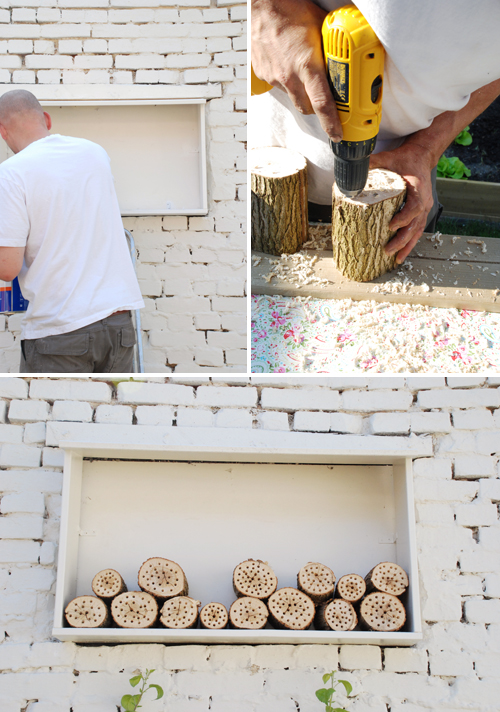
What are Solitary Bees ?
As well as Bumblebees and Honeybees (that live collectively) there are some 200 species of wild bees in the UK that are called ‘solitary bees’ because they make individual nest cells for their larvae. Some species nest in small tunnels or holes in the ground or in sandy banks, piles of sand, or crumbling mortar. Others use the hollow stems of dead plants such as brambles, or tunnels previously bored into dead wood by beetles. Mason Bees and Leafcutter Bees are well-known examples and are common in gardens. 
Solitary bees are harmless and do not sting, they do not live in hives or build combs, and they do not swarm.
If you find them (for example in old house walls) please leave them alone. Colonies are very faithful to their nest sites and may have been living there for many decades. They are part of the ‘fine grain’ of your local biodiversity – something to be cherished.
A number of species are commonly seen in gardens, and they are very useful as they pollinate fruit crops. It is easy for gardeners to encourage them. By drilling holes in dry logs or blocks of wood it is possible to create artificial nesting sites for them.
Constructing the House
All you need is a wooden box, open on one side, which is then fixed to a sunny fence or wall. You then fill it with blocks of wood or small logs in which you have drilled small holes. A variety of solitary bees will use these tunnels as nest sites. The box does not need to be deeper than 8ins, but must have an overhang at the top to keep rain off. You may already have a wooden box or a drawer from an old wooden chest of drawers that you can adapt for this purpose. If not, you can make one. The one in the picture is 8ins deep, 12 ins high at the front and 12ins wide, made out of untreated European spruce. I have given it a sloping, slightly overhanging roof to deflect rain.


I have not put a back on the example in photograph, because if you intend to fix the box against a wall or fence, you don’t need to put a back on it, or you can make a back of chicken wire, simply to help keep the wooden blocks in place. If the bee house is to be free standing, fixed to a pole, you will need to give it a wooden back, to give protection from rain and wind.
The dimensions do not have to be exact and you can make a larger bee house if you want. It is also possible to make a very large, free standing one, and pile up drilled logs and timber in it. (See photograph at foot of this page). For the structure of the house you can use any timber that you have to hand, so long as it has not been recently treated with a preservative. If you don’t have any timber around that you can re-cycle, builders merchants often have offcuts of wood available cheaply. Composite materials such as hardboard, chipboard or particleboard tend to disintegrate in the rain and are not suitable.
Inside the shell of the bee house you stack dry logs or sections of untreated timber, up to about 7ins in length, into which you have drilled a selection of holes of varying diameters between 2mm and 10mm, but no bigger. [Note that the diameter of the holes in some commercially sold wooden solitary bee houses is too large, and the bees cannot use them!] The open ends of these holes should face outwards, and must be smooth and free of splinters. If necessary use a countersinking drill bit to clean and smooth the entrance to each hole, as the bees will not enter holes with rough splintered wood around them. Carefully clean away any sawdust, as this will also put them off. If you are able to obtain extra- long drill bits and can drill deep holes into the wood you can make your bee house deeper, and stack longer sections of drilled logs and timber in it.
The bee house must be positioned in full sun, facing south east or south, at least a metre off the ground, and there must be no vegetation in front of it obscuring the entrances to the tunnels. The bees are cold- blooded and rely on the sun’s heat to warm them up in the morning, hence the need for a sunny site. They do not have furry coats to keep themselves warm like bumblebees do.
Bees Take up Residence
 Different species of Mason Bees (Osmia) will occupy different diameters of tunnels. They will construct a series of ‘cells’ in each tunnel. In each cell they leave a block of pollen that they have collected from nearby flowers, lay an egg, and wall it up with mud they have collected from the ground nearby (see image of walled-up tubes below right). In dry weather make a small mud patch for them.
Later in the summer, Leafcutter Bees (Megachile) may also use the tunnels, lining their cells with circles of leaf that they cut from wild rose bushes. Include some holes of very small diameter (e.g. 2mm) and you will get various other small solitary bees using them. I suggest drilling some blocks just with very small diameter holes, or having a whole separate bee house of them.
 You can also place commercial bee tubes in your bee house. These cardboard tubes are very popular with Mason Bees, but do not suit the smaller species. They are now marketed by a number of on-line suppliers, including CJ Wild Birds Ltd. (www.birdfood.co.uk) and Wiggly Wigglers (www.wigglywigglers.co.uk).
Bee activity will cease by mid-September at the latest. You can then remove the occupied logs and tubes and keep them in a cold dry place during the winter, to protect them from winter wet, replacing them in the bee house in March. An unheated shed, porch, or carport will do. This is very important – winter wet, not cold, is their enemy. Do not store in a warm place – they need to be cold and dry during the winter. Persistent wind-blown rain can dissolve the mud walls of the cells, and cause both wooden and cardboard bee tubes to rot. As autumns and winters are now very rainy, you need to ensure your bee tubes are protected from excessive wet. If your bee house has a good overhanging roof and is waterproof you can leave the tubes there. From April onwards, young bees that have over-wintered in a dormant state inside the tunnels will emerge, and start the cycle over again.
Beware Birds!
If you notice Woodpeckers or other birds attacking the tunnels looking for bee larvae, fix a piece of chicken wire across the front of the bee house. This does not seem to deter the bees.
Make a Bee Post
 An even simpler alternative is to make a bee post – drill a variety of holes up to 12mm in diameter into the side of a thick piece of untreated timber, and fix to a sunny wall or fence. (See photograph). Again this should be kept in a dry, cool place in winter and brought out in March. If you like you can give it a roof to deflect rain. Smooth down the entrances to the holes thoroughly so there are no sharp splinters, as these will put the bees off. New fence posts from garden centres are unsuitable because they have been treated with chemicals, but lengths of very old fence posts or old roof joists, such as you often find on skips, are ideal. In my experience the bee post is not as popular with the solitary bees as as as the bee houses described above, but other people have good success with it.
Bundles of dead stems
 Bundles of bamboo canes, sawn into lengths about 8ins long just below a joint may also be occupied by solitary bees, as will bundles of rigid dried stems of various herbaceous garden plants, especially raspberries, brambles, teasels, and elder. Some species of bees prefer these stems and will not use drilled holes. Rolls of dried reeds (sold as portable screens in garden centres) can also be cut up and placed in your bee house will be used by very small species of solitary bees. The bundles of stems must be kept completely dry at all times, under some sort of shelter – they will soon rot if exposed to rain. If you make a larger bee house you will have scope to include all of these nesting opportunities.
Buying Bee Houses
A number of commercially made wooden bee houses are available. Some of them are quite expensive, and one particular design does not work as the holes are too large! So beware wasting your money. The beauty of home- made bee houses is that you can use re-cycled or waste wood and logs and make them for virtually nothing. One commercially available model which is worth investing in if you are particularly interested has glass tubes for the bees to nest in. You can open a door and look at the larvae as they develop in their cells in the glass tubes. And of course the cardboard tubes that I mention above, and you can see in the illustrations above, are very popular with Mason Bees.
These are not for Bumblebees
Only solitary bees will use the kind of bee house I describe here. The needs of bumblebees are very different – their nests consist of communal wax combs, which they construct mostly in holes underground or in long tussocky grass. Bumblebee boxes are available from many wildlife gardening outlets, and some are hugely expensive – yet bumblebees rarely take to them. Beware wasting your money! Better to encourage the kind of flowery habitat, not over-manicured, that bumblebees like, and let them find their own nest sites. The website of the Bumblebee Conservation Trust has good advice about bumblebee nests, and how you can make inexpensive nest sites yourself. There is more information about Bumblebees on my BUMBLEBEES page.
A whole insect community
Various other sorts of parasitic solitary wasps and parasitic bees will find your bee house once it is occupied, preying on, or taking over, the nest cells of mason bees. Don’t worry about them, they are all part of the fascinating community of insects.
A larger Bee House
 It is easy to make a larger house for solitary bees. I first saw one like this in Switzerland in the early 1980s. Since then I have seen them on several occasions in Germany and Switzerland, but curiously they are rare in the UK. It is time to put that deficiency right!
The one on the left is about 5ft (1.5m) high. made out of recycled wood with part of a disused fence panel at the back.
For more info about some common solitary bees and what flowers will attract them, please download the ‘World of Wild Bees’ fact sheet from my fact sheets page.
There is also an excellent website about the different kinds of solitary bees you are likely to see in your garden at www.insectpix.net
It’s mainly in the details of choosing plants that are suitable for your region and appropriate for your local wildlife that you need to seek local advice. Many of the plants recommended for wildlife gardens in Britain are not suitable for North America.
For example, several well-behaved British wild flowers that are often recommended in the UK as bee and butterfly plants are highly invasive in North America and planting them is banned.
On the other hand, there are many scarlet, trumpet- shaped flowers such as Penstemons, Monardas, Pentas, Epilobium canum, Lonicera sempervirens and Lobelia cardinalis, that are of little or no use to wildlife here in Europe, but are perfect for many North American gardens as they will attract hummingbirds.
Pentas is illustrated on the masthead above, being visited by a female Costa’s Hummingbird. We don’t have hummingbirds in Europe – you are so lucky to have these fascinating litle birds visiting your gardens.
From; http://www.foxleas.com/bee_house.htm
I reproduced this item with permission from “The Pollinator Garden”, www.foxleas.com
© Marc Carlton 2011.


 Meal Delivery Service by Millie Barnes