Morning Glory
Posted: August 26, 2011 Filed under: Gardening Leave a commentI have been planting Morning Glories for two years…they never bloomed. When I moved a few months ago I moved the whole vine that I had by the front door. I had it growing up a chain so it was easy to move.
The morning after I slept in the new house for the first time, while still moving…I woke up to a Morning Glories blooming by my front door! My landlord said it was a sign..a great sign that I was meant to be in my new home. I love it here.
I woke up this morning feeling excited about the storm we were having..Hurricane Irene…figured we’d get some great rain. I looked up and as the sun was coming up it was shining through the front window..and I saw the Morning Glories..

Fave Garden Sites
Posted: August 17, 2011 Filed under: Gardening Leave a commentHere is a list of my favorite gardening sites I use for info and inspiration…






All Natural Mosquito Repellent
Posted: August 17, 2011 Filed under: Gardening, Non-Toxic Choices Leave a commentYa’ll probably know that garlic juice and oil in water sprayed around your yard or patio does an amazing job of warding off mosquitoes… Here’s a method when you can’t spray, or it’s raining…
I read an article about Lemon Eucalyptus oil being as effective a bug repellant as DEET. Wal-Mart was sold out of it today but they did have these cute little yellow coils you put on your wrist or ankle with oil of Citronella, Indonesian Lemongrass Oil, Philippine Geranoil Oil, They are .39 apiece and each one lasts about 200 hours. I test drove on my back porch late this afternoon and I have to say they really worked… Amazon has them for $14.99 for 10 of them. Almost 1/5 the price at Wal-Mart.

Garden Update…
Posted: August 17, 2011 Filed under: Gardening Leave a commentI am finally settled in to the new house, everything put away, organized…challenging..I went from having a garage to just a carport…
On the up side, I went from a gorgeous little private backyard with a TON of bamboo and shrubbery I had to continually fight..to a huge, just as private, backyard with almost no shrubbery but a canopy of huge oak trees..huge, old oak trees…filled with squirrels and birds..
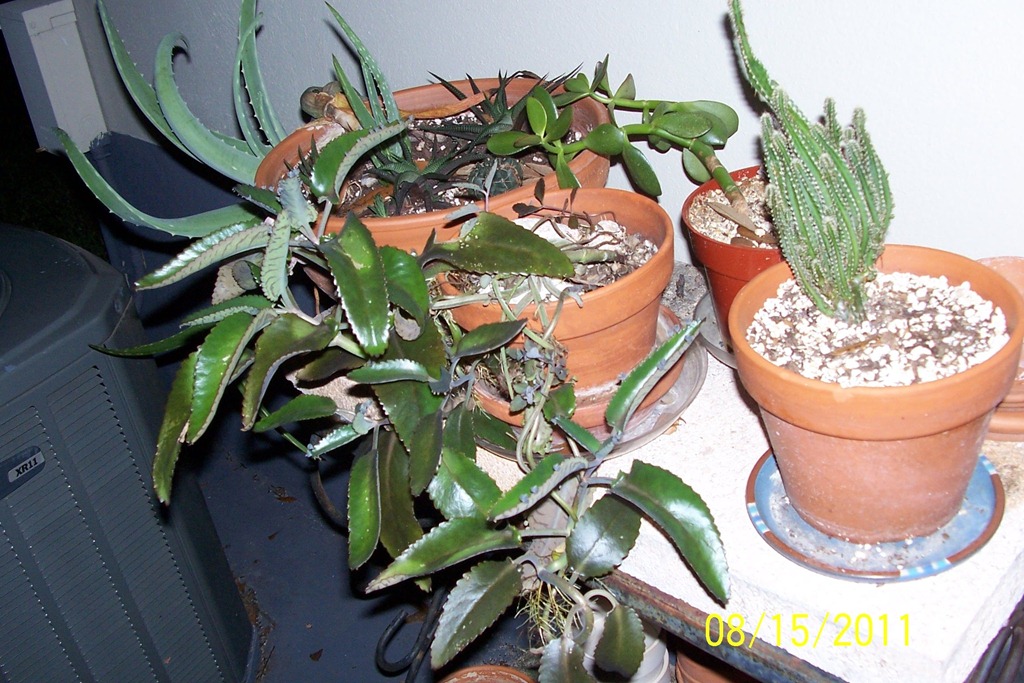 The succulents are happy…gotta get them planted…maybe a vertical wall?

It’s blank slate though, almost. Two big bushes of Lantana are against the fence, a third of the yard has ground cover; Ivy, wandering Jew, ferns…very low maintenance. I have put up three rain barrels and a hammock. Comfy Adirondack chairs on the porch, an air chair. In the front yard I planted hydrangeas, Lily’s my Aunt Jean gave me 5 years ago, plumbago, bougainvillea, basil, Salvia.. The seedling will get planted out front in a few weeks, after being under grow light; Poppies, Vinca, Onions, more basil, rosemary…
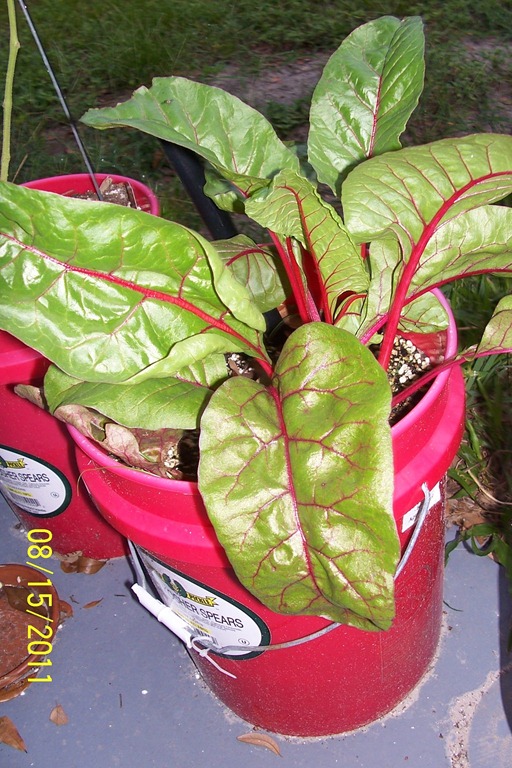 Swiss Chard in Sub-Irrigated container. I build them out of 5 gallon buckets.
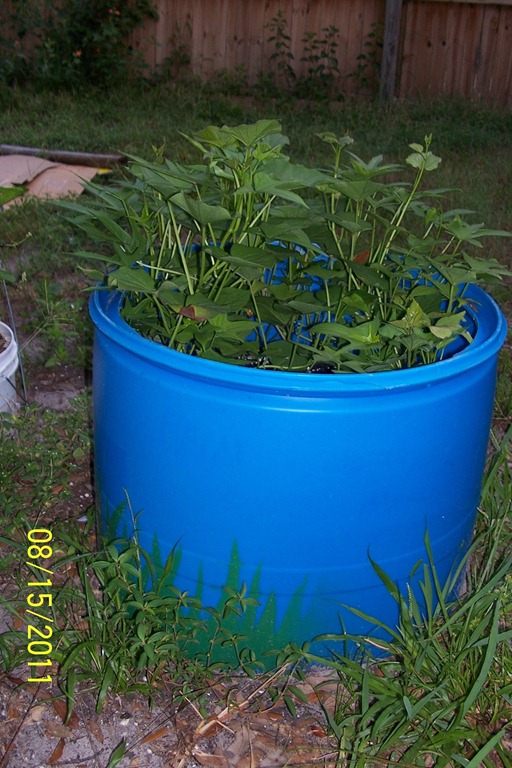 I’ll be digging sweet potatoes in another 2 months…
 Malabar Spinach. I bought this through Neem Tree Farms.
I have 5 feet high tomato plants..glad I grow in sub-irrigated containers…I moved the tomatoes and barrels of sweet potatoes from the other house…
Monday; I started sprouting seeds about a week ago. The lettuces are about an inch high…I’ll be eating baby lettuce in about a week to 10 days! Today I planted tropical milkweed, Poppies, Roma tomatoes, beets, Swiss chard, sunflowers, cucumbers, rosemary, more morning glories.
I laid down garden timbers to start an area for all the containers to go…on rocks so drainage will be good and it’ll look good. I got wire to put up on the fence posts for the tomatoes and cucumbers to grow up.. I’m hanging a trellis in front of the front window facing east..will help keep it cool and will look pretty with cucumbers and morning glory growing on it…gorgeous to watch the sun coming up through in the morning…over my desk…
Tuesday; Today I put up the second part of the compost bin…first one getting full of yard trimmings, kitchen scraps, paper, bunny poop with sawdust. It’s getting hotter…up to about 120 degrees…starts happening fast with all that green, wet material.
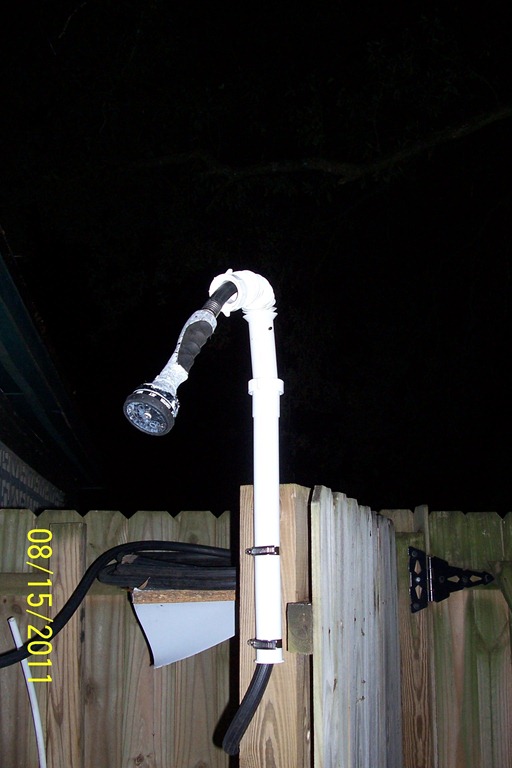
I also put up the solar shower, very basic with 50 feet of black hose and a shower head…actually a sprinkler head that gives me 10 different kinds of sprays…a great luxury in an outdoor shower. the coiled hose lays in the sun all day and by noon gives a great hot shower…but feels great cold earlier in the day after yard work
Grow Your Own….
Posted: August 15, 2011 Filed under: Food and it's Impact on Our Health, Gardening Leave a comment
Supporting Farmers Markets Creates Thousands of Jobs: Union of Concerned Scientists
Posted: August 11, 2011 Filed under: Food and it's Impact on Our Health, Gardening, Non-Toxic Choices Leave a comment
Image: Chris Schrier via flickr
Another great post from Treehugger
"What’s holding farmers markets back?" That’s the question behind a new report from the Union of Concerned Scientists, which determined the culprit to be federal policies that favor industrial agriculture over small and local farms. Change those policies, though, and you get a quick turnaround.
According to the report, just a little public funding for 100 to 500 farmers markets a year could create up to 13,500 jobs within five years.
"On the whole, farmers markets have seen exceptional growth, providing local communities with fresh food direct from the farm," said Jeffrey O’Hara, a UCS economist and author of the report, Market Forces: Creating Jobs through Public Investment in Local and Regional Food Systems. "If the U.S. government diverted just a small amount of the massive subsidies it lavishes on industrial agriculture to support these markets and small local farmers, it would not only improve American diets, it would generate tens of thousands of new jobs."
An example of how, from the report:
when greater consumption of fresh fruits and vegetables draws on produce supplied locally or regionally. Studies have suggested that this phenomenon could lead to thousands more jobs in the Midwest alone, even if land allocated to fruits and vegetables displaced some production of corn and soybeans.
The report highlights the importance of developing direct marketing channels. So many farmers markets right now are community-based and rely on volunteer labor, which almost inevitably stunts their growth. But, says the report, "modest public funding for 100 to 500 otherwise-unsuccessful farmers markets a year could create as many as 13,500 jobs over a five-year period."
According to the Union of Concerned Scientists, direct agricultural product sales amounted to a $1.2 billion-a-year business in 2007 (the most recent USDA figure), and most of that money recirculates locally. "The fact that farmers are selling directly to the people who live nearby means that sales revenue stays local," O’Hara said. "That helps stabilize local economies."
If you don’t believe it, the report provides a few examples:
- 34 farmers markets in West Virginia led to a gross increase of 119 jobs (net increase of 82 jobs), a gross increase of $2.4 million in output (net increase of $1.1 million), and a gross increase in personal income of $0.7 million (net increase of $0.2 million).
- 21 farmers markets in Oklahoma led to a gross increase of 113 jobs, $5.9 million in output (with a multiplier of 1.78), and a $2.2 million increase in income.
- 152 farmers markets in Iowa led to a gross increase of 576 jobs, a $59.4 million increase in output (with a multiplier of 1.55), and a $17.8 million increase in income.
- 26 farmers markets in Mississippi led to a gross increase of 16 jobs, a $1.6 million increase in output (with a multiplier of 1.7), and a $0.2 million increase in income.
Some Progress Has Been Made, But There’s Plenty More to Do
Local food systems have no doubt seen a boost in recent years: the number of farmers markets has jumped nationwide from 2,863 in 2000 to 6,132 in 2010.That might lead some people to question why farmers markets need public support. But there are major economic and political barriers that stump the growth of these markets and food systems. And the government helps agricultural giants that have already surpassed their potential, while in comparison almost ignores the little folks.
The USDA gave $13.725 billion last year in commodity, crop insurance, and supplemental disaster assistance to primarily large industrial farms. In the same year, the same agency spent less than $100 million to support local and regional food system farmers.
The Way Forward
To address these barriers, the report calls on Congress to:
• support the development of local food markets, including farmers markets and farm-to-school programs, which can stabilize community-supported markets and create permanent jobs. For example, the report found that the Farmers Market Promotion Program could create as many as 13,500 jobs nationally over a five-year period, if reauthorized, by providing modest funding for 100 to 500 farmers markets per year.
• level the playing field for farmers in rural regions by investing in infrastructure, such as meat-processing or dairy-bottling facilities, which would help meat, dairy and other farmers produce and market their products to consumers more efficiently. These investments could foster competition in food markets, increase product choice for consumers, and generate jobs in the community.
• allow low-income residents to redeem food nutrition subsidies at local food markets to help them afford fresh fruits and vegetables. Currently, not all markets are able to accept Supplemental Nutrition Assistance Program benefits.
"Farmers at local markets are a new variety of innovative entrepreneurs, and we need to nurture them," said O’Hara. "Supporting these farmers should be a Farm Bill priority."
The report was released just a few days ahead of the USDA’s 12th annual National Farmers Market Week, which starts this Sunday, August 7.
Garden Update
Posted: August 1, 2011 Filed under: Gardening Leave a commentI moved a month ago and am very glad that I do almost all my gardening in sub-irrigated containers. A lot of it was up and running quickly or transplanted ok. The banana tree likes it better here, the 7 foot pony tail palm got a new pot and is flourishing. It had been planted in the yard at the old house.
My Malabar spinach is doing good, vining up the tomato cage. I just planted Hydrangeas today. The bougainvillea is starting to creep up the the trellis, my favorite, the Plumbago was too big to move;
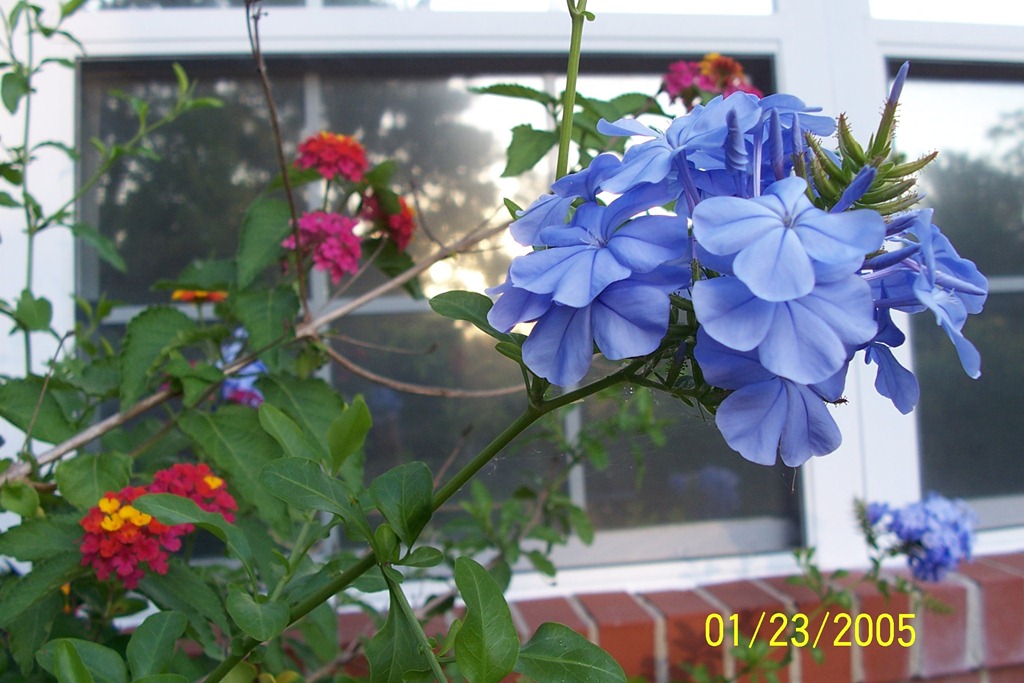
My flowers I put in the window boxes didn’t do good; I guess I’m spoiled with having everything in the sub-irrigated buckets because they need WAY less water than pouring water on plants in the ground…in fact they only use 10% of the water than a soil grow. And there is very little evaporation, in fact when it’s real hot and tomatoes are going through SO much water putting plastic across the soil saves water.
Growing Food Without Chemicals
Posted: July 29, 2011 Filed under: Food and it's Impact on Our Health, Gardening, Going Green; How and Why..., Non-Toxic Choices Leave a commentIf you’re into food, you’ve got to embrace manure. Like it or not, the manure after all, is the foundation upon which the sustainable food movement stands.
Growing Sweet potatoes
Posted: July 28, 2011 Filed under: Food and it's Impact on Our Health, Gardening 1 CommentFrom Mother Earth Magazine

An ideal staple crop for those seeking to meet most of their food needs with homegrown produce would be nutrient-dense, offer high yields, and have excellent flavor and storage qualities. A crop that fits this bill perfectly? The sweet potato.
Sweet potatoes are more nutritious and store better than any other root crop — they’re easy for home gardeners to keep for a full year. And while many people think of them as a Southern crop, you can in fact easily grow sweet potatoes in northern climates.
Unforgettable Flavor
I’ve been growing (in Canada!) and learning about sweet potatoes since the mid-1980s, when my friend, Suzanne Mason, who lives in South Carolina in the winter, brought me a half-bushel of cured sweet potatoes. They were incredibly sweet and delicious. I thought I knew sweet potatoes, but I never imagined they could be this good!
I wondered whether Suzanne’s grower in South Carolina had a secret. There must be a secret, or I wouldn’t have gone my entire life without coming across this superb flavor.
I now know that the matter is a bit more complicated than one simple secret. There are five facts about sweet potatoes that may seem like they’re secrets — because a sweet potato rarely makes the trip from field to dinner table without one or more of these facts being ignored — but none of them is optional if you want truly great sweet potatoes. Each ’tater truth by itself, if neglected, is sufficient to reduce flavor.
Five Facts for Fabulous Sweet Potatoes
1. Sweet potatoes are alive and they breathe. Never store them in a sealed plastic bag — the gases from their respiration will build up and the potatoes will eventually poison themselves. Paper bags or boxes are good for storage, or throw plastic tarps loosely over your crates of sweet potatoes. In fact, as long as you take care with the curing process (see fact No. 4) and store them at about 60 degrees Fahrenheit, you don’t need to cover sweet potatoes at all during storage (unless rodents could access them).
2. Do not toss or drop sweet potatoes into storage containers. When you dig them, they’ll be firm and appear indestructible — they’re not! A drop that is sufficient to crack an egg is sufficient to produce a tiny bruise on a sweet potato. After a few months in storage, that tiny bruise can turn into a large, rotten spot, which often ruins the entire potato.
3. Sweet potatoes are tropical plants and the storage roots (tubers) start to “shiver” at 50 degrees. Your refrigerator is probably set to a few degrees above freezing, which is a good temperature for carrots, apples and most juices, but not so good for tomatoes, bananas and especially sweet potatoes. At the cool temperature of your refrigerator (or in a supermarket cold room, where fresh fruit and vegetables, including sweet potatoes, are stored), a sweet potato will “shiver,” and in less than a day, the once living, breathing, healthy sweet potato will turn into a corpse. It will remain a good-looking corpse for a few days, but will then develop pockmarks and a hard core. The official name for this cause of death is “chilling injury,” and it’s thought to be the result of a change in metabolism that causes cell walls to no longer have proper control of what comes in and goes out.
4. Sweet potatoes need to be cured, starting on harvest day. To cure them, keep your sweet potatoes at 85 to 90 degrees for five days. During this time, the sweet potato will grow a second skin, which is an incredibly effective seal. After curing, you can leave a sweet potato on the kitchen counter for several months without noticeable moisture loss. Without curing, the sweet potato will only last a month or two in storage. Curing also initiates flavor development.
Providing proper curing conditions for five days may require some planning in advance. Think creatively about available spaces — a large closet with a 100-watt light bulb, a bathroom with an independent thermostat, or even a spare bedroom with a small electric heater. Keep your curing space at 80 to 90 percent humidity for best results.
5. A newly dug sweet potato is virtually tasteless — it’s definitely not a treat! A sweet potato doesn’t reach its flavor potential until it has been cured and then stored for a few months. Eat sweet potatoes when they’re new if you must, but don’t judge them until after New Year’s Day.
Hot Potatoes!
Sweet potato plants are, in most respects, undemanding. They prefer light, sandy soil, but will tolerate heavy clay. They respond well to rich soil, but can do surprisingly well in soil of low fertility. Sweet potatoes do best in sunny locations with regular rain or irrigation, but will mark time during a period of drought and then carry on when the rain returns. Excessive rain and flooding will slow them down, but won’t necessarily harm them.
Growing temperature is the only environmental factor that can’t be ignored — sweet potatoes like it hot! There are several critical temperatures for sweet potatoes, and I keep these temperatures straight by likening them to an old-fashioned report card. Because of chilling injury, a soil temperature below 50 degrees (50 percent) is a failure, and 50 to 55 degrees is dangerously close to the failure mark. Sixty percent, give or take a few percentage points, is an acceptable mark for a student not planning for higher education — and at about 60 degrees, the metabolism of the sweet potato slows to near zero, meaning it won’t grow. Temperatures above 70 degrees, as with grades, are conditions that allow growth: slow at 70 degrees, good at 80 degrees, very good at 90 degrees and excellent at 100 degrees.
Southern growers can wait until the soil warms up and still have time to grow a good crop of sweet potatoes. In Canada and the northern United States, June is the month with the longest, sunniest days, and although it’s an excellent growing month for crops that do well in 60-degree soil, it’s not so good for sweet potatoes — unless you get proactive.
Warm ’Em Up
In order to grow sweet potatoes in the North (Zones 3 to 5), you can’t wait until July — you must make full use of June by warming up the soil.
The simplest and most effective way to warm the soil is to cover it with a sheet of clear plastic. If you were thinking black plastic when I said soil warming, you may have skipped right over the word “clear.” Yes, clear plastic. About 90 percent of the energy from the sun goes through clear plastic, where it’s then absorbed by the soil and trapped there by the greenhouse effect. On the other hand, when opaque plastic gets hot, only a fraction of the heat is transmitted to the soil, and the rest just radiates back into the air above.
Look for clear builder’s plastic (used as a vapor barrier) that’s about 8 1/2 feet wide. Cutting it down the middle will make two sheets, each just more than 4 feet wide. This is an ideal width for slightly raised, 2-foot-wide beds. Lay the plastic on the bed so that 1 foot remains on each side, then pull the plastic snug and bury the 1-foot edges down the length of the bed. It’s important that the plastic, like the bottom sheet on a bed, be pulled taut and tucked in. Placing heavy objects on the edge of the plastic here and there down the length of the row is good for a start, but it won’t be sufficient. If you only loosely apply the plastic, the moisture under it will turn into hot vapor that will then flow out from under the plastic, causing the soil to lose heat and moisture.
If you’re using clear plastic to grow sweet potatoes in a northern climate, you’ll have a couple extra steps when it’s time to plant your slips: Cut an 8-inch slit in the plastic, and press the soil down to make a shallow, bowl-shaped depression (1 foot in diameter) centered on the slit. Plant the slip through the slit, and water well. Place sand or fine gravel around the plant to cover the slit and to weigh the plastic down into the depression in the bed. This will seal the slit, and the depression will ensure that, when it rains, water will run into the bed at the base of each plant.
Some gardeners cite weeds as a reason for not using clear plastic mulch. If weeds survive under your clear plastic, though, it’s a sign you did something wrong. Plastic fit snugly on the bed with no vents to allow hot air to escape will create an environment too hot and too confined for weeds.
Builder’s plastic comes in heavy, medium and light grades. Light is the best for warming up soil because it lies tighter on the bed. Some gardeners are uneasy about using plastic in the garden because it’s manufactured from a nonrenewable resource. However, in my opinion, capturing the heat of the sun under clear plastic is one of the most worthwhile uses we can make of that resource.
Harvest Time
While for most growers the main event comes in fall, you can cut and enjoy spicy, tender sweet potato greens during summer. My neighbor from China likes to grow sweet potatoes mainly for their vine tips. Just be aware that excessive harvesting of the greens will delay tuber growth and decrease yields.
When fall arrives, your sweet potatoes will not “mature” — they will just slow down and eventually stop growing when the soil temperature drops below 55 degrees or the vines get hit by frost. In either case, it’s time to dig your sweet potatoes!
A broadfork is a great tool for digging potatoes. After digging, gently wash your tubers on the same day. I wash using just the spray from a hose, but you can also use a pail of water, wiping lightly with a rag or soft brush. Washing immediately after you harvest has the benefit of leaving garden soil in the garden, where it belongs (soil has sand in it, which will eventually plug your drains). Also, clean sweet potatoes are nicer to handle and easier to inspect. Next, cure them, store them, and wait a month or more for them to turn into the best sweet potatoes you’ve ever tasted.
Sweet Potato Varieties
Over the years, I’ve grown about 40 sweet potato varieties. I’ve found significant differences in color, texture, growth habits, yield and time to harvest. But for me, the most important consideration is flavor, and I’ve found no variety that is far superior to any other. Flavor depends much more on curing, storage and method of cooking than on the variety you grow.
‘Beauregard,’ the main commercial variety, is a good producer, has good flavor, stores well, has compact vines, and its tubers tend to grow close to the stem.
If you want to try something different, consider growing ‘Toka Toka Gold,’ a yellow-fleshed variety that’s drier, smoother, denser and milder than most. It comes from New Zealand, where it’s sometimes referred to as ‘Golden Kumara.’
‘Georgia Jet’ is the most reliable variety for northern climates. Unfortunately, two quite different varieties are using that name. I think of them as the Real ‘Georgia Jet’ and the Impostor. The Real ‘Georgia Jet’ is the main commercial variety in Israel and the most popular variety among gardeners in Canada. The Impostor is widely grown in the United States, and while its flavor is excellent, the variety has a reputation for poor yields and cracking.
If you thought you’d been growing the Real ‘Georgia Jet’ but are now in doubt, telling the difference is easy: The Real ‘Georgia Jet’ blossoms, and the Impostor doesn’t (see a photo of a ‘Georgia Jet’ sweet potato blossom). If your ‘Georgia Jet’ did blossom, please write to us at OrganicGardening@MotherEarthNews.com and tell us the source of your stock. We’ll publish the information in an upcoming issue.
Simple Sweet Potato Slips
Unlike the standard potato, which is grown from tubers, sweet potato crops are started from “slips.” To create a slip, a sweet potato tuber is planted indoors or in a greenhouse — or stood up in a glass of water — to produce sprouts. The resulting sprouts are what you’ll plant outdoors, not the tuber. A slip can be a sprout directly from the sweet potato (see photo), or it can be a vine cutting from an already established sweet potato plant. You can order slips from mail-order suppliers, buy them at a garden center or grow your own.
To grow your own sweet potato slips from tubers, first place the tubers in water in early spring. When the sprouts form, break them off and plant them directly in the garden. Roots will form quickly. If you’d like to use a vine cutting, cut any sections from a long vine into 1-foot lengths, stand them up in a glass of water for two days to initiate rooting, and then plant them 1 to 2 feet apart with half their length below ground, half above. Soak your slips with warm water immediately after planting them.
Ken Allan, author of Sweet Potatoes for the Home Garden, has been growing vegetables in Canada for 37 years. For a long time, prime real estate in his garden went to the vegetables that are clearly better than their commercial equivalents, such as shell peas and tomatoes. That is, until Ken realized he could grow sweet potatoes in the North!
I Got a Bunny!
Posted: July 27, 2011 Filed under: Gardening 1 Comment
I inherited a cat, Jordon, 8 years ago when I moved to a new house. the previous owner left her (who does that???) I’m glad they did though, she’s a sweetie. She finally moved with me to this house last month after a few trips back to the other place. But I am allergic to her so she lives outside.
I have been giving much thought to getting a pet that would be a good match…I’m not a dog person, want something cuddly. Last week when taking a walk I saw two beautiful black rabbits frolicking in my neighbors yard…just hanging out. So when I got home I researched on the net what bunnies were like as pets. I learned that they make great pets as well as producing fertilizer that doesn’t need to be composted.
Further reading lead me to discovering Holland Lop rabbits. Viola! I found a pet. And, LOL…he’s pedigreed, a show bunny!
He is gentle, cuddly, clean, sleeps all night and I love him! I’ve named him Cornelius…he’s busy exploring the house…



 Meal Delivery Service by Millie Barnes
