How To Save Seeds From Your Garden
Posted: May 6, 2012 Filed under: Gardening Leave a commentFrom 
One of the most joyous feelings for a gardener is to see that first ripe pepper o tomato on the vine. Excitement boils over, as you can’t wait to taste the fruits of your labor.
But if you’re planning to save seeds from this year’s harvest, the smartest thing to do is to let that tomato or pepper or squash or cucumber ripen to the point of near bursting. That first-to-ripen fruit or vegetable is the earliest product of the hardiest plant and that’s exactly the seed you want to save for next year’s garden. That first-to-ripen seed will produce the most robust plant, able to survive pest attacks and weather extremes better than its brothers and sisters.

- My saved and leftover packet seeds are stored in mason jars to be used next season
If you’re saving seeds from a flower, find the best looking plant – sturdy, beautiful foliage and flower, best color, best growth pattern – and harvest the seeds from that specimen.
The seed saving methods for individual plants are considerably different. If you’re saving seeds from a plant more complex than beans or peppers (open fruit, pull out the seed, let it dry), it’s worth your while to spend a little time researching the techniques specific to the seeds you want to save. The book that introduced me to seed saving and one I highly recommend is: Saving Seeds: The Gardener’s Guide to Growing and Storing Vegetable and Flower Seeds. There’s also some excellent information from the International Seed Saving Institute.
Preparing the seeds for storing
Once you’ve harvested the seeds, allow them to dry for a few days at room temperature on a paper towel or newspaper. Do not store them damp, as they’ll rot. Then put the seeds in a standard white paper envelope, roll the top down and mark the envelope with very specific information: The plant the seed came from, including specific cultivar if known; date it bloomed or fruited; company that produced the seed; and the month and year you harvested the seed.
Planting a Pineapple
Posted: May 6, 2012 Filed under: Gardening Leave a comment Did you know that when you buy a pineapple, you can do more than compost the top (also known as the crown)? You can actually plant it to get two (or even three or four) pineapples for the price of one! Okay, the catch is that it takes patience, but at least while you’re waiting for your very own pineapple to grow, you’ll have a lovely tropical plant for your garden or sun room. Want to know how? It’s easier than you’d think.
First, you pick a fresh, whole pineapple up at the store (or farmer’s market, if you’re lucky enough to have someone growing pineapples nearby). Make sure the crown is green, healthy and that the pineapple isn’t overripe.
Next, you will twist off or cut off the crown. Make sure to trim off any additional flesh, leaving only the center and it’s root buds. You’ll also want to remove some of the bottom most leaves because, once planted, the leaves that are partially in dirt or touching the dirt will rot. Then place the crown upside down to dry in an area where the temperature does not fluctuate wildly. Leave it to dry for 5 – 7 days.
Once dry, you can plant your pineapple. Use a good quality potting soil and plant in a pot or, if you’re in a temperate climate, you can plant it outside. Make sure to give it some room to grow. These plants can grow up to 6 feet wide. It can take up to 20 months for your plant to produce fruit, but imagine how exciting it will be to make that first harvest!
Further reading: University of Hawaii – How to Grow a Pineapple in Your Home
(Image: Flickr member MartinEric2008 licensed for user under Creative Commons)
No-Mow Grass
Posted: May 6, 2012 Filed under: Gardening Leave a commentIve Haugeland and Tyler Manchuck, of Shades of Green Landscape Architecture in Sausalito, Calif., spend many hours researching, debating the pros and cons of different products, asking questions, and working with sustainable manufacturers to provide landscapes that are not a posh-type green project, but rather areas that truly benefit the environment. Shades of Green used a newly completed residence in Sausalito as an experimental project in which to introduce new, sustainable grass seed. “The no-mow lawn uses a blend of fescue. It takes way less water and you only need to cut it once a year,” says Haugeland.
Native Lawns
Read more about Shades of Green Landscape Architecture’s sustainable landscape design concepts.
According to Haugeland, “There are a lot more native lawns available on the market now. For example, Delta Bluegrass is producing several new different types. We started incorporating some of them into our design projects last year. The new grasses haven’t been problem free for us, so we are monitoring the projects to see if they hopefully do well over time.”

Stop Growing a Lawn…Just STOP IT!!
Posted: May 1, 2012 Filed under: Gardening 1 Comment
Lawns in the U.S. cover more than 50,000 square miles of soil and consume more chemicals than all those used in U.S. food related agriculture combined. Maintaining lawns involves mowing, watering, and often fertilizer, pesticides, or herbicides, that contribute to the watershed pollution.
Lawns in the U.S. also consume approximately 270 billion gallons of water a week — enough to water 81 million acres of organic vegetables- and all of this water is expensive. From TreeHugger.
My motto; If I can’t eat it I’m not watering it. My dish water and rinse water from washing dishes as well as from the shower (I keep a 5 Gallon bucket in there for the water that runs off of me…just use organic soaps) and then water the flowers…Water from the rain barrels water all the veggies and herbs…
Clean Garden Tools with Wax Paper
Posted: April 23, 2012 Filed under: Gardening Leave a comment
This Old House’s site recommends using wax paper as a cleaner for garden tools. The rough texture of the paper will loosen grime and the the wax will coat exposed metal surfaces to help prevent rust.
Eat Like a Hunter
Posted: April 22, 2012 Filed under: Gardening 1 CommentThe fuel we provide to our biological systems has effects that ripple through every aspect of our individual life. From mental acuity to mood to structure to disease, our choice of fuels is crucial. Thinking about food from the angle of a Paleolithic hunter quickly provides answers to questions science is unable to efficiently adjudicate. This is not about pure carnivory, but a nod to optimal foraging theory. Once we understand something about the strategies of a Paleolithic hunter we can begin to merge our ancient food system with our modern food system. If we lose either perspective, we will quickly go astray.
This post is from Evolvify…To Read the whole article….MORE….

So You Want to Grow Veggies Organically AND Be a Vegan?
Posted: April 22, 2012 Filed under: Gardening, Non-Toxic Choices 1 Comment Photo from All About Gardening
What do plants eat? They eat dead animals; that’s the problem. For me that was a horrifying realization. You want to be an organic gardener, of course, so you keep reading ‘Feed the soil, feed the soil, feed the soil…’
Alright. Well what does the soil want to eat? Well, it wants manure, and it wants urine, and it wants blood meal and bone meal. And I…could not face that. I wanted my garden to be pure and death-free. It didn’t matter what I wanted: plants wanted those things; they needed those things to grow…
So, I sort of played a moral hide-and-seek in my mind. I was left with this realization that I could eat an animal directly, or I could pass an animal through a plant and then eat it, but either way there were animals involved in this process. I could not remove animals from the equation.
I had to accept on some level that there was a cycle here, and it was very ancient, and ultimately very spiritual. It was really hard for me to accept the ‘death’ part of that equation. Years. It took me years to finally face it. But there wasn’t any way out of it if I was going to grow things.
Lierre Keith, on gardening as a vegan; October 8, 2009 on Underground Wellness Radio
Vertical garden- DIY
Posted: April 19, 2012 Filed under: Gardening Leave a commentI got the idea when I saw a website for Wooly Pockets, they are awesome, but pricy.
They have some amazing installations. Here are the two that inspired me;

 Pics from the wooly Pocket Site.
I bought a roll of burlap a few years ago and use it for mulching and for weed control sometimes…when I had a square foot garden it entailed a LOT of weeding. Since I switched to all container gardening I spend almost NO time weeding! Hence I have a lot of burlap.
I am using a shoe rack I have an extra of; I have them in all my closets for organization.

I am cutting 27 inch by 11 inch pieces of burlap to use for each insert. I am then folding each one over so that each finished insert will be thick enough to stay damp for moisture retention. I don’t want my plants drying out too much during the day.
Here is what one insert looks like;
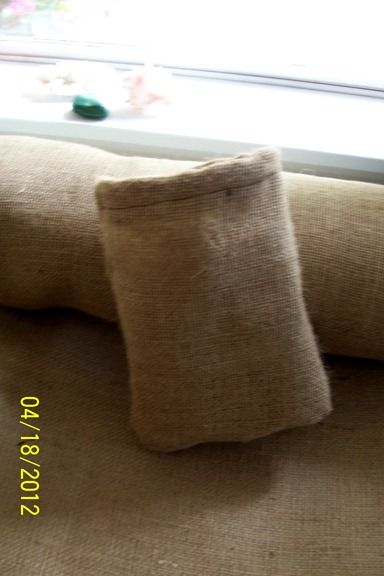
Here is a pic showing how it will look in the rack;

Here’s a few pics I found for inspiration….


The one I am making right now will have strawberries and herbs in it. I want to make another one for succulents but will use a pallet to plant in since I will want it to be permanent…
Fences of Fruit Trees
Posted: April 17, 2012 Filed under: Gardening Leave a comment“Almost anyone who has a backyard or garden would do well to plant fruit trees for the years ahead. Most fruit trees, though, take more years to mature than most of us have to prepare, and take up more space than most of us have in cities or suburbs. Luckily, only a few centuries ago master gardeners developed a way to cultivate fruit in narrow spaces – one that yields more fruit, more quickly, and with a longer growing season.
Espalier is a method of growing a dwarf fruit tree along a wall or fence, binding it for support, and bending the branches to follow certain lines, as Japanese artists do with bonsai trees. Most gardeners started espaliers with a “maiden,” a one-year-old sapling that had not yet forked, and tied it to a staff of wood to keep it straight. Then they tied the desired branches to the fence or wall as they emerged, bending and pruning aggressively as the tree grew.
With the tree’s natural growth concentrated into only two dimensions, it creates many spurs looking for a chance to spread, creating more flowers and fruit than their conventional counterparts, and earlier in the trees’ life. The fruit can be picked casually while standing or sitting, with no need for the ladders or devices needed to pick many other fruit trees, and no risk of injury. Growing a tree against a south-facing wall has another advantage; not only does the tree receive maximum light and heat, but the thermal mass of the wall absorbs the heat and provides shelter from the wind. In this way trees get a longer growing season, and can grow in cooler climates than they would ordinarily tolerate.”
Read more: Fences of fruit trees. Related: Irish hedgerows.
Let’s Build a Worm Farm!
Posted: April 9, 2012 Filed under: Gardening Leave a commentMarch 22, 2012 by Soulsby Farm – A Very Small Farm
Step by Step Instructions on how to build your very own Worm Composting Bin. This is a 5 minute project. I completed it in 3 minutes with a cold beer in one hand. You can buy worms locally or from several sources online. I purchased 2lbs of Red Wigglers online for $29.99.

Here’s all you need:
2 Rubbermaid tubs (or cheap knock-off like these) or some old 5 gal buckets.
2 blocks (in this case a couple 2×4 pieces)
Shredded Paper (I find that worms like bill collection letters the best)
Kitchen Scraps (no meat or dairy products just veggies)
Crushed egg shells (provide calcium)
Cheerios and coffee grounds (with filter)
Worms (Red Wigglers or Eisenia foetida, are the best compost worms)
Drill (2 bits 1/8″ and 1/4″)
Step 1: Drill 1/8″ holes in the top (for oxygen) and 1/4″ holes in the bottom for worm juices. In 1 tub.


Step 2: Place a couple of 2×4′s (as spaces) in the bottom of the nu-drilled tub. Place Drilled tub on to the spacers, fill drilled tub about a third with shredded paper.

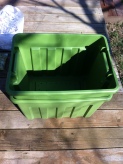

Step 3: Add crushed egg shells (great source of slow release calcium and can also act as a buffer, essentially helping to prevent excessively acidic conditions from developing.) and Cheerios (Worms like Cheerios).


Step 4: Add kitchen scraps (no meat, nothing greasy, no citrus,) veggie scraps and worms.
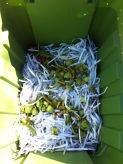

Step 5: Add some water. Worms like it moist and dark. Drill holes in top and leave em alone. In 90 Days you’ll have the best organic fertilizer and your plants will love you for it.


Interesting Worm Facts:
- There are over 4,000 species of earthworms.
- There are only about 6 species that are used for vermicomposting.
- Earthworms don’t have lungs, but instead breathe through their skin as long as it stays moist.
- Red Wigglers can consume up to 50% of their body weight per day
- Earthworms are hermaphrodites yet it still takes two worms to reproduce.
- Worms don’t have eyes , but are sensitive to light.
- Worms have no teeth for chewing food. They grind food in their gizzard by muscle action.
- A worm’s mouth is in the first anterior segment. There is a small protruding lip just over the mouth, called prostomium. When the worm is foraging, this lip is stretching out. The prostomium is for sensing food.
- You’ll be able to compost your kitchen scraps 10 times faster when compared to composting without them.
- One pound (16 ounces) of worms equals about 1,000 worms
- One pound of Red Wiggler worms can eat about half pound of organic matter every day.
Why should you start a Worm Farm?
- Remove excess waste from landfills & reduce your carbon footprint.
- Worms produce the best organic fertilizer
- Worm castings are five times richer in nutrients than the best topsoil and worm castings are pH neutral.
- Great treats for chickens and great for fishing.
- Worms make great friends. They just listen to you all day and never interrupt.
- If you’ve read this far, you’re crazy enough to do it.
What is Vermicomposting?
Worms and microorganisms convert organic materials to a beneficial soil amendment. The worms breakdown food scraps into nutrient rich compost.
Feed Worms:
- Vegetable scraps
- Fruit scraps and peels (mold/rot is fine)
- Bread and grains
- Coffee grounds (+ filters) and tea bags
- Crushed egg shells
- Napkins, paper towels
Don’t Feed Worms:
- Citrus
- Meats, fish
- Greasy foods
- Dairy products
- Twigs and branches
- Dog/cat feces, cat litter
You can leave the bin inside your house (there’s no smell) or you can build up a small army of worms and take over the world or just add them to your compost pile mid-summer. Or even better, start a Worm Farm (like Harry and Lloyd in ‘Dumb & Dumber‘) and call it I Got Worms.


 Meal Delivery Service by Millie Barnes
