Willow Work on my Porch
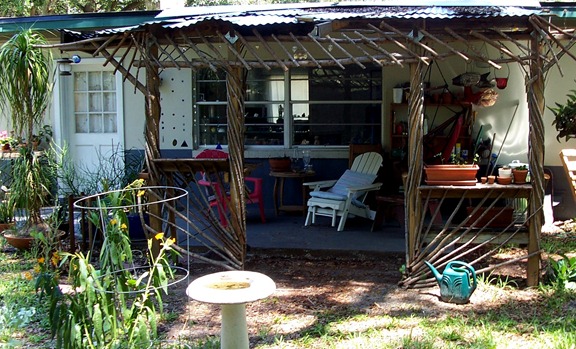
Posted: May 20, 2012 Filed under: Food and it's Impact on Our Health Leave a commentI moved into a new house last June, 2011. Here is what the back porch looked like then;

Billy Willow came last weekend and worked his magic and did willow work. The original metal roof had a layer of netting and a layer of worn out bamboo shades (no idea why!) that had stuff nesting in it. He ripped that out, repaired some of it, added a table and bench and many willow embellishments.

Here is a shot of the whole thing. The table top was in Rick O’Shea’s back yard, the wooden banister used for the table leg is an old bannister that was from the family home of my friend, Janice Ghelerter. As you can see it wraps around the table. All material for this project was found, recycled, gathered. The hanging glass beads I have had for years, they look awesome with the sun pouring through them in the afternoons! I have a collection of prisms hanging in the wood just under the roof on the edge.

Here’s the bench. The poppies and Bachelor Buttons are just sprouting. I’m still working on the tin roof, the potting bench will go in the greenhouse when it is finished. The garden, the water barrels, the compost is all to the left. In the foreground is the bird bath, cucumbers and milkweed thistle, which attracts butterflies.
Next year, when Billy returns from Michigan we will finish the willow work under the tin, add more bent willow…
Coconut Flour – Something Different to Bake With
Posted: May 20, 2012 Filed under: In The Kitchen with Millie- How To's 2 Comments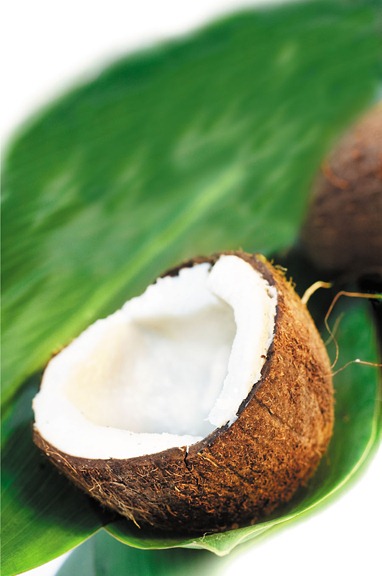

Coconut flour is a great gluten-free alternative flour. I’ve been baking with coconut flour for several years, mainly because of its low-carbohydrate nature. Plus, I’ve enjoyed the creativity others have put into developing tasty recipes. Besides being a nice alternative to wheat flour, coconut flour has many benefits.
- Low in carbohydrates
- High in fiber
- Rich in protein
- Very filling
Keep in mind that since coconut flour is not grain based and contains no gluten, it does not perform like wheat flour. Because coconut flour is very absorbent, only small amounts are used. Sifting coconut flour is a good idea because it tends to clump. And lastly, coconut flour is dry so any recipe you see will require lots of eggs.
I have bought coconut flour at Whole Foods but I’ve found it less expensive to order online.
Tropical Traditions – they also have hundreds of recipes using coconut flour
Sweet Recipes
Coconut Flour Bread from Nourished Kitchen
Strawberry Muffins with Strawberry Cream Cheese Frosting

Coconut Flour Cake from Nourished Kitchen
Miscellaneous coconut flour recipes
Macadamia Snowballs
Posted: May 20, 2012 Filed under: Food and it's Impact on Our Health Leave a comment
1 1/2 cup macadamias
1 1/2 cup dried apricots
1 cup grated coconut
1) Blend macadamias to a course texture in a food processor.
2) add apricots and blend until it forms a ball.
3) Roll into walnut sized balls, roll in coconut. Enjoy.
Wood Butter – A Recipe for Your Utensils!
Posted: May 20, 2012 Filed under: In The Kitchen with Millie- How To's Leave a comment
Several months ago Wendi with Bon Appetit Hon, did a post on Wood Butter; like you I had a moment of Huh? What? Well, typically called Spoon Oil, Wendi had decided that Wood Butter fit better and I agree; leave it to another food person to put the perfect name on this elixir that is so simple but so perfect for the care of the wood items we use in the kitchen. A necessity but also a bit indulgent…yes, butter is perfect! We need to take special care of our wood kitchen items in Denver due to the low humidity in our environment and I can be as lax as the next person. Making your own ‘wood butter’ makes it simple and inexpensive too.
Though Wendi had to find an online resource for the beeswax part of the magic, I was lucky to find a local resource. Redi-Arts carries it here in Jacksonville.
The process is easy but can be messy. Most ‘recipes’ include heating the wax in a mid size Ball jar in hot water and adding warmed mineral oil to the wax once it is melted. I preferred using a large glass measuring cup with a pour spout as I was going to be pouring the combined liquid into a whole bunch of small jars. I also used a funnel just for canning and it worked perfectly. The only negative to this method is the removal of the wax from the measuring cup and funnel. I decided since I’ll be doing this again, I’ll just save those two utensils just for this process and candle making and not worry about the residue layer that remained inside each.

What better way to show you the magic of Wood Butter than a Before and After photo. Totally untouched, promise. Everything in this photo has been treated with an application of wood butter including the bottom board. Simply apply a bit to a paper towel or a piece of cheesecloth and rub a dollop onto the surface until it’s rubbed in. The bowl in front was an inexpensive one I purchased from World Market and it was apparently never supposed to touch water. It did, I thought it ruined but ‘the butter’ did the trick. I found the wooden rolling pin at a yard sale and can’t believe the difference myself. All of my cutting boards have a renewed luster; in fact they seem new again. It is not a sage compound butter but it is a miracle butter!
Millie; I NEVER use mineral oil, it’s a petroleum product and highly carcinogenic. Replace the mineral oil in this tutorial with coconut oil (I also eat it and use it on my skin!)… You CAN skip the beeswax and just use coconut oil but the beeswax offers more protection. Remember; NEVER put your wooden utensils in the dishwasher! Do not leave them in the dish water either…
For Instructions and Full Post…
Smoked White Bean Soup
Posted: May 19, 2012 Filed under: Food and it's Impact on Our Health Leave a comment
I make this bean soup with turkey bacon (I don’t eat pork) but you can use ham hocks or regular bacon.
3 cup cannellini beans
1 large Vidalia onion- large diced
3 quarts chicken stock
3 whole bay leaves
6 slices turkey bacon
1 Tablespoon rosemary
6 medium carrots- cut in 1 1/2 inch long rounds
1 teaspoon smoked salt
freshly ground pepper
1) Rinse beans well, pick over to make sure there are no small rocks. Place beans in pot of cold water with one large piece of Kombu seaweed. (seaweed is optional). Slowly bring to boil. Let sit while you are starting other ingredients.
2) Sauté bacon in butter until cooked but not crisp. Remove from pan, set aside. Sauté onions in 2 Tablespoons butter over low heat, covered, for 1 hour.
3) Drain beans, add to caramelized onions. Add stock, carrots, all other ingredients. Add water as needed to cover plus about 2 inches over beans.
4) Simmer slowly until beans are tender. Remove 1 cup of beans, blend in blender with some stock, add back to soup. Adjust seasonings.
Serve with Gluten Free corn bread and sautéed kale with onions.
Moroccan Preserved Lemons
Posted: May 18, 2012 Filed under: Food and it's Impact on Our Health Leave a commentFrom Nourished Kitchen
MAY 15, 2012 BY JENNY 66 COMMENTS

Preserved lemons enhance the cooking of North Africa with their pronounced saltiness and a sourness that is oddly mellowed, rather than enhanced, through fermentation. Even with no other ingredients but salt and lemon, preserved lemons take on other unique and complex flavor profiles that can become even mint-like over time and after proper fermentation.
While you can buy them at specialty stores and online for up to $15 for a jar, you can make them yourself with just a little investment in salt, lemons and time.

For FULL post and Recipe CLICK HERE…
Millie’s Gluten Free Granola
Posted: May 18, 2012 Filed under: Food and it's Impact on Our Health 1 CommentThe best granola you’ve ever tasted!

Years ago I found Adele Davis’s Granola for sale at Jacksonville’s first health food store (1973), I fell in love. I have never tasted a better granola. Here is my gluten free recipe that started with that inspiration.
Serve with almond milk to keep the carbs lower.
6 cups gluten free oats- Publix carries it here locally or you can find it online from Bob’s Red Mill
2 cups shredded coconut
1 cup sliced almonds
1 cup sesame seeds
1/2 cup rice flour
1/2 cup tapioca flour
1/2 cup coconut oil
1 cup water
1/2 cup honey
2 teaspoons vanilla
1 teaspoon cinnamon
1) Preheat oven to 225 degrees.
2) Mix first 7 ingredients together.
3) Make a well in the middle of the granola, add honey. Pour HOT water over it and mix.
4) Spread on two cookie sheets, pat down firmly. You want it to bake together; this will form nice clumps of chewy granola.
5) At the end of an hour, gently stir and turn so that it can brown, being careful to leave it it clumps.
6) Bake until browned evenly, periodically spreading granola in from sides as it tends to brown quicker on the edges.
7) Cool on cookie sheets. When cooled completely store in air-tight containers. Glass canning jars work great!
National Trust – ‘What’s Your Beef?’ Report
Posted: May 16, 2012 Filed under: Food and it's Impact on Our Health Leave a comment
A recent report from the UK’s highly respected National Trust has confirmed what Animal Welfare Approved has been advocating for a long time: Feeding cattle on grass throughout their life-cycle is the most environmentally sustainable way to raise beef.
The new report – entitled What’s Your Beef – is an important contribution to the on-going debate about how to increase food security while reducing the environmental impacts of food production.
For FULL ARTICLE…
Chocolate Is a ‘Super Fruit’: Rich Source of Antioxidants
Posted: May 16, 2012 Filed under: Food and it's Impact on Our Health 2 Comments Cocoa pods and chocolate.
From Science Daily
ScienceDaily (Feb. 7, 2011) — It is widely known that fruit contains antioxidants which may be beneficial to health. New research published in the open access journal Chemistry Central Journal demonstrates that chocolate is a rich source of antioxidants and contains more polyphenols and flavanols than fruit juice.
When researchers at the Hershey Center for Health & Nutrition™ compared the antioxidant activity in cocoa powder and fruit powders they found that, gram per gram, there was more antioxidant capacity, and a greater total flavanol content, in the cocoa powder.
Similarly when they compared the amount of antioxidants, per serving, of dark chocolate, cocoa, hot chocolate mix and fruit juices they found that both dark chocolate and cocoa had a greater antioxidant capacity and a greater total flavanol, and polyphenol, content than the fruit juices. However hot chocolate, due to processing (alkalization) of the chocolate, contained little of any.
Dr Debra Miller, the senior author of the paper, says that, "Cacao seeds are a "Super Fruit" providing nutritive value beyond that of their macronutrient composition." Which is great news for chocolate lovers.
Beyond Apples: A Serving a Day of Dark Chocolate Might Keep the Doctor Away
Posted: May 16, 2012 Filed under: Food and it's Impact on Our Health Leave a comment
From Science Daily
ScienceDaily (Apr. 24, 2012) — Chocolate, considered by some to be the "food of the gods," has been part of the human diet for at least 4,000 years; its origin thought to be in the region surrounding the Amazon basin. Introduced to the Western world by Christopher Columbus after his fourth voyage to the New World in 1502, chocolate is now enjoyed worldwide. Researchers estimate that the typical American consumes over 10 pounds of chocolate annually, with those living on the west coast eating the most. Wouldn’t it be great if only chocolate were considered healthy?
In fact, chocolate is a great source of myriad substances that scientists think might impart important health benefits. For instance, it contains compounds called "flavanols" that appear to play a variety of bodily roles including those related to their potent antioxidant and anti-inflammatory actions. Many large-scale human studies have documented a statistical correlation between flavanol intake and risk for cardiovascular disease. And animal studies suggest that this relationship may be due to the physiologic effects that flavanols have on chronic inflammation, blood vessel health, and circulating lipid levels. However, few controlled human intervention studies have been conducted to test the direct effect of chocolate consumption on these variables.
For FULL ARTICLE….


 Meal Delivery Service by Millie Barnes