Thai Salmon with Homemade Sweet Chili Sauce
Posted: July 1, 2018 Filed under: Recipes Leave a comment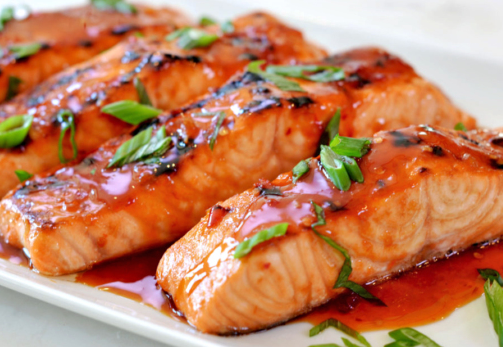
Thai Salmon
6 x 6 oz sockeye salmon fillets, skin on or off
Pinch of salt
1/2 cup Thai Sweet Chili Sauce
2 – 3 tbsp green onions, chopped
Toasted sesame oil
Thai Sweet Chili Sauce;
1 cup plus 4 tablespoon water, divided
2 tablespoons arrowroot
3 medium cloves of garlic, minced (about 1 tablespoon)
2 tablespoons finely chopped fresh Fresno, red Thai chilies, or red jalapeño peppers (seeds left in for a hotter sauce)
2/3 cup honey
1/3 cup rice vinegar.
2 teaspoons Bragg’s Amino Acids
1 teaspoon Red Boat Fish sauce
Make Chili Sauce;
Bring all ingredients, except 4 Tablespoons water and arrowroot, to a simmer. Simmer 15 minutes and then combine 4 T. room temperature water and arrowroot . Stir well and then stir into simmering liquid, stir until liquid simmers.
In a large baking dish, lay down salmon fillets in a row. Each fillet – sprinkle with a pinch of salt and top with 1 tbsp Thai sweet chili sauce. Brush or rub with your fingers to coat fish with sauce evenly on top, bottom and sides. Cover and let marinate in the fridge for at least 2 hours or overnight is the best (up to 24 hours).
Turn on oven’s broiler on High and position top oven rack 5″ – 6″ below the heat source. Line large baking sheet with unbleached parchment paper or silicone mat, spray with cooking spray and place salmon fillets skin side down (if any). Coat with remaining marinade from the dish (if any).
Broil for 6 minutes, rotating baking sheet once. Remove from the oven and brush top of each fillet with 2 tsp of Thai sweet chili sauce. Return to the oven and broil for another 2 minutes or until salmon has caramelized. Serve hot garnished with green onions, extra sauce.
Crispy Buffalo Cauliflower Bites
Posted: July 1, 2018 Filed under: Recipes Leave a comment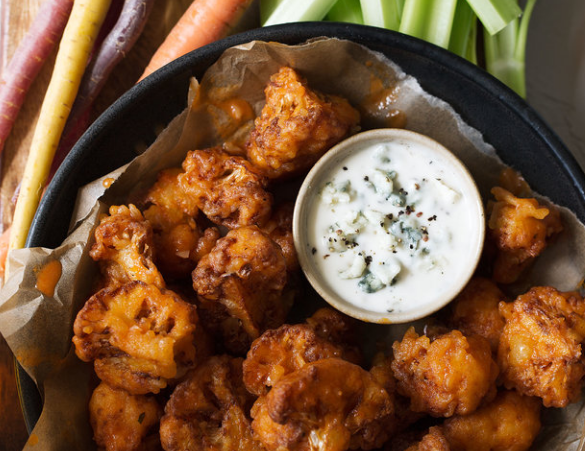
For the buffalo sauce:
¼ cup melted butter
¼ cup hot sauce of choice, I use Frank’s Red Hot®
1 tablespoon distilled white vinegar
1 teaspoon Worcestershire
1 clove garlic, minced
For the cauliflower:
1 large head cauliflower, cut into florets
ghee- for frying
½ cup arrowroot
¾ cup rice flour
½ teaspoon baking powder
1 teaspoon garlic powder
1 teaspoon kosher salt
½ teaspoon freshly ground black pepper
For serving:Dairy Free Ranch dressing.
Instructions:
For the buffalo sauce:
In a small bowl whisk together the butter, hot sauce, vinegar, Worcestershire and garlic until completely combined. Set aside until ready to use. If not using right away, store the sauce in an airtight container for up to a week – whisking to combine before using.
For the cauliflower:
Fill a large pot with enough oil to reach 2-inches up the side of the pan. Heat oil to 350°.
In a large bowl whisk together the cornstarch, flour, baking powder, garlic powder, salt and pepper. Slowly add ¾ cup cold water, whisking until a thin batter forms (about the consistency of pancake batter). If needed, add more water 1 tablespoon at a time until the desired consistency is reached.
Working in batches, dip the cauliflower in the batter, letting the excess batter drip off. Add to the hot oil and deep-fry until the cauliflower is golden brown, about 4 minutes.
Remove to a large bowl and toss with ¼ cup of the buffalo sauce. Serve immediately ranch dressing.
BLT Pasta Salad- gluten free
Posted: July 1, 2018 Filed under: Recipes Leave a comment
2-1/2 cups uncooked gluten free pasta
6 cups torn romaine lettuce
1 medium tomato, diced
1/2 cup sliced red onions
4 bacon strips, cooked and crumbled
1/2 cup dairy free ranch dressing (recipe below)
1 Tablespoon barbecue sauce
1/4 teaspoon pepper
- Cook pasta according to package directions. Drain. Then rinse pasta under cold water.
- In a large bowl, combine the romaine lettuce, tomato, bacon, onions and pasta.
- Drizzle the ranch dressing and barbecue sauce over the top. Gently toss to coat evenly. Season with pepper. Serve immediately and enjoy!
Dairy–Free Ranch Dressing Recipe
1 cup fresh mayonnaise.
1 tablespoon raw apple cider vinegar.
1 tablespoon unsweetened coconut milk OR Soy sour cream.
1 small garlic clove finely minced or pressed, OR ¾ teaspoon granulated garlic powder.
1 teaspoon onion powder.
2 teaspoons dried parsley.
2 teaspoons fresh chopped dill.
2 teaspoons fresh chopped chives.
Pan-Seared Salmon with Chimichurri
Posted: June 28, 2018 Filed under: Recipes Leave a comment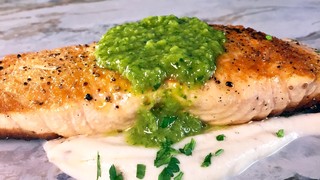
Pan-Seared Salmon with Chimichurri
Serves 4
1 cup fresh parsley leaves
1 cup fresh cilantro leaves
2 garlic cloves — minced
Salt and pepper
1/4 teaspoon red pepper flakes
1/2 cup plus 1 tablespoon extra-virgin olive oil
1/4 cup red wine vinegar
2 pounds skin-on salmon fillets
1) Combine parsley, cilantro, garlic, 1 teaspoon salt, and pepper flakes in food processor; pulse until coarsely chopped, about 5 pulses. Add ½ cup oil and vinegar; pulse, scraping down bowl as needed, until mixture is combined but still chunky, about 5 pulses. Transfer to bowl; set aside.
2) Pat salmon dry with paper towels and season with salt and pepper. Heat remaining 1 tablespoon oil in 12-inch nonstick skillet over medium-high heat until just smoking. Cook salmon, skin side up, until well browned, 4 to 6 minutes. Flip and continue to cook until well browned on skin side, 4 to 6 minutes. Transfer to platter. Spoon chimichurri over top. Serve.
Salmon Pho
Posted: June 24, 2018 Filed under: In The Kitchen with Millie- How To's, Recipes Leave a comment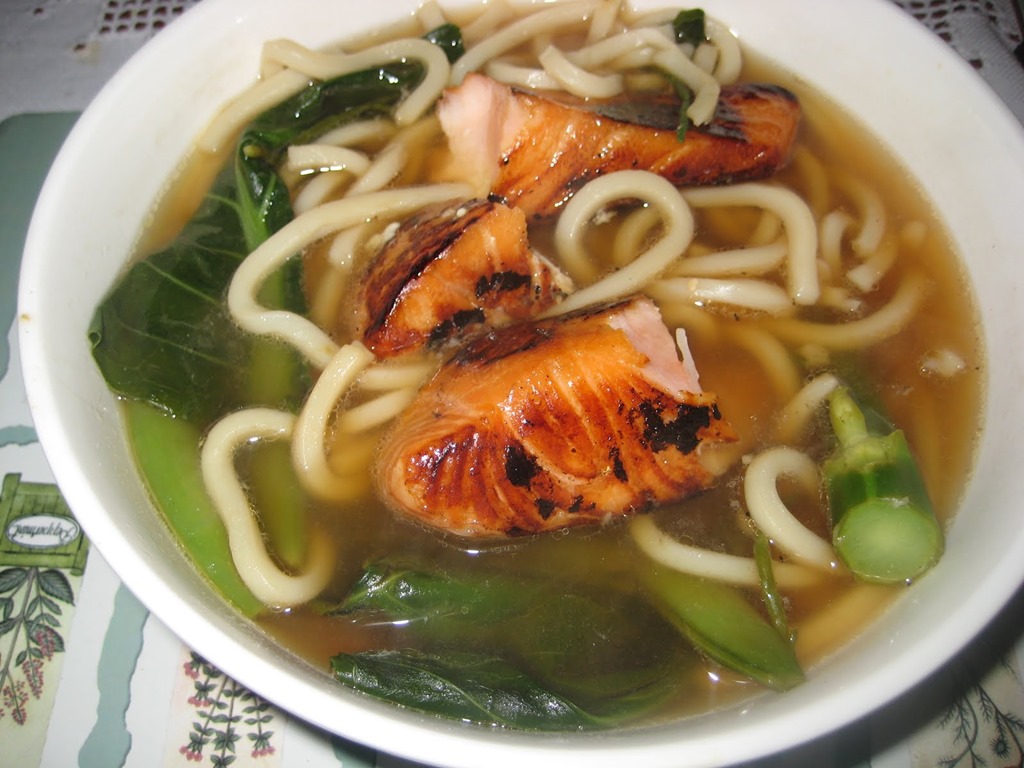
Salmon Pho
Serving Size : 4
1 Tablespoon cumin powder
1 teaspoon fennel powder
1 Tablespoon smoked paprika
1 teaspoon star anise powder
1/3 teaspoon clove
1/2 teaspoon cinnamon
1 medium Onion — diced
1 teaspoon minced garlic
1 Tablespoon ginger — grated
1 1/2 quarts chicken stock
3/4 tablespoon salt
2 tablespoons Red Boat fish sauce
2 tablespoons Mirin
2 Tablespoons Bragg’s Amino Acids
2 teaspoons toasted sesame oil
1 Tablespoon honey
For the bowls:
1 pound wild salmon — divided into 1/2 pound pieces
1 pound sliced mushrooms
1/2 medium yellow onion — sliced paper-thin
1 pound baby spinach
1 1/2 cups mung bean sprouts
1 1/2 scallions — green part only, cut into thin rings (3 to 4)
1/2 cup chopped cilantro
1) In a 3 quart iron Dutch oven, toast the spices on medium heat until aromatic, about 3 or 4 minutes.
2) Add broth and simmer about 15 minutes. Then strain liquid through cheesecloth into another pot or bowl. Wipe pan out.
3) Heat sesame oil until hot, add onions and cook until translucent. Add garlic and ginger and cook, stirring, until aromatic. Add mushrooms to pan and cook until done. Add the broth back to pot.
4) Heat the pho broth. Meanwhile bake salmon, at 295, for 9 minutes. Place in bowls you are going to serve the Pho in.
5) Add spinach to broth, let wilt, scoop out with slotted spoon and add beside salmon in bowl. Repeat with mung bean sprouts.
6) When ready to serve, pour hot broth over bowls, dividing the veggies evenly (onions, mushrooms). Top with cilantro and serve.
Diabetes Defeated by Diet: How New Fresh-Food Prescriptions are Beating Pricey Drugs
Posted: June 21, 2018 Filed under: Food and it's Impact on Our Health Leave a commentI have been teaching my clients how to heal from diabetes through nutrition for 20+ years. It is not that hard.
- Spending on diabetes drugs in the U.S. reached $53.7 billion last year, more than double what it was in 2013.
- Roughly 100 million Americans have diabetes or prediabetes.
- The Fresh Food Farmacy program, being tested by Geisinger Health System in Pennsylvania, which includes education and free nutritious meals, can lower diabetes treatment costs by 80 percent.
- The high-fat, low-carbohydrate ketogenic diet is being used by new health-care start-up Virta Health, which aims to treat 100 million patients by 2025.
At first glance Sami Inkinen, an elite triathlete and co-founder of the real estate company Trulia, and Rita Perkins, a grandmother of eight in central Pennsylvania, have little in common.
But they do share one thing: Both have grappled with diabetes.
“I thought, This is absolutely nuts,” Inkinen recalled of his diagnosis with prediabetes. “It was really a personal experience and a shocking experience that a world-class triathlete can become type 2 diabetic or prediabetic.”
For Perkins it was less of a surprise. Diabetes ran in her family, she said, and her weight had reached 300 pounds before she lost about 100 just through increased walking. But her diet was still bad, and she struggled to control her blood sugar.
Now things have turned around for both Perkins and Inkinen. And their paths were both through food.
In Shamokin, Pennsylvania, about 75 miles northwest of Allentown, Geisinger Health System is trying something new for some of its diabetes patients.
Instead of relying solely on drugs to manage the disease, doctors are writing prescriptions for certain patients to enter its Fresh Food Farmacy program: 15 hours of education about diabetes and healthier living, followed by 10 free nutritious meals a week for participants and their families.
Geisinger
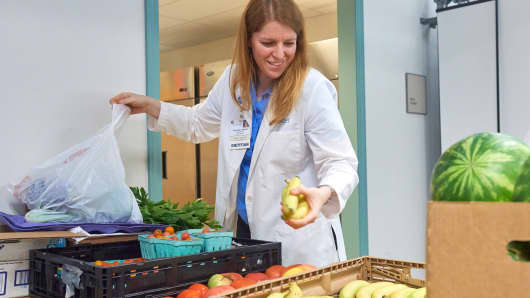
Dietitian Anna Ziegler selects fresh produce for a Fresh Food Farmacy patient.
“In health care we spend an awful lot on drugs and devices because it’s business,” said Dr. Andrea Feinberg, Geisinger’s medical director of health and wellness. “But we spend a very small amount on preventive medicine. … It’s sort of like we’re upside down and backward.”
The program targets people with diabetes and food insecurity, those for whom it’s not always clear where the next meal will come from.
“We understand the relationship of food insecurity and the impact that poverty has on developing certain lifestyle conditions, like type 2 diabetes,” Feinberg said. She added that the goal is “to diminish complications of diabetes and also close the meal gap to end hunger.”
The program, started 18 months ago, is a partnership with the Pennsylvania Food Bank. So far, it’s enrolled 150 patients, feeding a total of about 450 people a week.
Rita Perkins, her husband and three grandchildren who live with them are among those families. For Perkins the program has been transformative.
Each week, she visits the Farmacy and picks out food with guidance from a nutritionist. Perkins said the food, along with what she learned in the course about managing diabetes, has changed not just her approach to eating but also her family’s.
“Before, I’d never buy this stuff; I would never buy fresh fruit,” Perkins recalled. “Money was tight. And now since I get this stuff for free, I can put it on the table for the kids.”
Since she started the program, Perkins said her weight has dropped to 134 from 179. She walks all over town and said her doctors are evaluating the doses of her diabetes medications. Her blood sugar, measured by an A1C test, has been a steady 5.8 percent for the last six months (normal A1C, according to the National Institutes of Health, is below 5.7 percent).
“If a new diabetes drug became available that could double the effectiveness of glucose control, it would likely be priced considerably higher than $6 per week (and if it wasn’t, the pharmaceutical firm’s stockholders would be in revolt).”-Andrea Feinberg , Geisinger’s medical director of health and wellness
Those results aren’t atypical. On average, patients in the program have seen their A1C levels drop from a pre-enrollment level of 9.6 percent to 7.5 percent, Feinberg and colleagues wrote in an April article in NEJM Catalyst that they called “Prescribing Food as a Specialty Drug.”
“Clinically, we see great outcomes,” Feinberg told CNBC. “The impact is that we really know long-term that we’ll see a decrease in incidence of heart disease, the No. 1 killer here in the United States, because if you improve the diabetes, improve your cardiac risk factors, you have less heart disease as well.”
The program also should save money. With operational costs of $2,400 per patient each year, early findings show costs for patients in Geisinger Health Plan dropped by 80 percent: from an average of $240,000 per member per year, to $48,000 per member per year.
“If a new diabetes drug became available that could double the effectiveness of glucose control, it would likely be priced considerably higher than $6 per week (and if it wasn’t, the pharmaceutical firm’s stockholders would be in revolt),” Feinberg and her colleagues wrote.
Indeed, spending on diabetes drugs in the United States reached $53.7 billion last year, more than double what it was in 2013. The number of prescriptions in that time rose 18 percent, to 227 million, according to data from industry researcher IQVIA.
Ketogenic diet led to drop in blood glucose, weight and drug usage
Almost 3,000 miles away, in San Francisco, Inkinen got his startling diagnosis: He was pre-diabetic even as he set records in endurance sports (in 2014 he and his wife rowed across the Pacific Ocean, from California to Hawaii, he said on his blog: 2,750 miles in 45 days and 3 hours, setting a speed world record for two people.)
His solution? The ketogenic diet, a high-fat, low-carbohydrate way of eating that’s enraptured many in Silicon Valley.
“There is a way to reduce insulin resistance without exercise, without dieting or without bariatric surgery, using the traditional ketosis,” Inkinen told CNBC. “But to deliver this type of treatment, you would need technology and the ability to continuously monitor and deliver care.”
Inkinen’s online real estate information company, Trulia, was sold in 2014 to Zillow for $3.5 billion. So naturally, the next step for Inkinen was to start a new company. He teamed with a doctor and a scientist, Stephen Phinney and Jeff Volek, and founded Virta Health.
Virta connects patients virtually with doctors and coaches who help tailor the ketogenic diet to their lifestyles and monitor certain biomarkers daily.
In a trial of about 260 patients, published last year in JMIR Diabetes, Virta’s treatment led to reductions in blood glucose, weight and use of diabetes medication after 10 weeks. After a year A1C levels were down an average of 1.3 percent, diabetes medication usage was down 48 percent, and body weight was down 12 percent.
To cardiologist Ethan Weiss, who sits on Virta’s scientific advisory board, the outcomes are strong enough to recommend the program to his patients.
“For people with type 2 diabetes headed toward bariatric surgery, to have this result, that they’re coming off almost all insulin, coming down on almost all other diabetes medicines, losing weight, feeling like they control their diet, I think it’s an awesome thing to recommend,” said Weiss, an associate professor of medicine at the University of California San Francisco.
While most of the metrics move dramatically in the right direction — Inkinen says 60 percent of patients see their diabetes reversed in a span of between two and nine months — Weiss notes one data point that may not. Levels of LDL, or so-called bad cholesterol, appear to rise on the ketogenic diet. But he notes a distinction in the type of LDL that goes up, saying it may not be the type that leads to clogged arteries. And he says LDL levels can be controlled with drugs called statins, like Lipitor, if that’s a concern (though he said to him it’s not).
Virta’s program, which costs $370 a month after a $500 initiation fee if patients pay out of pocket, also saves money, according to Inkinen, who estimates an average savings of $9,600 per patient in the first 24 months in drug and medical costs. After the first year the cost drops to $199 a month.
The company is working to expand to more coverage from insurers and employers, with the goal of reversing diabetes in 100 million people by 2025.
That’s about the number of Americans with diabetes or prediabetes, according to the Centers for Disease Control and Prevention.
As usage — and costs — of diabetes medicines rise, both Geisinger and Virta are showing that food, along with a healthy dose of education and support, can go a long way in changing the course of this disease.
THAI MANGO AVOCADO SALAD
Posted: June 20, 2018 Filed under: Recipes Leave a comment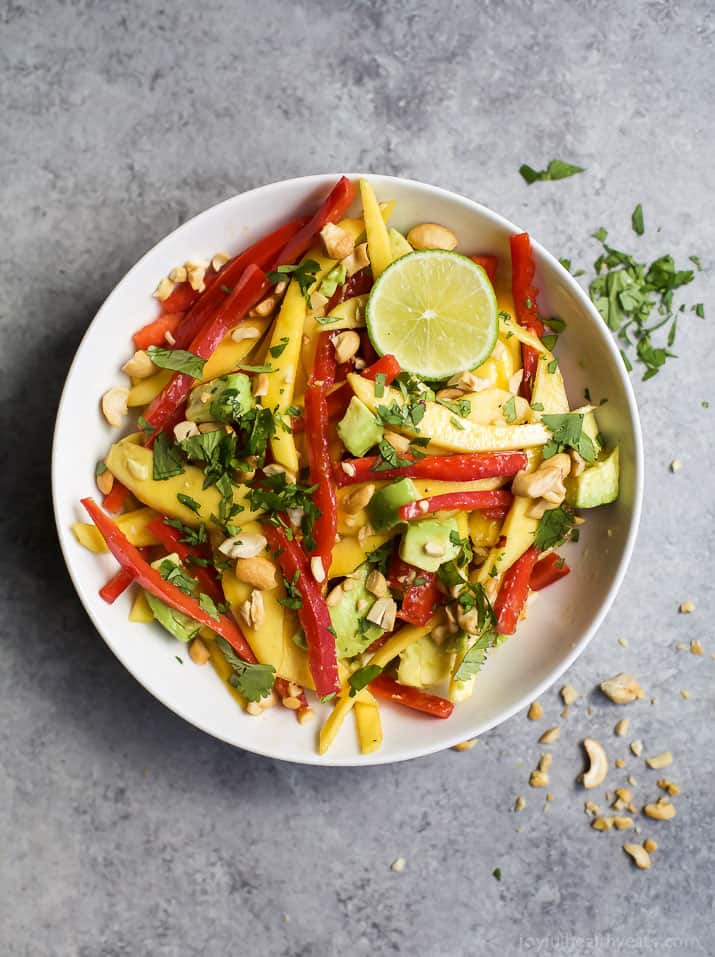
Dressing;
1/2 cup seasoned rice vinegar
1 tablespoon black sesame seeds
1 small clove garlic, minced
1 tablespoon Dijon mustard
1 tablespoons soy sauce
1/4 cup olive oil
2 tablespoons sesame oil
pinch of salt
1/4 teaspoon fresh cracked black pepper
Salad;
1 large mango, julienned
1 red pepper, julienned
1 avocado, diced
1/4 cup diced cashews, roasted and unsalted
1/4 cup diced fresh cilantro
1. In a small bowl, add lime juice, sesame oil, maple syrup, tamari, and sriracha. Using a whisk, stir until combined and oil no longer separates. Set aside.
2. To a medium bowl, add mango, red pepper, avocado, cashews, and fresh cilantro. Pour the sauce over the mango salad and gently toss using two spoons.
Serve immediately.
Crab Tabouli with Quinoa
Posted: May 9, 2018 Filed under: Recipes Leave a comment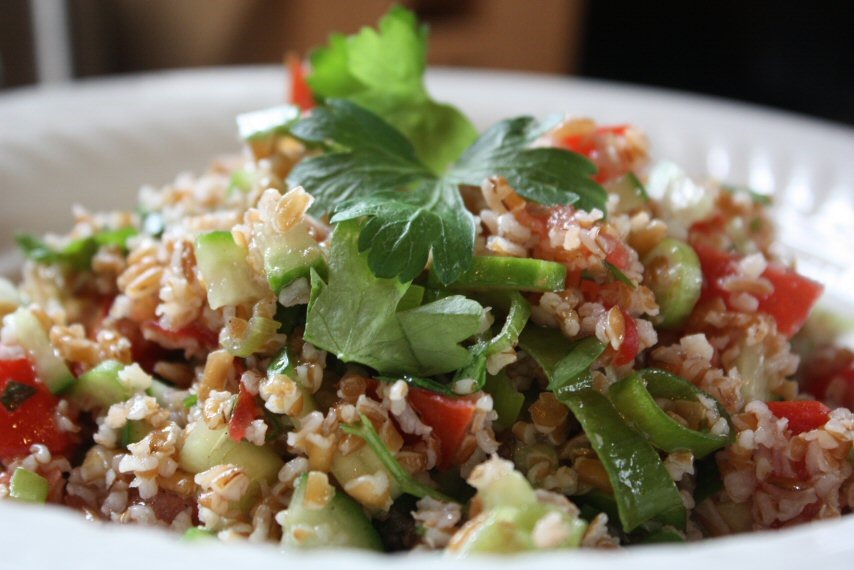
I demonstrated this dish in cooking class one night and my students took one look at the recipe and said they would never make it; too many ingredients!. But after tasting it they agreed that this dish was REALLY worth the effort!!
Serves 4
1 cup quinoa
3 cup boiling water
1 tart apple2 Roma tomatoes- diced small
1 medium cucumber- diced small
3 whole scallions- sliced thin on diagonal
1 yellow tomato- small diced
2 Tablespoons chopped spearmint
2 Tablespoons chopped basil
1/3 cup sliced black olives
1/2 cup fresh mayonnaise
2 Tablespoons lemon juice
1 pound lump crabmeat
salt and pepper
1) Toast quinoa on stovetop, in heavy skillet, shaking pan, until lightly browned. transfer to a bowl, pour in boiling water, cover tightly and let sit for about and hour. Or you can simmer on low until liquid is completely absorbed. Drain and cool.
2) Combine all ingredients except crab. fold in crab and season to taste. Cover and refrigerate for 2-4 hours.
Salmon Soba Noodle Bowl with Asparagus, Shiitakes, and Egg
Posted: April 23, 2018 Filed under: Recipes Leave a comment On the menu, for delivery tomorrow!
Soba Noodle Bowl with Asparagus, Shiitakes, Egg and Kimchi
Serves 4
For the soba noodles:
4- 6 ounce salmon filets
1 1/2 cups tahini
6 Tbs. fresh lime juice
4 Tbs. Coconut Aminos- (soy-free soy sauce)
4 Tbs. honey
2 Tbs. toasted sesame oil
2 garlic cloves, minced
Kosher salt and freshly ground pepper
10 oz. dried soba noodles
For the vegetables:
6 Tbs. Sesame oil
1 bunch asparagus, trimmed and cut into 3-inch pieces
2 Tbs. Coconut Aminos- (soy-free soy sauce)
2 heads Bok choy, leaves separated, cut into 3-inch pieces
1 1/2 lb. shiitake mushrooms, brushed clean, stemmed and sliced
Kosher salt
For serving:
4 hard- or soft-cooked eggs
1 cup (4 oz./125 g) kimchi
1/2 cup (1 1/2 oz./45 g) sliced green onions
3 Tbs. sesame seeds (I used Gamasio)
1. To make the soba noodles, in a bowl, whisk together the tahini, lime juice, soy sauce, honey, oil, garlic and 3 Tbs. water. Season with salt and pepper. Set aside. Cook the soba noodles according to the package instructions. Drain, transfer to a large bowl and set aside.
2. To make the vegetables, in a large fry pan over medium-high heat, warm 2 Tbs. of the oil. Add the asparagus and cook, stirring occasionally, until browned, about 7 minutes. Add 1 Tbs. of the soy sauce and cook for 1 minute longer. Transfer to a plate and cover loosely with aluminum foil.
3. In the same pan over medium-high heat, warm another 2 Tbs. of the oil. Add the Bok Choy and cook, stirring occasionally, until browned, about 5 minutes. Add the remaining 1 Tbs. soy sauce and cook for 1 minute longer. Transfer to a plate and cover loosely with foil.
4. In the same pan over medium-high heat, warm the remaining 2 Tbs. oil. Add the mushrooms and cook, stirring occasionally, until browned and tender, about 6 to 8 minutes. Season with salt. Set aside.
5. In the same pan, sear salmon (salt and pepper on on both sides) in butter and sesame oil about 4 minutes on each side.
5. Peel and halve the eggs lengthwise.
6. Add the tahini dressing to the noodles, thinning the dressing with 1 to 2 Tbs. of water if needed. Toss the noodles to coat, and divide among 4 bowls. Top with the vegetables, salmon, eggs, and kimchi. Garnish with the green onions and sesame seeds and serve immediately. Serves 4.
Berries Stimulate Cancer-Fighting Enzyme
Posted: April 8, 2018 Filed under: Food and it's Impact on Our Health Leave a comment
Raspberries, blueberries, and other berries contain natural pigments known as anthocyanins which give them their deep color. Numerous studies show that anthocyanins fight the inflammation that leads to aging. A new study from the University of Eastern Finland shows that anthocyanins increase the function of an enzyme in cancer cells that fights cancer called sirtuin 6 enzyme (SIRT6).
Sirtuins are enzymes that regulate the expression of genes that control the function of cells through key cellular signaling pathways. Aging causes changes in the function of sirtuin, and these changes contribute to the development of various diseases.
“The most interesting results of our study relate to cyanidin, which is an anthocyanin found abundantly in wild bilberry, blackcurrant and lingonberry,” says the study’s lead author Minna Rahnasto-Rilla.
Cyanidin increased SIRT6 enzyme levels in human colorectal cancer cells. The researchers also found it decreased the expression of two cancer genes — Twist1 and GLUT1. At the same time, cyanidin increased the expression of the tumor-suppressing FoXO3 gene in cells.
The findings that anthocyanins increase the activation of SIRT6 lays the foundation for the development of new cancer drugs.
The study’s findings were published in Scientific Reports.
A 2017 study published in the Journal of Nutritional Biochemistry found that pigs fed a high-calorie diet supplemented with purple potatoes, which are high in anthocyanins, lowered their risk of developing colon cancer. Pigs fed purple potatoes had levels of an inflammatory protein called interleukin-6 that were six times lower than that of pigs on a regular high-fat diet. Interleukin-6 is associated with the development of cancer.
The study authors suggested that a daily cup of fresh or frozen berries fights the inflammation that leads to aging.
A study from the U.K.’s University of East Anglia found that people who ate the most blueberries and strawberries — three or more servings a week — reduced their risk of a heart attack by a third when compared to women who ate berries once a month or less. Experts believe berries’ heart-healthy effects are due to anthocyanins, which help prevent the buildup of plaque in arteries.
© 2018 NewsmaxHealth.


 Meal Delivery Service by Millie Barnes