How to Steam Eggs Instead of Boiling Them
Posted: July 25, 2023 Filed under: In The Kitchen with Millie- How To's | Tags: #delivery, #glutenfree, #healthyeating, #Lactosefree, #mealdelivery, #MillieBarnes, #nutritioncoaching, #Ortega, #pescatarian, #Riverside, #SanMarco, #soyfree. #freedelivery, #Springfield, #vegetarian, #weightloss Leave a comment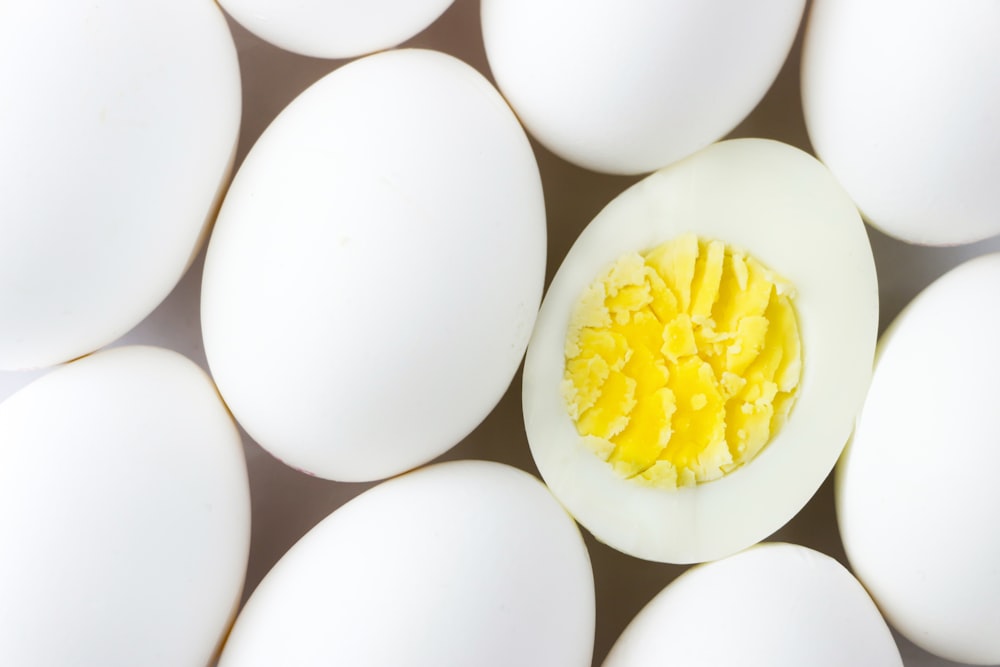
Photo by Mustafa Bashari on Unsplash
I tried for decades to get perfect boiled eggs. But I could never get the eggs to peel right. Then about 6 years ago I found an article about steaming them.
It works! They peel effortlessly every time. They are easier to time the degree that I want them cooked to.
Strat some water to boil in a covered pot. Let it get to a hard boil, you will see steam coming out from under the lid.
 I have had a set of these for 36 yea5rs and use them daily!
Using a net steamer place the eggs in it and quickly take off the lif and add the steamer to the pot.
Set your timer for 6 minutes for soft boiled, 10 minutes for hard boiled with a still translucent and bright yolk, or 12 to 15 minutes for cooked-through hard boiled.
Place the eggs in a bowl of ice water to cool. I do this in the sink so I can let the eggs fall in to it from a few feet up. This cracks the eggs and lets them break, letting water seep in between the cooked albumin and the shells. When ready, after a few minutes of letting the eggs chill, peel the eggs.
Asian Tuna Salad on a Bed of Nappa Cabbage
Posted: July 25, 2023 Filed under: Recipes | Tags: #delivery, #glutenfree, #healthyeating, #Lactosefree, #mealdelivery, #MillieBarnes, #nutritioncoaching, #Ortega, #pescatarian, #Riverside, #SanMarco, #soyfree. #freedelivery, #Springfield, #vegetarian, #weightloss Leave a comment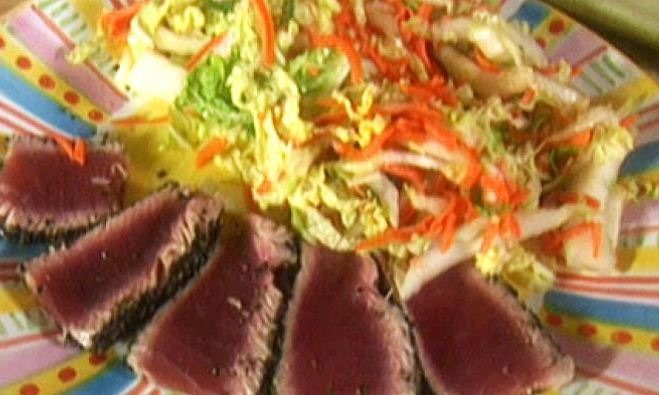
2 tablespoons lime juice
1 1/2 tablespoons fish sauce
11/2 t. Monk Fruit Sweetener or honey
1 teaspoon dark sesame oil
Coarse salt and cracked black pepper
1 medium Napa cabbage
1 bag shredded carrots
1/2 cup basil leaves, torn into quarters
1/2 cup mint leaves, torn
1/2 cup cilantro leaves, roughly chopped
4 tablespoons black and white sesame seeds
1 pound ahi tuna steaks
2 teaspoons extra-virgin olive oil
In a large salad bowl, whisk together lime juice, fish sauce, sugar, and sesame oil. Taste and adjust seasonings with salt and pepper. Cut cabbage in 1/2 lengthwise and slice into thin ribbons. Place cabbage, carrots, basil, mint, and cilantro in the bowl with the dressing. Toss to combine. Set aside.
Pour the sesame seeds out onto a plate. Press the tuna into the seeds on both sides, pressing gently so the sesame seeds stick.
Heat the olive oil in a 12-inch non-stick pan over medium high heat. Add fish to pan and cook until rare, about 2 minutes per side. Alternatively, cook until done to your likeness. Slice thin and distribute among 4 serving plates. Serve with a generous portion of Napa cabbage slaw.
Shrimp and Fall Greens Gumbo
Posted: June 27, 2023 Filed under: Recipes | Tags: #delivery, #glutenfree, #healthyeating, #Lactosefree, #mealdelivery, #MillieBarnes, #nutritioncoaching, #Ortega, #Pescataian, #pescatarian, #Riverside, #SanMarco, #soyfree. #freedelivery, #Springfield, #vegetarian, #weightloss Leave a comment 
12 ounces clam juice
1 pound medium shrimp — cut in half
1 tablespoon olive oil
3/8 cup onion — chopped
3/8 cup green pepper — diced
1 tablespoon garlic — chopped
1/4 cup tomatoes — seeded, diced
2 large bay leaf
1/2 tablespoon dried thyme
1/2 teaspoon tabasco sauce
1/2 bunch kale — chopped coarsely
1 cup rice
1/2 bunch scallions — dia. slices
1 1/2 tablespoons file powder
Boil water, reserved shrimp shells and clam juice for 15 minutes. strain and reserve stock.
Sauté onions, peppers and garlic in white wine for 2 minutes, add tomatoes, bay leaves, thyme, tabasco and reserved stock. bring to a boil. reduce heat, simmer 15 minutes.
Add rice to soup and simmer 20 minutes. Then add kale greens to soup, simmer until greens are bright green, about 3 minutes. add shrimp, simmer 1 more minute. turn off heat, add file powder, season w/ salt and pepper and tabasco.
Vegan Broccoli Mac and Cheese
Posted: June 22, 2022 Filed under: Recipes | Tags: #allergies, #BeyondPaleo, #cancer, #energy, #energy #pontevedrabeach, #glutenfree, #healing, #higherenergy, #immunesystem, #JacksonvilleFL, #jax, #Lactosefree, #mealdeliveryservice, #nutritioncoaching, #plantbased, #weightloss Leave a comment
6 Servings
The best traditional mac and cheese recipes rely on more than just the cheese. They use a bechamel to create a cheese sauce that enrobes the pasta and keeps the dish wonderfully creamy.
It follows, then, that the best vegan mac and cheese recipes rely on more than vegan cheese, too. In fact, plenty of them don’t use any vegan cheese at all, instead enlisting cashews to create the sauce and other powerful ingredients (such as nutritional yeast, miso and mustard) to bring nutty, deep and sharp flavors to the party. Some recipes add tapioca or potato starch to approximate the stretchiness of cheese, vegan or not.
Here, you cook potato, carrot, garlic and onion in a skillet with water and the requisite cashews, then the whole thing gets pureed with the aforementioned flavor boosters to become the sauce. The potato brings that starchiness, the carrot a hint of color.
One warning about this recipe: It makes a lot, filling a deep 12-inch cast-iron skillet. If your household is small, feel free to eat whatever portion you’d like, refrigerate some for the following few lunches
Make Ahead: Assemble and refrigerate for up to 3 days before baking.
Ingredients
- 2 tablespoons extra-virgin olive oil
- 1 medium white or yellow onion (8 ounces), chopped
- 1 teaspoon fine salt, divided, plus more to taste
- 2 garlic cloves, grated or pressed
- 1 medium russet potato (9 ounces), scrubbed and cut into 1/2-inch cubes
- 1 medium carrot (4 ounces), scrubbed and cut into 1/4-inch coins
- 1 cup (4 1/4 ounces) raw cashews
- 2 cups water, plus more as needed
- 5 tablespoons nutritional yeast
- 1 tablespoon white miso
- 1 tablespoon Dijon mustard
- 1/2 teaspoon smoked paprika
- 1/4 teaspoon cayenne
- 1 large head broccoli (1 1/2 pounds)
- 1 pound elbow macaroni
- 3/4 cup (2 ounces) vegan panko, such as Kikkoman brand
- 1/4 teaspoon freshly ground black pepper
1 Position a rack in the center of the oven and preheat to 450 degrees.
In a 12-inch cast-iron or other ovenproof skillet over medium heat, heat the oil until it shimmers. Add the onion and 1/2 teaspoon of the salt and cook, stirring occasionally, until the onion is translucent, 4 to 5 minutes. Add the garlic and cook, stirring, until fragrant, about 30 seconds.
2 Add the potato, carrot, cashews and water, increase the heat to high and bring to a boil. Reduce the heat to medium and simmer, uncovered, until the potatoes and carrots are very soft, 10 to 15 minutes. (Add hot water as needed to keep the vegetables just barely covered.) Remove from the heat and let cool for a few minutes.
3 Carefully pour the vegetables and liquid into a blender. Add the nutritional yeast, miso, mustard, smoked paprika, cayenne and 1/4 teaspoon of the salt. Blend on high until the sauce is very smooth, 1 to 2 minutes.
4 Bring a large pot of salted water to a boil. While the water is heating, cut the broccoli stem from the head and use a vegetable peeler to peel the stem’s tough outer layer. Cut the stem in half lengthwise and then into 1/4-inch half moons. Cut the head into bite-size florets.
5 Once the water is boiling, add the pasta and cook until 2 minutes shy of al dente according to the package directions, 3 to 5 minutes. Add the broccoli and cook for the remaining 2 minutes, or until the broccoli is bright green and the pasta is al dente.
6 Drain the pasta and broccoli and return to the pot. Pour in the sauce and stir to fully coat. Return the mixture to the cast-iron skillet and smooth into an even layer.
7 In a small bowl, toss the panko with the remaining 1/4 teaspoon of the salt and the pepper. Sprinkle over the mac and cheese. Bake for 10 to 20 minutes, or until the panko is lightly browned and the sauce starts to bubble. Serve hot.
By Joe Yonan
Avocado Key Lime Pie
Posted: May 24, 2022 Filed under: Recipes | Tags: #allergies, #BeyondPaleo, #cancer, #energy, #energy #pontevedrabeach, #glutenfree, #healing, #higherenergy, #immunesystem, #JacksonvilleFL, #jax, #Lactosefree, #mealdeliveryservice, #nutritioncoaching, #plantbased, #weightloss Leave a comment
I LOVE Key Lime Pie! BUT this way of making it has become my favorite dessert!!! This dessert is uncooked except for the pie shell, so making it very healthy, low glycemic and sugar free! The recommendation for eating avocadoes in 1/2 avocado a day for heart health.
Avocado Key Lime Pie
Key Lime Filling
2 ripe avocados
1/2 cup key lime juice
1 Tablespoon gelatin powder
8 oz cashew or sunflower cream cheese, room temperature
2 large Tablespoons of lime zest
1/3 Monk Fruit Sweetener
½ teaspoon stevia (or another ¼ cup sugar)
1 cup coconut milk, don’t shake it, just scoop the creamy part into the food processor
1 gluten free pie crust, baked and cooled
Key Lime Pie Filling
Place the lime juice in a small saucepan, whisk in the gelatin. Gently heat, while stirring, to dissolve the gelatin. Do not boil!
Place cream cheese, coconut milk/cream, lime/gelatin mix, lime zest, sugar, pinch of salt in food processor. Blend really well, you may have to stop and use a spatula to get it off of the sides and then continue blending.
Pour the mixture over the prepared crust, spread the top smooth and place in the fridge to set for at least 6 hours.
Are Eggs and Egg Yolks Bad For You?
Posted: May 16, 2022 Filed under: Food and it's Impact on Our Health | Tags: #allergies, #atlanticbeach, #BeyondPaleo, #cancer, #Covid, #covidvirus, #foodintolerances, #glutenfree, #healing, #jacksonville, #jacksonvillebeaches, #jax, #mealdeliveryservice, #MillieBarnes, #moreenergy, #nutritioncoaching, #PVB, #weightloss Leave a comment
On one hand, they’re considered an excellent and inexpensive source of protein and various nutrients. On the other hand, some people believe the yolks can increase your risk of heart disease.
Whole eggs have two main components:
Egg white: the white part, which is mostly protein
Egg yolk: the yellow or orange part, which is rich in nutrients
The main reason eggs were considered unhealthy in the past is that the yolks are high in cholesterol.
Cholesterol is a waxy substance found in food. It’s also made by your body. A few decades ago, large studies linked high blood cholesterol to heart disease.
In 1961, the American Heart Association recommended limiting dietary cholesterol. Many other international health organizations did the same.
Over the next several decades, worldwide egg consumption decreased significantly. Many people replaced eggs with cholesterol-free egg substitutes that were promoted as a healthier option.
For several decades, eggs were believed to increase heart disease risk because of their high cholesterol content.
It’s true that whole eggs are high in cholesterol
Whole eggs (with the yolks) are indeed high in cholesterol. In fact, they’re a significant source of cholesterol in the standard American diet.
Two large whole eggs (100 grams) contain about 411 mg of cholesterol (1Trusted Source). By contrast, 100 grams of 30% fat ground beef has about 78 mg of cholesterol (2Trusted Source).
Until recently, the recommended maximum daily intake of cholesterol was 300 mg per day. It was even lower for people with heart disease.
However, based on the latest research, health organizations in many countries no longer recommend restricting cholesterol intake.
For the first time in decades, the Dietary Guidelines for AmericansTrusted Source released in December 2015 did not specify an upper daily limit for dietary cholesterol.
Despite this change, many people remain concerned about consuming eggs. This is because they’ve been conditioned to associate high dietary cholesterol intake with high blood cholesterol and heart disease.
However, just because a food is high in cholesterol doesn’t necessarily mean it raises cholesterol levels in your blood.
Two whole eggs contain 411 mg of cholesterol, which exceeds the maximum daily limit that was in place for many decades. However, this restriction on dietary cholesterol has now been lifted.
How eating eggs affects blood cholesterol
Although it may seem logical that dietary cholesterol would raise blood cholesterol levels, it usually doesn’t work that way.
Your liver actually produces cholesterol in large amounts because cholesterol is a necessary nutrient for your cells.
When you eat larger amounts of high cholesterol foods, such as eggs, your liver produces less cholesterol because more of it is coming from your diet (3Trusted Source, 4Trusted Source).
Conversely, when you get little cholesterol from food, your liver produces more to compensate.
Because of this, blood cholesterol levels don’t change significantly in most people when they eat more cholesterol from foods (Trusted Source4Trusted Source).
In one long-term, well-designed study, consuming egg yolks daily for 1 year did not significantly change total cholesterol, LDL (bad) or HDL cholesterol, or the ratio of total cholesterol to HDL (an important marker of heart disease) in adults with early signs of age-related macular degeneration (5Trusted Source).
However, one review of well-designed studies in healthy individuals found that eating cholesterol-containing foods raised both LDL (bad) and HDL cholesterol, but the ratio of LDL to HDL (an important marker of heart disease risk) remained constant compared with the control group (6Trusted Source).
Likewise, in another study, 30 people who ate 3 eggs per day for 13 weeks had higher total cholesterol, HDL, and LDL (bad) cholesterol compared with those who took only a choline supplement.
However, their HDL to LDL ratio remained the same (7Trusted Source). The study’s authors concluded that eating foods high in cholesterol regulates the amount of cholesterol your body makes in order to maintain the HDL to LDL ratio.
Also, keep in mind that cholesterol isn’t a “bad” substance. It is actually involved in various processes in your body, such as:
· production of vitamin D
· production of steroid hormones like estrogen, progesterone, and testosterone
· production of bile acids, which help digest fat
Last but not least, cholesterol is an essential component of every cell membrane in your body, making it necessary for survival.
When you eat eggs or other cholesterol-rich foods, your liver produces less cholesterol. As a result, your blood cholesterol levels will likely stay about the same or increase slightly while your HDL to LDL ratio remains the same.
Do eggs increase heart disease risk?
Several controlled studies have examined how eggs affect heart disease risk factors. The findings are mostly positive or neutral.
Studies show that eating one to two whole eggs per day doesn’t seem to change cholesterol levels or heart disease risk factors (8Trusted Source, 9Trusted Source, 10Trusted Source, 11Trusted Source).
In one well-designed study, eating two eggs per day did not adversely affect biomarkers of heart disease compared with eating oatmeal (9Trusted Source). Additionally, those who ate eggs for breakfast reported greater satiety than those who ate oatmeal.
Another well-designed study found that eating two eggs per day did not significantly affect total cholesterol, LDL (bad) cholesterol, or glycemic control in people with overweight or obesity who also have prediabetes or diabetes (10Trusted Source).
Another well-designed study looked at the effects of eating eggs on endothelial function in people with heart disease. The endothelium is a membrane that lines your heart and blood vessels.
Eating 2 eggs for breakfast for 6 weeks did not result in differences in cholesterol, flow-mediated dilation (an assessment of vascular function), blood pressure, or body weight compared with eating Egg Beaters or a high carbohydrate breakfast (11Trusted Source).
Eating eggs may also help lower risk of metabolic syndrome.
One large study of adults reported that women who consumed seven eggs per week had lower risk of metabolic syndrome than those who ate one egg per week. (12Trusted Source)
Similarly, another study associated eating four to six eggs per week with decreased risk of metabolic syndrome, compared with eating one egg per month. (13Trusted Source)
What’s more, consuming eggs as part of a low carb diet improves markers of heart disease in people with insulin resistance or type 2 diabetes. This includes the size and shape of LDL particles (14Trusted Source, 15Trusted Source).
One study followed prediabetics who were on a carb-restricted diet. Those who consumed whole eggs experienced better insulin sensitivity and greater improvements in heart health markers than those who ate egg whites (14Trusted Source).
In another study, prediabetic people on low-carb diets ate 3 eggs per day for 12 weeks. They had fewer inflammatory markers than those who consumed an egg substitute on an otherwise identical diet (15Trusted Source).
Although LDL (bad) cholesterol tends to stay the same or increase only slightly when you eat eggs, (good) cholesterol typically increases (14Trusted Source, 16Trusted Source).
In addition, eating omega-3 enriched eggs may help lower triglyceride levels (17Trusted Source, 18Trusted Source).
Research also suggests that eating eggs on a regular basis may be safe for people who already have heart disease. In fact, eating eggs may be associated with fewer cardiac events.
One large study of healthy adults examined peoples’ egg consumption over almost 9 years. Daily egg consumption (less than 1 egg) was associated with a lower risk of cardiovascular disease, ischemic heart disease, and stroke among middle-aged adults. (19Trusted Source)
Another large study found no link between eating eggs and death from coronary heart disease. In men, eating eggs was associated with a lower incidence of death from stroke (20Trusted Source).
To top things off, a review of 17 observational studies with a total of 263,938 people found no association between egg consumption and heart disease or stroke (21Trusted Source).
Studies have shown that egg consumption generally has beneficial or neutral effects on heart disease risk.
Do eggs increase diabetes risk?
Controlled studies show that eggs may improve insulin sensitivity and reduce heart disease risk factors in people with prediabetes.
However, there is conflicting research on egg consumption and the risk of type 2 diabetes.
One recent review of studies determined that eating up to seven eggs per week does not significantly increase markers for cardiovascular disease and type 2 diabetes in both people with and without diabetes(22Trusted Source).
However, a review of two studies involving more than 50,000 adults found that those consuming at least one egg daily were more likely to develop type 2 diabetes than people who ate less than one egg per week (23Trusted Source).
A second study in women found an association between high dietary cholesterol intake and increased diabetes risk, but not specifically for eggs (24Trusted Source).
And a large observational study that found no link between eating eggs and heart attacks or strokes did find a 54% increased risk of heart disease when they only looked at people with diabetes (21Trusted Source).
Based on these studies, eggs could be problematic for people living with prediabetes or diabetes.
However, it’s important to keep in mind that these are observational studies based on self-reported food intake.
In fact, controlled studies have found that eating eggs along with a nutritious diet may benefit people with diabetes.
In one study, people with diabetes who consumed a high protein, high cholesterol diet containing two eggs per day experienced reductions in fasting blood sugar, insulin, and blood pressure, along with an increase in HDL cholesterol (25Trusted Source).
Other studies link egg consumption with improvements in insulin sensitivity and reduced inflammation in people with prediabetes and diabetes (14Trusted Source, 26Trusted Source).
Studies on eggs and diabetes provide mixed results. Several observational studies show an increased risk of type 2 diabetes, while controlled trials show an improvement in various health markers.
Your genes may affect how you respond to egg consumption
Although eggs pose no risk to health for most people, it’s been suggested that it may differ for those with certain genetic traits.
However, more research is needed in this area.
SUMMARY
Eggs are loaded with nutrients
Eggs are a particularly nutrient-rich food. They are a great source of high quality protein, as well as several important vitamins and minerals.
One large whole egg contains:
Calories: 72
Protein: 6 grams
Vitamin A: 10% of the daily value (DV)
Riboflavin: 16% of the DV
Vitamin B12: 21% of the DV
Folate: 9% of the DV
Iron: 5% of the DV
Selenium: 28% of the DV
Eggs also contain many other nutrients in smaller amounts.
SUMMARY
Eggs are high in a number of important vitamins and minerals, along with high quality protein.
Eggs have many health benefits
Studies show that eating eggs can have various health benefits. These include:
Help keep you full. Several studies show that eggs promote fullness and help control hunger so you eat less at your next meal (9Trusted Source, 39Trusted Source, 40Trusted Source).
Promote weight loss. The high quality protein in eggs increases metabolic rate and can help you lose weight (41Trusted Source, 42Trusted Source, 43Trusted Source).
Protect brain health. Eggs are an excellent source of choline, which is important for your brain (44Trusted Source, 45Trusted Source, 46Trusted Source).
Reduce eye disease risk. The lutein and zeaxanthin in eggs help protect against eye diseases like cataracts and macular degeneration (16Trusted Source, 47Trusted Source, 48Trusted Source, 49Trusted Source).
Decrease inflammation. Eggs may reduce inflammation, which is linked to various health conditions (15Trusted Source, 26Trusted Source).
Eating a Traditional Human Diet
Posted: May 5, 2022 Filed under: Food and it's Impact on Our Health | Tags: #allergies, #BeyondPaleo, #cancer, #energy, #energy #pontevedrabeach, #glutenfree, #healing, #higherenergy, #immunesystem, #JacksonvilleFL, #jax, #Lactosefree, #mealdeliveryservice, #nutritioncoaching, #plantbased, #weightloss Leave a commentI am puzzled as to why about 90% of the posts I see on all of the Paleo sites here on FB give recipes for dishes dealing with grain substitutes. This one gives the the following ingredients; flax meal, bananas, berries, honey or maple syrup, almond meal. Many are for dessert recipes with sugar, coconut meal, honey.. Keeping the focus on desserts and substitutes is not what following a Paleo Diet is about. Paleo is about optimizing our diet to meet our nutrient needs and if we are still craving these foods then we need to look at why and to move toward healthy fats, proteins and low glycemic vegetables with very small amounts of fruit.
Thai Shrimp Salad with Asian Greens and Cilantro Pesto
Posted: May 5, 2022 Filed under: Recipes | Tags: #allergies, #BeyondPaleo, #cancer, #energy, #energy #pontevedrabeach, #glutenfree, #healing, #higherenergy, #immunesystem, #JacksonvilleFL, #jax, #Lactosefree, #mealdeliveryservice, #nutritioncoaching, #plantbased, #weightloss Leave a comment
Poor Health Is Now The Norm
Posted: May 5, 2022 Filed under: Food and it's Impact on Our Health | Tags: #allergies, #BeyondPaleo, #cancer, #energy, #energy #pontevedrabeach, #glutenfree, #healing, #higherenergy, #immunesystem, #JacksonvilleFL, #jax, #Lactosefree, #mealdeliveryservice, #nutritioncoaching, #plantbased, #weightloss Leave a comment
Note- That stat for autism is now at 1 in 50 has autism.
Let’s face it; Americans are severly malnourished.
What Should You Eat Each Day? (Hint- more Fruits and Veggies!)
Posted: May 5, 2022 Filed under: Food and it's Impact on Our Health | Tags: #allergies, #BeyondPaleo, #cancer, #energy, #energy #pontevedrabeach, #glutenfree, #healing, #higherenergy, #immunesystem, #JacksonvilleFL, #jax, #Lactosefree, #mealdeliveryservice, #nutritioncoaching, #plantbased, #weightloss Leave a commentIt’s been a confusing few decades; low fat or not, are eggs healthy, what about fats, why NOT cook with olive oil?
Americans are confused. What IS great nutrition? What about calories? Why can’t I lose weight, I exercise a lot?


 Meal Delivery Service by Millie Barnes