Supporting Farmers Markets Creates Thousands of Jobs: Union of Concerned Scientists
Posted: August 11, 2011 Filed under: Food and it's Impact on Our Health, Gardening, Non-Toxic Choices Leave a comment
Image: Chris Schrier via flickr
Another great post from Treehugger
"What’s holding farmers markets back?" That’s the question behind a new report from the Union of Concerned Scientists, which determined the culprit to be federal policies that favor industrial agriculture over small and local farms. Change those policies, though, and you get a quick turnaround.
According to the report, just a little public funding for 100 to 500 farmers markets a year could create up to 13,500 jobs within five years.
"On the whole, farmers markets have seen exceptional growth, providing local communities with fresh food direct from the farm," said Jeffrey O’Hara, a UCS economist and author of the report, Market Forces: Creating Jobs through Public Investment in Local and Regional Food Systems. "If the U.S. government diverted just a small amount of the massive subsidies it lavishes on industrial agriculture to support these markets and small local farmers, it would not only improve American diets, it would generate tens of thousands of new jobs."
An example of how, from the report:
when greater consumption of fresh fruits and vegetables draws on produce supplied locally or regionally. Studies have suggested that this phenomenon could lead to thousands more jobs in the Midwest alone, even if land allocated to fruits and vegetables displaced some production of corn and soybeans.
The report highlights the importance of developing direct marketing channels. So many farmers markets right now are community-based and rely on volunteer labor, which almost inevitably stunts their growth. But, says the report, "modest public funding for 100 to 500 otherwise-unsuccessful farmers markets a year could create as many as 13,500 jobs over a five-year period."
According to the Union of Concerned Scientists, direct agricultural product sales amounted to a $1.2 billion-a-year business in 2007 (the most recent USDA figure), and most of that money recirculates locally. "The fact that farmers are selling directly to the people who live nearby means that sales revenue stays local," O’Hara said. "That helps stabilize local economies."
If you don’t believe it, the report provides a few examples:
- 34 farmers markets in West Virginia led to a gross increase of 119 jobs (net increase of 82 jobs), a gross increase of $2.4 million in output (net increase of $1.1 million), and a gross increase in personal income of $0.7 million (net increase of $0.2 million).
- 21 farmers markets in Oklahoma led to a gross increase of 113 jobs, $5.9 million in output (with a multiplier of 1.78), and a $2.2 million increase in income.
- 152 farmers markets in Iowa led to a gross increase of 576 jobs, a $59.4 million increase in output (with a multiplier of 1.55), and a $17.8 million increase in income.
- 26 farmers markets in Mississippi led to a gross increase of 16 jobs, a $1.6 million increase in output (with a multiplier of 1.7), and a $0.2 million increase in income.
Some Progress Has Been Made, But There’s Plenty More to Do
Local food systems have no doubt seen a boost in recent years: the number of farmers markets has jumped nationwide from 2,863 in 2000 to 6,132 in 2010.That might lead some people to question why farmers markets need public support. But there are major economic and political barriers that stump the growth of these markets and food systems. And the government helps agricultural giants that have already surpassed their potential, while in comparison almost ignores the little folks.
The USDA gave $13.725 billion last year in commodity, crop insurance, and supplemental disaster assistance to primarily large industrial farms. In the same year, the same agency spent less than $100 million to support local and regional food system farmers.
The Way Forward
To address these barriers, the report calls on Congress to:
• support the development of local food markets, including farmers markets and farm-to-school programs, which can stabilize community-supported markets and create permanent jobs. For example, the report found that the Farmers Market Promotion Program could create as many as 13,500 jobs nationally over a five-year period, if reauthorized, by providing modest funding for 100 to 500 farmers markets per year.
• level the playing field for farmers in rural regions by investing in infrastructure, such as meat-processing or dairy-bottling facilities, which would help meat, dairy and other farmers produce and market their products to consumers more efficiently. These investments could foster competition in food markets, increase product choice for consumers, and generate jobs in the community.
• allow low-income residents to redeem food nutrition subsidies at local food markets to help them afford fresh fruits and vegetables. Currently, not all markets are able to accept Supplemental Nutrition Assistance Program benefits.
"Farmers at local markets are a new variety of innovative entrepreneurs, and we need to nurture them," said O’Hara. "Supporting these farmers should be a Farm Bill priority."
The report was released just a few days ahead of the USDA’s 12th annual National Farmers Market Week, which starts this Sunday, August 7.
There’s Wood Powder in Your Shredded Cheese
Posted: August 6, 2011 Filed under: Food and it's Impact on Our Health, Non-Toxic Choices 1 Comment
It would totally ruin Taco Tuesdays if you reached into your bag of delicious shredded cheese and it had all congealed into a giant yellow-orange clump. But that never happens! Ever wonder why? Food companies add wood pulp, that’s why.
Wood pulp—or cellulose, to be exact—is made from grinding out wood and other plant matter. You eat it all the time, probably! It’s dumped into all sorts of dairy products because it’s a cheap replacement for other, non-wood ingredients, aside from keep cheese slivers from clumping together, FoodRenegade reports.
Is this such a bad thing? The crew at FR gives an emphatic yes, because it’s so unnatural. But so is eating shredded cheese out of a bag to begin with. The FDA says cellulose wood cheese is okay to eat, and when I want to make nachos or a baked potato or just put a handful of cheese in my mouth, a lot of the time I’d rather not take out a grater. You know what else isn’t natural? Cheese graters. Nor is cheese itself. If we continue this gourmand naturalism ad infinitum, we’ll be eating nothing but sand and blueberries. I say let’s use the safe food tech we have—delicious, easy, orange cheese in a bag, sprinkled with wood dust. [FoodRenegade]
Has Apple Turned Its Back on the People Harmed In Its Factories?
Posted: August 4, 2011 Filed under: Non-Toxic Choices Leave a commentAnother great post from Lifehacker

Even though Apple’s Chinese consumers bask in the luxurious image Apple has built for them, their workers oftentimes live far from the high life. While it isn’t that they outright put their workers in danger, it’s that Apple is so slow to react when things go wrong.
NPR has a lengthy piece regarding the ongoing health issues of one Jia Jingchuan, a 27-year-old former employee at Wintek, a company that manufactures iPhone parts. He’s one of the many workers who continues to suffer from nerve damage after being exposed to the now-illegal N-hexane chemical used in their screen cleaning products. While Apple has since responded to the issue—among many others—by banning the use of the chemical and pledging to follow-up with and monitor the treatment of the affected workers, Jia has had to pay for his own medical care. When he tries to reach them, he gets no response. And Steve Jobs won’t return his letters. In the meantime, he must get by without a job and without any prospects.
It comes as a surprise, as this is only one sad chapter in an even longer and sadder story. The shadow of the 17 Foxconn suicides last year, followed by the more recent explosions that rocked the Chengdu plant and took the lives of three people, still looms large over Apple. But Apple has spoken out and taken steps towards bettering the quality of life of their present employees, one would hope as much out of an abundance of concern for the human beings who work in these factories as well as for public relations’ sake.
However, Jia’s story is likely only one of many that asks how far Apple still needs to go. The company is currently ranked "dead last" behind 28 other companies in China in terms of their responsiveness to employee concerns, according to a 2010 report commissioned by the Green Choice Alliance. According to NPR:
"According to Ma [Jun, one of the leaders of the Green Choice Alliance, a coalition of 36 Chinese NGOs that tracks pollution reports among international brands operating in China] most multinational companies go through an evolution in dealing with complaints presented by Chinese civil society groups: "from nonresponsive, to somewhat resistant, to at least listening, to a proactive response." …Apple, however, has stayed resistant, fighting off attempts by others to uncover whether factories where workers have been poisoned or where pollution is extreme are their suppliers."
A striking contrast when you consider they’re a leader in the computing world, and are richer than the US government.
It seems to me that Apple is quite capable of squashing a few PR fires. But they are wanting in the caring for the little guy department. I understand that Steve Jobs and Time Cook are busy men, and looking after people not directly in their employ wouldn’t be very high on a list of priorities. But it’s not as though Apple lacks for the resources needed toward aiding people in their supply chain like Jia Jingchuan and anyone else in need. It should not be this way. [NPR, Image Credit: AP Photo/Kin Cheung]
You can keep up with Kwame Opam, the author of this post, on Twitter, Facebook, and occasionally Google+.
“Rawesome” Raw Milk Farm Raided…Again
Posted: August 3, 2011 Filed under: Food and it's Impact on Our Health, Going Green; How and Why..., Non-Toxic Choices 1 CommentPrivate buying club selling organic food and raw milk was raided again by SWAT teams for the second time today. Please share and PROTEST!!!

It has been reported this morning (August 3rd, 2011), that raw milk farm “Rawesome” in Venice, California has been raided once again by members of the SWAT team. With guns drawn, two of the owners arrested, and over $10,000 worth of raw milk dumped out, the freedoms of Americans are diminishing. There is, however, something we can do about it.
Rawesome Raid – Based on Public Health?
The excuse given for these absurd raids (that honestly casts embarrassment over the police force) is that raw milk is a health threat that causes listeria, e. coli disease and death. This certainly can be true for raw milk — but only if you are drinking raw milk from animals that are being raised in inhumane and poor conditions.
Clean, fresh raw milk from grass fed, free ranging animals, however, does not need to be pasteurized. Milk you purchase from a traditional grocery store does require pasteurization, as the farmers who raise these cows raise them in poor, dirty and sanitation conditions. Pasteurization is the answer for man’s dirty mistakes! Nature does not need to be cleaned, and man does not know more than nature.
Raw Milk Proven Safer than Other Commonly Sold Foods
Recent data from researcher Dr. Ted Beals, M.D., shows that between 1999 through 2010 illnesses resulting in raw milk consumption totaled to around 462, which is about 42 illnesses per year. Out of the 47.8 million food borne illnesses each year from foods such as raw meat (which is readily available at every grocery store), peanut butter and spinach, it is very curious as to why raw milk is targeted so violently.
Up to 2011, it is estimated that close to 10 million individuals drink raw milk as its popularity rises. More and more individuals are starting to realize and wake up to the fact that are rights as citizens, when it comes to what we consume or inject in our bodies, are slowly being taken away.
We are supposed to be free. We are supposed to be able to make informed decisions on our health. With the majority of the population overweight, diabetic and prediabetic, shouldn’t we focus more attention on the foods that are actually threatening the health of the American population? Shouldn’t we be performing raids on sugary cereals that surpress immune function and accelerate cancer growth, learning disorders and blood sugar instability?
Read Natural News’ article on the illegal actions of the SWAT members and the raid.
If you are living near Venice, CA, you can join in RIGHT NOW on the protest. See details over at Weston A. Price’s Facebook page OR Cheeselave.
Growing Food Without Chemicals
Posted: July 29, 2011 Filed under: Food and it's Impact on Our Health, Gardening, Going Green; How and Why..., Non-Toxic Choices Leave a commentIf you’re into food, you’ve got to embrace manure. Like it or not, the manure after all, is the foundation upon which the sustainable food movement stands.
What’s in Fast Food Chicken? (Hint: It’s NOT Chicken)
Posted: July 19, 2011 Filed under: Food and it's Impact on Our Health, Non-Toxic Choices 1 Comment
Organic Authority Written by Shilo Urban
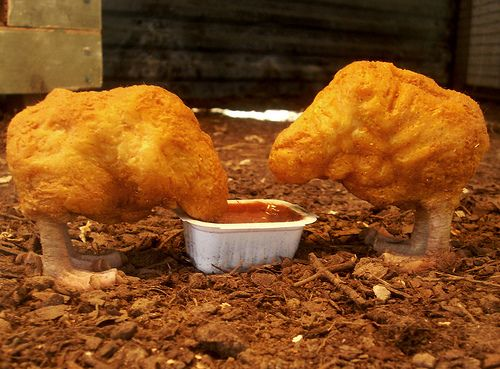
Frying chicken is fairly simple, if a little messy. You dip pieces of chicken into a mix of egg and milk, roll them around in flour and spices, then cook the chicken in sizzling hot oil until the pieces are brown, crispy and delicious.
But wait! Don’t forget to add a dash of dimethylpolysiloxane, an anti-foaming agent made of silicone that is also used in Silly Putty and cosmetics.
Now add a heaping spoonful of tertiary butylhydroquinone (TBHQ), which is a chemical preservative and a form of butane (AKA lighter fluid). One gram of TBHQ can cause “nausea, vomiting, ringing in the ears, delirium, a sense of suffocation, and collapse," according to A Consumer’s Dictionary of Food Additives. Five grams of TBHQ can kill you.
Sprinkle on thirteen other corn-derived ingredients, and you’re only about twenty shy as many ingredients as a single chicken nugget from McDonald’s. And you were using pulverized chicken skin and mechanically reclaimed meat for your chicken, right?
No one in his or her right mind would cook chicken like this. Yet every day, hoards of Americans consume these ingredients in Chicken McNuggets, which McDonalds claims are “made with white meat, wrapped up in a crisp tempura batter.”
However chicken only accounts for about 50% of a Chicken McNugget. The other 50% includes a large percentage of corn derivatives, sugars, leavening agents and other completely synthetic ingredients, meaning that parts of the nugget do not come from a field or farm at all. They come from a petroleum plant. Hungry?
Scariest perhaps is the fact that this recipe is a new and improved, “healthier” Chicken McNugget launched in 2003 after a federal judge called the deep-fried poultry bites “a McFrankenstein creation of various elements not utilized by the home cook.” Also terrifying is the fact that these McFrankenuggets are overwhelmingly marketed to children who love their fun shapes and kid-friendly size.
While McDonald’s is of course the poster child for fast food ire, if you look at the nutritional information for chicken at any fast food restaurant, the ingredient list will be dozens of items longer than the egg, flour, chicken and oil recipe you might use at home.
Eating fast food is a habit, but it is one that you can break? No doubt you rarely plan to have a delicious meal at Arby’s for dinner, a lingering lunch at Carl’s Jr. or a special breakfast at the Burger King in the airport. It just happens. You are late, tired, hungry, broke, or all of the above. You have no time, and you must find something to eat before you crash. All of a sudden a bright, friendly sign beckons from the side of the road: Drive-through!
In five minutes you are happily chowing down on an inexpensive, filling meal. But don’t be fooled – the true cost of fast food does not come out of your wallet, but out of your body, your health, and your years on this earth.
You can break the unhealthy fast food habit: educate yourself about the true ingredients of fast food items, plan ahead for your meals, carry healthy snacks like nuts to ward off hunger and cook healthy chicken recipesboneless chicken, water, food starch-modified, salt, seasoning (autolyzed yeast extract, salt, wheat starch, natural flavoring (botanical source at home. Convince yourself that fast food is the most disgusting stuff on the planet and is harmful to you and to those you love. After reading this, that shouldn’t be too hard.
Full ingredient list for a Chicken McNugget (from McDonald’s website):
White), safflower oil, dextrose, citric acid, rosemary), sodium phosphates, seasoning (canola oil, mono- and diglycerides, extractives of rosemary). Battered and breaded with: water, enriched flour (bleached wheat flour, niacin, reduced iron, thiamin mononitrate, riboflavin, folic acid), yellow corn flour, food starch-modified, salt, leavening (baking soda, sodium acid pyrophosphate, sodium aluminum phosphate, monocalcium phosphate, calcium lactate), spices, wheat starch, whey, corn starch. Prepared in vegetable oil (Canola oil, corn oil, soybean oil, hydrogenated soybean oil with TBHQ and citric acid added to preserve freshness). Dimethylpolysiloxane added as an antifoaming agent.
Full ingredient list for my mother’s fried chicken:
Bone-in chicken pieces, egg, milk, flour, canola oil, salt & pepper.
Millie; My ingredients for Fried Chicken; chicken, eggs, gluten free bread crumbs, salt, pepper, Organic Beef fat to fry in.
A Great Source for Floridians
Posted: July 17, 2011 Filed under: Food and it's Impact on Our Health, Gardening, Non-Toxic Choices Leave a commentHere is a wonderful site for seeing what grows best in Florida. I have used this site a lot lately to figure out what I can plant as far as flowers at my new house, while using very little water. One of my goals in moving was to find a house that didn’t have an expanse of grass in the yard. I am morally opposed to watering a normal yard. what a waste of water.
Plant Real Florida

My Favorite Websites and Blogs
Posted: July 16, 2011 Filed under: Food and it's Impact on Our Health, Gardening, Non-Toxic Choices, Skin Care 1 CommentI have had numerous requests for a list of the websites I love. Most of these I read daily;
 This site is one that I read every new post, every day. It’ll keep you abreast of new tech, software worth knowing about and TONS of tips and how-to’s. A must for anyone who wants to be more tech savvy.
 This website is a great source for all about gadgets and the newest tech.
EWG – Environmental Working Group
 This site a an incredible resource for learning about what’s toxic and how to help lower your bodies exposure. My favorite link in the site in SkinDeep; a resource for very personal care product you can imagine and how toxic it is, or isn’t..with the governments white paper on toxicity.
 This website explores the research of Weston Price who studied the effects on modern diets on humans and teaches how to follow a Traditional Human Diet. An amazing resource!
 This site will give you the REAL truth about cholesterol; why it’s your best friend and why yopur life depends on it.
 This is consistently, year after year, the ONLY website I pay to join; amazing recipes, how-to’s, product and equipment reviews AND America’s Test Kitchen..all in one site that is the definitive how to cook site!
 Home design, Tech, Green Living, How to decorate, ideas, inspiration..just plain fun…I explore this site consistently.
Yanko Design– Modern Industrial Design News
 Because I’m such a Nerd..I LOVE design, form…a look at how creative humans are…and how our minds work..
 Another Website that I NEVER miss a post. This site inspired me to begin growing my own food, to make high heat compost a priority, to install my outdoor solar shower…to realize my little bit of land could support me and feed me!
 I was a HUGE fan long before he published an article I wrote. This man inspired me to begin using a sawdust toilet, to really radicalize me environmentalism.. and I thought I was hard-core. But he nudged me .My kids thought I was crazy raising them without the use of paper towels or a dryer. But give up toilet paper…Read about he and his wife’s debate on this subject!
 You can learn about any aspects of growing most anything here; find the threads about your area of interest or area of the country…I love reading threads where people lend experience and wisdom, and have a bunch of different opinions. You can settle in and study and take the advice that resonates with you.
The Smart Gardener via Michael Pollen

here’s what Lifehacker had to say-
Smart Gardener is a free webapp that makes planning a garden really easy. The app lets you drag and drop garden beds to layout your garden and helps you find plants perfect for your location, then it generates an intelligent plan and even sends timely gardening reminders.
Smart Gardener may be helpful even for people without green thumbs, because it offers suggestions based on your specific location, time of year, and other details, even down to your garden’s orientation to the sun and how many adults and children are in your household. In addition to smart gardening plan, the app offers personalized advice for plant care and harvesting, with weekly email reminders if you wish. It seems almost foolproof..
These should keep ya busy a while. .To be continued……
Baskets for Kitchen Recycling
Posted: July 12, 2011 Filed under: In The Kitchen with Millie- How To's, Non-Toxic Choices Leave a commentI found a great idea for setting up a recycling system for the kitchen…
As you know, I do not use or buy plastic, I compost the little trash I generate; all food scraps, paper. The little plastic that I do generate I recycle or re-use. But I hadn’t found a great system..until now. And they look gorgeous!

Check out all the options here– Waste Not Basket
How eating Organic and Healthy Saves You Money
Posted: July 12, 2011 Filed under: Food and it's Impact on Our Health, Gardening, In The Kitchen with Millie- How To's, Non-Toxic Choices Leave a comment People tell me all the time that they cannot afford to eat organic. My feeling is that no one can afford NOT TO!
It is true that in the past organic food was much more expensive than the other alternatives. However the demand for these foods and products are so high now that the cost is often the same or lower! Last week organic strawberries at Publix were cheaper than the regular ones!
Most people buy a lot of prepared foods, frozen foods, convenience foods. The cost of these foods is absurd, you are paying for other people to do the work for you. I put my food dollars toward high quality food sand o the labor myself. I make everything from scratch (yogurt, spice mixes, bone broths, desserts, tortillas. etc.) and everything I eat is organic. I grow a lot of my own green leafy vegetables in sub-irrigated containers I built out of 5 gallon buckets.
I know you must be says..yeah, she must stay home and do that full time. I do not. I work a 50 hour a week job, run a small business, maintain a blog, write prolifically. These things do not take a lot of time. Making the grow buckets 2 years ago did, Learning how to grow food did. Growing in buckets means way less watering, my water bill is very low. I do almost no weeding. I never buy many herbs, I never buy green veggies, lettuce, tomatoes, cucumbers. I make my own skin cleaner (it the best I have ever used and costs me about 20 bucks a year).
Bust eating organically also means better health. Eating whole food means great health. I eat only fat, meat, veggies and fruit. Nothing that needs a label to tell me what is in it. I don’t eat veggie based meals (too many carbs), I don’t eat bean based meals (not healthy).
I eat wonderful decadent grass fed meat or organic meat every meal. I have two to three eggs cooked in butter or coconut oil every morning with turkey bacon or skinless chicken sausage, blueberries or fruit in season, homemade coconut milk yogurt. A 700 calorie breakfast that is going to keep me going with very high energy for 5 or 6 hours. Last night I had a 9 ounce sirloin steak, a small sweet potato with 1 Tablespoon of butter, Swiss chard cooked with coconut oil, garlic and caramelized onions. 2 ounces of dark chocolate and 1/2 a mango later in the evening, a great lunch during the day…What more could a person ask for??
My food cost is about $50.00 a week. See my grocery list and plan for the week here.
Buy my Cookbook or Book on Optimum Nutrition here…or go to my blog and explore…


 Meal Delivery Service by Millie Barnes
