Voluntary simplicity as hedonism
Posted: April 7, 2010 Filed under: Going Green; How and Why... Leave a commentPosted July 24, 2007 – 16:09 by Philip Brewer
Filed Under: Frugal Living

When people talk about voluntary simplicity (or living a frugal lifestyle under any of its many names), they often do so in terms of deprivation. The descriptions are all about doing without stuff. To me, that’s completely wrong. Voluntary simplicity is fundamentally a hedonistic lifestyle.
What do hedonists do? They do what ordinary people seem only to do when they’re on vacation. They go places that are interesting or beautiful and they linger in them. They go dancing and go to parties. They read good books. They hang out with cool people. They hike in the mountains and swim in the ocean and go sailing. They play golf or tennis. They eat good food and drink good wine. They listen to music or play music. They go to museums and theaters. They do whatever gives them pleasure until they’re tired, and then they lie in the shade and take a nap.
To me, voluntary simplicity is exactly the same thing. You think about what gives you the most pleasure and then arrange your life so you can do exactly that.
I saw a poster once that said, "My tastes are simple: I like to have the best." It’s a sentiment that probably resonates with everyone. But you can’t have the best of everything–where would you keep it? So, you have the best of only a few things, the things that matter the most to you. And, if you get rid of the other stuff–stuff that doesn’t matter as much to you–then your whole life gets easier. With less stuff you can live in a smaller house, or an apartment instead of a house, or a smaller apartment.
But a small apartment doesn’t mean a small life. A small apartment is a means to an end. The end is a life doing whatever you want.
Ruthless Frugality
Posted: April 7, 2010 Filed under: Going Green; How and Why... Leave a comment
Posted January 22, 2010 – 06:00 by Philip Brewer in Frugal Living

There are many strategies for frugality: Don’t buy stuff you don’t need. Stock up when you get a good price. Make smart decisions about when to pay up for quality and when to get the cheap stuff. Then there’s what I call ruthless frugality: Always getting the best price.
I’m not talking about stupid frugality — buying the cheapest shoes you can find even though they hurt your feet. Nor am I talking about shopping around, using coupons, and so on. Rather, I’m talking about getting the best price you can without regard for what’s behind the great price.
At the extreme, of course, there’s criminal frugality — buying stolen goods and pretending to believe that they fell off the back of a truck. But short of that, there are all sorts of things that enter the general stream of commerce at prices that embed lots of bad practices — stuff made in sweatshops by children or prisoners or slaves, stuff made in ways that poison the workers or trash the environment.
Most people delegate to the government the job of policing how things are produced. There are, for example, laws about how farm animals have to be treated, and most people hope that those laws are strict enough that the food produced is safe and the animals’ suffering is minimized.
But it’s worth thinking about the costs of ruthless frugality. One good reason to pay more than you need to is to be a good neighbor, such as by buying locally. Patronizing local shops often costs more, but part of the reason the big box stores are cheaper is because they’ve got competition. Let all the local stores die and you can expect to see prices rise at the chain stores. More important, money spent in local stores tends to stay in town — possibly getting spent on stuff that you make or services that you provide. Perhaps more important yet, local production is often more ethical and more sustainable.
I talk about voluntary simplicity as being an essentially hedonistic lifestyle, because a high overall level of frugality frees up resources that can go to those specific areas of your life where paying more makes a difference that matters to you. The upside of frugality is more of what you care about.
I think a little hedonism is great, when it is enabled by thoughtful choices about priorities. But I think a similar amount of thinking ought to go into where really cheap stuff comes from — and whether your values can support the ruthlessness built into the price.
Reusable Bottles: Glass Makes a Come Back
Posted: March 16, 2010 Filed under: Going Green; How and Why..., Non-Toxic Choices Leave a comment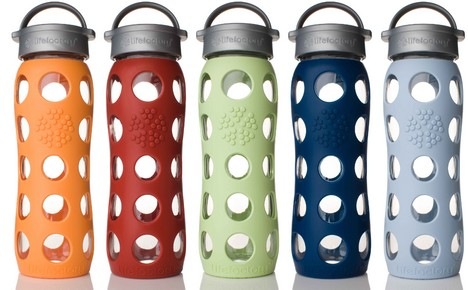
Image credit: Lifefactory Article from TreeHugger
As a rule, I am not one of these greenies that gets overly excited about new reusable bottles. I have an old reusable bottle somewhere, and it occasionally gets used when I venture out of the house—but I’ve always been a little confused by the amount of attention paid to fancy reusable bottles and their cousins, the reusable tote. But with recent scandals over BPA in old Sigg water bottles, and with Nalgene finally going BPA free, many folks with old reusables may be looking for alternatives. So howabout going old-school? Glass may be back.
Lifefactory is selling a line of bottles that even I must admit look pretty darned good. And they are made from plain-old glass, with a non-toxic silicone sleeve to protect them from breakage and allow for a better grip. After all the fancy water bottle materials out there, it’s kind of fun to see a press release extolling the virtue of (gasp!) glass:
"The glass make-up of the reusable bottle means what you see is what you get. Glass is a nonporous material containing zero harmful chemicals and does not scratch, significantly reducing bacterial growth. With Lifefactory bottles you will never experience any type of leaching into your liquid nor will you ever be left with a metallic taste. Best of all, glass is a low impact raw material that is readily abundant, easy to process and 100% recyclable, which is minimally taxing on our environment."
Not sure if I’ll be replacing my water bottle just yet, if I can even find it. But even I must admit, these are fine looking bottles.
Indian law would make criticizing GM crops an imprison-able offense
Posted: March 15, 2010 Filed under: Gardening, Going Green; How and Why..., Non-Toxic Choices Leave a commentHealth Freedom Alliance March 2, 2010
 Criticizing Genetically Modified (GM) products could land you in jail — if the draconian draft Biotechnology Regulatory Authority Bill (BRAB) of 2009, which will be tabled in the current session of the parliament by the UPA government, is passed.
In an unprecedented muzzle on the right to freedom of speech of the citizen, Chapter 13 section 63 of the draft bill says, “Whoever, without any evidence or scientific record misleads the public about the safety of the organisms and products…shall be punished with imprisonment for a term that shall not be less than six months but which may extend to one year and with fine which may extend to two lakh rupees or with both.” The BRAI Bill drafted by the department of bio-technology under the Ministry of Science and Technology comes on the heels of a moratorium on Bt Brinjal announced by the Environment Minister Jairam Ramesh.
“What they are doing is much worse than what Hitler or Mussolini did. Through this bill, they want to take absolute authority. They are behaving like a vendor instead of a regulator,” Pushpa M Bhargava, a member of the Supreme Court appointed Genetic Engineering Approval Committee (GEAC) said.
There are also other provisions in this bill which are disconcerting.
Article 27 (1) of the bill seeks to keep the information related to the research, approval and science of the GM Products out of the purview of the Right to Information ( RTI) Act.
In other words, farmers, NGO’s and Environmental groups that have been on the forefront of the campaign against BT Brinjal and other genetically modified crops, can longer obtain information about it.
Not only that, the three member experts of the Department of Biotechnology will override any existing legislation about GM technology in the states.
The draft bill also states that the BRAI will set up its own appellate tribunal which will have the jurisdiction to hear arguments on the issues concerning biotechnology. In case of any disputes, petitioners can only approach the Supreme Court of India.
“The BRAI bill is more draconian than what the nation faced during the Emergency ‘’ says Devinder Sharma, writer and Food Policy Analyst. “If the Bill was already in force, I would have been in jail.
Jairam Ramesh too would have been in jail for challenging the health and environmental claims of the company developing Bt Brinjal,” he said. The bill demonstrates the extraordinary hold the multinational companies have over the UPA government, he added. Kavitha Kurugunti of Kheti Virasat Mission said that this bill is just a way to silence the voices who are opposed to GM technology.
Babies Don’t Need Much Equipment
Posted: March 14, 2010 Filed under: Going Green; How and Why... Leave a commentGreen Baby Care from Planet Green.com
 Katie’s first step
I read the above article and was struck recently…or I should say, again…at how accessorized we are. The whole idea of buying a fortune in equipment to raise a baby always struck me as weird. I never used cribs, all my kids slept with me until they were ready and secure enough to sleep with the next oldest sibling. I used a cloth front pack, then a backpack when they about 6 months old……keeping them close…and happy. I breastfed the last 4, I swear I could leave the house with some cloth diapers and just the kids…no bottles…and those big ole cloth diapers were perfect as a blanket, a changing pad, a burp pad… The first year you have all the food you need already “on board”…what could be easier??
All those “products”? Who needs them?
Takeoutwithout: Refuse, Retake and Reconsider
Posted: February 8, 2010 Filed under: Going Green; How and Why..., Non-Toxic Choices Leave a commentFrom Treehugger
by Lloyd Alter, Toronto  on 01.25.10

Americans toss out enough paper and plastic cups, forks and spoons every year to circle the equator 300 times, and K.B. Lee is trying to do something about it. He has founded Takeoutwithout to convince restaurants to encourage and accommodate people who bring their own containers.
Borden Communications and Design, a firm specializing in "eco-logical" services, put together the snappy graphics. TOWO has its own 3Rs, as explained by Ellen Moorhouse in the Star:
Refuse (Do you really need all of those straws, plastic cutlery and napkins?); Retake (Bring your own containers, cups and bags.); and Reconsider (Take a look at your eating habits, and maybe, like Lee, make some changes.)
It is a new campaign, where they are inviting restaurants to encourage people to bring their own containers (many resist, worried about health and safety) and urging patrons to cut back. It is perhaps a good first step, although I would rather see deposits on everything and producer responsibility.
Retake and Reconsider: Two more to add to our seven R’s. One might also try the 25 Take-Out Foods You Can Make at Home For Cheaper
But if you can’t do that, at least try to bring your own. More at Takeoutwithout
I say; take a glass jar, get a Wrap n Mat from Reusablebags.com, get some Stainless steel jars, cloth napkins…stop eating fast food.
Join the Slow Food Revolution!!! Think Traditional Human Diet with no fast food, nothing in cans or boxes, whole foods…chickens, veggies, butter, fats, fruits, grass fed beef. Compost what you don’t use, make great soil, grow more veggies…no waste….
Frugal Green Living: Save $1000 A YEAR Using These 5 Tips
Posted: January 21, 2010 Filed under: Going Green; How and Why..., Non-Toxic Choices, Skin Care 1 CommentAnother great post from Treehugger

Image credit: thievingjoker @ flickr
Convince your boss to let you work four (slightly longer) days a week
Working four ten-hour days instead of five eight-hour days is not only a great way to have a longer weekend, but it’ll save you some cash, too. You’ll save 20% on whatever you spend for commuting, coffee, lunch, and any other daily expenses you incur by dragging yourself to the office. Let’s say you do it on the cheap, and don’t drive yourself, pay for parking, or spend more than a few bucks on lunch. Even if you spend $2 on the bus or public transit, $2 for a coffee and $6 for lunch, you can easily save several hundred bucks by working four days a week. Get the nitty-gritty in our guide for How to Go Green: Commuting.
Alternately, you can telecommute on the fifth day of the week; it’ll cost a bit more in energy and food expenses, but it’ll still save money in the long haul.
Annual savings: $500+ for a four-day workweek (that’s $10 per day, one day a week, for 50 weeks a year — you get two for vacation, right?); slightly less for telecommuters.

Photo credit: nasv @ flickr
Walk or bike on one trip that’s two miles round-trip per week
40 percent of urban travel in the U.S. is two miles per trip (or less), so hop on your bike (or take a walk) once a week, save some wear and tear (and gas) on your car, get a little fresh air, and save some bucks. Learn more about greening your ride in our guide for How to Go Green: Cars and take the savings to the bank. Ready to really make a change? Take the two mile bicycle challenge.
Annual savings: $56.26 — 104 miles (2 miles x 52 weeks) at 54.1 cents per mile, the average cost of driving per mile, according to AAA
Make your own all-purpose cleaner
Rather than dropping four bucks on individual green cleaning products and five or six bucks for a green toothpaste at the grocery store, you can easily swap out products you (probably) already have at home to do the same job. For cleaners, take 25 cents worth of baking soda, 25 cents worth of white vinegar or lemon juice, maybe a touch of essential oil, and voila! Small variations can yield toilet bowl cleaner, tub scrub, and toothpaste Plus, baking soda can clean most anything, including your hair (and it can strip paint, too!). By substituting baking soda for many of your cleaning needs, and adding a little elbow grease, the savings will add up.
Annual savings: $50 — give or take, depending on how much you clean (we figured six tubes of toothpaste at $4 each and one each of five cleaners — all-purpose, toilet scrub, tub scrub, window cleaner, and floor cleaner — at $5 apiece).
 Image credit: katsniffen @ flickr
Hang your laundry out to dry
Your dryer checks in at number two on the list of household energy hogs (right after your fridge), according to the U.S. Department of Energy, and uses more than you might think. By cutting the dryer out of the equation and using the ample solar energy that falls to the earth every day, you can save some bucks, and prolong the life of your clothes, too. Get the full scoop in our guide for How to Go Green: Laundry.
Annual savings: $70 per year in energy costs
Set your thermostat wisely
Properly manipulate your thermostat — hopefully it’s a programmable model — and your savings will mount quickly. Follow Energy Star’s tips — simple things like regulating for when you’re awake and asleep, and modulating the settings for summer and winter — and you can remain comfortably heated or cooled, with a few extra bucks in your pocket. Get more tips in our guide for How to Go Green: Heating.
Annual savings: $180, according to Energy Star, if you maintain your diligence for an entire year.
Below are my tips on how I do laundry and save even more than these tips outline;
My Level of Living Green
I air dry all laundry–had to put a lock on the dryer cord to convince my daughters I was serious–they learned to plan ahead! I wash all laundry in cold water, always wash full loads, and use a drying rack inside if it is raining. It’s good for the earth and great for your skin, a free humidifier in the house. Which also makes it feel a few degrees warmer in winter and cooler in summer. I use soapnuts for laundry. SoapNuts

2) Buy all organic meat, fats, butter, and the few veggies I still buy. Mostly I grow my own. Click HERE to go to my gardening Blog. Click HERE to see how I eat 100% organic and do so on less than $60.00 a week! And that includes grass fed organic meat at all three meals, at 2000 calories a day.
3) Buy all organic non-toxic beauty care products and make-up. I make my own skin care cleanser, exfoliants, and flower hydrosols. Here is a page on my blog showing the beauty products I use. Products I Use and Love!
4) Use baking soda and vinegar for cleaning the bathroom, kitchen sink and counters and general purpose cleaning. I use a loofah for scrubbing dishes (I am growing my own right now so I won’t have to buy them anymore!) My sister is crochets scrubbies for me from old t-shirts.
5) Take cloth bags to store for groceries and all other purchases. Take muslin bags I made to grocery store for produce. (I sell them!)

6) Recycle, re-use, make my own and have stopped buying anything I don’t really need. Don’t use paper towels, never have. I used cloth diapers for all 5 kids. I use a compost toilet, no toilet paper (think cloth baby wash clothes).
7) I compost all paper and food scraps, put all lawn clippings in my compost, use contents from my sawdust toilet to heat up the contents which enables me to do high heat (thermal) composting. The high heat and microbes render the finished product clean of harmful pathogens and pesticides and pharmaceuticals (if there are any; I eat organic, use no pharmaceuticals, no chemical cleaners).
Ideal;  My economy model;
  Yep, it’s a hose reel, recycled. But a 5 gallon bucket works great. You can use sawdust, but I use wheat bran that I buy from the feed store downtown for 12 bucks for 50 lbs…lasts me about 6 months. And the compost I get is amazing!!!
8) I try to not buy stuff in plastic, I try to buy all glass. Store all food in glass. Re-use glass jars. I mostly buy real food (meat, produce) try to not buy anything that needs a label, so no packaging.
10) Make my own gluten free granola, make my own mayonnaise, salad dressings, spice blends. I do not buy any packages foods, eat all real food (not products), make my own coconut milk yogurt, sauerkraut, kombucha tea.
11) I use a bike for errands close to the house.
12) Use very low flow shower heads. Ace Hardware has a 1.5 GPM with a shut-off valve.
13) Use all CF light bulbs…and use them as little as possible. I have one evening a week that I use no lights..on Shabbat! Dinner by candlelight!
14) Use grey water from shower (I keep a 3 gallon bucket in shower and take it outside to the flower beds.
15) Use water from rinsing dishes to water flower beds.
16) Use a broom on all my wooden floors instead of using vacuum cleaner.
17) Run as few errands as possible, car pool and combine trips. Ride my bike around neighborhood and for errands within a few miles.
18) Use micro-cloths to clean with, even on glass you do not need cleaning products!
19) I have NEVER bought bottled water. I bought a Kleen Kanteen for each person in the family, we refill and take with us. I’ve had mine over about 2 years.
20) Go paperless or CD-less as much as possible. I provide my clients with emails of my book, but still put cookbook software on CD.
21) Use only a hurricane lamp when we sit outside at night. It gives enough light to read by…but is perfect turned low …for just hanging out. Very romantic, too!
22) I carry my lunch each day to work in a insulated lunch box from Built, available at ReusableBags.com, using a stainless steel thermal jar for soup, glass wide mouth canning jars for other food, a wrap n’ mat for baked goods and a beautiful cloth napkin and real silver to utensils.
22)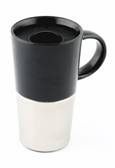 I carry my coffee, on the way to work, in a stoneware and stainless steel mug with a silicone lid (NO plastic!). From High Wave. And at only $12.00, it’s a steal!
23) I have an outdoor solar heated shower that I built.
24) I grow most of my food inside under grow light; no pests, very small amount of water use. I am growing cherry and big sweet tomatoes, basil, thyme. I have sweet potatoes growing, beets (mmmm, beet greens), onions, lavender (I use it in the skin care products I make and sell), Swiss chard, purple flowering kale, nasturtiums, cucumbers, peppers, bell peppers, purple basil, cucumbers, tomatoes, beet greens, garlic and lettuce in my sunroom hydroponically. Outside I have lettuce, banana tree, garlic, some tomatoes.
25) I use a non-disposable razor, an old-fashioned stainless steel, very high quality razor that uses double edged blades. It was 24.00 from ClassicShaving.com. The blades are 10 for 5.99, and they are double edged! They give the closest, smoothest shave you can imagine! No disposable blade can compare. I spend about 50 cents a year on blades!
26) Wash dishes with 2 dish pans in the sink, one for hot soapy water, one with warm rinse water. Do glasses first, pause a moment to let the soapy water drip off, then move to rinse water. Stop when rinse water is almost full and rinse quickly. Repeat with silver, plates, then pots and utensils. All with 2 dishpans full of water. Then I pour the soapy water, with all that organic matter, onto my plants in the garden. It helps repel pests and loosens the soil. And good for the biceps when you carry it outdoors.
27) I hand water my garden with buckets from the rain barrels that are under the eaves of my garage. 10 feet from my garden. The front flower garden gets watered entirely from the dish water.
29) I work out at home, no expensive gym memberships that I never used anyway. I save all the expense of membership, and gas and time driving. I have a set of weights, two exercise balls, a weighted hula hoop, a yoga mat and a chin-up bar.
30)  I hand grind my coffee each morning with my Zassenhaus Model 169 DG Closed Hopper Walnut Zassenhaus coffee mill that I got at Sweet Maria’s.
 I make my Turkish coffee in an Ibrik on the stove top.
 I use a ceramic filter holder to make pour over coffee, and use a gold coffee filter.
31) I do not “buy” presents, I make them, and wrap them if I have brown paper bags, which I will decorate, I have done water colors on packages and they come out great…I like the affect.
Pollan says health-care reform will fail unless we change the way we eat
Posted: September 16, 2009 Filed under: Food and it's Impact on Our Health, Going Green; How and Why... 1 CommentFrom The Grist
 NPR’s Guy Raz: What if health care is overhauled and it doesn’t change the American diet in any way?
Michael Pollan: We’ll go broke. If we don’t get a handle on these health care costs, the new system or the old system, we’ll go broke. And that’s why I think that really food is the elephant in the room when we’re talking about health care.
First in The New York Times last week and then on NPR this weekend, Michael Pollan made that point that if we want to fix our health-care system, we have to fix our food system.
From his op-ed in the Times:
[T]he fact that the United States spends twice as much per person as most European countries on health care can be substantially explained, as a study released last month says, by our being fatter. …
That’s why our success in bringing health care costs under control ultimately depends on whether Washington can summon the political will to take on and reform a second, even more powerful industry: the food industry. …
Cheap food is going to be popular as long as the social and environmental costs of that food are charged to the future. There’s lots of money to be made selling fast food and then treating the diseases that fast food causes. One of the leading products of the American food industry has become patients for the American health care industry.
But even with that grim diagnosis, Pollan is optimistic about the future, arguing that if insurance companies are required to accept everyone, as called for by even weak health-reform legislation now in Congress, then the insurance industry will become a powerful ally in fight for better food and against the agribusiness lobby.
Grist’s Tom Laskawy is less optimistic, noting that the poor and the elderly—the most unhealthy groups—are likely to keep getting their health coverage from the government (Medicare, Medicaid, and the VA) and not the insurance industry.
Still, both Pollan and Laskawy are encouraged by New York City’s new anti-soda ad campaign, which Laskawy says is supported by health insurance companies. Will we see more such public-health campaigns around the country, no matter what happens with health-care reform in Washington, D.C.?
Here’s an ad from NYC’s campaign:

I say low fat milk is as bad a choice as the soda…both are products of corn! Eat grass fed meat and only eat dairy if it’s organic and straight from the cow!
The Voice of Reason Concerning the Whole Foods Boycott
Posted: August 18, 2009 Filed under: Food and it's Impact on Our Health, Going Green; How and Why... Leave a commentMichael Bluejay’s site has long been a favorite of mine. I don’t think there is a better blog out there that covers how to conserve electricity. Following is what he wrote about the Whole Foods Boycott. Now, frankly, I do not shop at Whole Foods for many reasons. I support local business as much as possible. I realize some folks in some areas of the country have no choices, in Jacksonville, Fl, we do. I support businesses who keep the money in our community, I support those who treat their employees well, I support those who buy locally as much as possible and I support those businesses who have honest, open corporate practices such as Publix, who do an amazing amount of community service and also truly care about their customers.
I do not support Winn Dixie because of the horrible way they treat their employees; of this I know about personally after working as a Food Service Manager with them.
I do not support Native Sun because of their dishonesty and the way they treat their employees.
The only health food stores in Jacksonville that I do support are Grassroots, Bio-max and The Good Earth. I have long supported Southern Nutrition but their mostly empty shelves nowadays have made me give up on them. Grassroots is by far my favorite, it has an old fashioned, homey feel to it, it is in way cool 5 Points…and best of all, it’s a great, well stocked store by people who know tier stuff.
But, back to what Michael has to say about the whole thing..I have to agree.
Whole Foods Market: What’s wrong with Whole Foods?
Whole Foods Market does some good things. For starters, they practically created the modern market for organic foods single-handedly. Organics would likely still be hard to find and a lot more expensive (rather than a little more expensive) were it not for their efforts. Whole Foods also requires its suppliers to meet standards for humane treatment of farm animals, which has greatly improved the lives of millions of creatures. They also support the Fair Trade movement and have a more democratic workplace than can be found in just about any other organization of its size. So giving credit where it’s due, Whole Foods has often been a force for good.
But just because a company sells natural foods doesn’t mean it can do no wrong. Many of Whole Foods’ actions have been controversial, especially where their labor practices are concerned. As the Texas Observer put it, "People shop at Whole Foods not just because it offers organic produce and natural foods, but because it claims to run its business in a way that demonstrates a genuine concern for the community, the environment, and the ‘whole planet,’ in the words of its motto. In reality, Whole Foods has gone on a corporate feeding frenzy in recent years, swallowing rival retailers across the country…. The expansion is driven by a simple and lucrative business strategy: high prices and low wages." (1)
We’re not suggesting that anyone stop shopping at Whole Foods and we’re not calling for any kind of boycott (see sidebar at left) — we just want consumers to realize that even a company that puts on a socially-responsible face doesn’t always live up to its own hype.
Here are fourteen questionable aspects of Whole Foods Market:
(1) Aggressive monopolization. Tons of independent co-ops throughout the country don’t exist any more because Whole Foods bought them out. Whole Foods also absorbed all its significant competitors (Wild Oats, Bread & Circus, Fresh Fields, Bread of Life, Merchant of Vino, Nature’s Heartland, Food for Thought, Harry’s Farmers Market, Mrs. Gooch’s Natural Foods Markets, and U.K.-based Fresh & Wild). (2) They’ve thus created a near-monopoly in the natural foods grocery business. Consumers are better served by a diversity of stores, but Whole Foods has been trying to wipe out the competition — and has been quite successful at doing so.
(2) Failure to support farmworkers. When United Farm Worker activists passed out literature at an Austin Whole Foods Market, Whole Foods called the cops and had them arrested. Embarrassed by the public outcry, Whole Foods then promised to support the UFW’s grape boycott, but then broke that promise when it moved the store a couple of blocks away, saying the agreement applied only to the old location. They also produced deceptive literature for their customers blasting the farmworkers group and describing farmworker conditions as being no problem at all. About this, the UFW says, "Several major cases have been tried in states such as North Carolina and Florida during recent years where it was found that workers were being kept by their employers in a state of virtual slavery. This is worlds away from the ideal and naïve (and disingenuous) information put out by Whole Foods." (3,4)
(3) Fierceless devotion to profit. It’s not unusual for a business to try to maximize profit. But when the business puts on a socially-responsible face, consumers have the hope that the business will put "Doing the Right Thing" above "Making More Money". That’s not always the case at Whole Foods. It’s precisely why Whole Foods swallows its competitors, sells certain questionable products, and keeps wages as low as possible. Common Dreams says, "A closer look at the company’s business practices and Mackey’s ideas about business and society reveals a vision not that different from a McDonald’s or a Wal-Mart. In fact, the Whole Foods business model is more or less the standard stuff of Fortune 500 ambition. This is a vision of mega-chain retailing that involves strategic swallowing up (or driving out of business) of smaller retail competitors. It is a business model that objectively complements the long-term industrialization of organics (that is, large-scale corporate farms) over small family farms. It is also a vision in which concerns about social responsibility do not necessarily apply where less publicly visible company suppliers are concerned. Subsidiaries of cigarette manufacturers (for example, Altria, owner of Kraft’s organic products) or low-wage exploiters of minority workers (such as California Bottling Co., Inc., makers of Whole Foods’ s private-label water) are apparently welcome partners in this particular eco-corporate version of ‘the sustainable future.’" (2,5)
(4) Refusal to carry only turtle-safe shrimp. When Earth Island Institute asked Whole Foods to carry only shrimp caught in nets certified to protect endangered sea turtles, Whole Foods flatly refused. (1)
(5) CEO posing as someone else on the Internet. For seven years, Whole Foods CEO John Mackey posted on the Yahoo Finance board about his company and its competitors while pretending to be someone else. By trashing rival Wild Oats, their stock price could drop and he could buy them out for less money. Mackey also had the gall to anonymously praise himself. ("I like Mackey’s haircut. I think he looks cute!") (6) He didn’t stop there: He also criticized specific employees, under the cover of anonymity. Daily Kos said of this, "The very idea of the founder and CEO of a major national corporation hiding behind a pseudonym to lambaste one of his own hourly wage earners on an online message board says something about the personal moral integrity of union-busting executives." (7) After being discovered, he was unrepentant, trying to justify his behavior in a long blog post, and making a point to say specifically that his actions weren’t unethical. (8, 9)
(6) Poor working conditions. Workers organizing for a union in Madison said, "The ridiculously high turnover rate, wages that are lower than the industry standard, pervasive lack of respect, constant understaffing, absence of a legally-binding grievance procedure, and other poor and unfair labor practices-all of which have led to widespread low morale-highlight the simple fact that workers ultimately have no say in the terms and conditions of their employment at any Whole Foods Market-not just Madison. Workers are not recognized or appreciated for their contributions. Instead, Whole Foods relies on worker apathy and lack of investment in their jobs to keep turnover high, and for the most part, wages, benefits, and other working conditions poor. This environment should be unacceptable for any workplace." (1)
(7) Anti-Union. Whole Foods is so fiercely anti-union it has actually fired employees who were trying to organize one. As Common Dreams says, "Whole Foods matches Wal-Mart in its reputation for corporate anti-unionism. It’s a hostility rooted in a management whose ‘core values’ are intrinsically patrician and antidemocratic. The latter qualities were revealed in all their dismal hypocrisy most forcefully in 2002 when employees of the chain’s Madison, Wisconsin, store voted to unionize and join the United Food and Commercial Workers (UFCW). In a story that caught the attention of the New York Times and other media, Mackey had what might be described as a New Age temper tantrum, treating the specter of collective bargaining at one of his stores as a disaster of almost unspeakable proportions….The yearlong effort to defeat Madison’s first organizing drive revealed Mackey as a "socially enlightened" poseur, a New Age business type who talks about love and ecological footprints and other enlightened things, but who turns to the hard boot of corporate scare tactics and disinformation when confronted with a group of employees who dare to assert their democratic right to self-representation." (1,10)
And "In 2006, after truck drivers working at its San Francisco-based distribution center voted to unionize with the Teamsters. The company fired two of the drivers, altered its sick-leave policy, froze wage increases, refused to provide information to the union that was necessary to negotiate a contract, and ‘harassed and disciplined employees,’ found NLRB investigators, who concluded that ‘Whole Foods engaged in a variety of [illegal] retaliatory measures to discourage union activity.’ An out-of-court settlement required Whole Foods to reinstate the employees and reverse some of its policies." (20)
(8) Low Wages. Whole Foods has been widely criticized for keeping wages low. "Companies such as Whole Foods or other non-union chain competitors are paying many of their hourly employees what in late 1960s dollars would be equivalent to the minimum wage or below." (1) And they can certainly afford to pay more. Whole Foods stores bring in $800 per square foot in a year, double the industry average. (11)
(9) Refusal to come clean on the use of GMO’s and toxic chemicals in its products. "Whole Foods is still not fully transparent about the use of GMOs in store-brand products, and has ignored shareholder requests for information on the use of toxic chemicals in products like baby bottles that are sold in stores." (12) Whole Foods also asked shareholders to vote against a resolution asking Whole Foods to report about endocrine disruptors and other toxic chemicals in its products. (13)
(10) Selling dangerous food. You might think that with a company that champions healthy eating, anything in their store would be safe to eat. You’d be wrong. Whole Foods sold fish so toxic in mercury that one customer’s blood levels had to be reported to the Center for Disease Control. (17) Whole Foods didn’t start identifying potentially mercury-laden fish in its California stores until the government forced them to do so. Even then, a quarter of Whole Foods stores failed to display proper signage as required by law. (18)
(11) Misleading shoppers about its support of small farmers. Signs at Whole Foods Market say, "Help the Small Farmer — Buying organic supports the small, family farmers that make up a large percentage of organic food producers." What they’re not telling you is that while the number of family farmers is a large percentage of the total, overwhelming majority of organic output comes from corporate farms. As Slate put it: "There are a lot of small, family-run organic farmers, but their share of the organic crop in this country, and of the produce sold at Whole Foods, is minuscule." Slate also pointed out that Whole Foods has pictures and profiles of small organic farmers in their stores, but doesn’t actually carry products from those farmers. (14)
(12) Gagging shareholders. Whole Foods refused to let shareholders speak about shareholder resolutions at its annual meeting. " ‘Given that the annual shareholder meeting is the one time each year that top executives and directors have to show up and be accountable to shareholders, it is unconscionable for companies not to allow proponents to make a short statement in support of their proposals,’ said Beth Young, senior research associate for The Corporate Library (TCL), which assesses corporate governance….’It also seems to flatly contradict the company’s pledge to ‘recognize everyone’s right to be listened to and heard regardless of their point of view,” Mr. Herbert told SocialFunds.com. ‘Whole Foods should recognize that any company that presents itself as socially responsible, as it does, is an easy target for a cynical press and public when it fails to uphold reasonable standards of corporate practice.’" (15)
(13) Obfuscating executive compensation. Forbes magazine says, "Media reports frequently tout Whole Foods’ pay policy, which caps the chief executive’s salary and bonus at 14 times the average worker’s pay. The Wall Street Journal, Slate.com, Harvard Business Review and BusinessWeek have all mentioned the pay cap, generally in favorable terms. But they all omitted one thing: stock options." When you count stock options, Mackey really made close to $3 million, or eighty-two times the average workers’ salary. Forbes continues, "Whole Foods manages to obscure Mackey’s total pay package by ballyhooing the salary cap." A company is certainly entitled to pay its execs whatever it wants, but the issue here is that WF is deceptive about how much its execs actually receive, relative to the lower-paid workers. (16)
(14) Forcing smaller competitors to hand over private financial data. Whole Foods has been trying to force many of its smaller competitors to hand over private sales and financial data about those smaller stores. Whole Foods already holds a massive advantage due to its size, but that’s apparently not enough for them. As one of the harassed smaller groceries put it, "Allowing Whole Foods to look through all of our private information about how we operate and what our plans are for the future unfairly adds to their already large size and financial advantage. We’ve been able to build a successful local business being David against their Goliath, and we’re happy to keep doing that, but we do object to having one hand tied behind our back." (19)
Why Is There Still an Endocrine Disruptor In My Toothpaste?
Posted: July 21, 2009 Filed under: Going Green; How and Why... Leave a commentby Lloyd Alter, Toronto on 07.17.09

Three years ago John first wrote There’s A Frog Disruptor In My Soap, including a scary list of products containing the bacteriocide Triclosan. We keep asking Why Is There Still a Frog Disruptor In My Toothpaste? and nothing changes. With the current swine-flu induced hand washing craze, more people are dosing themselves with more Triclosan, even though alcohol-based products work just as well, and Germ Fighters Lead to Hardier Germs.
But this may finally be changing.
Dan Shapley of The Daily Green tells us about a petition has been filed by the Food and Water Watch to the Food and Drug Administration, making the following claims:
The presence of triclosan in the human body (as evidenced by scientificstudies of its activity in blood, urine and breast milk) imposes an immense and dangerous ―body burden. This presence raises concerns about a multitude of threats to humans;
Bacterial resistance to antibiotic medications and antibacterial cleansers is just one category of threats emanating from the growing body burden of triclosan. Suchresistance renders humans (especially vulnerable subpopulations) wide open to bacteria-induced illnesses and death;
Endocrine disruption is another potential result of triclosan bioaccumulation in the body. This effect, in turn, poses serious threats to thyroid and other organ functions, and it can also influence the development of cancer;
Wastewater contamination by triclosan is a serious health threat. Importantly, triclosan products used in the home and in the workplace typically yield residues that flow into wastewater from rinsing, cleaning and other normal activities. Because these residues are not rendered harmless by the wastewater treatment process, they are free to reenter the environment—and ultimately the human body.
And they put this stuff in toothpaste???
The list of organizations supporting the petition is extensive and impressive, and includes the Sierra Club, the Center for Environmental Health, the Natural Resources Defense Council and more. Perhaps the new and improved FDA will finally listen. Read the petition PDF here

Updated List of Products with Triclosan
Food and Water Watch provides an updated list of products that contain Triclosan:
Neutrogena Deep Clean Body Scrub Bar
Lever 2000 Special Moisture Response Bar Soap, Antibacterial
CVS Antibacterial Hand Soap
Dial Liquid Soap, Antibacterial Bar Soap
Softsoap Antibacterial Liquid Hand Soap
Cetaphil Gentle Antibacterial Cleansing Bar
Clearasil Daily Face Wash
Clean & Clear Oil Free Foaming Facial Cleanser
Dawn Complete Antibacterial Dish Liquid
Ajax Antibacterial Dish Liquid
Colgate Total Toothpaste
Right Guard Sport Deodorant
Old Spice Red Zone, High Endurance and Classic Deodorants
Vaseline Intensive Care Antibacterial Hand Lotion
Support Companies That Do Not Use Triclosan
CleanWell
LUSH
Nature’s Gate
Vermont Country
Naked Soap Works
MiEssence
Purell Instant Hand Sanitizer
Ivory
Paul’s Organic
Dr. Bronner’s Magic Soaps
Tom’s of Maine
The Natural Dentist
Listerine Essential Care
Peelu
Weleda
Toxic Free Basics
More on Triclosan:
There’s A Frog Disruptor In My Soap
Antibacterial Cleaners Do More Harm Than Good


 Meal Delivery Service by Millie Barnes