Vancouver-area mayor wants people to convert their lawns to vegetable gardens
Posted: May 5, 2011 Filed under: Food and it's Impact on Our Health, Gardening, Non-Toxic Choices 2 Comments
Mayor Darrell Mussatto wants to convert North Vancouver’s lawns to urban farmland.
"We don’t need a lot of expensive technical solutions like rooftop gardens. What about front yards and back yards?" Mussatto said. "That’s a huge land base, and how many of those yards are dedicated to turf?
"Twenty per cent of the people live on 80 per cent of the land, and most of their yards are lawn," he said. "It can easily be changed over to fruits and vegetables."
The City of North Vancouver is second in population density in the region, trailing only Vancouver. But Mussatto sees a lot of wasted space in people’s yards, space that could be producing food.
North Vancouver council has instructed staff to prepare an urban agriculture strategy.
"We want people to convert the yards of single family homes to gardens and even commercial farms," Mussatto said.
Vancouver already has several commercial yard-farming firms, including City Farm Boy.
Ward Teulon has been farming residential yards in Vancouver since 2006 and maintains a roster of 10 yards, including a rooftop garden near Yaletown.
Homeowners take a share of the vegetables that Teulon grows and the rest is distributed to his 38 shareholders, people who pay an annual fee of about $600 for a weekly basket of produce from May through mid-October.
"There was a lot of good soil that wasn’t being used, so I put up some posters trying to find yards," said Teulon. "Once I got a few yards, word of mouth did the rest."
North Vancouver is determined to wipe away all impediments to urban agriculture. Standards of maintenance bylaws were designed to encourage people to maintain a particular kind of landscaping and drive agriculture out of the urban environment, according to Coun. Craig Keating.
"People recognize that the way we are dealing with food in our society has got to change, we need to re-examine how we deal with public spaces and parks," Keating said. "We should be re-examining whether front yards should only be decorative, and commercial agriculture in the city is something I do support.
"We need to make sure there aren’t any obstacles to inhibit family yards from converting to agricultural uses," Keating said.
Keating has even volunteered to convert his own front yard to vegetable garden. The Edible Garden Project employs volunteers to plant and tend vegetable gardens for distribution to low-income residents.
A series of work parties have converted about one quarter of Keating’s 5,000-square-foot yard into raised beds for vegetables.
"We are working with volunteers from the Edible Garden Project, a class of social justice students from Nelson came in Thursday, and a group from Canucks Autism Network came on Saturday," Keating recounted.
"Up till now the front yard has been a monument to long grass and dog poop. Now we are doing something socially redeemable," Keating said.
Millie- I say make growing and fertilizing grass and other non-edibles illegal…we can’t afford the water waste..especially here in Florida!
Read the complete post at http://communities.canada.com/vancouversun/blogs/greenman/archive/2010/11/14/vancouver-area-mayor-wants-people-to-convert-their-lawns-to-vegetable-gardens.aspx
In Defense of the Cow: How Eating Meat Could Help Slow Climate Change
Posted: September 21, 2010 Filed under: Food and it's Impact on Our Health, Gardening, Non-Toxic Choices Leave a comment
Back to the Basics: Bison, Grass, and Healthy Soil
When the first plows turned the rich soils of the Midwest grasslands, some soils were 20% carbon. Now, after years of chemical farming and cultivation, many soils are 5% carbon or even less-some as low as 1%. As a result, that “lost” carbon now lives in our atmosphere as carbon dioxide (CO2). Furthermore, the loss of soil carbon can deplete the soil’s ability to manage water.
Prior to our cultivation of the Midwest, ruminants played an important role in healthy soil ecology. These former grasslands were historically populated by the American bison, which numbered at about 60 million. In contrast, there are about 96 million beef and dairy cattle in the US alone. As a ruminant, the bison grazed the plains for thousands of years. Moving in expansive herds, the bison ate the grasses down as they traveled in search of greener pastures. While migrating to new grazing areas, each ruminant would leave natural fertilizer: animal waste and plant litter. This natural process helped to build the rich and fertile soils of the Midwest.
Grass Grazers: More Than Your Average Hamburger
Similarly, well-managed cattle can greatly enhance the growth and propagation of grasses. These grasses can sequester huge amounts of carbon annually, especially when grazing practices include high density, short-term exposure efforts with the cattle eating the grasses down and moving on to let the grasses grow back. This sustainable grazing technique causes some root shedding below the soil line, leaving lots of organic matter, and thus, carbon. On just one acre of biologically healthy grassland soil, there can be between 0.5 – 1.5 tons of carbon deposited in the soil annually. This is equivalent to taking up to 5.5 tons of CO2 out of the atmosphere and sinking it into an acre of soil.
While this impressive level of carbon sequestration is impossible in the high desert of New Mexico with little rainfall, it is absolutely viable in Florida, the East and Midwest, as well as the North West where there is rain or available water to grow pasture. With proper management, ruminants can once again contribute to the life and water cycle supporting ecology of our biological system, where cattle may be absolutely critical to the health of our soils. This amazing ecological interaction on 11 billion global acres of grazed land would equate to sequestering 60% of human-caused CO2.
Furthermore, let’s not throw stones at cattle as methane culprits, when we have larger human-caused methane problems–namely from fossil fuel use and landfills. Our unrestrained use of coal, natural gas, oil, and petroleum products combined with our over-consumption of just-plain-stuff that ends up in landfills produces over three times the methane emissions as ruminants in this country. Cattle must be saying, “Stop pointing fingers! You single-stomached humans are contributing more methane emissions than our digestive systems could ever hope to!"
Well-managed beef and dairy cattle living on pasture are not only an asset to us all, but also to a bio-diverse earth.
Another great article from TreeHugger
Indoor Garden
Posted: July 6, 2010 Filed under: Gardening Leave a comment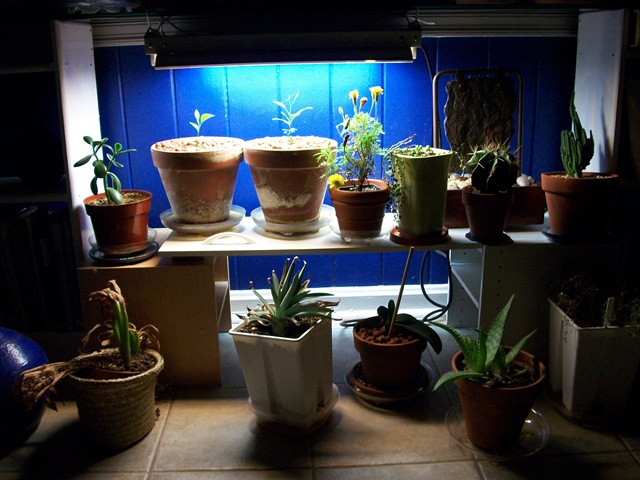
Right under the lights are two orange trees I started from seeds. They came from my friend Janice’s cousins tree in Mandarin. I heard after they sprouted that they were hard to sprout, but after pricing citrus trees I decided to try. They took 2 months to sprout between wet paper towels. They are about 5 inches tall now…
Finally.. A Garden Update
Posted: April 17, 2010 Filed under: Gardening Leave a comment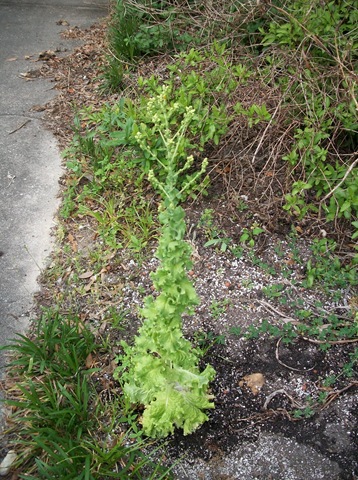 It’s been a hectic few months..new job..stuff going on…I started in January sproutin’ stuff in the kitchen…then all the new little plants grew under grow lights until about two weeks ago…when I put them all out front and they sprung up like crazy… I have been picking cucumbers for about a week.
Last spring, when I built the 5 gallon grow buckets and started tomatoes, peppers and greens in them… I noticed a tiny lettuce plant growing at one point, but ended up covering it up when I covered the dirt and top of bucket with plastic (to keep out pests and retain moisture).
A month or so later I noticed it growing downward, from under the edge of the plastic. I thought to myself that mother nature sure was tenacious. Then this thing started growing upward…looking very Dr. Suessian. At the end of fall I picked my last tomatoes and cleaned out all the grow buckets.
Jump ahead to the coldest day we had, sometime in January, I think…and I looked out the window…after all it was 21 degrees outside. Bear in mind that I live in Jacksonville, FL…so this is highly unusual… But, in my flower bed that day…a tiny lettuce plant pooped out of the soil.. I was amazed..
then I learned about over-wintering seeds.. makes ‘em hardier…and they know just when to sprout out.. Amazing…Anyway, that’s it above…I haven’t eaten any yet… I just want it to go to seed… It’s cool to watch how it grows…I have never given a thought to lettuce having flowers…I can’t wait to see ‘em.
 Here’s the Stevia plant…one leaf in a cup of tea is perfectly sweet.. It was a slow starter, took 2 months to get to two inches high…but now it doing good…going to plant more..
 Here’s my greens..I’ve been eating off of these plants since December..growing in my kitchen..now they are outdoors…they will keep me in greens until about November or so…I’ll start more in August… I have beets and I eat the greens as much as I can, my faves. The other is Swiss Chard.
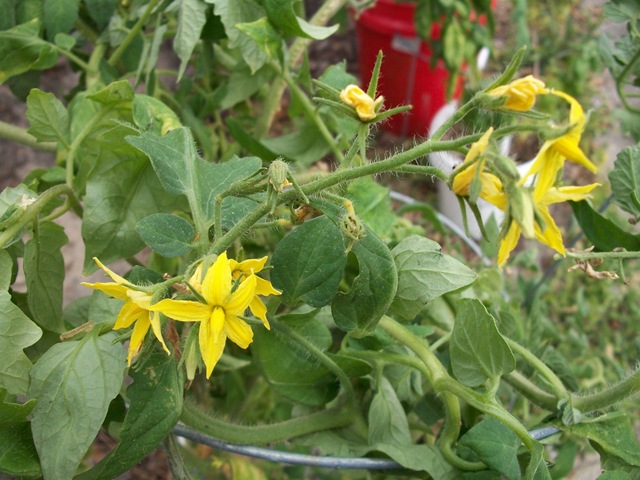 Cherry tomatoes…with Dill and Parsley growing under them..
And last …my bran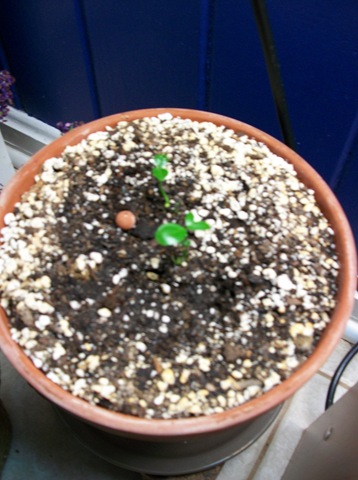 d new little orange trees. They took 3 months to sprout…I about gave up!
Indian law would make criticizing GM crops an imprison-able offense
Posted: March 15, 2010 Filed under: Gardening, Going Green; How and Why..., Non-Toxic Choices Leave a commentHealth Freedom Alliance March 2, 2010
 Criticizing Genetically Modified (GM) products could land you in jail — if the draconian draft Biotechnology Regulatory Authority Bill (BRAB) of 2009, which will be tabled in the current session of the parliament by the UPA government, is passed.
In an unprecedented muzzle on the right to freedom of speech of the citizen, Chapter 13 section 63 of the draft bill says, “Whoever, without any evidence or scientific record misleads the public about the safety of the organisms and products…shall be punished with imprisonment for a term that shall not be less than six months but which may extend to one year and with fine which may extend to two lakh rupees or with both.” The BRAI Bill drafted by the department of bio-technology under the Ministry of Science and Technology comes on the heels of a moratorium on Bt Brinjal announced by the Environment Minister Jairam Ramesh.
“What they are doing is much worse than what Hitler or Mussolini did. Through this bill, they want to take absolute authority. They are behaving like a vendor instead of a regulator,” Pushpa M Bhargava, a member of the Supreme Court appointed Genetic Engineering Approval Committee (GEAC) said.
There are also other provisions in this bill which are disconcerting.
Article 27 (1) of the bill seeks to keep the information related to the research, approval and science of the GM Products out of the purview of the Right to Information ( RTI) Act.
In other words, farmers, NGO’s and Environmental groups that have been on the forefront of the campaign against BT Brinjal and other genetically modified crops, can longer obtain information about it.
Not only that, the three member experts of the Department of Biotechnology will override any existing legislation about GM technology in the states.
The draft bill also states that the BRAI will set up its own appellate tribunal which will have the jurisdiction to hear arguments on the issues concerning biotechnology. In case of any disputes, petitioners can only approach the Supreme Court of India.
“The BRAI bill is more draconian than what the nation faced during the Emergency ‘’ says Devinder Sharma, writer and Food Policy Analyst. “If the Bill was already in force, I would have been in jail.
Jairam Ramesh too would have been in jail for challenging the health and environmental claims of the company developing Bt Brinjal,” he said. The bill demonstrates the extraordinary hold the multinational companies have over the UPA government, he added. Kavitha Kurugunti of Kheti Virasat Mission said that this bill is just a way to silence the voices who are opposed to GM technology.
Non-Toxic Way to Kill Fire Ants
Posted: February 14, 2010 Filed under: Gardening, Non-Toxic Choices Leave a comment 
I know fire ants are picky eaters and any type poison that is effective takes seven feeding steps before the queen receives it. Plus, if the bait is stored in close proximity to any petroleum or fertilizer products they won’t touch it. Contact poisons that are on the market just cause the colony to move away. A well developed colony can be as deep as 30 feet and spread out some 20 to 50 feet from the mound center. This was documented by studies done in the early 60’s when they were first sited in South Alabama.
An environmentally friendly cure for fire ants has been announced by Walter Reeves on his Georgia Gardener radio program.
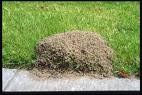
Simply pour two cups of CLUB SODA (carbonated water) directly in the center of a fire ant mound. The carbon dioxide in the water is heavier than air and displaces the oxygen which suffocates the queen and the other ants. The whole colony will be dead within about two days.
Besides eliminating the ants, club soda leaves no poisonous residue, does not contaminate the ground water, and does not indiscriminately kill other insects. It is not harmful to your pets, soaks into the ground. Each mound must be treated individually and a one liter bottle of club soda will kill 2 to 3 mounds. Spread the word.
Creating community is easier than you think.
Posted: February 12, 2010 Filed under: Gardening 1 CommentFrom Good.Is

Is it just me or, is the modern urban neighborhood getting remarkably old-fashioned? In the Los Feliz (locals pronounce this los-FEE-liz) community of Los Angeles where I live, it feels like everything that was old is new (and smart) again. Things my grandparents in Kentucky have always done—checking in on neighbors, sharing a new crop of tomatoes—seem not so much folksy as generally just a good way to live, even if you are in the big city.
1.Turn your front yard into a farm.
Grass is an expensive, water-intensive waste of space. Rip out the sod and start a small front yard farm to produce food for your household and some of your favorite neighbors. Sounds daunting (or don’t have a yard)? Organize some other like-minded urban agrarians and transform a vacant lot into a community garden. You may even get a tax credit.
2. Make every Sunday a block party.
Sundays are lazy time, and the worldwide movement Ciclovia has taken advantage of our weekend sloth. “There’s less traffic on Sunday,” says Tim Joe Linton, one of the organizers of cicLAvia an initiative to bring the car free days to the car capital of the world. Aside from the obvious benefits of music and picnics in the street, letting the bikes take over can be a boon to the local economy. “Many local shops see their business double,” Linton says.
3. Throw a potluck with your neighbors.
All of them. This may mean inviting people you may not know, like, or otherwise find interesting, but that’s what makes this fun: everyone is invited. If you want to ,add some entertainment.
4. Install a bench in front of your house (and create other types of informal public spaces).
Temporary dog parks, hop scotch zones, and dumpster pools work too.
5. Say hi to your neighbors.
Now that one’s not so hard, is it?
Here’s to dynamic neighborhoods, smarter communities, and the treehouse making a comeback. How are you breathing life back into your neighborhood?
Cucumbers Have Sprouted! Finally, a Garden Update…
Posted: February 4, 2010 Filed under: Gardening Leave a comment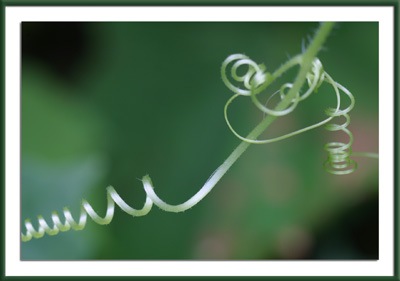 I’ve always liked cucumbers, not loved them..but enjoyed them. Just not to the degree to which I love , say…tomatoes..or onions.. until this year. As I have begun growing them, and making pickles…I have grown to love them. Mainly because they are such beautiful, delightful plants..to grow. They pop right up out of the soil, quickly…looking robust and they just burst forth in growth immediately…and they are so beautiful…the delicate leaves and tiny vines that twist around everything are such a gorgeous shade of green.
Then there are the flowers. The sweetest yellowiest delicate little things, they just make me happy to look at them. I grew them indoors last year, didn’t get much fruit…mainly because I didn’t get the hang of helping them pollinate..but I had hundreds of beautiful flowers in my living room!
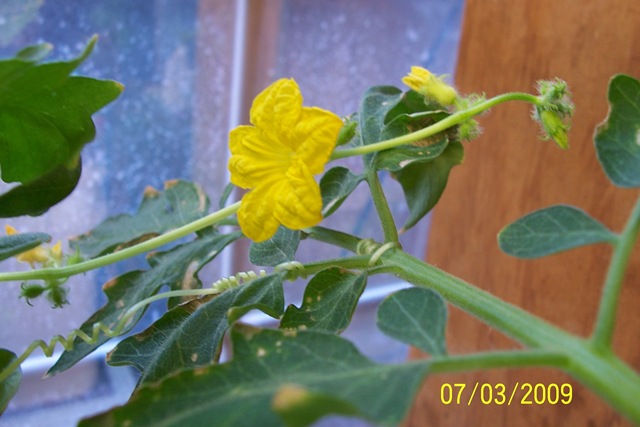
Then I sat a grow bucket on my front step…the plant loved it, it grew up a chain by my front door. All I had to do was reach out and grab one or two.
I used to think February was such a drab month, always overcast and cold…but now inside my house are seedlings popping out; Beefsteak and Roma tomatoes, cucumbers, Swiss chard, beets, scallions, Stevia, lettuces red and green. Outdoors the greens are recovering from the cold of a few weeks ago…

Gotta get these strawberries planted, I’m making growing bags out of burlap, like hanging shoe pocket things…will keep you posted…..
Growing Potatoes in a Container
Posted: January 17, 2010 Filed under: Gardening 22 Comments
Potatoes are not difficult to grow in the ground, they are much easier to grow in containers. And the most practical container for growing potatoes is a half-barrel container.
Make certain that any container that you use has drainage holes in the bottom. If not, drill four 1-inch holes. You will want to set your containers on bricks to elevate them and keep them from direct contact with the soil.
Next, purchase a good potting mix to use in your containers. To this potting mix add about one shovelful of premoistened peat moss to each 1 cubic foot bag of potting material and mix thoroughly. The peat moss provides the potatoes with the acidity they require. Initially you are going to fill each container only half full of the potting mix.
At this point I already have my potatoes sprouting; some sweet potatoes and some new potatoes, sprouted in the kitchen in water.
Fill your container a third full of potting mix-peat-compost mix.
Water the container two or three times a week during the entire growing period. Because of the drainage holes and the rapid draining nature of the peat mixture, overwatering will not be a problem. Let the hose run gently in the barrel until you can see water escaping from the drainage holes.
Try not to disturb the root system too much, and leave some of the small potatoes to mature to full size. When the plants turn yellow and start to dry up, the rest of the potatoes will have reached full size. Pull up the plants and remove the potatoes. Store your potatoes in a cool, dark place. While in storage, if they develop any green sections or sprouts, cut the sections off before cooking.
When the young potato plants emerge through the surface and are about 8 inches tall, fill the remainder of the barrel (partially burying the young plants) to within 3 inches of the top with the other half of the soil mixture.
The potato plants will grow to about 3 feet tall from the soil surface of the container. The container will soon fill with a network of underground stems, bearing many potatoes. When small blossoms appear on the plants, the tiny, tender new potatoes will be ready to harvest. Simply feel around in the container and pick some.
As the potatoes grow, add more soil and compost. After they reach
the top of the barrel, plant a couple of bush beans in each barrel. This
is a companion plant for potatoes. The beans protect the potatoes
against the Colorado potato beetle, and the potatoes protect the
beans against the Mexican bean beetle. Horseradish is also good for
the potato and distasteful to pests. DO NOT co-plant with onions or
garlic.
As soon as the potatoes flower you will find little spuds in the soil.
Pee-Cycling
Posted: January 17, 2010 Filed under: Gardening 2 CommentsAccording to PopSci.com, researchers from Finland are claiming that tomatoes fertilized with urine show a four-fold increase in crop yields. And it doesn’t end there – the same tomatoes also showed higher beta-carotene than unfertilized ones, and much more protein than traditionally fertilized plants. A panel of (presumably unsqueamish) blind tasters also attested to the fact that the flavor was just as good too.
In a way it’s no surprise – studies have already shown that urine in the garden is a good thing, and Josh has given us some guidance on how to garden with pee. But a four-fold increase in fruits?! That’s huge.
And for those wondering why I’m mixing urine with charcoal – there’s some evidence to suggest that DIY biochar can help retain nutrients for longer, and it can also provide a habitat for important microorganisms. I’ll let you know if it works out for me.
Here’s how to fertilize with urine;
When you use urine fertilizer in your garden, make sure to use the urine as soon as you make it. Old urine won’t keep. It will go bad. Don’t apply the urine to the leaves of the plants. The urine needs to go in the soil around it.
If you find yourself, with too much urine, you can always put the urine on the compost pile. It’s the best compost activator there is!
If you have been reading my blog long, you know I use a sawdust toilet and use high heat composting to break it down. You can read about that here;
I use a sawdust toilet, and use this Tupperware pitcher for a urinal. It is easy to use and then I empty it into the compost bin (it’s the best compost activator there is!)
 Or you can get any flat (slim line) pitcher. It fits easily under the sink, out of site. I marked where I fill it to, then where an 1 to 8 ratio is when diluted with water…and water my inside and outside plants.
Here is a great site for learning more about all this; Humanure Handbook
Read also Pee in the Shower, Save your Rivers


 Meal Delivery Service by Millie Barnes