Help NationofChange Stand Up Against Monsanto!
Posted: March 30, 2012 Filed under: Food and it's Impact on Our Health, Gardening, Non-Toxic Choices Leave a commentThe multinational biotech giant Monsanto is the world’s leading producer of genetically modified seeds and crops, responsible for 90 percent of the genetically engineered seed on the United States market. Researchers found that consumption of GMO corn or soybeans may lead to significant organ disruptions in rats and mice-particularly in the liver and kidneys.
Monsanto, the company that brought the world Agent Orange, is also the creator of the best-selling herbicide Roundup, which has spawned over 120 million hectares of herbicide-resistant super weeds while damaging massive amounts of soil.
Monsanto has created several varieties of “superbugs”. Monsanto engineered genetically modified crops containing Bt, a toxin incorporated in GMO crops which has spawned insect populations which are resistant to bio pesticide. Insect populations have and are mutating to resist the bio pesticide. So far, at least 8 insect populations have developed resistance, with 2 populations resistant to Bt sprays and at least 6 species resistant to Bt crop as a whole. Farmers are therefore forced to use even more pesticides to combat the resistant bugs.
Monsanto may be destroying the planet’s soil. Certain bacteria essential as “food starters” such as L cremoris, used in raw and fermented dairy products have begun to disappear in certain geographic regions. The case has been found to be an element of Monsanto’s Roundup herbicide, glyphosate that is destroying and/or altering the microbial biodiversity of the soil, jeopardizing the fertility of the entire biosphere.
Help us speak truth to power. Donate what you can afford to support NationofChange.
Monsanto has been caught running “slave-like” rings, holding off pay, and forcing undocumented workers to buy their food only from the Monsanto company store. The company not only “hired” all of the workers illegally, but also prevented them from leaving the farm premises and withheld their salaries.
Monsanto effectively owns most US diplomats, and is currently using this political capital to start “Trade Wars” against nations opposed to Monsanto’s destructive policies. France, Hungary, and Peru are a few of the countries that have decided to stand up to Monsanto, going as far as destroying 1000 acres of maize found to have been grown with GMOs.
Peru has passed a monumental 10-year ban on modified foods and French legislatures are planning to launch new restrictions regarding the use of Monsanto’s 810 maize on French soil.
Monsanto poses one of the greatest threats on the planet to human health and the environment. NationofChange is teaming up with activists across the country for an ongoing campaign to fight back against one of the worst corporations in the world.
The first step: raise awareness about Monsanto’s crimes against human health and the environment.
This month, we are raising $6,200 for an educational and enlightening billboard campaign targeted in Monsanto’s home county of St. Louis Missouri.
Learn more at NotionofChange.org/armsrace

A 30 Day Guide to Healing, lose 20 pounds this Month!
Posted: March 28, 2012 Filed under: Food and it's Impact on Our Health Leave a comment

Green Man Gourmet in Avondale
Posted: March 26, 2012 Filed under: Food and it's Impact on Our Health Leave a comment
I recently had the pleasure of offering a tasting of my Gluten and Lactose Free Desserts in the Green Man Gourmet store in lovely Avondale. The tasting was a huge success. Many people have told me about the store and friends have brought be some samples of their spices, so I was very pleased to make it in finally. The store is beautiful!, the owner a delight! Never have I seen spices and herbs so beautifully displayed…the array of salts alone was awesome.
I Here are a few of the salts (hover over to see names of each salt)…
I got some Bonfire Smoked Salt and went straight home and cooked up a grass fed beef hamburger with it. I was blown away by the flavor, best hamburger I have ever had!



 Orchid Oolong from Green Man Gourmet
I have been looking for a source for Oolong tea and tried this one. It is one of the best teas I have ever had, flowery and rich, a very relaxing concoction. I can’t wait to go back and try some of the others…he has a wonderful section.
Also available are some wonderful accessories; black iron pans both new and used, high quality stainless steel pans and utensils, tea making accessories, beer and wines, chesses. When I was in they were building a display for produce.
Please visit the store and the Website- Green Man Gourmet.
They will be offering my Gluten and Lactose Free Desserts SOON!!

Chocolate Mousse
Posted: March 25, 2012 Filed under: Food and it's Impact on Our Health Leave a comment
8 oz. Organic, Fair trade semisweet chocolate chips
8 large organic eggs
1 tsp. vanilla extract
1/4 C plus 2 Tablespoon confectioners’ sugar
1. Preheat the oven to 350. Coat an 8 1/2″ spring form pan with butter and line the bottom with parchment.
2. Melt the chocolate in the microwave, a double boiler or a bowl set over a saucepan of simmering water. (easiest)
3. Separate the yolks from the whites and transfer the yolks to a bowl. Beat the yolks until thick and pale. Gradually beat in the chocolate until blended. Fold in the vanilla.
4.; In a separate bowl, beat the whites with 1/4 C sugar until soft peaks form. Fold 1/4 of the whites into the chocolate mixture and then fold in the remaining whites. Pour the mixture into the prepared pan and bake for 20-25 minutes, until set but still slightly jiggly in the center. Cool in the pan to room temp before cooling completely (still in the pan), in the fridge. The dusting of the remaining 2 Tablespoon sugar is optional.
The timing can be a bit tricky. I’m still attempting perfection with this. Gas via electric can make a difference. My first I baked 23 min and it was pretty well set but through the week didn’t get rubbery.
This recipe was shared by Flo Cohen Simons via Robin Takes 5 which is a book available on Amazon.
Garden Update- Building More Grow Buckets
Posted: March 24, 2012 Filed under: Gardening Leave a comment
Most of the plants I started under grow lights I got into grow buckets today. I had to build 6 new ones this week.
From bottom of pic on left; an orange tree, Roma tomatoes, strawberries, cherry tomatoes. Off to left; Malabar spinach, then Swiss chard, beets, more Swiss chard, and in blue barrel is sweet potatoes.
So this week I will get more 5 gallon buckets and plant the cucumbers, kale, larger cukes, more Malabar spinach and spinach.

Malabar spinach is one of the most beautiful plants I’ve grown. It grows in a spiral and twists around the supports. The berries that came off of it last year sprout really easy so I have years worth of plants!
Here last years plant; I only got one, I ordered it from Neem Tree Farm. This is where I get Neem Powder for brushing my teeth.
My Book, The Criterion Diet Is Available for Sale
Posted: March 24, 2012 Filed under: Food and it's Impact on Our Health Leave a commentMy 30 Day Guide to Great Nutrition and Eating gluten and lactose fee is available for SALE on Smashwords.

Click HERE to Buy my Book…
Red meat halves risk of depression
Posted: March 24, 2012 Filed under: Food and it's Impact on Our Health Leave a comment
The Australian government recommends eating 65 -100g of lean, red meat three to four times a week Photo: ALAMY
Experts admitted surprise at the findings because so many other studies have linked red meat to physical health risks.
The team made the link after a study of 1000 Australian women.
Professor Felice Jacka, who led the research by Deakin University, Victoria, said: “We had originally thought that red meat might not be good for mental health but it turns out that it actually may be quite important.
“When we looked at women consuming less than the recommended amount of red meat in our study, we found that they were twice as likely to have a diagnosed depressive or anxiety disorder as those consuming the recommended amount.
“Even when we took into account the overall healthiness of the women’s diets, as well as other factors such as their socioeconomic status, physical activity levels, smoking, weight and age, the relationship between low red meat intake and mental health remained.
“Interestingly, there was no relationship between other forms of protein, such as chicken, pork, fish or plant-based proteins, and mental health. Vegetarianism was not the explanation either. Only nineteen women in the study were vegetarians, and the results were the same when they were excluded from the study analyses.”
Professor Jacka, an expert in psychiatric health, believed the diet of the sheep and cattle was relevant.
“We know that red meat in Australia is a healthy product as it contains high levels of nutrients, including the Omega-3 fatty acids that are important to mental and physical health,” she said.
“This is because cattle and sheep in Australia are largely grass fed. In many other countries, the cattle are kept in feedlots and fed grains, rather than grass. This results in a much less healthy meat with more saturated fat and fewer healthy fats.”
But eating too much red meat could be as bad for mental health as not eating enough.The Australian government recommends eating 65 -100g of lean, red meat three to four times a week.
“We found that regularly eating more than the recommended amount of red meat was also related to increased depression and anxiety,” Professor Jacka added. “We already know that the overall quality of your diet is important to mental health. But it seems that eating a moderate amount of lean red meat, which is roughly three to four small, palm-sized serves a week, may also be important.”
The results of the study are published in the journal Psychotherapy and Psychosomatics.The Department of Health recommends consuming no more than 70g of red meat a day – the equivalent of a Big Mac burger. ends
Originally posted in – The Telegraph
Grass Fed Meat: our true environmental savior
Posted: March 22, 2012 Filed under: Food and it's Impact on Our Health Leave a comment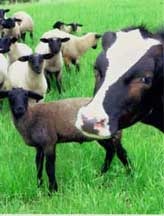
This article was originally published here and is part of the January 2009 round up.
How many times have you heard that we need to eat more vegetarian fare to curb Climate Change? Greepeace and even David Suzuki put it in their top ten actions we can take. It seems every green magazine I pick up, every green blog I read, I’m shamed for living as what my body is designed to be, an omnivore. This makes me feel very sad and a little angry. Here’s why:
- The current population of cattle in the US is only marginally more than the numbers the Native Bison (or Buffalo) enjoyed before Europeans arrived: 96 million cattle have replaced most of the estimated 60 to 100 million Bison that existed in the 19th century. How could there be too many cattle now? This is how..
The figures Suzuki and Greenpeace are working from actually reveal what industrial factory farming is using and outputting. The ancient practice of subsistence grass farming is a totally different picture. Much of the resources used for the beef industry are used in the production of grains fed to confined cattle. There is no reason for this except to boost the bottom line of ‘agricorp’ companies. No ruminant should be eating grain or soy. Industrial agriculture only does so because governments subsidise their feed. - It is very easy to throw about grandiose, knee jerk recommendations which get headlines but it is Greenpeace’s very followers who will suffer from living by them. I live in Byron Bay, some call it a vegetarian paradise. Australia’s modern affair with vegetarianism began right here, more than 30 years ago. Looking around me, I witness first hand the ravages such a diet leaves in it’s wake. Young, idealistic 20 somethings may not notice immediately the affects of such a diet. However, coming into their 50s and 60s now, I see many long time vegetarians; exhausted, overwhelmed and caffeine addicted from years of underNourishing themselves. (BTW It takes 140 Litres of water to make enough coffee for one cup. I challenge you to find a vegetarian who isn’t caffeine addicted. I haven’t yet.)
Many lose their creativity and the naturally buoyant, positive attitude which is our birthright. Many wind up, infertile, unmotivated, ineffective and resentful without knowing why. Greenpeace needs robust, energetic, creative people to work with them toward change. Their recommendations threaten to deny them and our Earth of just this. - Grass fed, properly managed animal foods are actually a great way to sequester many billions of metric tonnes of carbon from the atmosphere.
To be more responsible, Greenpeace should recommend we boycott confined, grain fed animal foods and demand grass fed animal foods. Is that too complicated for our ‘dumbed down’ population?
Some Facts about Grass Fed Meat
- Grazing land comprises more than half the total land surface of the Earth.
- Soil organic carbon is the largest reservoir in interaction with the atmosphere. It contains 82% of terrestrial carbon.
- Forests can be net carbon emitters in their early stages and take many years to reach their sequestration potential
- “An acre of pasture can sequester more carbon than an acre of forest.” We can offset the nations entire emissions, simply by planting more grass either as winter crops or instead of crops. – Dr Chistine Jones of the Carbon Coalition.
- “Soil represents the largest carbon sink over which we have control. Improvements in soil carbon levels could be made in all rural areas, whereas the regions suited to carbon sequestration in plantation timber are limited.” – Dr Christine Jones
- 50% to 66% of the historic carbon loss (42 to 78 gigatons of carbon) was created by the world’s poorly managed, degraded agricultural soils and is therefore ripe to become the world’s greatest carbon sink.
Difference between carbon farming pasture (right) and ordinary pasture: courtesy of the Carbon Farmer’s of Australia Association.
- Introducing carbon credits for grass farmers who manage their grazing so they actually sequester carbon will also help improve water retention and soil erosion issues.
Raising grain-fed cattle is resource-intensive. It takes more than 35 fossil fuel calories to create one calorie of energy from grain-fed meat. A cow must consume about 8 pounds of grain (3.6kg) in order to yield one pound of meat (450gm), grain which is grown with fossil fuels and pesticides. Much of the exorbitant water use in grain feeding CAFOs is for cleaning the tonnes of waste, waste that in grass farming is a vital resource for soil fertility. Why do this when you can just let the cow go on the grass? Answer: corporate ‘bottom line’ industrial farming.
The ‘methane cattle fart’ statistic we hear all the time is taken from the writings of Dr Andrew Moxey, a widely respected economist who exposed modern agriculture’s contribution to emissions. He says “methane from livestock accounts for 20 per cent of green house gas emissions”, but reading just a little further, you’ll find he also says: “nitrous oxide from fertilizer adds up to 26 per cent [and] carbon dioxide from ploughing up grassland is the major contributor…45 per cent“.
What is on the agenda of people who continually misquote Moxey?
What environmentalists are saying is we should eat the grains instead of the cattle. What they don’t realise is neither we nor the cattle need the grains. They don’t realise this because they’ve been indoctrinated into the idea that we can (and should) eat a grain based diet. No mind that our ancestors never did. No mind that following a grain based diet has brought us to the point where 8% of the western population suffer diabetes (this is expected to quadruple by 2050). No mind that by 2020, 80% of all Australian adults and a third of all children will be overweight or obese. 37% of American Children are already overweight and the CDC predict that figure will be 50% by 2020. It also predicts that the generation of children who are currently under 10 years old are unlikely to outlive their parents.
Even so the USDA still recommends we continue with the sudden diet change that they initiated post world war II. (Please note the USDA food pyramid is created by the US Department of Agriculture – not the US department of Nutrition nor the US department of Health.) Before their self serving dietary recommendations, humans had never tried to consume 6 servings of grain foods. That’s three sandwiches a day. We couldn’t grow, harvest and process that much grain by hand. Only with the advent of the petrol driven harvest combine and industrial processing (dollars for the new manufacturing giants of the 50s) could we even consider eating this much grain, let alone feed it to our livestock. So why is it now the only other option to vegetarianism?
Risks: Sugary Drinks Linked to Heart Disease
Posted: March 22, 2012 Filed under: Food and it's Impact on Our Health Leave a commentA man who drinks one 12-ounce sugar-sweetened drink a day sharply increases his risk for heart disease, according to a large epidemiological analysis.
Researchers analyzed data from a prospective study of 42,883 male health professionals, ages 40 to 75. The men responded to diet questionnaires every four years, and more than 18,000 of them provided blood samples.
Over 22 years, 3,683 of the men had heart attacks. Even after controlling for factors like smoking, exercise and family history, the scientists found that men who drank the sweetened beverages most often were 20 percent more likely to have had a heart attack than those who drank the least.
They calculated that one serving daily of a sugar-sweetened beverage was linked to a 19 percent increase in the relative risk of cardiovascular disease. The study was published online in the journal Circulation last week.
Sugar-sweetened drinks were linked with adverse changes in levels of HDL,triglycerides and C-reactive protein. Dr. Frank B. Hu, senior author of the analysis and a professor of medicine at Harvard, said that a study a little over two years ago found similar results in women.
Is diet soda a good alternative? No, said Dr. Hu.
“Some studies have found a relationship between diet soda and metabolic disease,” he said.


 Meal Delivery Service by Millie Barnes