Cauliflower Rice
Posted: November 8, 2015 Filed under: Recipes | Tags: #Beyond-Paleo, gluten-free, Paleo Leave a comment
Cauliflower Rice
Serving Size : 4
1/2 heads organic cauliflower
1 whole onion — diced
1 1/2 tablespoons butter
1 tablespoon garlic granules
1/2 tablespoon thyme
salt and pepper
Sauté onion in butter until golden.
Place florets in bowl of food processor in batches. Process until evenly chopped but not completely pulverized.
Remove rice to a large bowl and continue processing florets in batches until all florets are “riced”.
Heat butter in pan over medium high heat and add cauliflower rice. Fry it, with onions, garlic powder, thyme, salt and pepper for about 4 or 5 minutes, stirring gently, often to keep it from sticking.
Chocolate Brownie Cookies
Posted: October 30, 2015 Filed under: Recipes | Tags: #Beyond-Paleo, #Paleodesserts, dairy free, gluten-free Leave a comment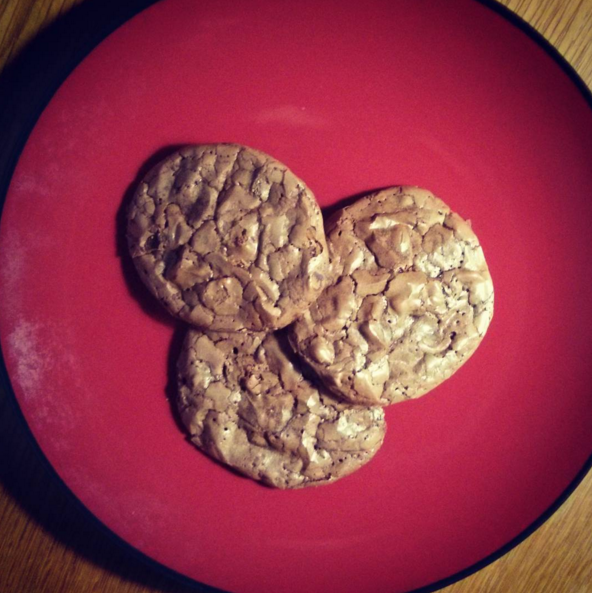
Chocolate Brownie Cookies
Serving Size : 50
1/4 cup all-purpose flour
1/4 teaspoon baking powder
1/8 teaspoon salt
2 large eggs
2/3 cup sugar
1/2 tablespoon brewed espresso
1 teaspoon vanilla extract
2 tablespoons unsalted butter
5 ounces extra-bittersweet chocolate — chopped
2 ounces unsweetened chocolate — chopped
3/4 cup mini chocolate chips
1) Preheat oven to 375°F. Line 2 baking sheets with parchment paper.
2) In a small bowl, whisk together the flour, baking powder, and salt. Set aside.
3) In the bowl of an electric mixer, briefly whip the eggs to break them up. Add the sugar, espresso, and vanilla and beat on high speed for 15 minutes, until thick.
4) While the eggs are whipping, place the butter in the top of a double boiler, or in a small metal bowl suspended over a pot of simmering (not boiling) water, and scatter the extra-bittersweet and unsweetened chocolate on top. Heat until the butter and chocolate melt. Remove the boiler top from over the water and stir the chocolate and butter until smooth.
5) Gently fold the chocolate mixture into the egg mixture until partially combined (there should still be some streaks). Add the flour mixture to the batter and carefully fold it in. Fold in the chocolate chips.Chill the batter in the freezer for a half hour.
6) Drop the batter by heaping teaspoonfuls onto the prepared baking sheets and bake until puffed and cracked, 8 to 9 minutes. Cool on a wire rack before removing from the baking sheets.
Variation; Substitute 1/2 cup chopped toasted nuts or dried sour cherries for an equal amount of the chocolate chips.
3-Ingredient Mixture to Slow the Spread of Cancer
Posted: October 7, 2015 Filed under: Food and it's Impact on Our Health, Non-Toxic Choices Leave a comment3-Ingredient Mixture to Slow the Spread of Cancer: “There is no other natural ingredient in the world which is more effective for reducing inflammation in the body than using turmeric. American doctor, Carolyn Anderson, gave the public a very simple recipe that can prevent cancer. It is a mixture of three easily available ingredients. According to the words of Doctor Anderson, these findings are created on the basis of a two thousand years old tradition of using these ingredients in eastern India and are now confirmed by the latest studies and researches of the western medicine. Anderson claimed that if you use these three ingredients every day, there is almost no possibility to develop cancer.
Mix These Three Ingredients and You will not Develop Cancer
The Recipe:
Mix 1/4 teaspoon of turmeric with 1/2 teaspoon of olive oil. Add a greater pinch of freshly grounded pepper in it. Mix these three ingredients in a cup. You can consume just the mixture, or you can also add it in various dishes, soups and salads. However, you should be careful not to boil these ingredients too much. If you use them in cooked dishes, you should add them at the very end. If you consume just the mixture, you should add some water.
But what exactly prevents the cancer and the spreading of cancer? The doctor gave the answer on her blog.
‘All answers lie in the turmeric. The turmeric is a spice in the form of a yellow powder, which is one of the components of curry. Its anti-inflammatory abilities are incredibly powerful. There is no other natural ingredient in the world which is more effective for reducing inflammation in the body than the turmeric. The molecules in the turmeric which cause this anti-inflammatory effect are called curcumin.
Read Also: Here’s How Brazilian Wasp Venom Destroys Cancer Cells
Most recent studies have revealed that the turmeric prevents many kinds of cancer, such as colon cancer, prostate cancer, brain cancer and breast cancer. In the experiments applied to mice, it was shown that when the mice were exposed to carcinogenic chemicals, as long as they were using turmeric, the developing of various types of cancer was completely prevented. This ingredient has only one flaw, and that is that the turmeric is hard to dissolve in the digestive tract. Therefore, the best way to cure and prevent cancer is to use the combination of turmeric with pepper or ginger. According to the researches, the pepper increases the effectiveness of turmeric as much as 200 percent.’
Anderson also emphasized that you should use this mixture several times every day in order to prevent cancer successfully, but to kill cancer cells as well. ‘Use it as often as possible’, says Anderson, and adds that this mixture, or the natural remedy against malignant cancers, has no side effects.
“
Why "Everything in Moderation" Doesn’t Work
Posted: September 24, 2015 Filed under: Food and it's Impact on Our Health | Tags: #BeyondPaleo, #toxicfoods, Paleo Leave a commentEverything in moderation—it seems like such a good idea. It “feels” right because it promotes the idea of a balanced approach to nutrition in a nice, neat, simple saying. But does it help us or hurt us?
Let’s look at the term moderation, which is defined as: restraint; avoidance of extremes or excesses; temperance. Is this really how most people act out moderation with nutrition?
For many people, moderation looks like this:
- Day 1: A doughnut at the office
- Day 2: A low-fat pastry with their “coffee” (meaning a couple shots of espresso in a heated milkshake of ingredients)
- Day 3: Pizza night
- Day 4: Cupcakes at the birthday party at the office
- Day 5: A handful of chocolates from the candy dish
- Day 6: A couple glasses of wine at a wine and cheese party
- Day 7: Hot wings and a couple beers watching the game with friends
It’s been more than a week since this person had that doughnut, so those wings and beers a week later “feels” like moderation. But it isn’t. When you are eating something from the same category of non-health foods once day, it’s not a treat—it’s a habit. And your body is built on your habits. Having any type of junk food once a day isn’t moderation, it’s a lifestyle.
Superfoods and Supervillians

There’s this relatively modern concept of “superfoods,” but there’s really no such thing. For most of human history, food was just food. There have been no newly discovered foods that act like nutritional superheroes in our bodies. Yes, kale is healthy, but it is healthy in the standard ways our bodies expect and it’s always been healthy. It hasn’t become “Kale the Superfood” in the last decade. Healthy food should be our normal. It’s not super; it is what is expected.
In contrast, on the junk-food side of things, there are countless new and sometimes very distorted freaky foods that act like “supervillains” in our bodies. There are no superheroes in the world of food—just a lot of very good but ordinary people, along with a number of supervillains. It takes a lot of work and time by a lot of good, ordinary people to fight the destruction caused by just a few supervillains. While everything in the ”healthy” category is normal, in the ”unhealthy” category, most foods have significant, powerful, deleterious effects that are not solved simply by eating healthy food at the next meal.
The major problem is that there are all kinds of weird “food” products (they might be edible, but they aren’t really food) with harmful chemicals, sugars, and fats that can disrupt your physiology. And the resulting dietary imbalances rapidly generate inflammation and a kind of hormonal static that can take weeks or months to clear.
If you eat healthfully most of the day, but have a treat each day, you’re actually creating an imbalance. And this leads to another problem.
I’ve Been Good, Now I Can Be Bad
When you feel like a saint, the idea of self-indulgence doesn’t feel wrong. It feels right—like you earned it. “Moral licensing” is a dangerous phenomenon. When you do something good, you feel good about yourself. This means you’re more likely to trust your impulses, which often means giving yourself permission to do something bad. If you tell yourself that you’re “good” when you eat healthfully and “bad” when you don’t, then you’re more likely to eat junk tomorrow if you ate good food today.
We need to stop self-judging our morals based on our food choices—it destroys our ability to have a healthy relationship with food. If you eat a healthful food, you are getting more healthful—you are neither a good nor bad person.
It’s Not Just You
I have learned too much about how the brain and body work, and coached too many people over the years, to accept “everything in moderation” as a workable concept. Like any overly simplistic attempt to reduce a complex aspect of human physiology to a simple rule, it just does not work for the majority of people.
And the continued belief in outdated, ill-conceived concepts like this one results in massive psychological damage to people struggling to find health: If it’s so simple, yet elusive for you, there must be something wrong with you. The lack of progress can get internalized as a personal flaw when it is really a conceptual flaw arising from simplifying something that just isn’t that simple.
What it all boils down to: We need copious amounts of healthy food and a small amount of food with little to no value. Moderation as it is commonly used will result in moderately unhealthy people instead of thriving people.
The Takeaway
Each day we walk through a world that presents us with dozens or even hundreds of temptations and visual triggers for junk foods. We can’t escape seeing it and the constant visual stimuli can weaken our resolve. If we only eat an unhealthy food once instead of the other 99 times we’ve come across it every day, it may “feel” like moderation, but your physiology works the way it works. Consuming junk food daily—which is not moderate, by definition—erodes health and counteracts many of the other healthy choices (like exercising) you may be making on a regular basis.
This post is a guest post written by Jonathan Ross that originally appeared on ACEFitness.org. Named the 2010 IDEA Personal Trainer of the Year, Ross serves as ACE senior consultant for personal training.
“Superfoods” Aren’t Super. They Should Be Your Normal Foods
Posted: September 24, 2015 Filed under: Food and it's Impact on Our Health | Tags: #Beyond-Paleo, #Primaldiet, #superfoods Leave a comment
It’s easy to pat yourself on the back for the one vegetable you ate today—and if you normally eat zero, by all means celebrate that healthy eating victory. But singling out foods as “super” or healthy may backfire.
Instead, we should think of healthy foods as normal, and eating that veggie should be a non-event. Jonathan Ross explains at Greatist:
Yes, kale is healthy, but it is healthy in the standard ways our bodies expect and it’s always been healthy. It hasn’t become “Kale the Superfood” in the last decade. Healthy food should be our normal. It’s not super; it is what is expected.
If you feel like eating something healthy is an accomplishment, you’re likely to think it’s fine to have some junk food later—after all, you did a healthy thing and an unhealthy thing, so on average you’re doing fine. Instead, we should recalibrate our expectations: see the less-optimal choices for what they are, and make healthy the new normal.
Using Microgreens in your Diet
Posted: September 17, 2015 Filed under: Food and it's Impact on Our Health, Gardening | Tags: #microgreens, #smoothies, Paleo 3 Comments
I posted this week about the nutritional benefits of microgreens. They contain 4 to 10 times the nutrition as sprouts or their full grown versions.
Many people suggest that you use them in salads or to cook with. I think the best way of using them are in smoothies. You can eat more of them and you are not exposing them to heat. They are easy to grow yourself in the kitchen window or for families, under grow lights.
I will begin selling trays of these microgreens soon by making them available for delivery on the Meal Delivery Service. Look for the addition to the weekly menu in your email.
Save Yourself Some Time and Don’t Salt That Eggplant
Posted: September 14, 2015 Filed under: In The Kitchen with Millie- How To's | Tags: #BeyondPaleo, #savingtime, Paleo Leave a comment
Every eggplant recipe I’ve ever encountered has instructed me to salt the big purple fruit before cooking to “draw out bitter compounds,” but it turns out that’s not really necessary.
According to Epicurious, this thinking is leftover from a time when eggplants were much more bitter than what you’ll find in the store today; the bitterness has been bred out of them.
Full disclosure: I’ve only ever salted eggplant once before I’ve cooked it, the first time I cooked it. I had never tasted a difference between salted and not, but it’s nice to have my sloth validated.
3 Ways to Work Mega-Nutritious Microgreens into Your Diet
Posted: September 14, 2015 Filed under: Food and it's Impact on Our Health | Tags: #BeyondPaleo, #microgreens, Paleo Leave a comment
From KnowMoreTV.com
By Jessica DeCostole, RDN
First came the popular trend of baby spinach and kale, and now the world is turning its attention to even younger seeds called microgreens—the first shoots of leafy plants that are less than 14 days old. You may have spotted them at your local farmers market or caught a celebrity chef garnishing a meal with them on the Food Network.
These tiny plants are packed with BIG nutrition. In fact, a recent study published in The Journal of Agricultural and Food Chemistry found that microgreens from 25 nutritious vegetables (such as cilantro, celery, red cabbage, green basil and arugula) contained higher concentrations of disease-fighting Vitamins E and K and carotenoids than fully mature varieties.
So how do these infant greens develop become so nutrient-dense in such a short period of time? Microgreens are planted in soil and absorb its minerals as they grow which increases their nutritional content (unlike sprouts, for example, which are grown only using water). Here are three easy ways to start working these tiny but mighty greens into your diet. They’ll not only add flavor to your meals, but tons of vitamins too!
Play with garnishes
These greens look beautiful atop a caprese salad of mozzarella and tomatoes, or served with a piece of chicken or fish. It just adds a touch of color as well as a very strong and concentrated taste of the original vegetable. And as the fall approaches, don’t forget to add microgreens to complete a creamy soup like butternut squash.
Make a windowsill garden
While microgreens are starting to be sold in large supermarkets, you may still need to head to your local farmers market to get them—or you can grow your own! Check out this six step how-to guide. Since microgreens are cut as soon as the seeds sprout, you will see the fruits or ‘greens’ of your labor quickly and be able to enjoy what you grow.
Switch up your lunch
While it would be hard to make a whole salad base with microgreens, you can easily mix some in with your baby spinach or romaine lettuce base to add unexpected flavors to your lunch. The tiny leaves and stems also make a great extra topping on all types of sandwiches and add a nice crunch.
Jicama, Red Pepper Salad with Toasted Cumin Dressing
Posted: September 13, 2015 Filed under: Recipes | Tags: #BeyondPaleo, #salads Leave a comment
Jicama, Red Pepper Salad with Toasted Cumin Dressing
Serving Size : 4
1 large jicama
1 jar roasted red pepper — sliced
1 medium red onion — thin half moons
1 bunch scallion — thin diagonal cut
1/4 cup cilantro — chopped
Dressing:
3 tablespoons lime juice
1 teaspoon cumin — toasted
1 teaspoon toasted sesame oil
salt and pepper — to taste
1 teaspoon garlic powder
1) Peel jicama and slice in to medium matchsticks. Cut red peppers into matchsticks.
2) Blend all dressing ingredients in the blender.
3) Combine all ingredients and let stand for about 20 minutes before serving.
Do Microgreens Have More Nutrition?
Posted: September 9, 2015 Filed under: Food and it's Impact on Our Health | Tags: #BeyondPaleo, #microgreens, #Primaldiet, Paleo Leave a comment
From NutrionFacts.org
USDA researchers recently published a study assessing the nutrition content of 25 commercially available microgreens, seedlings of vegetables and herbs that have gained popularity in upscale markets and restaurants. Just a few inches tall, they boast intense flavors and vivid colors, but what about their nutritional content? No one knew until this new study came out.
We’ve known that baby spinach, for example, have higher levels of phytonutrients than mature spinach leaves, but what about really baby spinach, just a week or two old?
Microgreens won hands down (leaves down?), possessing significantly higher nutrient densities than mature leaves. For example, red cabbage microgreens have a 6-fold higher vitamin C concentration than mature red cabbage, and 69 times the vitamin K.
Microgreens are definitively more nutrient dense, but are often eaten in small quantities. Even the healthiest garnish isn’t going to make much of a difference to one’s health. And microgreens may go for $30 a pound! But BYOM—birth your own! You can have rotating trays of salad you can snip off with scissors. It’s like gardening for the impatient—fully grown in just 7 to 14 days! If that’s too long, what about sprouting? See my video Antioxidants Sprouting Up.
Homemade sprouts are probably the most nutrition-per-unit-cost we can get for our money. See Biggest Nutrition Bang for Your Buck, where they beat out the previous champ, purple cabbage (Superfood Bargains). Broccoli sprouts are probably the best.


 Meal Delivery Service by Millie Barnes