Low Carb French Dressing
Posted: October 20, 2016 Filed under: Recipes Leave a comment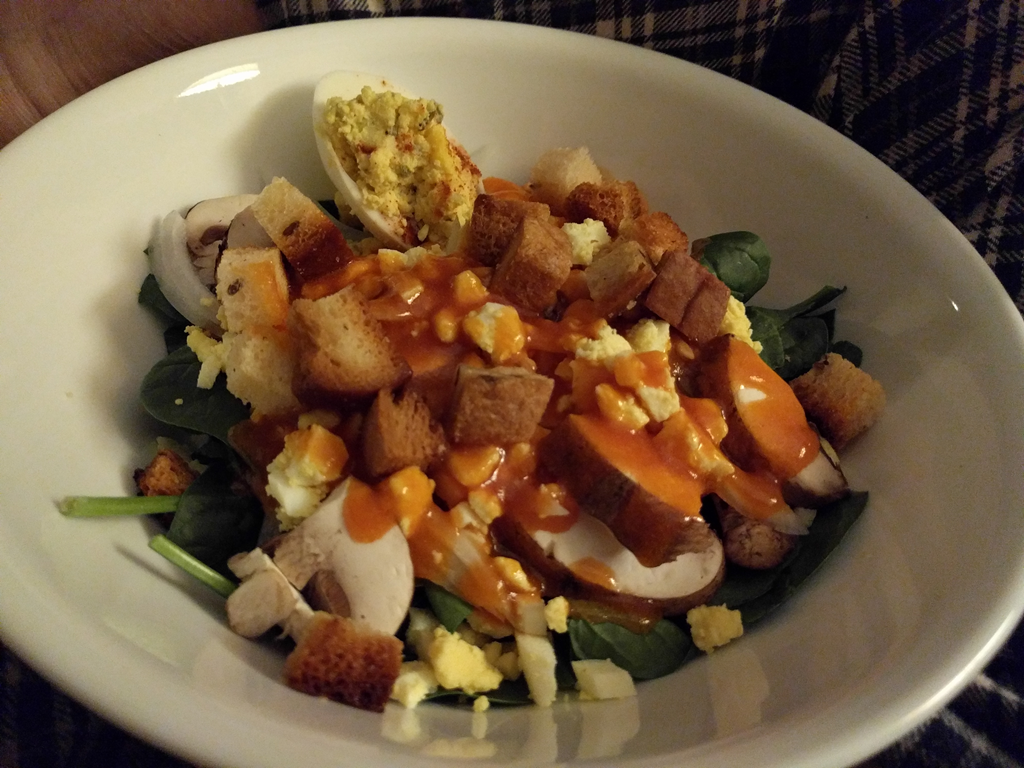
Makes 16 ounces
3/4 cups olive oil
1/2 cup apple cider vinegar
3/4 teaspoons salt
1/2 teaspoon garlic powder
1/3 teaspoon stevia
1 Tablespoon Worcestershire sauce
salt and pepper
1 cups low sodium ketchup
cayenne — to taste
Blend all ingredients in the blender
Preventing Alzheimer’s Disease Is Easier Than You Think
Posted: October 14, 2016 Filed under: Food and it's Impact on Our Health Leave a commentPsychology Today– Science shines new light on root cause of memory problems.
Posted Sep 07, 2016

Do you have Insulin Resistance?
If you don’t know, you’re not alone. This is perhaps the single most important question any of us can ask about our physical and mental health—yet most patients, and even many doctors, don’t know how to answer it.
Here in the U.S., insulin resistance has reached epidemic proportions: more than half of us are now insulin resistant. Insulin resistance is a hormonal condition that sets the stage throughout the body for inflammation and overgrowth, disrupts normal cholesterol and fat metabolism, and gradually destroys our ability to process carbohydrates.
Insulin resistance puts us at high risk for many undesirable diseases, including obesity, heart disease, cancer, and type 2 diabetes.
Scarier still, researchers now understand that insulin resistance is a powerful force in the development of Alzheimer’s Disease.
What is insulin resistance?
Insulin is a powerful metabolic hormone that orchestrates how cells access and process vital nutrients, including sugar (glucose).
In the body, one of insulin’s responsibilities is to unlock muscle and fat cells so they can absorb glucose from the bloodstream. When you eat something sweet or starchy that causes your blood sugar to spike, the pancreas releases insulin to usher the excess glucose out of the bloodstream and into cells. If blood sugar and insulin spike too high too often, cells will try to protect themselves from overexposure to insulin’s powerful effects by toning down their response to insulin—they become “insulin resistant.” In an effort to overcome this resistance, the pancreas releases even more insulin into the blood to try to keep glucose moving into cells. The more insulin levels rise, the more insulin resistant cells become. Over time, this vicious cycle can lead to persistently elevated blood glucose levels, or type 2 diabetes.
Insulin resistance and the brain
In the brain, it’s a different story. The brain is an energy hog that demands a constant supply of glucose. Glucose can freely leave the bloodstream, waltz across the blood-brain barrier, and even enter most brain cells—no insulin required. In fact, the level of glucose in the cerebrospinal fluid surrounding your brain is always about 60% as high as the level of glucose in your bloodstream—even if you have insulin resistance—so, the higher your blood sugar, the higher your brain sugar.
Not so with insulin—the higher your blood insulin levels, the more difficult it can become for insulin to penetrate the brain. This is because the receptors responsible for escorting insulin across the blood-brain barrier can become resistant to insulin, restricting the amount of insulin allowed into the brain. While most brain cells don’t require insulin in order to absorb glucose, they do require insulin in order to process glucose. Cells must have access to adequate insulin or they can’t transform glucose into the vital cellular components and energy they need to thrive.
Despite swimming in a sea of glucose, brain cells in people with insulin resistance literally begin starving to death.
Insulin resistance and memory
Source: Suzi Smith, used with permission
Which brain cells go first? The hippocampus is the brain’s memory center. Hippocampal cells require so much energy to do their important work that they often need extra boosts of glucose. While insulin is not required to let a normal amount of glucose into the hippocampus, these special glucose surges do require insulin, making thehippocampus particularly sensitive to insulin deficits. This explains why declining memory is one of the earliest signs of Alzheimer’s, despite the fact that Alzheimer’s Disease eventually destroys the whole brain.
Without adequate insulin, the vulnerable hippocampus struggles to record new memories, and over time begins to shrivel up and die. By the time a person notices symptoms of “Mild Cognitive Impairment” (pre-Alzheimer’s), the hippocampus has already shrunk by more than 10%.
The major hallmarks of Alzheimer’s Disease—neurofibrillary tangles, amyloid plaques, and brain cell atrophy—can all be explained by insulin resistance. A staggering 80% of people with Alzheimer’s Disease have insulin resistance or full-blown type 2 diabetes. The connection between insulin resistance and Alzheimer’s Disease is now so firmly established that scientists have started referring to Alzheimer’s Disease as “Type 3 Diabetes.”
This does not mean that diabetes causes Alzheimer’s Disease—dementia can strike even if you don’t have diabetes. It’s more accurate to think of it this way: Insulin resistance of the body is type 2 diabetes; insulin resistance of the brain is type 3 diabetes. They are two separate diseases caused by the same underlying problem: insulin resistance.
Are you already on the road to Alzheimer’s Disease?
You may be surprised to learn that Alzheimer’s Disease begins long before any symptoms appear.
The brain sugar processing problem caused by insulin resistance is called “glucose hypometabolism.” This simply means that brain cells don’t have enough insulin to burn glucose at full capacity. The more insulin resistant you become, the more sluggish your brain glucose metabolism becomes. Glucose hypometabolism is an early marker of Alzheimer’s disease risk that can be visualized with special brain imaging studies called PET scans. Using this technology to study people of different ages, researchers have discovered that Alzheimer’s Disease is preceded by DECADES of gradually worsening glucose hypometabolism.
Brain glucose metabolism can be reduced by as much as 25% long before any memory problems become obvious. As a psychiatrist who specializes in the treatment of college students, I find it positively chilling that scientists have found evidence of glucose hypometabolism in the brains of women as young as 24 years old.
Real hope for your future
We used to feel helpless in the face of Alzheimer’s Disease because we were told that all of the major risk factors for this devastating condition were beyond our control: age,genetics, and family history. We were sitting ducks, living in fear of the worst—until now.
The bad news is that insulin resistance has become so common that chances are you already have it to some degree.
The good news is that insulin resistance is a major risk factor for Alzheimer’s Disease that you CAN do something about.
Eating too many of the wrong carbohydrates too often is what causes blood sugar and insulin levels to rise, placing us at high risk for insulin resistance and Alzheimer’s Disease. Our bodies have evolved to handle whole food sources of carbohydrates like apples and sweet potatoes, but they simply aren’t equipped to cope with modern refined carbohydrates like flour and sugar. Simply put, refined carbohydrates cause brain damage.
You can’t do anything about your genes or how old you are—but you can certainly change how you eat. It’s not about eating less fat, less meat, more fiber, or more fruits and vegetables. Changing the amount and type of carbohydrate you eat is where the money’s at.
Three steps you can take right now to minimize your risk for Alzheimer’s Disease
1. Find out how insulin resistant you are. Your health care provider can estimate where you are on the insulin resistance spectrum using simple blood tests such as glucose, insulin, triglyceride and HDL cholesterol levels, in combination with other information such as waist measurement and blood pressure. In my article How to Diagnose, Prevent and Treat Insulin Resistance, I include a downloadable PDF of tests with healthy target ranges for you to discuss with your health care provider, and a simple formula you can use to calculate your own insulin resistance.
2. Avoid refined carbohydrates like the plague, starting right now. Even if you don’t have insulin resistance yet, you remain at high risk for developing it until you kick refined carbohydrates such as bagels, juice boxes and granola bars to the curb. For clear definitions and a list of refined foods to avoid:http://www.diagnosisdiet.com/refined-carbohydrate-list/
3. If you have insulin resistance, watch your carbohydrate intake. Unfortunately, people with insulin resistance need to be careful with all carbs, not just the refined ones. Replace most of the carbs on your plate with delicious healthy fats and proteins to protect your insulin signaling system. The infographic below provides key strategies you’ll need to normalize blood sugar and insulin levels.
You can wield tremendous power over insulin resistance—and your intellectual future—simply by changing the way you eat. Laboratory tests for insulin resistance respond surprisingly quickly to dietary changes—many people see dramatic improvements in their blood sugar, insulin, and triglyceride levels within just a few weeks.
If you already have some memory problems and think it’s too late to do anything about it, think again! This 2012 study showed that a low-carbohydrate high-fat diet improved memory in people with “Mild Cognitive Impairment” (Pre-Alzheimer’s Disease) in only six weeks.
Yes, it is difficult to remove refined carbohydrates from the diet—they are addictive, inexpensive, convenient, and delicious—but you can do it. It is primarily your diet, not your DNA, that controls your destiny. You don’t have to be a sitting duck waiting around to see if Alzheimer’s Disease happens to you. Armed with this information, you can be a proactive swimming duck sporting a big beautiful hippocampus who gets to keep every single one of your marbles for the rest of your life.
Oprah’s Investment in Weight Watchers Was Smart Because the Program Doesn’t Work
Posted: October 14, 2016 Filed under: Food and it's Impact on Our Health Leave a comment
By Traci Mann

On October 19, Oprah made news by buying a 10 percent stake in Weight Watchers. Analysts quickly speculated about what the move could mean for Weight Watchers, with the general consensus being that Oprah’s involvement, endorsement, and ability to promote it on her OWN network will be a boon to the company. Sure enough, stock prices more than doubled by the end of the day of the announcement and have stayed up since.
At first glance — and in stark contrast to some of the other wellness ideasshe touts — Winfrey seems to be investing in a scientifically sound weight-loss company. Studies have shown, after all, that Weight Watchers, along with three other popular diets (Zone, Atkins, and South Beach), leads to modest weight loss (an average of about ten pounds) in a year. In fact, those same studies found that only Weight Watchers participants reliably lost more weight than people in control groups who were not enrolled in a diet program at all. At first glance, Weight Watchers works.
But the truth is a bit more complicated: Winfrey’s venture is, in fact, a brilliant investment, although not necessarily for the reason she thinks. It’s brilliant not because Weight Watchers works but because it doesn’t. It’s the perfect business model. People give Weight Watchers the credit when they lose weight. Then they regain the weight and blame themselves. This sets them up to join Weight Watchers all over again, and they do.
The company brags about this to its shareholders. According to Weight Watchers’ business plan from 2001 (which I viewed in hard-copy form at a library), its members have “demonstrated a consistent pattern of repeat enrollment over a number of years,” signing up for an average of four separate program cycles. And in an interview for the documentary The Men Who Made Us Thin, former CFO Richard Samber explained that the reason the business was successful was because the majority of customers regained the weight they lost, or as he put it: “That’s where your business comes from.”
RELATED STORIES
Nice Words Can Lead to Weight LossI Am Training for a Marathon. So Why Am I Getting Fat?
But what about those aforementioned studies showing Weight Watchers works? There’s an important catch: While most dieters do lose weight in the short term, they gain most of it back in the long term. In the one study that followed up with Weight Watchers dieters over a longer-term span, the average dieter had already regained six of the 12 pounds they had lost when researchers checked in two years later. This general pattern is true no matter the diet, and the weight regain only continues in the years that follow. My labreviewed 60 years of clinical trials of diets, and we found that people lose an average of 10 percent of their starting weight on most diets but within two to five years have gained back all but about two pounds.
So, in reality, despite the short-term effectiveness of certain diet regimes, the most common outcome of dieting itself, by a landslide, is either weight regain or trivial weight loss — which leads to a lot of repeat business for companies like Weight Watchers. But no diet, not even Weight Watchers, can claim that more than a small minority of its customers successfully keep the weight off in the long term. To be fair, Weight Watchers doesn’t explicitly promise long-term weight loss, but it neglects to mention that it’s extremely unlikely and instead makes vague claims on its website, such as, “Our proven program works.” Works for what? It would be easy for potential customers to misconstrue the website’s statement that they’ve “helped millions of people change their relationship with food for good.”
The problem is that dieting itself leads to a host of physiological changes that undermine long-term efforts to maintain the weight loss. Some of these changes probably evolved to keep us alive in times of famine. For example, if your body detects that not enough calories are coming in, your metabolism changes so that you can run your body on fewer calories than before, leading your body to store more as fat. So if you eat the same amount of calories that you were eating when you lost weight on your diet, after a while you will stop losing weight, and maybe even start gaining it. Dieters sometimes refer to this as “the plateau,” and it is a predictable result of calorie restriction. Few dieters make it past this plateau.
Dieting also leads to changes in the hormones of the gastrointestinal system, the so-called gut hormones. Some of those hormones (such as leptin and peptide YY) influence when you feel full, and others (including ghrelin) influence when you feel hungry. Levels of leptin and peptide YYdecrease after dieting, whereas levels of ghrelin increase. So food that made you feel full before you dieted will feel less satisfying as your diet goes on, and the extra hunger makes it that much harder to stick to your diet.
To make matters worse, another counterproductive result of dieting is neurological changes that may make food seem even more tempting and even harder to resist than before. Brain-imaging studies by Eric Stice and his colleagues found that, when shown pictures of high-calorie foods, people who had fasted for as few as five hours that day or had lost even two pounds in the last two weeks had increased activation in brain regions associated with liking and craving those foods, paying attention to those foods, and being motivated to acquire and eat them. Stice and his colleagues also found that the longer you deprive yourself, the more appetizing and tougher to resist the foods get. Not surprisingly, these neurological changes have been linked to weight gain.
None of this is to suggest that no one successfully loses weight and keeps it off for several years. But based on surveys of those who do, conducted by Rena Wing at the Brown University’s Alpert Medical School, these folks are not casual dieters. Rather, they tend to make weight loss a singular focus of their life, weighing themselves and everything they eat every day. They tend to eat the same foods in the same amounts most days, and they exercise a ton: a minimum of an hour a day, seven days a week. As obesity expert Kelly Brownell, dean of Duke University’s School of Public Policy, told the New York Times, “They never don’t think about their weight.”
So, despite the inspirational stories of a few outliers, the bottom line is that your goal to keep weight off is at odds with your body’s goal to keep you alive. And your body has the upper hand, making this an unfair fight. When the weight invariably comes back, as it does for all but about 5 percent of dieters, they shouldn’t blame themselves. The problem isn’t the dieter. The problem is dieting itself, as well as the constant temptations in our current food environment. Until people understand this, Weight Watchers will continue to create repeat customers instead of successful dieters, and Oprah will get an impressive return on her investment.
Traci Mann, Ph.D., is a professor of psychology at the University of Minnesota and the author of Secrets From the Eating Lab: The Science of Weight Loss, the Myth of Willpower, and Why You Should Never Diet Again.
How Junk Food Can Damage Your Kidneys as Much as Type 2 Diabetes
Posted: October 14, 2016 Filed under: Food and it's Impact on Our Health Leave a comment
BY ADAM BIBLE AND BRITTANY SMITH
Seems every month another bit of smart research craps on fast food’s head—and this month is no different. A study in Experimental Physiology has tied fast food to the type of kidney damage seen in folks with type 2 diabetes. Supersize that insurance plan!
In the study, rats were fed either high-fat rodent chow (60% of calories from fat) for 5 weeks or junk food consisting of cheese, chocolate bars, biscuits, and marshmallows for 8 weeks to see how insulin resistance and too much sugar or fat affect the kidneys.
The researchers tested the effect of these diets on blood sugar levels and glucose transporters. They then compared changes seen in their diet-induced obesity and insulin resistance to changes in rats with actual type 1 and type 2 diabetes.
How Much Junk Food Can You Really Get Away With Eating? >>>
Little background info: Type 2 diabetes is typically linked to obesity; in short, your body doesn’t react properly to insulin, or doesn’t produce enough of it, which causes a surplus to accumulate in the blood. This raises blood sugar levels, and certain types of glucose transporters and their regulatory proteins. This can have severe long-term consequences for organs, especially the kidneys.
For type 2 diabetic rats, there was a higher number of glucose transporters (GLUT and SGLT) and regulatory proteins; this was also the case for rats fed a high-fat and junk food diet.
“The Western diet contains more and more processed junk food and fat, and there is a well-established link between excessive consumption of this type of food and recent increases in the prevalence of obesity and type 2 diabetes,” lead study author Havovi Chichger said in a press release.
These Foods Make CANCER Cells Grow In Your Body! STOP Eating Them Right Now!
Posted: September 29, 2016 Filed under: Food and it's Impact on Our Health, Non-Toxic Choices Leave a comment
From A Good Health Blog
It is very important for all of us and for our health in general to have healthy lifestyle, to exercise every day and to eat healthy food, which means plenty of vegetables and fruits and avoid processed and junk food. This is the reason you should be very careful and you should know that the food that you consume can possibly contain carcinogenic compounds and agents, the main cause for this terrible disease. The latest statistics have shown that almost 1.5 million people were diagnosed with cancer only last year. This is why you have to know how to protect yourself and to avoid foods containing cancer-causing compounds. In this article, we will show you a list of 10 foods that we consume each day and they are loaded with carcinogenic compounds.
Here Are The Ten Foods Loaded with Cancer-Causing Agents:
- Soda pop
In a recent study that was published in the American Journal of Nutrition, was discovered that people who drink soda beverages every day are at higher risk of stroke compared to persons who don’t. You should know that the sugar, the coloring and the food chemicals found in the pop sodas release acid into the body that in fact causes cancer. And also, these ingredients are the main reason you’re gaining weight. This means that you should stop dinking soda drinks or at least avoid them as much as you can.
- Refined sugars
You have to avoid refined sugar, since it significantly increases the blood insulin level and this type of sugar is a source of energy and food for the cancer cells. Medical experts claim that high-fructose corn syrup (HFCS) and fructose-rich sweeteners are a great source of energy for the metabolism and proliferation of cancer cells. The pies, cakes, juices, cookies, cereals, sodas, sauces, etc., contain these sugars that significantly increase the risk for cancer. Because of the high consumption of these foods the cancer rates are raising fast globally.
- Microwave popcorn
Do you know that the bags in which the corns are popped are lined with some chemicals that have been linked to infertility? Well yes, and also you should know that these chemicals have also been connected to lung cancer, pancreatic cancer and liver cancer. And, the worse thing is that many companies use GMO corn kernels, although they don’t want to admit it, which is even more health detrimental.
- Canned tomatoes
The first thing you need to remember is that every type of food that is packed in a can is unhealthy, mostly because of the lining of Bisphenol A on the cans that has been known to contain carcinogens. However, you need to be very careful when you buy canned tomatoes, as canned tomatoes are especially dangerous due to their high acidity level that destroys the lining and causes the chemical to leech inside the tomatoes. Therefore, when you eat canned tomatoes – those chemicals end up in your body. This is why you must always buy fresh tomatoes.
- Foods that are highly salted, pickled or smoked
These foods are really dangerous and bad for our overall health, mostly because of the technique they are produced. The manufactures use nitrates and nitrites to add that salty, smoky flavor that we all love. During this process, these products are being exposed to high amounts of tar, that the smoke produces and we all know that tar is the well-known cancer-causing agent. The products, for example, bologna, bacon, and sausage are extremely high in fat and salt. All of them increase the risk of stomach cancer and colorectal cancer.
- Farmed salmon
Eating fish is very healthy and all nutritionist highly recommended eating fish at least twice a week. However, the truth is that this doesn’t include the farmed fish that apparently everyone is eating. As the latest statistics show, nearly 60% of all fish that Americans consume is farmed fish, and farmed salmon is among the worst types of food we may possibly put on our plates. This kind of fish is bad for our health, as the fish farmers use an assortment of pesticides, chemicals, antibiotics and many other cancer causing agents to make it grow bigger and to be more resistive to diseases. That’s the reason you should avoid farmed salmon, and any other farmed fish and look for a label that confirms that you buy a wild salmon.
- GMOs
Everyone knows that the GMO (Genetically Modified) foods are proven as cancer-causing foods. In light of this, locally grown and organic foods are highly recommended.
- Processed meat
Also you should avoid processed meat, including bacon, hot dogs, sausages and every other processed meat that contain chemical preservatives which make them look as if they are fresh. These products also contain sodium nitrite and sodium nitrate that are connected to cancer, especially the colon cancer.
- Red meat
The most recent study discovered that meat is related and causes colon cancer. The study was conducted by a group of researchers from the US, and it involved about 150 000 people, aged 50-74. It was revealed that long-term use of red meat can increase the risk of colon cancer in the examined subjects. These researchers also found that eating fish and poultry can be beneficial for your general health.
- Potato chips
Besides the fact that potato chips are so high in calories and fat, you also need to know that they contain artificial flavors and colors and additives. The bad thing is that these are all the stuff that the human body doesn’t need. The potato chips are being fried in very high temperatures, and that creates certain harmful substances, which are known as acrylamide, a carcinogen agent that is also found in the cigarettes.
As we said before, you definitely have to avoid these foods, as they can be very bad for you and your health and they are loaded with cancer-causing agents. Try to always eat more fruits and vegetables.
20 Ways to Flavor Your Kombucha
Posted: July 27, 2016 Filed under: Food and it's Impact on Our Health, In The Kitchen with Millie- How To's, Recipes Leave a comment

It’s been Kombucha week all up on Naturally Loriel lately.
First, we walked through a really easy tutorial on how to make kombucha at home. Then we infused it with elderberries and lavender to create an immune boosting elixir that makes the perfect concoction to be consuming at this time of the year.
And finally, we’re ending this Kombucha party with a roundup of some of the most delicious kombucha recipes around the crunchy web-sphere.
The second ferment or flavoring kombucha happens when you take already brewed kombucha and infuse it with fruits, herbs, or flowers. The fruit can be in chunk form, puree, or as a juice. You let the fruit and the brewed kombucha ferment for a few days, and the result is a fizzy, probiotic-rich drink that has taken on the taste of whatever you’ve chosen to put in the bottle. The amount of sugar (fruit chunks, puree, and/or juice) plays a huge role in how fizzy your second ferment will be. More fruit, more fizz. Less fruit, less fizz. Having quality flip top bottles also helps in the fizzy-ness factor.
Flavoring your own homemade kombucha can take a little bit of trial and error to find that perfect taste but, it’s always fun when you hit the golden flavor that makes you gobble it up in one sitting.
When we’re not flavoring our kombucha with elderberries in the Adams’ household, we love simple concoctions like guava and strawberry, simple “lemonade” kombucha, and berries with lemon.
Below in the printable recipe card, you’ll find a few of my personal favorite recipes and then scroll below to find 15 other ways to flavor your kombucha from some of my favorite crunchy bloggers.
20 Ways to Flavor Your Kombucha
Serves: All of these recipes fill up one 32oz bottle
Ingredients
Guava-Berry Kombucha
- ½ cup guava juice
- 3 strawberries, cut into small pieces (organic, if possible)
Guava Kombucha
- ½ cup guava juice
Blackberry-Lime Kombucha
- 4 blackberries, cut into small pieces
- 1 inch lime (with rind), cut into pieces
Lemonade Kombucha
- 2 inches lemon (with rind), cut into small pieces
Berry-full Kombucha
- 2 strawberries, cut into small pieces (organic, if possible)
- 4 blueberries, smashed (organic, if possible)
- 1 inch lemon (with rind), cut into small pieces
Instructions
- Place your desired ingredients into your flip top bottle
- Pour the first ferment of kombucha; leaving about an inch from the top
- Leave on your counter for 3-7 days; burp once or twice throughout the day to release excess carbonation
- Store in the refrigerator
Alcohol Is Even Deadlier Than You Think, Scientist Reminds Us
Posted: July 27, 2016 Filed under: Non-Toxic Choices Leave a comment
Lauren ArataniIntern, HuffPost Hawaii
An opinion piece published in the scientific journal Addiction in July gathers evidence to argue that alcohol is a direct cause of cancer in several areas of the body.
The article reviews 10 years’ worth of studies from several organizations, including the World Cancer Research Fund, the American Institute for Cancer Research and the International Agency for Research on Cancer.
And its conclusions are dire.
Nearly 6 percent of cancer deaths worldwide can be linked to alcohol, including in people who drink light to moderate amounts of alcohol, according to author Jennie Connor, a professor of epidemiology at the University of Otago in New Zealand. “From a public health perspective,” she writes, “alcohol is estimated to have caused approximately half a million deaths from cancer in 2012.”
Connor concludes that there is a strong link between alcohol consumption and cancer in specific areas of the body, such as the liver, colon, esophagus and female breast. She says there are also causal contributions in other areas such as the prostate, pancreas and skin.
How alcohol causes cancer is not deeply understood, according to the article, but it is thought to depend on the “target organ.” For example, cancers of the throat, mouth and liver can be largely attributed to a carcinogenic compound called acetaldehyde. Salivary acetaldehyde levels have been found to reach high levels when drinking.
Breast tissue is another area that seems to be particularly susceptible to alcohol.
Connor noted the United Kingdom’s Million Women Cohort study, which found that women who drank 70 to 140 grams of alcohol per week experienced a 13 percent increase in breast cancer and a 5 percent increase in total cancer compared to those who drank less than 20 grams per week.
Unfortunately, the amount you drink might not matter all that much. While heavy drinkers have a higher risk of liver, colon and laryngeal cancer than light drinkers, Connor writes, all drinkers have the same risk of mouth, esophagus, breast and pharynx cancer.
Connor also acknowledges that some of the studies she reviewed show that those who drink light to moderate of alcohol have a reduced risk of developing cardiovascular disease than abstainers.
But many epidemiologists agree that research confirms alcohol actually causes cancer, Connor wrote, while the relationship between drinking and heart disease is not as conclusive.
For example, other lifestyle factors beyond alcohol consumption ― such as a person’s healthy behavior and demographic conditions ― typically put abstainers at a higher risk than those who moderately drink. Connor cites a 2005 study that showed 27 out of 30 risk factors for cardiovascular disease were more prevalent in abstainers than moderate drinkers.
“Promotion of health benefits from drinking at moderate levels is seen increasingly as disingenuous or irrelevant in comparison to the increase in risk of a range of cancers,” she wrote.
As a solution to alcohol-attributed cancer, Connor suggests everyone should reduce their alcohol consumption, not just heavy drinkers.
“Population-wide reduction in alcohol consumption will have an important effect on the incidence of [cancer], while targeting the heaviest drinkers alone has limited potential,” she wrote.
While the majority of the population readily accepts that smoking causes lung cancer, “alcohol’s causal role is perceived to be more complex than tobacco’s,” Connor wrote.
Getting people to stop drinking to prevent cancer, in the same way people stop smoking to prevent cancer, is not the focus of any significant push.
Connor also warns of the backlash that research such as her own may receive from alcohol companies.
“There will be orchestrated attempts to discredit the science and the researchers, and to confuse the public,” she wrote. “The stakes are high for alcohol industries when there is no argument, on current evidence, for a safe level of drinking with respect to cancer.”
Ultimately, alcohol is just one of many factors that can cause cancer, but Connor suggests reducing consumption or even partaking in a “dry period” as steps in the right direction to reduce your risk.
Correction: An earlier version of this article incorrectly identified Connor’s opinion article as a new study on alcohol’s link to cancer. In fact, Connor’s opinion piece reviews existing literature on the subject and does not present new data or conclusions. Language has been updated throughout.
Researchers document troubling rise in strokes in young adults, starting at age 25
Posted: May 15, 2016 Filed under: Food and it's Impact on Our Health Leave a commentBy Jennifer Breheny Wallace May 11
 From the WashingtonPost
Robin Dickinson and her family. (Adam Houseman)
There’s a troubling statistic in the United States when it comes to strokes. Although stroke hospitalizations have declined in recent years among the aged, the opposite appears to be be happening among younger Americans. In a study released Wednesday in the Journal of the American Heart Association, researchers found that between 2000 and 2010, hospitalizations for ischemic stroke, the most common type, dropped nearly 20 percent overall — but among people ages 25 to 44, there was a sharp 44 percent increase in the rate.
Ischemic stroke accounts for about 80 percent of all strokes and occurs when a blood vessel in the neck or brain is blocked. Deprived of blood’s oxygen and vital nutrients, brain cells begin to die and the abilities controlled by that part of the brain, like muscular control or speech, are compromised.
Doctors attribute the apparent rise in strokes among younger adults to the same lifestyle risk factors traditionally found in older patients, such as obesity, diabetes and high blood pressure. For other young adults, stroke may be caused by rare conditions, like congenital heart defects, or injury to the arteries in the neck, which can be caused by even minor trauma.
[Pop a daily aspirin to help prevent heart attacks, stroke and colon cancer]
“When people think of stroke, they think of Grandpa who smokes and has high blood pressure,” says neurologist Lee Schwamm, director of Massachusetts General Hospital, Acute Stroke Services. “And while he’s more likely to have one, it doesn’t mean that if you’re young and healthy you can’t have a stroke too.”
Roughly 90 percent of the 800,000 strokes each year in the United States happen to adults age 50 and older, but the new study underscores just how significant the risk is for those who are younger.
The data analyzed includes information on 8 million hospital stays and came from the Nationwide Inpatient Sample, the largest publicly available database in the United States on these patients. The researcher found that stroke hospitalizations decreased in the two oldest age groups: For those 85 and older, stroke hospitalizations went from 2,077 per 100,000 to 1,618; those ages 65 to 84, the ratio dropped from 846 per 100,000 to 605. But for those ages 45 to 64, the rate rose from 149 per 100,000 to 156; and for those ages 25 to 44, from 16 to 23 per 100,000.
[They said my dad was having a stroke. I wish I had been able to handle it better.]
The researchers said their results should be interpreted with caution because some people fail to recognize that they are having a stroke and don’t seek medical attention, so the number of hospitalizations may be lower than the actual number of people experiencing the condition. Also, among the younger individuals, “we cannot rule out that changes were due to chance since the number of events were small.” However, the researchers added that their findings are consistent with smaller regional studies — such as one in Cincinnati and northern Kentucky — that also showed a similar trend of increasing strokes among younger Americans.
Robin Dickinson’s case serves as a cautionary tale about why even the young should be vigilant about recognizing symptoms of stroke. At age 31, she was married with two young children and working as a family physician near Denver when she unknowingly suffered two strokes within days of each other. The second sent her to the hospital.
“With both strokes, I instantly started spinning and would fall over if I closed my eyes,” she said, “but I dismissed them as migraines.”
While the extreme dizziness gradually got better, she says, it never went away. “Like so many other young adults who have suffered a stroke, I was in denial, even though as a doctor I knew what the symptoms were telling me,” says Dickinson.
[Another reason not to binge-drink: It can give you a heart attack or stroke]
Doctors found the cause of her strokes was due to a tiny tear in a large vessel in her neck that allowed a blood clot to form, break off and limit blood flow to the part of the brain that’s responsible for balance and coordination.
After the strokes, which occurred three years ago, Dickinson said her family’s life was turned upside down. Extreme dizziness, triggered by fatigue, forced her to severely limit her work schedule. “Our finances got so bad that we could only afford to eat potatoes, oatmeal and rice, so we went on food stamps,” she says.
“Three years later,” says Dickinson, “I’m doing better and better, but I still struggle to bring a sense of normalcy back to our family’s lives.”
With a stroke, time-loss is brain-loss — nearly two million brain cells die every minute a stroke goes untreated, increasing the risk of disability or death. Unsuspecting young adults like Dickinson often delay seeking medical attention. But, this delay can cause them to miss the small, critical window when the clot-busting drug tissue plasminogen activator (tPA) may be administered to rescue dying brain cells and stop further damage. Research shows the sooner the drug is given, the better the results — and after four-and-a-half hours, the window for receiving it closes.
“Unfortunately, not all patients qualify for this drug and not every hospital has the staff to administer it 24 hours a day,” says neurologist Salina Waddy, a stroke expert with the National Institutes of Health. “So, the best thing a patient can do is to prevent a stroke in the first place.” Up to 80 percent of strokes are preventable by managing key risk factors, like eating well, exercising, not smoking and limiting alcohol consumption.
Each year significantly more women die from stroke than from breast cancer — and yet many women think of stroke as a man’s disease. According to a 2015 national survey, only 11 percent of the 1000 women surveyed could identify female-specific stroke risk factors, like migraine headaches with aura, hormone-replacement therapy, oral contraception and pregnancy, particularly in the final month and postpartum.
 Catherine Zalewski (Zalewski family)
In the summer of 2010, new mom Catherine Zalewski, now 34, was getting ready to feed her 6-month old daughter when she felt a sudden wave of exhaustion accompanied by a tingling of pins-and-needles throughout her body. “I didn’t know what was going on, just that I felt off and my vision was doubled,” says Zalewski. “I remember that I kept missing my daughter’s mouth with the bottle.”
As a former Mrs. New Jersey and a certified personal trainer, Zalewski has always been healthy and in shape, so it never occurred to her that she could be having a stroke. After she managed to put her daughter down in her crib, Zalewski climbed into bed herself for a nap, assuming parental exhaustion was to blame for her symptoms.
Seven hours later, her husband returned home, found her in bed and brought her to the hospital. The stroke left her partially paralyzed. For six weeks, Zalewski underwent in-patient rehabilitation, relearning how to walk, talk and dress herself. “It took me weeks to be able to hold my daughter all by myself,” she says.
In looking for the cause of the stroke, doctors discovered that Zalewski had a patent foramen ovale (PFO), a hole in her heart that required surgery to close. She had the surgery later that year.
With a successful recovery behind her, Zalewski gave birth to a baby boy last year. “Three months later, I was back at the gym training with a client when I suddenly began to feel a numbing sensation,” she says. “My words began to slur, and I quickly realized I was having another stroke — but I couldn’t get the words out.”
Luckily, the manager of her gym noticed the warning signs and called 911. Within an hour she was given the clot-busting drug tPA. Because of the early intervention, her recovery this time was quick. She was back at home and resuming her normal routine within a week.
While doctors still don’t know the cause of her two strokes, Zalewski says she believes it has to do with her pregnancies. “My advice to young mothers is to pay close attention to your own health, too,” says Zalewski. “As women we often take care of everyone else first — let my story be the lesson of the devastating consequences that can come from putting yourself last.”
May is National Stroke Awareness Month. As Catherine Zalewski’s story shows, strokes are highly treatable if you act fast. The American Stroke Association teaches the acronym FAST to help you quickly spot a stroke and take quick action:
- Face drooping. Does one side of the face droop or is it numb? Ask the person to smile. Is the person’s smile uneven?
- Arm weakness. Is one arm weak or numb? Ask the person to raise both arms. Does one arm drift downward?
- Speech difficulty. Is speech slurred? Is the person unable to speak or hard to understand? Ask the person to repeat a simple sentence, like “The sky is blue.” Is the sentence repeated correctly?
- Time to call 911. If someone shows any of these symptoms, even if the symptoms go away, call 911 and get the person to the hospital immediately. Check the time so you’ll know when the first symptoms appeared.
Bacon Smashed Potatoes
Posted: May 12, 2016 Filed under: Recipes Leave a comment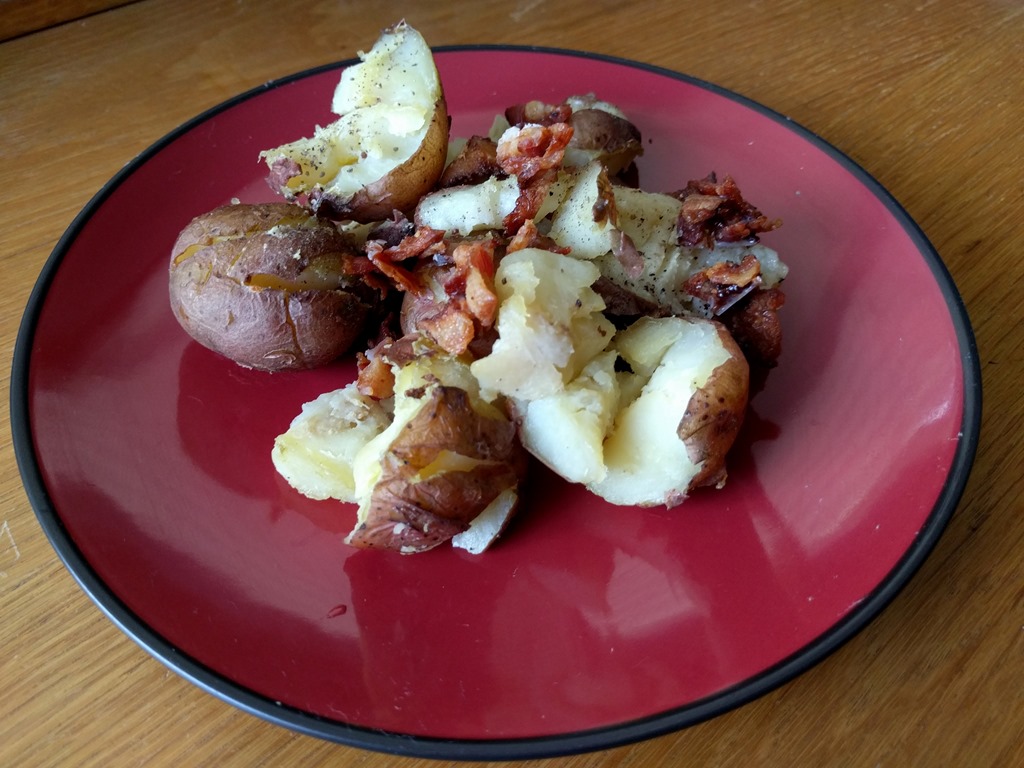
4 Servings
1 1/2 pounds red skinned potatoes, whole. Buy them all close to the same size, not real small.
1/2 pound bacon, cut into 1/2-inch pieces
2 to 3 tablespoons cider vinegar
1 teaspoon sugar
1) Steam potatoes in a large steamer rack set over boiling water, covered, until very tender, 20 to 25 minutes.
2) Meanwhile, cook bacon in a 12-inch heavy skillet over medium heat until crisp. Transfer bacon with a slotted spoon to paper towels to drain, reserving fat in skillet. Add 2 tablespoons vinegar, sugar, and 3/4 teaspoon each of salt and pepper to hot bacon fat, scraping up brown bits.
 3) Transfer potatoes to a baking sheet pan. Using a potato masher (not a ricer, us the old fashioned kind that has the loops .
Add vinegar mixture to potatoes and smash with a potato masher to desired texture, Season with dill, crispy bacon, and vinegar, salt, and pepper to taste.
Garden Update
Posted: May 12, 2016 Filed under: Gardening Leave a commentFinally! I have finally been able to get back in the garden. Many of you know I have had 6 eye surgeries in the last two years, lots of time I couldn’t dig in the dirt or simply didn’t have the time or energy. But now that I am well and feeling way better, I’ve been loving getting it all back in shape!
 Patio garden is fully planted, turmeric just starting to come up! Pineapple doing well. The garden right behind the wrought iron has graviola, ginger, turmeric, sunflowers, scallions.
 Kitchen garden; turmeric in foreground, medicinal hibiscus, scallions, pineapp0les, onions, scallions, rosemary, cilantro, basil, yarrow, ginger and beets…so far!
 Graviola, for making bloodroot tincture.
 Yarrow blooming, turmeric coming up. I love watching the new leaves unfurl.


 Meal Delivery Service by Millie Barnes