All Natural Mosquito Repellent
Posted: August 17, 2011 Filed under: Gardening, Non-Toxic Choices Leave a commentYa’ll probably know that garlic juice and oil in water sprayed around your yard or patio does an amazing job of warding off mosquitoes… Here’s a method when you can’t spray, or it’s raining…
I read an article about Lemon Eucalyptus oil being as effective a bug repellant as DEET. Wal-Mart was sold out of it today but they did have these cute little yellow coils you put on your wrist or ankle with oil of Citronella, Indonesian Lemongrass Oil, Philippine Geranoil Oil, They are .39 apiece and each one lasts about 200 hours. I test drove on my back porch late this afternoon and I have to say they really worked… Amazon has them for $14.99 for 10 of them. Almost 1/5 the price at Wal-Mart.

Garden Update…
Posted: August 17, 2011 Filed under: Gardening Leave a commentI am finally settled in to the new house, everything put away, organized…challenging..I went from having a garage to just a carport…
On the up side, I went from a gorgeous little private backyard with a TON of bamboo and shrubbery I had to continually fight..to a huge, just as private, backyard with almost no shrubbery but a canopy of huge oak trees..huge, old oak trees…filled with squirrels and birds..
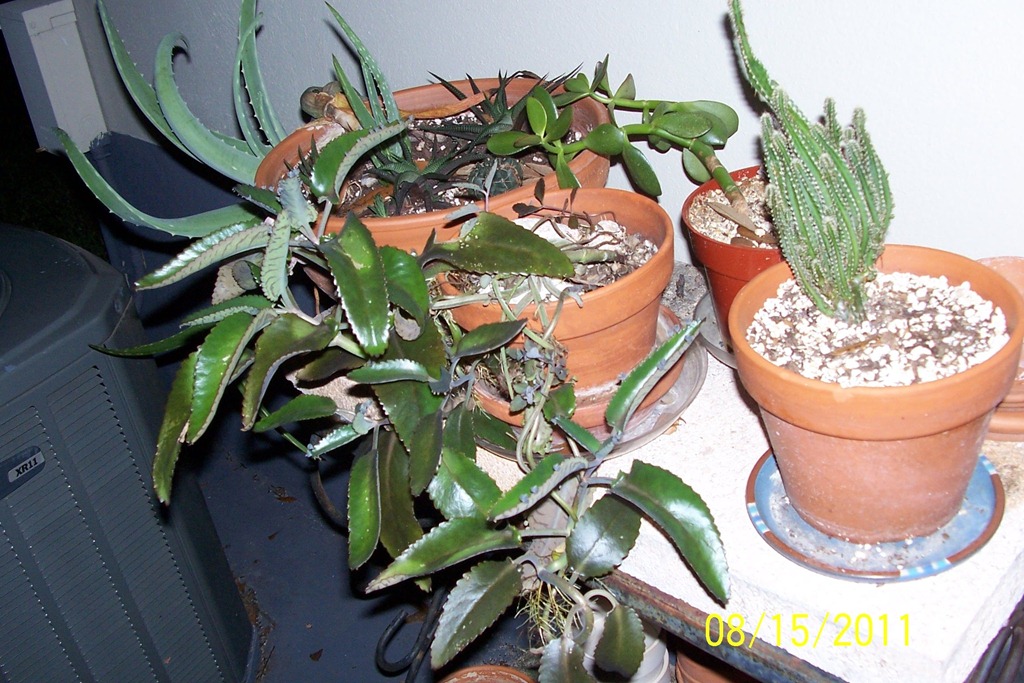 The succulents are happy…gotta get them planted…maybe a vertical wall?

It’s blank slate though, almost. Two big bushes of Lantana are against the fence, a third of the yard has ground cover; Ivy, wandering Jew, ferns…very low maintenance. I have put up three rain barrels and a hammock. Comfy Adirondack chairs on the porch, an air chair. In the front yard I planted hydrangeas, Lily’s my Aunt Jean gave me 5 years ago, plumbago, bougainvillea, basil, Salvia.. The seedling will get planted out front in a few weeks, after being under grow light; Poppies, Vinca, Onions, more basil, rosemary…
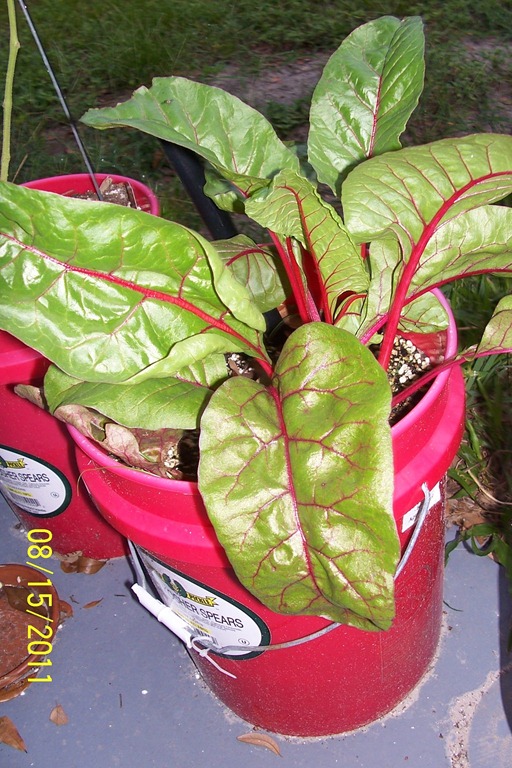 Swiss Chard in Sub-Irrigated container. I build them out of 5 gallon buckets.
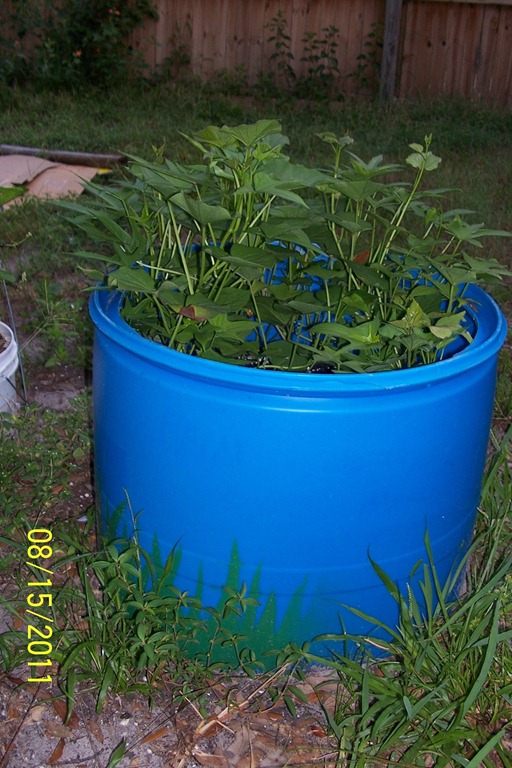 I’ll be digging sweet potatoes in another 2 months…
 Malabar Spinach. I bought this through Neem Tree Farms.
I have 5 feet high tomato plants..glad I grow in sub-irrigated containers…I moved the tomatoes and barrels of sweet potatoes from the other house…
Monday; I started sprouting seeds about a week ago. The lettuces are about an inch high…I’ll be eating baby lettuce in about a week to 10 days! Today I planted tropical milkweed, Poppies, Roma tomatoes, beets, Swiss chard, sunflowers, cucumbers, rosemary, more morning glories.
I laid down garden timbers to start an area for all the containers to go…on rocks so drainage will be good and it’ll look good. I got wire to put up on the fence posts for the tomatoes and cucumbers to grow up.. I’m hanging a trellis in front of the front window facing east..will help keep it cool and will look pretty with cucumbers and morning glory growing on it…gorgeous to watch the sun coming up through in the morning…over my desk…
Tuesday; Today I put up the second part of the compost bin…first one getting full of yard trimmings, kitchen scraps, paper, bunny poop with sawdust. It’s getting hotter…up to about 120 degrees…starts happening fast with all that green, wet material.
I also put up the solar shower, very basic with 50 feet of black hose and a shower head…actually a sprinkler head that gives me 10 different kinds of sprays…a great luxury in an outdoor shower. the coiled hose lays in the sun all day and by noon gives a great hot shower…but feels great cold earlier in the day after yard work

Grow Your Own….
Posted: August 15, 2011 Filed under: Food and it's Impact on Our Health, Gardening Leave a comment
Inspiration: Recharge with a Weekend Internet Sabbatical(via @Lifehacker)
Posted: August 15, 2011 Filed under: Food and it's Impact on Our Health Leave a commentInspiration: Recharge with a Weekend Internet Sabbatical(via @Lifehacker)
Supporting Farmers Markets
Posted: August 11, 2011 Filed under: Food and it's Impact on Our Health Leave a comment“What’s holding farmers markets back?” That’s the question behind a new report from the Union of Concerned Scientists, which determined the culprit to be federal policies that favor industrial agriculture over small and local farms. Change those policies, though, and you get a quick turnaround.
Supporting Farmers Markets Creates Thousands of Jobs: Union of Concerned Scientists
Posted: August 11, 2011 Filed under: Food and it's Impact on Our Health, Gardening, Non-Toxic Choices Leave a comment
Image: Chris Schrier via flickr
Another great post from Treehugger
"What’s holding farmers markets back?" That’s the question behind a new report from the Union of Concerned Scientists, which determined the culprit to be federal policies that favor industrial agriculture over small and local farms. Change those policies, though, and you get a quick turnaround.
According to the report, just a little public funding for 100 to 500 farmers markets a year could create up to 13,500 jobs within five years.
"On the whole, farmers markets have seen exceptional growth, providing local communities with fresh food direct from the farm," said Jeffrey O’Hara, a UCS economist and author of the report, Market Forces: Creating Jobs through Public Investment in Local and Regional Food Systems. "If the U.S. government diverted just a small amount of the massive subsidies it lavishes on industrial agriculture to support these markets and small local farmers, it would not only improve American diets, it would generate tens of thousands of new jobs."
An example of how, from the report:
when greater consumption of fresh fruits and vegetables draws on produce supplied locally or regionally. Studies have suggested that this phenomenon could lead to thousands more jobs in the Midwest alone, even if land allocated to fruits and vegetables displaced some production of corn and soybeans.
The report highlights the importance of developing direct marketing channels. So many farmers markets right now are community-based and rely on volunteer labor, which almost inevitably stunts their growth. But, says the report, "modest public funding for 100 to 500 otherwise-unsuccessful farmers markets a year could create as many as 13,500 jobs over a five-year period."
According to the Union of Concerned Scientists, direct agricultural product sales amounted to a $1.2 billion-a-year business in 2007 (the most recent USDA figure), and most of that money recirculates locally. "The fact that farmers are selling directly to the people who live nearby means that sales revenue stays local," O’Hara said. "That helps stabilize local economies."
If you don’t believe it, the report provides a few examples:
- 34 farmers markets in West Virginia led to a gross increase of 119 jobs (net increase of 82 jobs), a gross increase of $2.4 million in output (net increase of $1.1 million), and a gross increase in personal income of $0.7 million (net increase of $0.2 million).
- 21 farmers markets in Oklahoma led to a gross increase of 113 jobs, $5.9 million in output (with a multiplier of 1.78), and a $2.2 million increase in income.
- 152 farmers markets in Iowa led to a gross increase of 576 jobs, a $59.4 million increase in output (with a multiplier of 1.55), and a $17.8 million increase in income.
- 26 farmers markets in Mississippi led to a gross increase of 16 jobs, a $1.6 million increase in output (with a multiplier of 1.7), and a $0.2 million increase in income.
Some Progress Has Been Made, But There’s Plenty More to Do
Local food systems have no doubt seen a boost in recent years: the number of farmers markets has jumped nationwide from 2,863 in 2000 to 6,132 in 2010.That might lead some people to question why farmers markets need public support. But there are major economic and political barriers that stump the growth of these markets and food systems. And the government helps agricultural giants that have already surpassed their potential, while in comparison almost ignores the little folks.
The USDA gave $13.725 billion last year in commodity, crop insurance, and supplemental disaster assistance to primarily large industrial farms. In the same year, the same agency spent less than $100 million to support local and regional food system farmers.
The Way Forward
To address these barriers, the report calls on Congress to:
• support the development of local food markets, including farmers markets and farm-to-school programs, which can stabilize community-supported markets and create permanent jobs. For example, the report found that the Farmers Market Promotion Program could create as many as 13,500 jobs nationally over a five-year period, if reauthorized, by providing modest funding for 100 to 500 farmers markets per year.
• level the playing field for farmers in rural regions by investing in infrastructure, such as meat-processing or dairy-bottling facilities, which would help meat, dairy and other farmers produce and market their products to consumers more efficiently. These investments could foster competition in food markets, increase product choice for consumers, and generate jobs in the community.
• allow low-income residents to redeem food nutrition subsidies at local food markets to help them afford fresh fruits and vegetables. Currently, not all markets are able to accept Supplemental Nutrition Assistance Program benefits.
"Farmers at local markets are a new variety of innovative entrepreneurs, and we need to nurture them," said O’Hara. "Supporting these farmers should be a Farm Bill priority."
The report was released just a few days ahead of the USDA’s 12th annual National Farmers Market Week, which starts this Sunday, August 7.
Peeing outdoors
Posted: August 11, 2011 Filed under: Food and it's Impact on Our Health Leave a commentValuable Nutrients are lost when we use water to flush away our waste…and we foul our clean water source. urine is high in nutrients and plants LOVE it..tomatoes yeild 4 times as much when urine is used to fertilize them copared to chemical fertilizers.
I’m rockin’ out the Dagoba chocolate with blueberries…mmmmm
Posted: August 10, 2011 Filed under: Food and it's Impact on Our Health Leave a commentFabulous dinner with my friend, Andrew…grass fed steaks pan seared in butter, organic sweet potatoes, Swiss Chard sauteed in butter with caramelized onions, ginger tea, Dagoba chocolate for dessert. Doesn’t get any better..or healthier..than that!
I’m rockin’ out the Dagoba chocolate with blueberries…mmmmm
There’s Wood Powder in Your Shredded Cheese
Posted: August 6, 2011 Filed under: Food and it's Impact on Our Health, Non-Toxic Choices 1 Comment
It would totally ruin Taco Tuesdays if you reached into your bag of delicious shredded cheese and it had all congealed into a giant yellow-orange clump. But that never happens! Ever wonder why? Food companies add wood pulp, that’s why.
Wood pulp—or cellulose, to be exact—is made from grinding out wood and other plant matter. You eat it all the time, probably! It’s dumped into all sorts of dairy products because it’s a cheap replacement for other, non-wood ingredients, aside from keep cheese slivers from clumping together, FoodRenegade reports.
Is this such a bad thing? The crew at FR gives an emphatic yes, because it’s so unnatural. But so is eating shredded cheese out of a bag to begin with. The FDA says cellulose wood cheese is okay to eat, and when I want to make nachos or a baked potato or just put a handful of cheese in my mouth, a lot of the time I’d rather not take out a grater. You know what else isn’t natural? Cheese graters. Nor is cheese itself. If we continue this gourmand naturalism ad infinitum, we’ll be eating nothing but sand and blueberries. I say let’s use the safe food tech we have—delicious, easy, orange cheese in a bag, sprinkled with wood dust. [FoodRenegade]
has Apple turned It’s back on the People harmed in It’s factories?
Posted: August 4, 2011 Filed under: Food and it's Impact on Our Health Leave a commentEven though Apple’s Chinese consumers bask in the luxurious image Apple has built for them, their workers oftentimes live far from the high life. While it isn’t that they outright put their workers in danger, it’s that Apple is so slow to react when things go wrong.
NPR has a lengthy piece regarding the ongoing health issues of one Jia Jingchuan, a 27-year-old former employee at Wintek, a company that manufactures iPhone parts. He’s one of the many workers who continues to suffer from nerve damage after being exposed to the now-illegal N-hexane chemical used in their screen cleaning products. While Apple has since responded to the issue—among many others—by banning the use of the chemical and pledging to follow-up with and monitor the treatment of the affected workers, Jia has had to pay for his own medical care. When he tries to reach them, he gets no response. And Steve Jobs won’t return his letters. In the meantime, he must get by without a job and without any prospects.
has Apple turned It’s back on the People harmed in It’s factories?


 Meal Delivery Service by Millie Barnes
