Trolls Die Young: Nasty People Have Higher Risk of Heart Attack and Stroke
Posted: September 9, 2010 Filed under: Non-Toxic Choices Leave a commentby Lloyd Alter,
Dan Blankenhorn of Smart Planet was thinking of his commenters when he suggested that "trolls die young", based on a study researchers of the US National Institute on Aging. They looked at 5,614 Sardinians from four villages, and found that "those who scored high for antagonistic traits on a standard personality test had greater thickening of the neck (carotid) arteries compared to people who were more agreeable. Thickness of neck artery walls is a risk factor for heart attack and stroke."

The effect is quite pronounced; those in the bottom 10% of agreeableness, the most antagonistic, manipulative and quickest to anger had a 40% higher risk of thicker arterial walls, a known factor for cardiovascular disease.
From the press release:
"People who tend to be competitive and more willing to fight for their own self interest have thicker arterial walls, which is a risk factor for cardiovascular disease," said Angelina Sutin, Ph.D., lead author of the study and a postdoctoral fellow with the National Institute on Aging, NIH, in Baltimore, Md. "Agreeable people tend to be trusting, straightforward and show concern for others, while people who score high on antagonism tend to be distrustful, skeptical and at the extreme cynical, manipulative, self-centered, arrogant and quick to express anger."
Dr. Sutin notes that while thickening of artery walls is a sign of age, young people with antagonistic traits already had thickening of the artery wall. Her prescription:
"People may learn to control their anger and learn ways to express anger in more socially acceptable ways"
8 Misleading Food Label Terms Every Eater Should Know
Posted: August 3, 2010 Filed under: Food and it's Impact on Our Health, Non-Toxic Choices 4 CommentsFrom- http://food.change.org/
by Kristen Ridley
 As more and more Americans are renewing their interest in where their food comes from, food companies have made an effort to catch those sustainable food dollars while changing their products as little as possible. The easiest way to do this is through advertising, hiring skilled writers to tweak the wording on the label or extol marginally better production as sustainable. These underhanded tactics can befuddle contentious shoppers, leaving them wondering what precisely is meant by these vague terms and flowery language.
After years of carefully perusing labels and subsequently researching food companies, I’ve developed a sort of translation of some common advertising terms to help me suss out what’s really sustainable — a spin doctor-to-English dictionary, if you will. Ideally you would shop in a manner that allows you to ask the farmer yourself just how he or she produces food, but when that’s not an option, here’s a helpful guide to eight food label terms and what they actually mean.
1. Cage Free. This means exactly what it says and nothing more. The carton may try to imply happy chickens in the sunshine, but cage-free hens are still confined entirely indoors in crowded and dirty conditions, and still very much treated like machines. It is certainly a big step up from being crammed into a tiny cage, unable to move, like most hens. But as I experienced for myself at Comic Con last weekend, being jostled around in a big room packed wall-to-wall with your peers can make you exhausted and miserable.
2. Free Range. Again, this term implies happy animals in the sunshine, but don’t be fooled. Look for the phrase "access to the outdoors" on the label. That means that the animals in question are confined most of the time with just a small yard to visit from time to time—if they can squeeze through the crowd to get there, that is. Now sometimes this label is applied to something truly free range, but look for terms like "pastured" and "grass fed" to confirm this. By itself, this label isn’t very trustworthy.
3. Organic. This is the most strictly regulated of the common sustainable food labels. To be called organic, a farm must go through a certification procedure and meet a very specific set of requirements, including cutting out all artificial fertilizers, chemicals, antibiotics, and hormones. Certainly if you’re going to rely on a label to make a quick food decision, this is the one. But organic doesn’t always mean what you think it means. There are a few dubious allowances in the organic regulations, and the majority of organic produce is grown miles away in vast monocultures that, while loads better for the soil and local environment, doesn’t exactly follow the spirit of sustainability.
4. Natural. This means absolutely nothing from a labeling standpoint. I joke that this is the label companies use when they have nothing real to advertise, and as such, I generally count it as a point against whatever food it’s on.
5. Humane. This term is very subjective and not regulated in any way (although the Humane Society is certainly trying to change that). I usually assign just as much weight to this label as I do to "natural," with the exception of those foods with the "Animal Welfare Approved" label. Other humane certification programs exist, but the rigorous AWA standards are the real deal. AWA animals are also required to be pastured.
6. Local. Again, this can mean almost anything. At the very least it generally means it was grown in-state, but in a place as big as California, that doesn’t mean much. It also makes no guarantee regarding how the food is grown — unless it says otherwise, it is probably conventional, pesticides and all. Besides, isn’t purchasing local food from a supermarket kind of defeating the purpose?
7. Grass Fed. There is a push to regulate this label the same way organic is (and the push back by those who fear a government label wouldn’t be strict enough), but as of now there is no certification process. It’s true that a producer could slide in an animal that was finished on grain (although I have never found an instance where this actually happened), so a more assuring label is "Grass Finished" or "100% Grass Fed."
8. Pastured. This term isn’t regulated either, so use some common sense, but it means that an animal was raised grazing or foraging outside on pasture. You can bet it lived a pretty good life given that the animals had to have enough space not to kill the grass. It’s a helpful term because animals like chickens and pigs can’t live on grass alone, thus the term "grass fed" can’t apply. But pastured animals are able to supplement their feed with bugs and forage, creating a much happier and healthier animal, whatever the sort. I consider pastured the gold standard, but I always ask questions or do more research to make sure the producer thinks "pastured" means the same thing I do.
Hopefully this will be helpful for those trying to navigate the sea of supermarket advertising. If you’re looking for more easy-to-digest little tips to live by that will help you eat healthier and more sustainably, check out Michael Pollan’s guide, Food Rules. And if you can think of any other term that needs explaining, please share in the comments section.
Paying for Packaging: It’s Time to Stop
Posted: July 6, 2010 Filed under: Going Green; How and Why..., Non-Toxic Choices Leave a commentFrom;

by Thursday Bram on 29 June 2010

Next time you take a walk through the grocery store, take a look at the packaging — especially on relatively expensive items. Any item with a lot of packaging always costs more than its counterpart without. Hamburger Helper offers a great example: not only does it come in a box, but there are packets within the box. Compare the price of a box or bag of pasta, with less packaging, and a few spices (which is not all that far off from what Hamburger Helper is). In such cases, we aren’t just paying for packaging — of course convenience is a key pricing factor — but the connection is still there.
Reducing the Packaging in Your Cart
One of the easiest strategies is to buy in bulk when possible. The packaging on small, convenience-sized containers of common staples — like oatmeal — adds up very quickly when you compare it to the packaging on one large container. Another option is to choose to buy from locations that don’t rely as heavily on packaging. For instance, at many farmer’s markets, you simply bring your own bags. Similarly, many food co-ops actually require you to bring in containers to purchase certain items, like grains. There are even a few grocery stores that offer you the same option. Investing in a few reusable bags and containers can help you get away from buying pre-packaged foods.
Lastly, cooking from scratch can be a key strategy in minimizing packaging. There’s far less packaging on "ingredients" (which also happen to be cheaper) than on mixes and meals that are practically ready to go.
It is important to make a conscious decision, however, if you want to stop paying for packaging on your food. It’s very easy to have a blind spot when it comes to the paper and plastic your food comes wrapped up in. Unless you’re paying attention, a small jar of mustard and a big bottle will seem to have roughly the same amount of packaging materials. But when you consider their relative size, one size certainly requires more jars than the other.
A Bigger Impact
There’s additional value in reducing the packaging we buy than simple costs. There is no doubt that there’s a huge environmental impact made by each piece of packaging that winds up in the trash and even recycling such items isn’t the best option. The best solution is to not use more packaging than is absolutely necessary in the first place.
It’s not always an option, but making an effort to focus on reusable packaging or less-harmful packaging is a step in the right direction. You can minimize the plastic packaging you need, for instance, without hurting your own bottom line.
Not aging fast enough? Drink a soda!
Posted: May 4, 2010 Filed under: Food and it's Impact on Our Health, Non-Toxic Choices Leave a commentHoo boy. The American Beverage Association isn’t going to like this news one bit. Food companies now add significant amounts of phosphates to soda and other processed foods. And now researchers have found evidence that phosphates may accelerate aging (via Science Daily):

High phosphate levels may also increase the prevalence and severity of age-related complications, such as chronic kidney disease and cardiovascular calcification, and can also induce severe muscle and skin atrophy.
"Humans need a healthy diet and keeping the balance of phosphate in the diet may be important for a healthy life and longevity," said M. Shawkat Razzaque, M.D., Ph.D., from the Department of Medicine, Infection and Immunity at the Harvard School of Dental Medicine. "Avoid phosphate toxicity and enjoy a healthy life."
"Soda is the caffeine delivery vehicle of choice for millions of people worldwide, but comes with phosphorous as a passenger" said Gerald Weissmann, M.D., Editor-in-Chief of the FASEB Journal. "This research suggests that our phosphorous balance influences the aging process, so don’t tip it."
This has nothing to do with sweeteners, food coloring or any other previously established badness associated with soda and processed food — it’s a "new and improved" risk.
And what, pray tell, are these phosphates doing there in the first place? According to other scientists, food companies starting adding them at high levels only in the last 20 years:
…[W]hile a moderate level of phosphate plays an essential role in living organisms, the rapidly increasing use of phosphates as a food additive has resulted in significantly higher levels in average daily diets. Phosphates are added to many food products to increase water retention and improve food texture.
"In the 1990s, phosphorous-containing food additives contributed an estimated 470 mg per day to the average daily adult diet," he said. "However, phosphates are currently being added much more frequently to a large number of processed foods, including meats, cheeses, beverages, and bakery products. As a result, depending on individual food choices, phosphorous intake could be increased by as much as 1000 mg per day."
"Increase water retention and improve food texture"?! That’s worth shaving years off our lives for sure! We’re all lab rats now.
Reusable Bottles: Glass Makes a Come Back
Posted: March 16, 2010 Filed under: Going Green; How and Why..., Non-Toxic Choices Leave a comment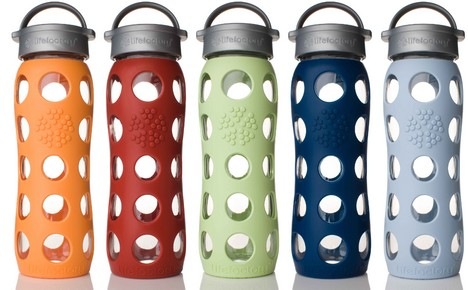
Image credit: Lifefactory Article from TreeHugger
As a rule, I am not one of these greenies that gets overly excited about new reusable bottles. I have an old reusable bottle somewhere, and it occasionally gets used when I venture out of the house—but I’ve always been a little confused by the amount of attention paid to fancy reusable bottles and their cousins, the reusable tote. But with recent scandals over BPA in old Sigg water bottles, and with Nalgene finally going BPA free, many folks with old reusables may be looking for alternatives. So howabout going old-school? Glass may be back.
Lifefactory is selling a line of bottles that even I must admit look pretty darned good. And they are made from plain-old glass, with a non-toxic silicone sleeve to protect them from breakage and allow for a better grip. After all the fancy water bottle materials out there, it’s kind of fun to see a press release extolling the virtue of (gasp!) glass:
"The glass make-up of the reusable bottle means what you see is what you get. Glass is a nonporous material containing zero harmful chemicals and does not scratch, significantly reducing bacterial growth. With Lifefactory bottles you will never experience any type of leaching into your liquid nor will you ever be left with a metallic taste. Best of all, glass is a low impact raw material that is readily abundant, easy to process and 100% recyclable, which is minimally taxing on our environment."
Not sure if I’ll be replacing my water bottle just yet, if I can even find it. But even I must admit, these are fine looking bottles.
Indian law would make criticizing GM crops an imprison-able offense
Posted: March 15, 2010 Filed under: Gardening, Going Green; How and Why..., Non-Toxic Choices Leave a commentHealth Freedom Alliance March 2, 2010
 Criticizing Genetically Modified (GM) products could land you in jail — if the draconian draft Biotechnology Regulatory Authority Bill (BRAB) of 2009, which will be tabled in the current session of the parliament by the UPA government, is passed.
In an unprecedented muzzle on the right to freedom of speech of the citizen, Chapter 13 section 63 of the draft bill says, “Whoever, without any evidence or scientific record misleads the public about the safety of the organisms and products…shall be punished with imprisonment for a term that shall not be less than six months but which may extend to one year and with fine which may extend to two lakh rupees or with both.” The BRAI Bill drafted by the department of bio-technology under the Ministry of Science and Technology comes on the heels of a moratorium on Bt Brinjal announced by the Environment Minister Jairam Ramesh.
“What they are doing is much worse than what Hitler or Mussolini did. Through this bill, they want to take absolute authority. They are behaving like a vendor instead of a regulator,” Pushpa M Bhargava, a member of the Supreme Court appointed Genetic Engineering Approval Committee (GEAC) said.
There are also other provisions in this bill which are disconcerting.
Article 27 (1) of the bill seeks to keep the information related to the research, approval and science of the GM Products out of the purview of the Right to Information ( RTI) Act.
In other words, farmers, NGO’s and Environmental groups that have been on the forefront of the campaign against BT Brinjal and other genetically modified crops, can longer obtain information about it.
Not only that, the three member experts of the Department of Biotechnology will override any existing legislation about GM technology in the states.
The draft bill also states that the BRAI will set up its own appellate tribunal which will have the jurisdiction to hear arguments on the issues concerning biotechnology. In case of any disputes, petitioners can only approach the Supreme Court of India.
“The BRAI bill is more draconian than what the nation faced during the Emergency ‘’ says Devinder Sharma, writer and Food Policy Analyst. “If the Bill was already in force, I would have been in jail.
Jairam Ramesh too would have been in jail for challenging the health and environmental claims of the company developing Bt Brinjal,” he said. The bill demonstrates the extraordinary hold the multinational companies have over the UPA government, he added. Kavitha Kurugunti of Kheti Virasat Mission said that this bill is just a way to silence the voices who are opposed to GM technology.
The Only Safe Vaccines Are The Ones Never Used
Posted: March 15, 2010 Filed under: Non-Toxic Choices Leave a commentTue, 06 Feb 2007 04:13 UTC

Dr. James R. Shannon, former director of the National institute of health declared, “the only safe vaccine is one that is never used.”
Cowpox vaccine was believed able to immunize people against smallpox. At the time this vaccine was introduced, there was already a decline in the number of cases of smallpox. Japan introduced compulsory vaccination in 1872. In 1892 there were 165,774 cases of smallpox with 29,979 deaths despite the vaccination program. A stringent compulsory smallpox vaccine program, which prosecuted those refusing the vaccine, was instituted in England in 1867. Within 4 years 97.5 % of persons between 2 and 50 had been vaccinated. The following year England experienced the worst smallpox epidemic[1] in its history with 44,840 deaths. Between 1871 and 1880 the incidence of smallpox escalated from 28 to 46 per 100,000. The smallpox vaccine does not work.
Much of the success attributed to vaccination programs may actually have been due to improvement in public health related to water quality and sanitation, less crowded living conditions, better nutrition, and higher standards of living. Typically the incidence of a disease was clearly declining before the vaccine for that disease was introduced. In England the incidence of polio had decreased by 82 % before the polio vaccine was introduced in 1956.
Non-Toxic Way to Kill Fire Ants
Posted: February 14, 2010 Filed under: Gardening, Non-Toxic Choices Leave a comment 
I know fire ants are picky eaters and any type poison that is effective takes seven feeding steps before the queen receives it. Plus, if the bait is stored in close proximity to any petroleum or fertilizer products they won’t touch it. Contact poisons that are on the market just cause the colony to move away. A well developed colony can be as deep as 30 feet and spread out some 20 to 50 feet from the mound center. This was documented by studies done in the early 60’s when they were first sited in South Alabama.
An environmentally friendly cure for fire ants has been announced by Walter Reeves on his Georgia Gardener radio program.
Simply pour two cups of CLUB SODA (carbonated water) directly in the center of a fire ant mound. The carbon dioxide in the water is heavier than air and displaces the oxygen which suffocates the queen and the other ants. The whole colony will be dead within about two days.
Besides eliminating the ants, club soda leaves no poisonous residue, does not contaminate the ground water, and does not indiscriminately kill other insects. It is not harmful to your pets, soaks into the ground. Each mound must be treated individually and a one liter bottle of club soda will kill 2 to 3 mounds. Spread the word.

Takeoutwithout: Refuse, Retake and Reconsider
Posted: February 8, 2010 Filed under: Going Green; How and Why..., Non-Toxic Choices Leave a commentFrom Treehugger
by Lloyd Alter, Toronto  on 01.25.10

Americans toss out enough paper and plastic cups, forks and spoons every year to circle the equator 300 times, and K.B. Lee is trying to do something about it. He has founded Takeoutwithout to convince restaurants to encourage and accommodate people who bring their own containers.
Borden Communications and Design, a firm specializing in "eco-logical" services, put together the snappy graphics. TOWO has its own 3Rs, as explained by Ellen Moorhouse in the Star:
Refuse (Do you really need all of those straws, plastic cutlery and napkins?); Retake (Bring your own containers, cups and bags.); and Reconsider (Take a look at your eating habits, and maybe, like Lee, make some changes.)
It is a new campaign, where they are inviting restaurants to encourage people to bring their own containers (many resist, worried about health and safety) and urging patrons to cut back. It is perhaps a good first step, although I would rather see deposits on everything and producer responsibility.
Retake and Reconsider: Two more to add to our seven R’s. One might also try the 25 Take-Out Foods You Can Make at Home For Cheaper
But if you can’t do that, at least try to bring your own. More at Takeoutwithout
I say; take a glass jar, get a Wrap n Mat from Reusablebags.com, get some Stainless steel jars, cloth napkins…stop eating fast food.
Join the Slow Food Revolution!!! Think Traditional Human Diet with no fast food, nothing in cans or boxes, whole foods…chickens, veggies, butter, fats, fruits, grass fed beef. Compost what you don’t use, make great soil, grow more veggies…no waste….
“Vege”-tarian Diets?
Posted: January 28, 2010 Filed under: Food and it's Impact on Our Health, Non-Toxic Choices 1 CommentI was in a debate online with some vegetarians about nutrition this morning, and one of them suggested that I go to the site GoVeg.com. So I did.
Here’s the first image on thier site;

Here’s the one labeled “transitions”…all products, no food.
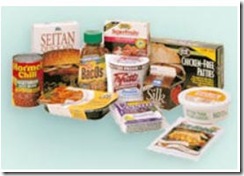 hhhmmmm..no veggies here..
On thier site I took one of thier meal plans for one day ands analyzed it. I copied thier recipes exactly and used software to get the nutrition info for the day. Here are the results. Hhhmmmm, lots more “products”, nothing I would consider real food…and still no vegetables in site…looks like mostly soy and seitan (pure wheat gluten- a component of some grains that humans cannot digest)…
So, here is thier menu for one day;
Breakfast
Banana Muffins
Fresh fruit
Lunch
Avocado Reuben
Sumptuous Spinach Salad With Orange-Sesame Dressing
Dinner
Mama’s Mock Meatloaf
Creamy Chive Mashed Potatoes With Brown Gravy
Here’s the nutrition info for this day;
2583 calories- too high
Calories from fat- 47%
Calories from carbs- 47%
Calories from Protein- 9%
Protein is dangerously low.
Fat % would be fine except that most of the fat is mono-unsaturated fats, which leads to cancer, stoke and heart disease. And who recommends margarine anymore…haven’t you heard that hydrogenated fats and trans-fats are UNHEALTHY?
Vitamin C was 391 mg. too low
Vitamin D was only 21640 IU, way low, you need a minimum of 50,000 IU a day.
Calcium was at 87% of the RDA, a figure which is too low anyway.
Cholesterol was only 3% of what the governments recommendations are!
This is NOT good nutrition; too many carbs, not enough protein, no high quality protein whatsoever, no vital amino acids and CLA, not enough healthy fats for building an immune system, not enough fiber from veggies.
And, why are they calling this a vegetarian diet…I see no almost no veggies here. Most of the carbs come from white flour and sugar. Soy is a highly toxic food for humans, it’s not a good replacement for grass fed meats.
Here’s what thier FAVORITE “PRODUCTS’ page looks like;
So grab a shopping cart, stroll down the aisle of your local supermarket or health food store, and add these great vegan vittles to your grocery list: 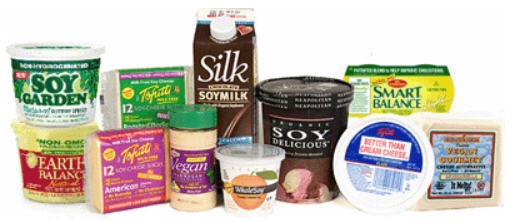
Dairy Substitutes
Earth Balance Natural Buttery Spread
Soy Garden Natural Buttery Spread
Tofutti Soy-Cheese Slices
Organic Soy Delicious Non-Dairy Frozen Dessert
Tofutti Non-Dairy Frozen Dessert
Soyco—Soymage Vegan Grated Parmesan
WholeSoy Creamy Cultured Soy Yogurt
WhiteWave—Silk Chocolate Soymilk
Tofutti—Better Than Cream Cheese
Smart Balance 37% Light Buttery Spread
Follow Your Heart—Vegan Gourmet Cheese Alternative
Rice Dream Non-Dairy Beverages
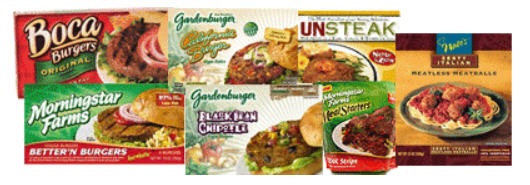
Beef Substitutes
Boca Original Vegan Burgers
Gardenburger California Burgers
Now & Zen—Unsteak
Nate’s Meatless Meatballs
Morningstar Farms—Better ’n Burgers Veggie Burgers
Gardenburger Black Bean Chipotle Burgers
Morningstar Farms Meal Starters Steak Strips
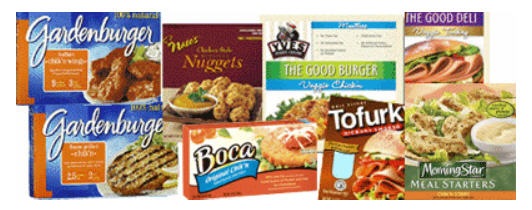
Chicken and Turkey Substitutes
Gardenburger Flame Grilled Chik’n
Gardenburger Buffalo Chik’n Wings
Nate’s Chicken Style Nuggets
Yves Veggie Cuisine—Veggie Chick’n Burgers
Tofurky Deli Slices
Yves Veggie Cuisine—Veggie Turkey Slices
Boca Chik’n Patties
Boca Chik’n Nuggets
Morningstar Farms Meal Starters Chik’n Strips
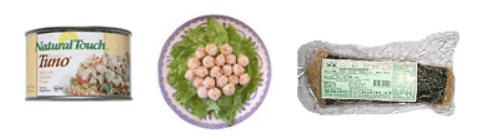
Seafood Substitutes
Vegieworld.com—Vegetarian Lobster Balls
Vegieworld.com—Vegetarian Salmon
Natural Touch—Tuno
I have yet to find any mention of fruits and vegetables, or real food on this site….jeeez, ya think someone selling “products” might be behind all this??
I eat 2000 calories a day. (See the post before this one for a typical day for me)Every single calorie I eat comes from REAL FOOD! NOT products, nothing processed, all of it needs no labels, it’s whole food. I eat on about 40 bucks a week, grow almost all my own veggies and herbs. No packaging to throw away to fill up our landfills, plenty of great compost to grow more veggies with. I am able to eat almost all locally grown and produced food.
Which diet looks healthier to you AND our planet???


 Meal Delivery Service by Millie Barnes