Worm Compost Tower Creates And Delivers Compost Naturally
Posted: February 19, 2012 Filed under: Gardening Leave a commentFrom a post on Treehugger.com
After spending $200+ on my tumbler compost bin, seeing this MacGyver in-garden worm composter brings on a little Jubbling envy. It’s a basic idea and seems like it should work. The video explains it – put your compost solution directly in your garden, in this case a bottom perforated PVC pipe, and create and distribute your compost at the same time. Cut out the middleman, which is you, and put the worms in charge of spreading the compost
How Much Space Do You Need For a Vegetable Garden?
Posted: February 12, 2012 Filed under: Gardening Leave a commentFrom Vegetable Gardener
Millie- This is what mine looks like now, except I am using the fence to trellis tomatoes and cucumbers on.

This vegetable garden is in a Brooklyn backyard.
Photo by canarsiebk under the Creative Commons Attribution License 2.0.
Not much. Truthfully, it depends on the types of veggies you want to grow and how many. But you’ll want to know what you have to work with before you choose your vegetable seeds or seedlings. For example, if your kids really want to grow giant pumpkins, a good-sized part of the yard or a large raised bed could easily be devoted to pumpkins. But, one thing is for sure, you absolutely do not need what is referred to to as "land" to plant a vegetable garden. Not even close.
There are ways around to successfully grow sprawling veggies like pumpkins and other squash. One way would be to "train" the vines by physically aiming them in a direction and pruning them to keep only several vines. If you prune, remember that you’ll harvest less fruit than if the plant was left to its own devices. Another way to save space with vining veggies is to grow them vertically.
There are some veggies take to containers with ease. Carrots, peppers, and lettuce come to mind. Tomatoes usually do well in containers, although if you let them dry out to the point where the soil pulls away from the sides of the container, they may never forgive you which can affect their performance by producing less fruit.
In fact, if you think of containers as basically small raised beds, it’s hard to think of anything that wouldn’t grow in them. One thing that’s different about containers versus raised beds is that the container will dry out faster because it has sides above ground that absorb the heat.
When choosing a container, take into consideration the mature size of the vegetable plant. Hanging baskets along the eaves of the sunny side of your house can work, too. Creative containers such as the Topsy Turvy hanging tomato planter is also a good option.
If you know you’re going to need more space, have you considered working it into yourlandscaping? What about your lawn? Many people have front and back lawns that aren’t used at all. They’re watered, mowed, and they add some green to the yard. But have you ever thought about if you’re using them? So, step outside and take a look at your lawn. Are you willing to give some of it up?
If you’re absolutely certain that you either have nowhere to plant or you honestly do need more space, consider a community garden. Many cities shave a community gardens where you can lease a plot for the year (and beyond). The nice thing about gardening in a large space among other gardeners is camaraderie, the guidance, and chance to share your vegetables with other gardeners.
Anonymous Takes Down Monsanto.com
Posted: January 31, 2012 Filed under: Food and it's Impact on Our Health, Gardening, Going Green; How and Why..., Non-Toxic Choices Leave a commentPosted on January 21, 2012 by Sabra
In a thread of hack events from the Anonymous group, the most recent target has been Monsanto.com. Anonymous, which briefly knocked the FBI and Justice Department websites offline as well as Music Industry websites in retaliation for the US shutdown of file-sharing site Megaupload, is a shadowy group of international hackers.
Click here to see the videos- http://www.organiccommonsense.com/organic/anonymous-takes-down-monsanto-com/
Anonymous Message To Monsanto: We fight for farmers! – Video Transcript
To the free-thinking citizens of the world: Anonymous stands with the farmers and food organizations denouncing the practices of Monsanto We applaud the bravery of the organizations and citizens who are standing up to Monsanto, and we stand united with you against this oppressive corporate abuse. Monsanto is contaminating the world with chemicals and genetically modified food crops for profit while claiming to feed the hungry and protect the environment. Anonymous is everyone, Anyone who can not stand for injustice and decides to do something about it, We are all over the Earth and here to stay.
To Monsanto, we demand you STOP the following:
- Contaminating the global food chain with GMO’s.
- Intimidating small farmers with bullying and lawsuits.
- Propagating the use of destructive pesticides and herbicides across the globe.
- Using “Terminator Technology”, which renders plants sterile.
- Attempting to hijack UN climate change negotiations for your own fiscal benefit.
- Reducing farmland to desert through monoculture and the use of synthetic fertilizers.
- Inspiring suicides of hundreds of thousands of Indian farmers.
- Causing birth defects by continuing to produce the pesticide “Round-up”
- Attempting to bribe foriegn officials
- Infiltrating anti-GMO groups
Monsanto, these crimes will not go unpunished. Anonymous will not spare you nor anyone in support of your oppressive illegal business practices.
AGRA, a great example:
In 2006, AGRA, Alliance for a Green Revolution in Africa, was established with funding from Bill Gates and The Rockefeller Foundation.
Among the other founding members of, AGRA, we find: Monsanto, Novartis, Sanofi-Aventis, GlaxoSmithKline, Procter and Gamble, Merck, Mosaic, Pfizer, Sumitomo Chemical and Yara. The fact that these corporations are either chemical or pharmaceutical manufacturers is no coincidence.
The people of the world see you, Monsanto. Anonymous sees you.
Seeds of Opportunism, Climate change offers these businesses a perfect excuse to prey on the poorest countries by swooping in to “rescue” the farmers and people with their GMO crops and chemical pesticides. These corporations eradicate the traditional ways of the country’s agriculture for the sake of enormous profits.
The introduction of GMOs drastically affects a local farmers income, as the price of chemicals required for GMOs and seeds from Monsanto cripples the farmer’s meager profit margins.
There are even many cases of Monsanto suing small farmers after pollen from their GMO crops accidentally cross with the farmer’s crops. Because Monsanto has a patent on theri brand of seed, they claim the farmer is in violation of patent laws.
These disgusting and inhumane practices will not be tolerated.
Anonymous urges all concerned citizens to stand up for these farmers, stand up for the future of your own food. Protest, organize, spread info to your friends!
SAY NO TO POISONOUS CHEMICALS IN YOUR FOOD!  SAY NO TO GMO!
SAY NO TO MONSANTO!
We are Anonymous
We are legion
We do not forgive
We do not forget
Expect us
Stopping Monsanto
Posted: January 31, 2012 Filed under: Food and it's Impact on Our Health, Gardening, Going Green; How and Why..., Non-Toxic Choices 1 Comment
We all been outraged at Monsanto’s aggressive, even illegal, certainly immoral marketing and pollution practices lately. we have all bitched voraciously all over the Internet. Go HERE to read about their deplorable business practices.
So what can we do about it? Yes, sign the petitions, re-post, re-blog..spread the word! And then?
Again’ VOTE with your Dollars! Buy certified organic food, grow your own food… purchase heirloom seeds and organic seeds. Learn how to grow from the seeds of your own food you raise. I bought seeds 4 years ago, am still using the same seed packets or have seeds from my last crop of tomatoes, Malabar spinach, lettuces. The seed packets tell you to “broadcast the seeds” then thin the plants. That is ridiculous! Of coarse they want you to waste the seeds, and buy more next year. I sprout each seed or direct plant into perlite and then soil.
So let’s put Monsanto out of business, let’s do what they re most scared of; make our voices heard load and clear. AND stop supporting them,, buy organic food, cleaning products, clothing..etc. Stop supporting chemical companies, not just Monsanto. Stop buying plastic, stop getting shopping bags (bring your own), stop getting take-out.
Learn to live with less, buy better quality when you do. Re-use as much as possible.
It is possible to drastically lower your carbon footprint. This in turn impacts big business.
Every single choice you make has an impact.
And go to Millions Against Monsanto and speak out.
Growing Her Own Food- On a Balcony
Posted: January 29, 2012 Filed under: Food and it's Impact on Our Health, Gardening Leave a commentA cool little video…shows clearly how easy it is to grow your own food…in a tiny little space..
Why Sustainability Is Boring and Merely ‘Consuming Less’ Misses the Point
Posted: January 23, 2012 Filed under: Gardening, Going Green; How and Why... Leave a commentFrom Apartment Therapy
You’re probably wondering right now if this is Re-Nest you’re reading. Wait, what?Have we suddenly upped and thrown our morals to the wind? Isn’t Re-Nest supposed to be about conscious and responsible living and design at home? Don’t we believe that the choices we make—what we use, what we buy— have an impact on the planet? Aren’t we for reuse and against throwawyism? Yes, yes, and yes—which is exactly why sustainability is boring and merely ‘consuming less’ misses the point.
We’ve all heard the hot button words: green, eco-friendly, sustainable, recycled, upcycled, reclaimed, reused, non-toxic, all-natural… the list goes on. And I’m the first to admit that Re-Nest writers, myself included, use these descriptors all the time as a way of defining what is "good" and what is "bad" in this nebulous green world we’re trying to create for ourselves. (See? I did it again.)
But to be honest, I’m growing tired of my reliance on these words to define what is important. Because while these descriptors can be incredibly useful and informative, more often than not they’re excuses for bad design, condescending judgement and behavior (hence the top photo), or blatant greenwashing.
Are there ways we can "tweak" our thinking on this? I think so.
Note: I’m not saying we should abandon the old views entirely, but rather expand those views to include some of the broader new views in our understanding of what it means to, well, be green.

Old View: Don’t be a consumer.
New View: Buy fewer things of higher quality that you’ll value more.
It’s not about not consuming; it’s about mindful consuming. Bruce Sterling, the founder of the Veridian Design Movement (or "bright green environmentalism") wrote in his last Veridian note that "it’s not bad to own fine things that you like. What you need are things that you GENUINELY like. Things that you cherish, that enhance your existence in the world. The rest is dross."
Old View: Live minimally and frugally.
New View: Practice appropriatism.
As Frank Chimero writes, "Add things until it starts sucking, take things away until it stops getting better." It shouldn’t simply be about consuming less; instead, we should ask ourselves ‘What is better?’ and ‘What is appropriate?’ and we should celebrate both thrift and aspiration.
Old View: Sustainable, recycled, upcycled.
New View: Heirloom, repairable, upgradable.
Justin McGuirk in this article for The Guardian says, rightly so, that the wordsustainable is not an adjective you would use to describe something you love. "To sustain something is to keep it alive, pure and simple. It’s more of a duty than a passion," he writes, that "suggests the flatlining of human ambition." If sustainability is an aesthetic predominantly defined by brown, recycled wood and cardboard products, then it will ultimately fail to interest the majority of the population. Encourage design that appeals to people’s sense of aesthetic, not just to their sense of duty. The best green design should be able to improve your life and the planet without sacrificing style and comfort.
Old View: Reduce, reuse, recycle.
New View: Be against throwawayism.
Learn to love and take care of your stuff. Buy well and buy once. Get "radically improved everyday things," as Bruce Sterling says. The objects you use the most should be the highest quality you can afford.
Will Urban Gardens Wilt Post-Recession?
Posted: January 13, 2012 Filed under: Gardening Leave a comment
City gardening is often heralded as a modern solution adopted by crafty urban developers and foodies. But urban gardening during times of economic and political turmoil is as deep-rooted in the American tradition as apple pie. Take the Panic of 1893: The U.S. was caught in a serious economic recession (sound familiar?), unemployed factory workers filled the streets, scant social assistance programs existed, and cities were in full-blown panic mode. Enter “Potato Patch Farms,” an urban gardening initiative that also began in Detroit. Mayor Hazen Pingree’s program connected unemployed families with unused city land and provided them with farming materials and education. More than 1,700 families took advantage of Pingree’s program, and the idea spread to 18 other cities, including Boston, New York, Philadelphia, and Seattle—some of the leaders of today’s urban farming boom.
To read the whole article- Good Magazine
How To Build a Sub-Irrigated Grow Bucket from ONE Bucket
Posted: January 3, 2012 Filed under: Gardening Leave a commentMaterials needed;
One 5 gallon bucket with lid– these are available from your hardware store, but they are pricey at about 5 to 7 dollars apiece. I have friends who are in the construction industry so was able to get some from them. When I exhausted that supply I went to Deli’s in my neighborhood and got the buckets they get pickles in. I washed them with soap and sat them in the sun for a few days to get the pickle smell out.
A few large zip ties
Small saw or sharp knife to cut the lid down.
Drill
1 1/2 foot length of PVC pipe, 2 inch size.
3 plastic 16 ounce Solo cups or other containers to prop up the lid.
1 16 oz. Solo cup to use as a means of osmosis to get moisture to your soil.
window screen- fine mesh
small bag of organic potting soil
small bag of organic compost
small bag of Perlite
an old, or new, pair of cheap pantyhose
1) First we will be working with the lid. start with cutting it down just a little, remove half of the lip on it. It should fit down in the bucket about half way. Take off a bit at a time, you can always take more off!. In the pic below they have used a bucket bottom, we are going to trim the lid to do this.

2) Here is a picture of what you are shooting for; See how you will have one hole in the middle slightly smaller than the rim of one Solo cup? Then you need one more hole to fit the piece of PVC pipe in. Make sure you trim the bottom of the PVC at an angle or the water will not flow out effectively.
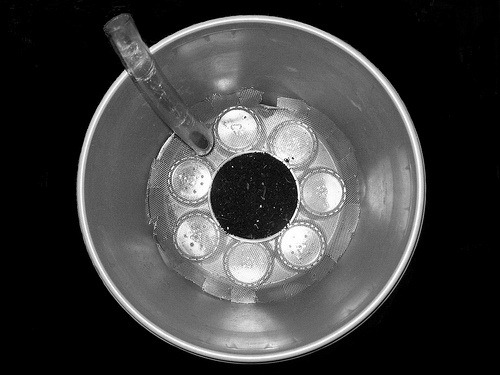 This picture has many cups under it, I use only three, and PVC instead of the Plastic tube shown.
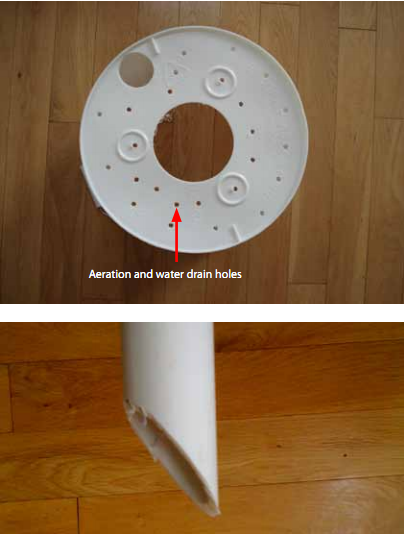
3) Get the lid just right and then let’s work on the bucket. Check where the bucket lid comes to and drill a small hole at that point on the side of the bucket. This is where the water will drain when you water the plant.
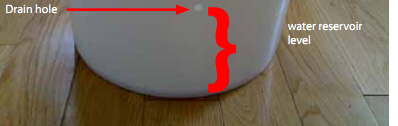
4) In a separate bucket or container mix the soil, compost and Perlite in equal amounts and mound it up some.
4) Now place the 3 Solo cups upside down in the 5 gallon bucket. Take the panty hose and cut each leg off about 14 inches up. Place one leg in the Solo cup and fill it with the soil mixture. Dampen the soil, set aside. Place the lid to the bucket on the upside down cups, slide the PVC pipe in the hole you’ve drilled for it, diagonal side down. Use zip ties to hold the pipe straight up after drilling two small hone near the top of the bucket. Put the cup with soil in the large hole in the middle.
5) Place the screen over the whole thing in the bucket and make it come up the side a few inches. Place the rest of your soil in the bucket so that it comes up to about 2 inches below the rim. Now water the soil slowly and with a sprinkler head on your water bucket. or hose. This is the only time you will water from the soil. Normally you water into the tube until it flows out the side hole.
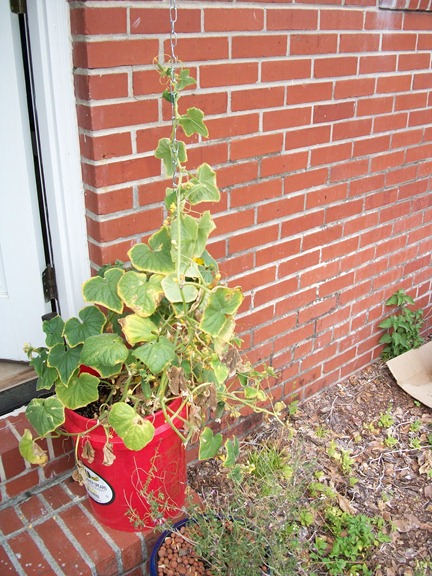 Cucumbers in Grow Bucket growing up a chain.
What Does Gardening Have to Do with the #Occupy Movement?
Posted: November 23, 2011 Filed under: Gardening, Non-Toxic Choices Leave a comment Colleen Vanderlinden
November 21, 2011


My colleagues here at TreeHugger have done an amazing job covering the #Occupy movement. Chris has looked into the idea of #Occupy being a building block to a Constitutional Convention. Lloyd has discussed the issue of police brutality, and Sami has looked at the misconceptions people have about the movement.
I’m here, as always, to look at it with a gardener’s eye. (Stay with me.)
A few weeks ago, my friend and fellow garden writer Mr. Brown Thumb started the #OccupyGardens hashtag on Twitter, kind of as a joke. But the more I looked at it, the more it made sense. Occupy is about fighting greed, about taking control from the corporations and their government cronies and bringing it back to we the people, the 99%.
What is more basic to all of our needs than food?
In Jenna Woginrich’s excellent book, Made from Scratch, she argues that:
"Vegetable gardening has been called ‘the peaceful sedition’ because at the most basic level, when a person can feed and shelter herself, she doesn’t require a government to provide for her. … It’s not about pride or independence, or even connecting with nature. It’s about wanting hash browns on a Saturday morning and being able to run out to the backyard in your bathrobe to grab some potatoes from the garden."
I would argue that, even more, it means that she doesn’t need a corporation to provide for her. And when we don’t need the corporations, they cease to have the ability to exist — or at least cease to have so much power that the will of the people means nothing. Look at the way we’re fighting for something as simple, as self-explanatory, as GMO labeling. 87 percent of Americans want to know if they’re eating GMOs or not. The hubris of corporate America, and their Congressional lapdogs, is what is keeping us from that knowledge.
"Certain gardens are described as retreats when they are really attacks." — Ian Hamilton Finlay
This is how I’ve come to see my garden, bit by bit, over the years. Where others see a peaceful place to while away a summer afternoon, I see a full arsenal in my fight against corporatocracy. The shake of a seed packet is my chant; rows of chard and beds of potatoes are my weapons.
Roger Doiron, of Kitchen Gardeners International, recently gave a TEDx talk about the power of gardening. It is definitely worth a look:
Every bite of food we grow ourselves, every forkful that comes from our own labor instead of from the troughs of corporate food, is a statement that we are taking our power back. We don’t need them to feed us. Whether from our garden, our farmer’s market, or our local CSA, we can feed ourselves.
#Occupy Wall Street, and L.A., and Detroit. But #Occupy the garden, as well.
Want to get started?
- 66 Things You Can Grow Yourself, in Containers10 Most Nutritious Crops, and How to Grow ThemGrowing a Garden to Feed a FamilyThree Easy to Grow Veggies10 Veggies You Can Grow in Shade
Online Hub Could Become the ‘Fresh Direct’ of Locally Grown Food
Posted: November 2, 2011 Filed under: Food and it's Impact on Our Health, Gardening, Going Green; How and Why... Leave a comment
Brian Merchant
Via- Treehugger
October 25, 2011


tami.vroma via Flickr/CC BY 2.0
Local Orbit founder Erika Block believes that more restaurants and shops would stock locally-sourced food — if only the process of tracking it down and arranging distribution were easier. As of now, Block says, a chef, shop owner, or determined local eater must maintain many disparate relationships with farmers and producers in order to make sure all of the ingredients they need make it into the kitchen or onto the shelves. Local Orbit, an online hub that streamlines the connections between buyers and growers, seeks to provide the missing link that makes the process easier and much more efficient.
I sat down with Block at this year’s Poptech conference; as a social innovation fellow, she delivered a talk about how Local Orbit could broaden the horizons of possibility for local food markets everywhere. She sat down with me for an interview, and we discussed all of the above:
CLICK HERE to watch the Interview


 Meal Delivery Service by Millie Barnes