Saturated Fats are Best for Cooking!!
Posted: July 20, 2009 Filed under: Food and it's Impact on Our Health Leave a comment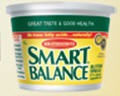 Margarine- The process used to make a liquid oil opaque yellow and spreadable produces an incredibly unhealthy product that hardly qualifies to be called a food. It doesn’t matter if you start with the best quality extra virgin olive, the final product is still an unhealthy food.
Promoted as a cholesterol free and healthier choice than good old butter, margarine is the ultimate source of trans fats, which rather ironically elevate cholesterol and damage blood vessel walls. Even more ironic is the fact that margarine is still recommended by health authorities including the Australian Heart Foundation who also promote reducing dietary trans fats. Clever loopholes in labelling allow margarines to claim that they are ‘virtually’ trans fat free. Margarine is a good example of a politically correct unhealthy food.
What about the new cholesterol lowering margarines?
Save your money, you’ll be getting a dose of the very same phyto sterols by using extra virgin olive oil liberally in your diet. Most fruits and vegetables also contain phyto sterols.
 Saturated fat- coconut oil, organic butter, lard. When cooking with heat, saturated fats are the safest and healthiest to use. NONE of the atoms of carbon in their carbon-chain share multiple bonds. They are thus more stable and don’t oxidize as readily. Examples of foods containing a greater proportion of saturated fats include coconut oil, butter, ghee, tallow, and suet.
Monounsaturated fats have ONE (hence the prefix “mono”) pair of carbon atoms in their carbon-chain which share two bonds. This makes them more reactive than saturated fats, since the redundant extra atomic bond can be grabbed by something else, such as oxygen, turning the oil rancid, or oxidizing it. This happens more easily under the influence of heat and light. Although the use of saturated fats for frying is much safer and healthier, at a pinch monounsaturated fats would be the only other fat type I would use, and then only for light (pan) frying for a single dish (no second frying with the same oil). Foods with a large quantity of monounsaturated fat include olive oil, and lard (which has a high saturated fat content too). Good olive oil should come in a dark glass bottle, to protect the oil from light, and so that plastic molecules don’t leach in.
Polyunsaturated fats have MORE THAN ONE (hence the prefix “poly”) pair of carbon atoms in their carbon-chain which each share two bonds. They may have two, three, or more such double-bond pairs. This makes them extremely reactive to light and heat, and they oxidize very readily.
Free radi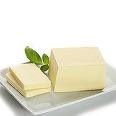 cals, anyone? The widespread use of polyunsaturated oils are the main reason behind the subtle shift towards promoting monounsaturated olive oil, and encouraging people to eat foods rich in anti-oxidants. Polyunsaturated oils include sunflower oil. You should NOT expose it to heat, as by doing so you are damaging it further and creating additional free radicals. I say “further” and “additional”, as the oil is usually exposed to heat as part of factory processing, and usually sits in a brightly lit shop in a clear plastic bottle prior to sale. As a bonus to the oxidizing oil, in it you also receive tiny amounts of molecules of the degassing plastic (but that’s another story). Polyunsaturated vegetable oils are also high in Omega-6 essential fatty acids, which can throw your Omega 3 to Omega 6 balance out of whack, which isn’t good. Now don’t write off all polyunsaturated oils. Some polyunsaturated oils are high in Omega 3 essential fatty acids, necessary for proper brain function. These important polyunsaturates come from fish oils (cod-liver oil is particularly good), and from the flax plant (flaxseed or linseed oil). Good health food shops know just how fragile these important polyunsaturated oils are, and sell them in dark glass or even metal bottles to exclude light, and store them in a refrigerator to prevent the oil being affected by heat. The better brands will confirm that heat was excluded from all stages of processing.
Fighting Plants: 7 Delicious Herbs that Pack a Powerful Antimicrobial Punch
Posted: July 20, 2009 Filed under: Food and it's Impact on Our Health Leave a commentAdding herbs to your favorite dishes adds flavor, variety and color. Antimicrobial herbs provide all of that – PLUS they give your health a major boost.
Antimicrobial herbs have a unique ability to destroy and inhibit the growth of disease-causing microorganisms. This takes major stress off of your immune system, helping to stimulate it and thereby helping you to fight off a wide array of potential infections.
Antimicrobial herbs are capable of taking on a large variety of microorganisms, such as:
-
Bacteria
-
Mold
-
Parasites
-
Viruses
-
Yeasts
-
Other living organisms
You may already be familiar with the following antimicrobial herbs, but their potent disease-fighting properties may surprise you. I recommend they be added generously to your cooking!
 1. Chili Peppers
Chili peppers contain a substance called capsaicin, which is what makes them so spicy (the spicier the pepper, the more capsaicin it contains). Capsaicin is also an anti-inflammatory compound that helps with pain relief and many other ailments.
Contrary to popular belief, chili peppers do not cause stomach ulcers. In fact, they help prevent them by killing bacteria you eat. They also contain vitamins C and A, which boost immunity and help fight off potential pathogens.
Did you know? Capsaicin is mostly in the chili pepper’s seeds and white inner membranes. Taking these out will remove some of the pepper’s heat, but it will remove some of its healing properties as well.
 2. Clove
The active compound in cloves, eugenol, combines with other clove components to make this pungent spice highly anti-bacterial. It’s also anti-inflammatory and the compound has been studied for use in preventing:
-
Toxicity from environmental pollutants
-
Digestive tract cancers
-
Joint inflammation
Because clove extracts are anti-bacterial (and provide a mild anesthetic), they’re used in the United States for dental procedures like root canal therapy and temporary fillings. They’re also used in some sore throat sprays and mouth washes.
Did you know? Cloves are an excellent source of traditional nutrients too, including omega-3 fatty acids, dietary fiber, vitamin C and magnesium.
 3. Garlic
Allicin, one of garlic’s healthy compounds (and the one that gives it its odor), has powerful antibacterial and antiviral properties. When combined with the vitamin C in garlic, these compounds kill harmful microbes and fight diseases including:
-
Cold and flu
-
Stomach viruses
-
Candida yeast
-
Tuberculosis
-
Botulism
Garlic is also a potent antibiotic, fighting a wide range of pathogens, and studies show it even appears to fight antibiotic-resistant strains of bacteria.
Did you know? Along with being able to lower blood pressure, insulin and triglycerides, allicin may also help prevent weight gain. A study on rats — published in the December 2003 issue of the American Journal of Hypertension — found that rats’ weights remained stable or decreased slightly when allicin was given along with a sugar-rich diet, while other rats’ weights increased.
 4. Mustard Seed
Researchers from the University of Manitoba in Winnipeg, Canada found that the antimicrobial properties of mustard seed are so strong that when powdered mustard was added to hamburger meat, it killed E. coli bacteria.
The compound responsible for this effect is allyl isothiocyanate. The U.S. Department of Agriculture reported that this potent compound can fight off not only E. coli but also listeria, Staphylococcus aureus and other food borne pathogens.
Unfortunately, prepared mustard that is typically consumed in the United States does not contain this healthy component.
Did you know? Isothiocyanates in mustard seed have also been studied for their ability to inhibit the growth of existing cancer cells and protect against the formation of new ones.
 5. Sage
Sage is a powerful antimicrobial that is known to kill fungi, including Candida albicans, and other microbes such as salmonella. Sage leaf extract is also known to kill the microbe that causes gingivitis.
Sage is an anti-inflammatory and antioxidant. It contains flavonoids, phenolic acids and oxygen-handling enzymes, all of which give it a unique ability to prevent oxygen-based damage to cells. Sage may be useful in fighting rheumatoid arthritis and other inflammatory conditions, bronchial asthma and atherosclerosis.
Did you know? Sage is also good for your brain. A study in the June 2003 Pharmacological Biochemical Behavior found that people given sage essential oil extracts had significantly improved recall abilities compared to those given a placebo.
 6. Rosemary
Rosemary has both antibacterial and antifungal properties and is sometimes recommended to treat yeast overgrowth in the intestines.
Further, it is known to stimulate the immune system, increase circulation and improve digestion.
Did you know? Rosemary has been traditionally regarded as a memory enhancer. Students in ancient Greece, for instance, would put sprigs of the herb in their hair while studying.
7. Thyme
Thyme contains volatile oil components that are known to fight a wide range of bacteria and fungi, including:
-
Staphylococcus aureus
-
Bacillus subtilis
-
E. coli
-
Shigella sonnei
Recent studies have also shown that thyme can help prevent foods from becoming contaminated and even help decontaminate already contaminated foods. A study in the February 2004 issue of Food Microbiology found that thyme essential oil decontaminated lettuce contaminated with Shigella, an infectious organism that can cause diarrhea and intestinal damage.
Washing produce in a solution of just 1 percent thyme essential oil was also able to decrease the number of Shigella bacteria to undetectable levels.
Did you know? Thyme has been used for its antiseptic properties since the 16th century, both in mouthwashes and topically.
Packaging Design at It’s Worst
Posted: July 16, 2009 Filed under: Food and it's Impact on Our Health Leave a comment
Poor packaging design and ridiculous examples of over-packaging come in all shapes and sizes, but it doesn’t get much worse than these individually-wrapped bananas, complete with plastic shrink-wrap and (very non-biodegradable) polystyrene, spied in a U.K. grocery store.
See the slide show on TreeHugger.
What you can do;
Make or buy muslin bags for produce.
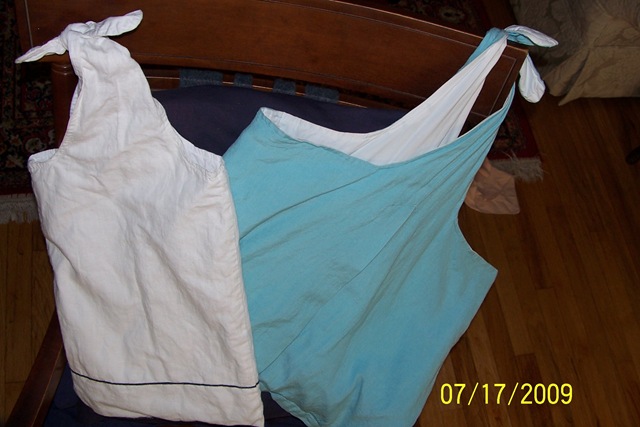
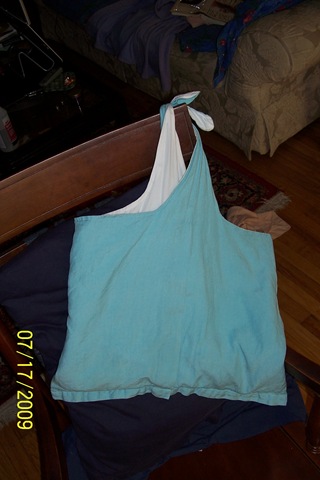
I made shopping bags out of old silk clothing; it’s very strong, but folds up very small, so I can keep one in my purse.
A nutrition client of mine lost 85 pounds, she was kind enough to give me some old, beautiful linen dresses, they made awesome shopping bags. I incorporated some of the pleats and embroidery that was part of the clothing;
More on BPA
Posted: July 16, 2009 Filed under: Food and it's Impact on Our Health Leave a comment
As if you need more reasons to ditch BPA… YourTotalHealth.com reported today:
"The latest study, from Harvard School of Public Health, shows just how quickly the compound goes from bottles to bodies. College students drank from hard plastic polycarbonate bottles made with BPA. Levels of the compound in urine rose by two thirds in a week"
Read more here. (Then go check the plastics still in your cupboards.)
Use glass to store food in; Pyrex with BPA free plastic tops are my fave, stainless steel is great. Don’t buy food in cans or plastic bottles!
Stay Away From Dryer Sheets!
Posted: July 15, 2009 Filed under: Food and it's Impact on Our Health Leave a comment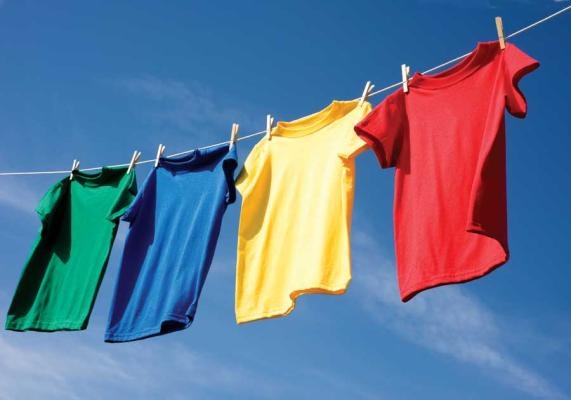
From Trying To Be Greener
Doing laundry is a real pain in the neck, and I mean that literally. I live in an apartment building and use a laundry room in the basement. Because I have to haul a big bag of clothes to do this, I only do this chore once a week (which makes the bag even heavier I guess). I go up and down to change the clothes from washer to dryer and then haul them up when they’re done. When the job is done, I get a great sense of satisfaction knowing everything is clean and I don’t have to do it again until next week.
Well, I didn’t get that feeling of satisfaction yesterday because after I dumped out my clean clothes on the bed to put them away, an artificial perfume smell began to permeate from the bag. It hit me right away – I must have missed a dryer sheet that someone else left in one of the dryers!
You may think I’m over-reacting but I was so angry and still am. It’s all I smell now in my apartment. I started using Seventh Generation Baby Detergent right before my daughter was born. There’s no fragrance in it at all and I’ve really gotten used to my clothes smelling like nothing. Now all I smell is artificial fragrance which many companies use to hide the chemical smell in dryer sheets.
Here’s some of what can be typically found in dryer sheets and what these chemicals have been linked to:
- Benzyl acetate: Linked to pancreatic cancer
- Benzyl Alcohol: Upper respiratory tract irritant
- Ethanol: On the EPA’s Hazardous Waste list and can cause central nervous system disorders
- Limonene: Suspected Gastrointestinal or Liver Toxicant, Immunotoxicant,
Kidney Toxicant, Neurotoxicant, Respiratory Toxicant, and Skin or Sense Organ Toxicant - A-Terpineol: Can cause respiratory problems, including fatal edema, and central nervous system damage
- Ethyl Acetate: A narcotic on the EPA’s Hazardous Waste list
- Camphor: Causes central nervous system disorders
- Chloroform: Neurotoxic, anesthetic and carcinogenic
- Linalool: A narcotic that causes central nervous system disorders
- Pentane: A chemical known to be harmful if inhaled
Health effects from being exposed to the chemicals in fabric softeners include:
- Central nervous system disorders
- Headaches
- Nausea
- Vomiting
- Dizziness
- Blood pressure reduction
- Irritation to skin, mucus membranes and respiratory tract
- Pancreatic cancer
If you’d like to make your clothes softer, choose instead the wonder products – vinegar or baking soda. Just add a quarter cup of either of them to the wash cycle the next time you do laundry. Then you can enjoy the sweet smell of nothing.
Sun Chips Packaging Goes Green
Posted: July 15, 2009 Filed under: Food and it's Impact on Our Health Leave a comment I perform Food Demos for a marketing company part time and the other day I did a demo for Sun Chips. As you know, I am NOT a proponent of eating junk food..everyone should eat a diet of whole food, not food out of bags, boxes or cans. But junk food isn’t going away. What a great day it would be if everyone ate whole foods and not processed ones. But we know that foods like Sun Chips aren’t going away any time soon.
They are now advertizing that their bags now will be completely compostable by Earth Day 2010. The bags will be made from polyastic acid, or PLA, and will compost in 12-16 weeks at temperatures over 55 degrees F.
Many products like these are consumed around the planet daily. This is at least a step in a better direction and perhaps it will prompt other companies to implement similar packaging with their own products.
I’m Speechless (and you know THAT doesn’t happen often!!)
Posted: July 15, 2009 Filed under: Food and it's Impact on Our Health Leave a commentThe other day I saw a commercial that made my mouth drop open. Clorox Bleach ran a commercial saying to wash your baby’s bottles and toys in a mixture of water and Clorox to disinfect them. What?!!!
As you probably know by now, I am an extremely radical environmentalist, it is very very rare for me to use a commercial product that contains harmful chemicals. But there are times that I have to use bleach, but on baby toys???????
Soap and water works fine to clean with! If something needs disinfecting baking soda and vinegar work beautifully! Lavender oil is a natural disinfectant, also.
Stay informed and help ban BPA
Posted: July 15, 2009 Filed under: Food and it's Impact on Our Health Leave a comment Recently Coca-Cola, Campbell’s, Del Monte and other manufacturers of canned foods and beverages, met to come up with a public relations and lobbying strategy to stop the government from banning the use of Bisphenol-A, or BPA, from being used in the linings of metal lids and cans. The level they’re willing to stoop will shock you.
BPA is an endocrine disruptor which mimics estrogen. It has been shown to cause impaired brain and neurological functions, testicular and breast cancer, chromosomal and reproductive system abnormalities, early puberty, adult-onset diabetes, and obesity and resistance to chemotherapy. It can be found in some plastics with recycling code “7″, the lining of canned drinks and foods except for Eden Organics’ canned beans, canned baby formula, the lining of baby food jars, some plastic reusable water bottles, and some baby bottles (for a list of BPA-free baby bottles and other plastic baby items, click here). Canada and Suffolk County in New York have banned BPA in baby bottles and other states plan to follow suit.
Safer States is group of environmental health coalitions and organizations that works to protect citizens from toxic threats, such as lead, PBDEs, phthalates, and bisphenol A, at a state level. They believe a national chemical policy reform is urgently needed; however, they aren’t standing by waiting for it. Their site will keep you up to date with studies, new locations, and places where these toxic chemicals are being banned. Their site also has a link for you to easily contact members of congress and ask them to ban BPA from food and beverage containers.
Chocolate- How to Love It Even More- (if that’s possible!)
Posted: July 15, 2009 Filed under: Food and it's Impact on Our Health Leave a comment
People who know me know that I love chocolate. Not a little, but a lot. So much so, that if my house were burning and I had time to grab only one thing before I headed for safety, I might waste a moment or two trying to decide if I should bring my chocolate stash with me. Yes, that’s how much I love the product of the cocoa bean. (Don’t worry, my children always come first in my priorities!)
If you’re reading this blog, the chances are that you are looking for ways to live a bit greener. Maybe you’re new to this or maybe you’re an eco pro. Either way, I’m going to talk about three different ways you can make a difference with your chocolate consumption.
Chocolate Tip #1: Go local
In my mind, one of the best ways to be environmentally friendly is to be a locavore. I shop locally — local stores owned by local citizens — whenever I can. Are you lucky enough to have a locally-owned gourmet chocolate shop? If so, shop there. Personally, I have tried to do this, but I only know of Peterbrook’s Chocolate locally and I cannot stand thier chocolate.
Chocolate Tip #2: Go organic
Organic chocolate was grown with no pesticides or chemical fertilizers, which means a safer and healthier Planet Earth and a safer and healthier YOU. And, if you choose organic chocolate, chances are that it is also Fair Trade chocolate, which means that the farmers growing the cocoa beans were paid living wages and worked in safe conditions.
Chocolate Tip #3: Be wise
What if you need chocolate right now and there are no local or organic options? Then make some smart choices.
I personally don’t buy chocolate made by Hershey’s and Nestle because I have issues with some of their corporate practices. Instead, I prefer Cadbury’s and Ghirardelli. What you do or not buy is up to you, but if you’re committed to making a change to benefit Planet Earth, do your research. Find out where different companies buy their cocoa beans. If they buy from Central America, do they buy Fair Trade cocoa beans? Or do they get their cocoa beans from the Ivory Coast, which has a sordid history of human rights violations and use of child labor in the cocoa industry.
If you follow just one of the tips above part of the time, you’ll be making a difference while still eating delicious chocolate. For more information on organic and Fair Trade chocolates, click here.
As you can imagine, I have some favorites. Okay, that’s an understatement, but here is a list of my five favorite chocolates that are either 100% or partially organic or the companies have corporate ethics that I admire.

- Newman’s Own Organics — From signature gourmet chocolate bars to peanut butter cups to Newman-O’s, these yummy treats are certified organic. Plus, we all know that Newman’s Own and Newman’s Own Organics give their net profits to charity. So you’re doing a good thing when you eat NOO chocolate!
- Whole Foods — Like most grocery stores, Whole Foods has its own in-store brands; unlike most grocery stores, these chocolates are made with organic ingredients. Try the truffles, you won’t be disappointed.
- Vosges — Vosges makes a variety of gourmet treats.
- Green & Black Chocolates– The Maya Gold Bar is my fave!!
So that’s the skinny on chocolate from an eco-friendly chocoholic! If anyone else has any recommendations, please leave them in the comments so that we can all give them a try.
Easy Ways to Go Green
Posted: July 14, 2009 Filed under: Food and it's Impact on Our Health Leave a comment- Make Repairs
Why throw away something that costs $50 dollars when you can repair it for $15? Fix-it shops which have long been on the brink of extinction are seeing a resurgence. Repairing your gear is a lot greener than replacing it, because it uses fewer resources. You’ll also save a bundle of money, especially if you take the time to repair things yourself. - Energy-Efficiency
You don’t have to buy solar panels to reduce your electric bills. Doing small things, like using CFL light bulbs, putting padded drapes, insulated blinds, plastic, or bubble wrap over the windows, turning off lights, putting appliances on power-saver mode, sewing draft snakes and a host of other cheap solutions will save you a few hundred dollars a year. - Water Conservation
The water that flows to you home comes at a price. Reducing the amount of water you use, will reduce the amount of money you spend. Don’t flush every time, build and use a sawdust toilet, use organic soaps and re-use that grey water for the flowers outside, don’t water your grass. - Gas Mileage
Simple things like keeping your tires inflated, taking heavy objects out of the car and not letting your car idle are all eco-friendly ways to reduce emissions. They will also save you money. Use a bike! - Renting/Borrowing/Buying Used
Do you really need a brand-new copy of 50 First Dates? I mean, how many times do you need to watch it to make it worth $24.99? A movie ticket doesn’t even cost that much? You can watch movies online through NetFlix or you can find them used for a fraction of the price. You can also just borrow a copy from a friend and spend no money. - Make Your Own
Why buy it when you can make your own? You can make your own shampoo, your own sawdust toilet or just about anything if you put your mind to it. - Reuse
Why throw it in the trash bin if you can put it to practical use? You can reuse almost anything! - Home-Cooked Meals
You can make a meal from scratch rather than buying a prepackaged one. Most meals are cheap if you make them out of their base materials, and you will be able to make more for less. It’s also healthier than buying a lot of that processed junk. - Drink Tap Water
A filter on your tap is a relatively cheap investment. It reduces waste significantly. And if you’re drinking five or so bottles of water a day, it will yield significant savings. You can also just drink straight from the tap with no filter, and you’ll probably be fine. I mean, if there is a health problem with your water, your water provider is legally obligated to inform you. - Alternative Travel
Traveling by plane is expensive, it’s also not that great for the environment. Not vacationing, vacationing locally or taking the Greyhound and in some cases the train are all less expensive and eco-friendly ways to travel.
You don’t have to buy anything to go green. You just have to put in a little effort.


