A Fish Oil Story
Posted: December 18, 2009 Filed under: Food and it's Impact on Our Health Leave a commentFrom The New York Times
By Paul Greenberg
 “WHAT’S the deal with fish oil?”
If you are someone who catches and eats a lot of fish, as I am, you get adept at answering questions about which fish are safe, which are sustainable and which should be avoided altogether. But when this fish oil question arrived in my inbox recently, I was stumped. I knew that concerns about overfishing had prompted many consumers to choose supplements as a guilt-free way of getting their omega-3 fatty acids, which studies show lower triglycerides and the risk of heart attack. But I had never looked into the fish behind the oil and whether it was fit, morally or environmentally speaking, to be consumed.
The deal with fish oil, I found out, is that a considerable portion of it comes from a creature upon which the entire Atlantic coastal ecosystem relies, a big-headed, smelly, foot-long member of the herring family called menhaden, which a recent book identifies in its title as “The Most Important Fish in the Sea.”
The book’s author, H. Bruce Franklin, compares menhaden to the passenger pigeon and related to me recently how his research uncovered that populations were once so large that “the vanguard of the fish’s annual migration would reach Cape Cod while the rearguard was still in Maine.” Menhaden filter-feed nearly exclusively on algae, the most abundant forage in the world, and are prolifically good at converting that algae into omega-3 fatty acids and other important proteins and oils. They also form the basis of the Atlantic Coast’s marine food chain.
Nearly every fish a fish eater likes to eat eats menhaden. Bluefin tuna, striped bass, redfish and bluefish are just a few of the diners at the menhaden buffet. All of these fish are high in omega-3 fatty acids but are unable themselves to synthesize them. The omega-3s they have come from menhaden.
But menhaden are entering the final losing phases of a century-and-a-half fight for survival that began when humans started turning huge schools into fertilizer and lamp oil. Once petroleum-based oils replaced menhaden oil in lamps, trillions of menhaden were ground into feed for hogs, chickens and pets. Today, hundreds of millions of pounds of them are converted into lipstick, salmon feed, paint, “buttery spread,” salad dressing and, yes, some of those omega-3 supplements you have been forcing on your children. All of these products can be made with more environmentally benign substitutes, but menhaden are still used in great (though declining) numbers because they can be caught and processed cheaply.
For the last decade, one company, Omega Protein of Houston, has been catching 90 percent of the nation’s menhaden. The perniciousness of menhaden removals has been widely enough recognized that 13 of the 15 Atlantic states have banned Omega Protein’s boats from their waters. But the company’s toehold in North Carolina and Virginia (where it has its largest processing plant), and its continued right to fish in federal waters, means a half-million menhaden are still taken from the ecosystem every year.
For fish guys like me, this egregious privatization of what is essentially a public resource is shocking. But even if you are not interested in fish, there is an important reason for concern about menhaden’s decline.
Quite simply, menhaden keep the water clean. The muddy brown color of the Long Island Sound and the growing dead zones in the Chesapeake Bay are the direct result of inadequate water filtration — a job that was once carried out by menhaden. An adult menhaden can rid four to six gallons of water of algae in a minute. Imagine then the water-cleaning capacity of the half-billion menhaden we “reduce” into oil every year.
So what is the seeker of omega-3 supplements to do? Bruce Franklin points out that there are 75 commercial products — including fish-oil pills made from fish discards — that don’t contribute directly to the depletion of a fishery. Flax oil also fits the bill and uses no fish at all.
But I’ve come to realize that, as with many issues surrounding fish, more powerful fulcrums than consumer choice need to be put in motion to fix things. President Obama and the Congressional leadership have repeatedly stressed their commitment to wresting the wealth of the nation from the hands of a few. A demonstration of this commitment would be to ban the fishing of menhaden in federal waters. The Virginia Legislature could enact a similar moratorium in the Chesapeake Bay (the largest menhaden nursery in the world).
The menhaden is a small fish that in its multitudes plays such a big role in our economy and environment that its fate shouldn’t be effectively controlled by a single company and its bottles of fish oil supplements. If our government is serious about standing up for the little guy, it should start by giving a little, but crucial, fish a fair deal.
Paul Greenberg is the author of the forthcoming “Four Fish: The Future of the Last Wild Food.”
What Not to Buy at Walmart
Posted: December 13, 2009 Filed under: Food and it's Impact on Our Health Leave a commentThis article is part of a package on consumers and Walmart. To read the other article, on what to buy at Walmart, click here.

While Walmart has recently burnished its reputation among upscale shoppers, there are still some product categories where you’d be better off going elsewhere — either because you’re straying beyond Walmart’s core competency, or to avoid supporting the giant retailer’s bad behavior. Here are three of them.
1. High-End Electronics
Though Walmart has expanded its selection of name-brand electronics, it’s still focused on value-oriented products in the sub-$1,000 price range. And its sales staff tend not to be experts in the finer points of multimedia interface. So if you want to splurge on a top-of-the-line television or digital SLR camera — and get the accompanying level of service and accessories — you’ll want to visit a specialty electronics store. Best Buy (BBY), for example, has a customer support team (the Geek Squad) capable of explaining why, for instance, you may need a television with several HDMI ports.
2. Books
This year, Walmart slashed prices aggressively to establish itself as the low-price leader for best-selling books. The store cut the cost of popular novels such as Stephen King’s Under the Dome by 70 percent to $13.99, sparking a price war with Amazon (AMZN).
The Walmart/Amazon rivalry translates into incredibly low prices for consumers on some of the most popular book titles. But Walmart’s prices come at a cost, say local business advocates. In the long-run, such deep discounts can drive independent booksellers out of business. And without these stores, consumers will have difficulty finding all but the most well-known authors, says Stacy Mitchell, senior researcher with the Institute for Local Self-Reliance, a non-profit that advocates for local businesses.
3. Wood Furniture
Despite Walmart’s increased focus on sustainability, the retailer has a long way to go in the furniture category. In December 2007, an environmental group published a report tracing furniture from Walmart suppliers to wood illegally logged in protected Russian habitats for Siberian tigers and other wildlife. Several months later, Walmart promised to investigate its suppliers and joined the Global Forest & Trade Network, an organization dedicated to eliminating illegal logging. Environmental activists have applauded Walmart’s promise to purge environmentally rotten wood, but Walmart could take until a self-imposed deadline of 2013 to phase out the products. Until then, consumers can’t be certain that Walmart’s wood furniture comes from well-managed forests.
What to Buy at Walmart
Posted: December 12, 2009 Filed under: Food and it's Impact on Our Health Leave a commentby Catherine Holahan | Dec 10, 2009
From CBS MoneyWatch.com
Despite (or perhaps because of) the fact that Walmart (WMT) is the nation’s largest retailer, there are plenty of people who wouldn’t be caught dead in one. To these folks, Walmart conjures images of a rapacious juggernaut of stadium-sized stores offering low-quality merchandise, spotty service, and mistreating employees and the environment — while driving small local retailers out of business.

But many of those misgivings are starting to fade, partly as a result of some well-timed improvements to the company’s product line-up and its environmental record. What’s more, there’s nothing like the worst recession in 80 years to nudge “low prices” a little higher on the collective priority list. And while Walmart may not be making its employees rich, the chain handed out very few pink slips in the downturn and remains the country’s largest private employer.
To be sure, there are plenty of reasons to remain wary of the retail behemoth. Whether you are concerned about the threat to a downtown business district, object to the retail culture, or just have a mental picture of the Walmart shopper that you can’t square with your own self image, it may not be for you. But it’s worth keeping in mind that, when it leverages its enormous scale for good, Walmart can make a difference in a hurry. It’s one thing when a boutique sells fair-trade coffee, but when Walmart gets into the game, a lot of sustainable farmers benefit. Here are five product categories where you can comparison shop in good conscience at the nation’s “low-price leader.”
1. Moderately Priced Consumer Electronics
Dying to get the latest hi-definition TV from Vizio or Viore? We thought not. Those low-priced brands are what Walmart has focused on in the past, but recently the retailer has expanded its offerings to include high-def TVs from top makers such as Samsung (SSNLF), Sony (SNE), Philips (PHG), and Sharp (SHCAY). It also now offers digital cameras made by the likes of Nikon and Canon.
Walmart still isn’t the best place to shop for a top-of-the-line television or digital SLR camera. But its focus on bringing in more big brands has made it an attractive option for shoppers seeking consumer electronics in the sub-$1,000 price range. This year, for example, some WalMart stores offered a 50-inch Samsung plasma television for less than $700 during the Thanksgiving holiday weekend.
What Walmart doesn’t have is an army of educated sales people ready to explain all the settings on the back of that SLR or the subtle differences between a high-def TV with a resolution of 1080i versus one with 1080p. But such service has become less important now that 90 percent of consumers turn to the Internet for detailed product reviews, says James Russo, Nielsen’s vice president of global consumer insights.
“Consumers will do their research outside the store,” says Russo. “So if Walmart has the right selection and price point, consumers will go there.
2. Smart Phones
In the past year, Walmart has beefed up its offerings of higher-end cell phones, especially Blackberries. This is good news if you’ve reached the end of your phone contract and are looking to compare new phones and carriers all in one place, since Walmart sells phones and service plans from each of the four largest U.S. carriers: Verizon (VZ), AT&T (T), Sprint (S), and T-Mobile (DT). So if you want to see how T-Mobile’s G1 phone, which uses Google’s Android operating system, matches up against Apple’s iPhone, Walmart is the place for you. You can’t do that at an AT&T store, or even at one of Apple’s fancy boutiques.
3. Coffee
While Walmart has been criticized in the past for being more concerned with price than environmental or labor issues when sourcing its goods, one area where it’s improving its record is with coffee. This year, the company partnered with TransFair USA, an independent certifying agency, to offer fair trade-certified coffee in its Walmart and Sam’s Club stores. The coffee is sustainably grown by farmers who receive a living wage and is thus more expensive than competing coffees — roughly $5.88 for a 10 to 12 ounce bag, compared with less than $5 for supermarket brand Eight O’Clock Coffee. But it tastes better (or at least it should), and by selling fair-trade coffee, Walmart vastly expands the market for such goods.
Carmen K. Iezzi, executive director of the Fair Trade Federation, a North American association for such products, says Walmart’s expansion of fair trade certified items like coffee was promising, although she cautioned that it’s too early to tell how much impact Walmart’s efforts will have. Still, coffee is a good start. “When any major corporation begins to move in the direction of more sustainable practices, that is a positive sign,” says Iezzi.
4. Video Game Bundles
Of course, Walmart’s primary appeal has always been its low prices, but it makes sense for shoppers to do a cost/benefit analysis: Is it worth it to save $10 on a book, when you could be supporting an independent bookseller instead? On the other hand, you can save a lot more money if you’re in the market for video game systems, which Walmart often bundles with starter games. For example, Walmart was recently selling the Xbox 360 Elite gaming system, along with two games, including this season’s blockbuster title, Call of Duty: Modern Warfare 2, for just $259. The game console alone sells for upward of $249 at stores such as Sears, while Call of Duty typically retails for $60. And buying video game consoles and products at Walmart is arguably a guilt-free purchase. After all, Sears (SHLD) isn’t known for standing up against suburban sprawl.
5. Laundry Detergent
When it comes to the environment, Walmart’s suppliers have often fallen far short of best practices. Now the chain is trying to clean up its act by offering more eco-friendly products. One area where it’s done the most is laundry detergent. The company recently switched to selling only concentrated laundry detergent in its U.S. stores — these products use up to 50 percent less packaging and require less fuel to transport than the earlier versions. Once again, scale matters: Walmart has a serious carbon footprint, so cutting laundry detergent containers by half can have a big impact.
Walmart has taken steps to combat phosphates, which pollute the water and lead to an explosion of the algae population that destroys fish habitats and plants. The company already says there are no phosphates in detergent it sells in the U.S., and earlier this year, it announced plans to choose more eco-friendly suppliers for the laundry and dish detergent it sells in its Americas region, cutting phosphates by 70 percent by 2011. The Americas region includes Canada, Mexico, and countries in Central and South America..
And Walmart has unveiled broader initiatives to improve its eco-image. In July, the company began developing a sustainability index that will eventually rank all of its suppliers and products based on their environmental impact. “Walmart is taking some important steps, although they’ve still got a long way to go,” says Honor Schauland, a campaign assistant at the Organic Consumers Association, a Minnesota-based consumer advocacy group.
Walmart didn’t become the world’s largest retailer by accident. Executives in Benton, Ark., are well aware that stocking sustainable products was a good way to attract a more affluent consumer. And those consumers like low prices on recognizable brands as much as anyone, especially in the current economy, says Doug Conn, a managing director at Hexagon Securities who focuses on the retail sector.
“They have picked up on trends like organics and natural products, and that has helped get new customers,” says Conn. “But the key theme is that customers are more value-oriented than they have ever been this holiday season, and Walmart is the default place to go for low prices.”
In other words, new customers are coming for the deals. But if they shop the categories mentioned above, they can feel good about being thrifty without worrying that they’ve abandoned their ideals just to save a buck.
Catch of the Freezer
Posted: December 12, 2009 Filed under: Food and it's Impact on Our Health Leave a commentFrom The New York Times

By ASTRID SCHOLZ, ULF SONESSON and PETER TYEDMERS
GO local. Eat organic. Buy fresh. Those food mantras continue to make waves among environmentally conscious consumers. But — as is often the case in these climate-conscious times — if the motivation is to truly make our diets more earth-friendly, then perhaps we need a new mantra: Buy frozen.
Several years ago, the three of us — two ecological economists and one food system researcher — teamed up in an effort to understand how to develop sustainable food systems to feed a planet of nine billion by 2050. As the focus of our study, we chose salmon, an important source of protein around the world and a food that is available nearly anywhere at any time, regardless of season or local supply.
We examined the salmon’s life cycle: how the fish are caught in the wild, what they’re fed when farmed, how they’re processed and transported and how they’re consumed.
And what did we find in our research? When it comes to salmon, the questions of organic versus conventional and wild versus farmed matter less than whether the fish is frozen or fresh. In many cases, fresh salmon has about twice the environmental impact as frozen salmon.
The reason: Most salmon consumers live far from where the fish was caught or farmed, and the majority of salmon fillets they buy are fresh and shipped by air, which is the world’s most carbon-intensive form of travel. Flying fillets from Alaska, British Columbia, Norway, Scotland or Chile so that 24 hours later they can be served “fresh” in New York adds an enormous climate burden, one that swamps the potential benefits of organic farming or sustainable fishing. (Disclosure: A nonprofit subsidiary of Ecotrust, the North Pacific Fisheries Trust, lends money to sustainable fisheries.)
Fresh fish is wonderful and healthful, and if it’s driven a reasonable distance to market, then its relative environmental impact is low. Fortunately for conscientious diners, when fish is flash-frozen at sea, its taste and quality is practically indistinguishable from fresh. More important, it can be moved thousands of miles by container ship, rail or even truck at much lower environmental impact than when air freighted. If seafood-loving Japanese consumers, who get most of their fish via air shipments, were to switch to 75 percent frozen salmon, it would have a greater ecological benefit than all of Europe and North America eating only locally farmed or caught salmon.
Is the future full of fish sticks? No. But when it comes to eating seafood from halfway around the world, we need to get over our fetish for fresh. With the challenges facing the world’s oceans mounting, buying frozen is a powerful choice that concerned eaters everywhere can make.
Has the added bonus of killing parasites too. In fact, commercial freezing (lower temp than your household fridge) is a food safety requirement on many kinds of fish to be served as sushi…
Astrid Scholz is the vice president of knowledge systems at Ecotrust in Portland, Ore. Ulf Sonesson is a researcher at the Swedish Institute for Food and Biotechnology. Peter Tyedmers is a professor at Dalhousie University in Halifax, Nova Scotia.
Another Garden Update- Flowers
Posted: December 7, 2009 Filed under: Gardening Leave a commentGreat day for photography, dark an cloudy outside.
 The azalea’s started to bloom, then it plunged to 39 degrees…in a few days it’ll be back to 80 degrees..winter in Florida! My tomatoes have ripening fruit, the peppers are producing and flowering again..


 And the strawberries are sending out shoots like crazy…
Finally! A Garden Update..
Posted: December 3, 2009 Filed under: Gardening Leave a commentIt’s been forever, I know.. And I have been gardening all along…just focused on other things, ya’ll! Mainly blogging, working, looking for more work, my daughter moved in…all kind of things…
It’s storming like crazy here tonight…but in the kitchen;
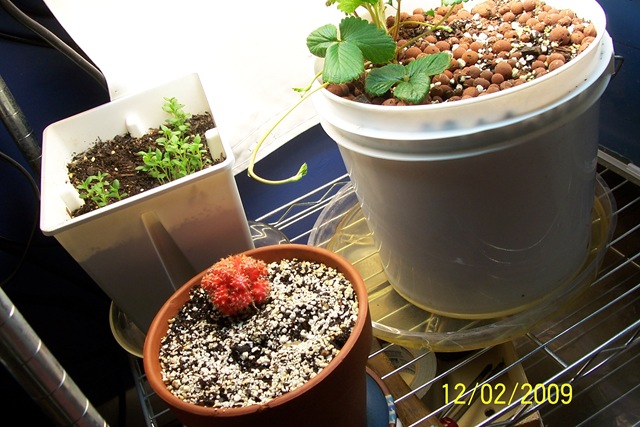 Lavender, Cactus, and strawberries.
 New strawberry leaf
 Strawberries, finally flowering..
 Baby Lettuce, a few of these I will let grow into heads, each one will give me months of lettuce…and in the meantime I eat delicate little baby lettuces sprinkled over thick tomato slices (which are still blooming and have ripening tomatoes on them outside).
 Purple peppers are still blooming and have ripening fruit, too. They, like the tomatoes, have fared WAY better in sub-irrigated containers, made out of 5 gallon buckets.

 Here’s the cucumbers, growing up a chain by my front door..
 Basil and thyme are doing great…
 These beets greens just keep producing for months as long as I keep taking the outside leaves off to et for dinner..
Most of these plants will come inside under the grow lights soon…but for now, they’re doing great. The lowest the temperature has gotten here is 41 degrees so far and it didn’t faze any of them…
35 Ways to Never Waste Food Again
Posted: December 2, 2009 Filed under: Gardening, In The Kitchen with Millie- How To's 2 Comments-
Simple ideas that make a big difference in your budget and help save resources too.
-
 By Colleen Vanderlinden
From Planet Green


"Use it up, wear it out, make do, or do without" is a favorite adage in both frugal and green circles, and it is something I strive to live by. One of the best ways to "use it up" is to think differently about our food and ways to avoid wasting it. Lloyd wrote a great post a while back about the statistics for how much food we waste in the U.S., and the numbers are, frankly, appalling. On average, we waste 14% of our food purchases per year, and the average American family throws out over $600 of fruit per year. Most of the food we waste is due to spoilage; we’re buying too much and using too little of it.
We’ve all had it happen: half the loaf of bread goes stale because no one wants to eat sandwiches today, and the grapes we bought as healthy snacks for the kids’ lunches languish in the crisper. With a little creativity, and an eye toward vanquishing waste in our lives, we can make use of more of our food before it goes to waste. Here are a few ideas for you.
Millie; The most important step you can take to save money is make everything from scratch! I make my own coconut milk yogurt, Kombucha tae, meat stocks, mayonnaise, granola (gluten free), salad dressings, literally everything- see How I eat and Shop Organically AND Economically.
Using Up Vegetables
1. Leftover mashed potatoes from dinner? Make them into patty shapes the next morning and cook them in butter for a pretty good "mock hash brown."
2. Don’t toss those trimmed ends from onions, carrots, celery, or peppers. Store them in your freezer, and once you have a good amount saved up, add them to a large pot with a few cups of water and make homemade vegetable broth. This is also a great use for cabbage cores and corn cobs.
Use all the food clippings in your traditional meat stocks; I keep them in a large zip-lock bag in the freezer. Onion skins are great for flavor, too!
3. Don’t toss broccoli stalks. They can be peeled and sliced, then prepared just like broccoli florets.
4. If you have to dice part of an onion or pepper for a recipe, don’t waste the rest of it. Chop it up and store it in the freezer for the next time you need diced onion or peppers.
5. Roasted root vegetable leftovers can be turned into an easy, simple soup the next day. Add the veggies to a blender, along with enough broth or water to thin them enough to blend. Heat and enjoy.
6. If you’re preparing squash, don’t toss the seeds. Rinse and roast them in the oven, just like you would with pumpkin seeds. The taste is pretty much the same.
7. Celery leaves usually get tossed. There’s a lot of good flavor in them; chop them up and add them to meatloaf, soups, or stews.
8. Use up tomatoes before they go bad by drying them in the oven. You can then store them in olive oil in the refrigerator (if you plan on using them within a week) or in the freezer.
9. Canning is always a good option. If you’re doing tomatoes, you can use a boiling water bath. If you’re canning any other type of veggie, a pressure canner is necessary for food safety.
10. Before it goes bad, blanch it and toss it in the freezer. This works for peas, beans, corn, carrots, broccoli, brussels sprouts, cauliflower, and leafy greens like spinach and kale.
11. Too many zucchini? Make zucchini bread or muffins. If you don’t want to eat the bread now, bake it and freeze it, then defrost when you’re ready to eat it.
12.Pickle it. Cucumbers are the first veggie most of us think of pickling, but in reality, just about any vegetable can be preserved through pickling.
Ideas for Cutting Down on Fruit Waste
13. Make smoothies with fruit before it goes bad. Berries, bananas, and melons are great candidates for this use-up idea.
14. Jam is really easy to make, and will keep for up to a year if you process the jars in a hot water bath. If you don’t do the water processing part, you can keep the jam in the refrigerator for a month, which is a lot longer than the fruits would have lasted.
I make apple butter and freeze it in amounts I will use in a week (about a cup).
15. Dry your fruit and store it in the freezer or in airtight containers.
16. Make fruit spreads.
17. Make a big fruit salad or "fruit kebabs" for your kids. For some reason, they seem to eat more fruit if it’s in these "fancier" forms.
18. Use up the fall bounty of apples by making applesauce or apple butter.
19. Don’t throw out those watermelon rinds! Pickled watermelon rind is a pretty tasty treat.
20. Make a fruit crumble out of almost any fruit you have on hand. Assemble and bake it now, or leave it unbaked and store it in the freezer for a quick dessert.
Make the Most of Meat
21. Use organic chicken carcasses and bones to make traditional meat stocks. (there is an art to making stocks, you do not just boil the bones!). Chicken Stock 101
22. Ditto for bones from beef! Beef Stock 101
23. The fat you trim from beef can be melted down and turned into suet for backyard birds. If it’s organic and/or grass fed beef bones, use it to fry with…it makes the best French fries in the world!!
24. Turn leftover bits of cooked chicken into chicken salad for sandwiches the next day.
25. Use leftover roast beef or pot roast in an easy vegetable beef soup the next day by adding veggies, water, and stock.
Herbs and How to Get the Most Out of Them
26. Chop herbs and add them to ice cube trays with just a little water. Drop whole cubes into the pan when a recipe calls for that type of herb.
27. You can also freeze herbs by placing them in plastic containers. Certain herbs, such as basil, will turn black, but the flavor will still be great.
28. Make pesto with extra basil or parsley.
29. Dry herbs by hanging them by their stems in a cool, dry location. Once they’re dry, remove them from the stems and store them in airtight containers.
Don’t Waste a Drop
30. Leftover coffee in the carafe? Freeze it in ice cube trays. Use the cubes for iced coffee or to cool down too-hot coffee without diluting it. You can do the same with leftover tea.
31. If there’s a splash or two of wine left in the bottle, use it to de-glaze pans to add flavor to whatever you’re cooking.
32. If you have pickle juice left in a jar, don’t pour it down the drain. Use it to make a fresh batch of refrigerator pickles, or add it to salad dressings (or dirty martinis).
33. You can also freeze broth or stock in ice cube trays, and use a cube or two whenever you make a pan sauce or gravy.
34. If there’s just a bit of honey left in the bottom of the jar, add a squeeze or two of lemon juice or hot water and swish it around. The lemon juice will loosen up the honey, and you have the perfect addition to a cup of tea.
35. Grow your own herbs, lettuce, tomatoes and green peppers. They are easy to grow and will save you a bunch!
36. Do not buy paper towels, buy more dish cloths and use them for years! Also use cloth napkins.
Finally….
37. If you can’t think of any way to use that food in the kitchen, compost it. Everything, even meat and dairy will work in a compost pile if you do thermal composting, and at least your extra food can be used for something useful. Such as growing more food!
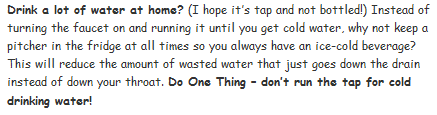
Do One Thing; Keep Water in the Fridge Instead of Running The Tap
Posted: November 18, 2009 Filed under: Food and it's Impact on Our Health Leave a commentFrom The Good Human
Decrease In Physical Activity May Not Be A Factor In Increased Obesity Rates Among Adolescents
Posted: November 18, 2009 Filed under: Food and it's Impact on Our Health Leave a comment
ScienceDaily (Nov. 3, 2009) — Decreased physical activity may have little to do with the recent spike in obesity rates among U.S. adolescents, according to researchers at the Johns Hopkins Bloomberg School of Public Health.
Prompted by growing concern that the increase was due to decreased physical activity associated with increased TV viewing time and other sedentary behaviors, researchers examined the patterns and time trends in physical activity and sedentary behaviors among U.S. adolescents based on nationally representative data collected since 1991. The review found signs indicating that the physical activity among adolescents increased while TV viewing decreased in recent years.
The results are featured in the October 30 online issue of Obesity Reviews.
"Although only one third of U.S. adolescents met the recommended levels of physical activity, there is no clear evidence they had become less active over the past decade while the prevalence of obesity continued to rise," said Youfa Wang, MD, PhD, MS, senior author of the study and an associate professor with the Bloomberg School’s Center for Human Nutrition and the Department of International Health. "During the recent decade, U.S. adolescents had greater access to TV, but significantly fewer of them watched TV for three or more hours per day. In addition, daily physical education attendance rates improved along with the use of physical education class in engaging in physical activity. However, there are considerable differences in the patterns by age, sex and ethnicity."
Wang, along with co-authors Shiru Li, MD, MS, former visiting scholar with the Bloomberg School’s Center for Human Nutrition, and Margarita Treuth, PhD, adjunct associate professor with the Bloomberg School’s Center for Human Nutrition and a professor with the University of Maryland East Shore, examined findings from the nationally representative Youth Risk Behavior Surveillance (YRBS) surveys from 1991 to 2007. The survey included U.S. high school students in grades 9 through 12 and provided information about their physical activities including enrollment and participation in physical education in school and sedentary behaviors including screen time.
Based on these surveys, researchers examined the patterns and time trends and compared the observed physical activity patterns with the national goals set in Healthy People 2010, a comprehensive agenda for improving the health of all Americans. They found that minority students were less likely to be physically active and more likely to engage in sedentary behaviors than white students. Girls were less active than boys and decreased physical activity was related to an increase in age.
"The large gaps between the 2007 achievement and the 2010 targets indicate that the goals are unlikely to be achieved by 2010," said Wang. "Our study suggests that more vigorous efforts are needed to help young Americans engage in adequate regular physical activity and reduce sedentary behaviors, which will help promote good health. In addition, these findings may suggest factors other than physical activity, and sedentary behaviors such as unhealthy eating may play a more important role to help explain the recent increase in obesity."
The research was supported in part by research grants from The National Institute of Diabetes and Digestive and Kidney Diseases (NIDDK) and The Eunice Kennedy Shriver National Institute of Child Health and Human Development (NICHD).
Charter for Compassion
Posted: November 17, 2009 Filed under: Food and it's Impact on Our Health Leave a commentA call to bring the world together…
Bringing together voices from all religions, all nations, all backgrounds, the Charter for Compassion seeks to remind the world that we all share the Golden Rule.


Karen Armstrong Dalai Lama Desmond Tutu
The principle of compassion lies at the heart of all religious, ethical and spiritual traditions, calling us always to treat all others as we wish to be treated ourselves. Compassion impels us to work tirelessly to alleviate the suffering of our fellow creatures, to dethrone ourselves from the centre of our world and put another there, and to honour the inviolable sanctity of every single human being, treating everybody, without exception, with absolute justice, equity and respect.
It is also necessary in both public and private life to refrain consistently and empathically from inflicting pain. To act or speak violently out of spite, chauvinism, or self-interest, to impoverish, exploit or deny basic rights to anybody, and to incite hatred by denigrating others—even our enemies—is a denial of our common humanity. We acknowledge that we have failed to live compassionately and that some have even increased the sum of human misery in the name of religion.
We therefore call upon all men and women ~ to restore compassion to the centre of morality and religion ~ to return to the ancient principle that any interpretation of scripture that breeds violence, hatred or disdain is illegitimate ~ to ensure that youth are given accurate and respectful information about other traditions, religions and cultures ~ to encourage a positive appreciation of cultural and religious diversity ~ to cultivate an informed empathy with the suffering of all human beings—even those regarded as enemies.
We urgently need to make compassion a clear, luminous and dynamic force in our polarized world. Rooted in a principled determination to transcend selfishness, compassion can break down political, dogmatic, ideological and religious boundaries. Born of our deep interdependence, compassion is essential to human relationships and to a fulfilled humanity. It is the path to enlightenment, and indispensible to the creation of a just economy and a peaceful global community.
Please join this wonderful cause– Let’s All Work Together to Understand Each Other and Live Compassionately.


 Meal Delivery Service by Millie Barnes