H&M and Wal-Mart Caught Destroying Clothing, Deny It Is Policy
Posted: January 17, 2010 Filed under: Food and it's Impact on Our Health Leave a commentFrom Treehugger

Cynthia Magnus with destroyed clothing, Suzanne DeChillo/The New York Times
The New York Times is having a hard time these days, and the mainstream media are taking a lot of hits. But you have to admit, there is still a lot of power in those presses. Just yesterday Jim Dwyer wrote A Clothing Clearance Where More Than Just the Prices Have Been Slashed, about how graduate student Cynthia Magnus discovered that piles of clothes from Wal-Mart and H&M were being destroyed and thrown out. Dwyer keeps it short:
It is winter. A third of the city is poor. And unworn clothing is being destroyed nightly.
H&M did not return the reporter’s ten calls but he ran the story anyways. And today?
A different headline in the Times: Clothing Retailer Says It Will No Longer Destroy Unworn Garments
A spokesperson responded quickly this time.
"It will not happen again," said Nicole Christie, a spokeswoman for H & M in New York. "We are committed 100 percent to make sure this practice is not happening anywhere else, as it is not our standard practice."
A Wal-Mart spokesperson said that the company typically donated or recycled such items, and did not explain how the store just happened to have a giant hole-punching machine.
One has to wonder, how long it would have taken if Consumerist or even TreeHugger had been the one to break this story. Would the blogs have got a call back in a day? Could they even find a number?
There is still such a big role to be played by the big papers like the Times. If only they had not become so timid with respect to other issues.
Growing Potatoes in a Container
Posted: January 17, 2010 Filed under: Gardening 22 Comments
Potatoes are not difficult to grow in the ground, they are much easier to grow in containers. And the most practical container for growing potatoes is a half-barrel container.
Make certain that any container that you use has drainage holes in the bottom. If not, drill four 1-inch holes. You will want to set your containers on bricks to elevate them and keep them from direct contact with the soil.
Next, purchase a good potting mix to use in your containers. To this potting mix add about one shovelful of premoistened peat moss to each 1 cubic foot bag of potting material and mix thoroughly. The peat moss provides the potatoes with the acidity they require. Initially you are going to fill each container only half full of the potting mix.
At this point I already have my potatoes sprouting; some sweet potatoes and some new potatoes, sprouted in the kitchen in water.
Fill your container a third full of potting mix-peat-compost mix.
Water the container two or three times a week during the entire growing period. Because of the drainage holes and the rapid draining nature of the peat mixture, overwatering will not be a problem. Let the hose run gently in the barrel until you can see water escaping from the drainage holes.
Try not to disturb the root system too much, and leave some of the small potatoes to mature to full size. When the plants turn yellow and start to dry up, the rest of the potatoes will have reached full size. Pull up the plants and remove the potatoes. Store your potatoes in a cool, dark place. While in storage, if they develop any green sections or sprouts, cut the sections off before cooking.
When the young potato plants emerge through the surface and are about 8 inches tall, fill the remainder of the barrel (partially burying the young plants) to within 3 inches of the top with the other half of the soil mixture.
The potato plants will grow to about 3 feet tall from the soil surface of the container. The container will soon fill with a network of underground stems, bearing many potatoes. When small blossoms appear on the plants, the tiny, tender new potatoes will be ready to harvest. Simply feel around in the container and pick some.
As the potatoes grow, add more soil and compost. After they reach
the top of the barrel, plant a couple of bush beans in each barrel. This
is a companion plant for potatoes. The beans protect the potatoes
against the Colorado potato beetle, and the potatoes protect the
beans against the Mexican bean beetle. Horseradish is also good for
the potato and distasteful to pests. DO NOT co-plant with onions or
garlic.
As soon as the potatoes flower you will find little spuds in the soil.
Pee-Cycling
Posted: January 17, 2010 Filed under: Gardening 2 CommentsAccording to PopSci.com, researchers from Finland are claiming that tomatoes fertilized with urine show a four-fold increase in crop yields. And it doesn’t end there – the same tomatoes also showed higher beta-carotene than unfertilized ones, and much more protein than traditionally fertilized plants. A panel of (presumably unsqueamish) blind tasters also attested to the fact that the flavor was just as good too.
In a way it’s no surprise – studies have already shown that urine in the garden is a good thing, and Josh has given us some guidance on how to garden with pee. But a four-fold increase in fruits?! That’s huge.
And for those wondering why I’m mixing urine with charcoal – there’s some evidence to suggest that DIY biochar can help retain nutrients for longer, and it can also provide a habitat for important microorganisms. I’ll let you know if it works out for me.
Here’s how to fertilize with urine;
When you use urine fertilizer in your garden, make sure to use the urine as soon as you make it. Old urine won’t keep. It will go bad. Don’t apply the urine to the leaves of the plants. The urine needs to go in the soil around it.
If you find yourself, with too much urine, you can always put the urine on the compost pile. It’s the best compost activator there is!
If you have been reading my blog long, you know I use a sawdust toilet and use high heat composting to break it down. You can read about that here;
I use a sawdust toilet, and use this Tupperware pitcher for a urinal. It is easy to use and then I empty it into the compost bin (it’s the best compost activator there is!)
 Or you can get any flat (slim line) pitcher. It fits easily under the sink, out of site. I marked where I fill it to, then where an 1 to 8 ratio is when diluted with water…and water my inside and outside plants.
Here is a great site for learning more about all this; Humanure Handbook
Read also Pee in the Shower, Save your Rivers
First Strawberry!
Posted: January 17, 2010 Filed under: Gardening Leave a commentThe coldest week I’ve ever experienced in Florida ended yesterday…and today I have my first strawberry!

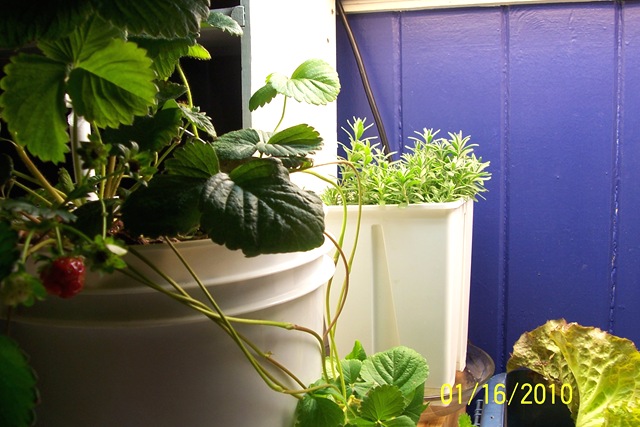 Love that splash of red, lavender is behind, lettuce to the right.
Of course, outside is decimated..except the lettuce which sprouts up and is 5 inches high. Yep, it made it through 21 degree weather, 5 nights of hard freezes. It was the seed from the lettuce plant I let go to seed. It was sprouting out from under the plastic I had covering the soil in the sub-irrigated grow bucket…hung in all summer. Sprouted 10 days ago. So that got me to thinking about how hardy it was..that led to searching on garden forums for a hint of why. And viola! Winter Sowing. I’m really tickled about this and you’ll see why..
Here’s how WinterSown.org explains it;
Winter Sowing is done outdoors during Winter using mini-greenhouses made from recyclables; there are no heating devices, no energy wasting light set-ups or expensive seed starting devices.
You can learn How to Winter Sow Seeds Outdoors.The FAQs (frequently asked questions) will show you many different tips and techniques for Winter Sowing, they are written in a friendly and encouraging manner. The Winter Sowing Method adapts easily to fit everyone’s own needs and skill level. Because the method is budget wise it can fit into everyone’s wallet size too.
Amazingly, just when Winter is about to break, and you’re still getting nightly freezes, the first of your flats will begin to germinate. When I saw this I thought that the seedlings were goners, but they thrived. The seeds know when it’s safe to come up; it’s part of their genetics. Now is the time to check the moisture in the flats. On an above-freezing day, open them up and if they look like they need a drink give them one. The excess water will drain away. Don’t forget to replace the lids tightly.
And all the hardening off, winterizing, makes for tougher, hardier plants!
So go read these simple instructions.. I’m fixing to start new veggies inside, but I’m also going to experiment with this method and I’ll keep you posted along the way!
This week I will plant new lettuce, a small amount, I planted scallions today. I will plant Swiss chard and beets tomorrow although the ones outside are still going, I’m shocked… Basil may bounce back, but the one in the square food garden went to seed last year. I can’t wait to see what pops up this year. What an adventure learning all this…by just diving in and doing it… It is so easy to grow most of my veggies. I spend a few hours a week now that I am growing mostly indoors; easy..no bugs, very low water needs, …and savings of about 30 dollars a week…
One Light Bulb at a Time
Posted: January 11, 2010 Filed under: Non-Toxic Choices Leave a commentThis is from my friend Florence. Thank you so much!

From i360Photo.com
I haven’t personally checked the accuracy of each statement and have no clue where the nearest Kroger’s is but this seems like a good way to begin the new year. Just a thought.
One Light Bulb at a Time
A physics teacher in high school, once told the students that while one grasshopper on the railroad tracks wouldn’t slow a train very much, a billion of them would. With that thought in mind, read the following, obviously written by a good American …Good idea .. . . one light bulb at a time . . . .
Check this out . I can verify this because I was in Lowes the other day for
some reason and just for the heck of it I was looking at the hose
attachments .. They were all made in China . The next day I was in Ace
Hardware and just for the heck of it I checked the hose
attachments there. They were made in USA . Start looking ..
In our current economic situation, every little thing we buy or do affects
someone else – even their job . So, after reading this email, I think this
lady is on the right track . Let’s get behind her
My grandson likes Hershey’s candy . I noticed, though, that it is marked
made in Mexico now. I do not buy it any more.
My favorite toothpaste Colgate is made in Mexico … now I have switched to Crest. You have to read the labels on everything ..
This past weekend I was at Kroger. I needed 60 W light bulbs and Bounce dryer sheets . I was in the light bulb aisle, and right next to the GE brand I normally buy was an off-brand labeled, "Everyday Value . " I picked up both types of bulbs and compared the stats – they were the same except for the price .. The GE bulbs were more money than the Everyday Value brand but the thing that surprised me the most was the fact that GE was made in MEXICO and the Everyday Value brand was made in – get ready for this – the USA in a company in Cleveland , Ohio .
So throw out the myth that you cannot find products you use every day that
are made right here ..
So on to another aisle – Bounce Dryer Sheets . .. . yep, you guessed it,
Bounce cost more money and is made in Canada . The Everyday Value
brand was less money and MADE IN THE USA ! I did laundry yesterday
and the dryer sheets performed just like the Bounce Free I have been using
for years and at almost half the price!
My challenge to you is to start reading the labels when you shop for
everyday things and see what you can find that is made in the USA – the
job you save may be your own or your neighbors!
If you accept the challenge, pass this on to others in your address book so
we can all start buying American, one light bulb at a time! Stop buying
from overseas companies!
(We should have awakened a decade ago .. . .. . . . )
Let’s get with the program and help our fellow Americans keep their jobs and create more jobs here in the USA.
I passed this on …….. will you ???????
 I loved the sentiment here.. I would add to this that there really isn’t any reason to buy dryer sheets, and they are chemical laden…just dry your clothes til they are just dry, or use the clothesline…no cost, and no boxes or disposable stuff to throe away.
Make Drool-Worthy Bacon Cups for Your Holiday Party
Posted: January 3, 2010 Filed under: In The Kitchen with Millie- How To's Leave a commentFrom LifeHacker
 When it comes to party appetizers, pigs in a blanket are yesterday’s news. If you really want to wow your guests, we have two words for you: bacon cups.
Make sure you have lunch before you check out home project weblog Not Martha’s post on how to make these knock-your-socks-off bacon cups, because you will get hungry. The author experimented with different ways to weave mini bacon baskets together and plop them on the bottom of a foil-lined muffin tin to hold their shape in the oven.
She went through loads of bacon and tried several methods before landing on the perfect way to make two different sized baskets. The larger size is perfect for holding a lettuce and tomato salad, while the smaller version is perfect for bite-size appetizers or finger food.
Making these little goodies is a bit more involved than just opening a bag of chips and dumping them in a bowl. Morgan, the post’s author, cautions:
This all took three hours and my house filled with smoke, but it was worth it. Be sure to put a cookie sheet with a rim below the cooking bacon in the oven, there was a lot of dripping fat and I saw a few flames. Watch your oven carefully!
We love her idea of making tiny BLTs out of the cups. What else would make a good filling? Scrambled eggs? Diced toast? More bacon? Lets hear your ideas in the comments.
How To;
I had an occasion calling for bacon themed food and my mind immediately turned towards the famed bacon mat. I needed something a little more single-serving though, so I decided to attempt bacon cups. In the bacon mat instructions there is mention of draping the mat over an overturned metal bowl and cooking it so that it would turn out in as a bowl shape. I decided to try using the backs of various muffin and mini cake pans, I ran out of bacon before I got to try as many as I would have liked so I’ll have to try more at a later date. Any excuse for more bacon.
I set the oven at 400 degrees and carefully formed foil over the back of the muffin pan. I did not coat with cooking spray, it would have been easier to remove but I suspect that the bacon would not have held the form as well if the foil was oiled and would have popped apart half way through cooking. On the other hand some bacon did break when I was peeling away the foil. I cooked the bacon, moving the pans around, until it was crisp looking and waited for it to cool before removing the foil and shaped bacon.
This all took three hours and my house filled with smoke, but it was worth it. Be sure to put a cookie sheet with a rim below the cooking bacon in the oven, there was a lot of dripping fat and I saw a few flames. Watch your oven carefully!
For cup shapes I used the back of this Wilton King-Size Muffin Pan. These are the width of jumbo muffins but are almost twice as tall (see this cupcake for a visual).
For the first try I used two layers of bacon on the sides and wove it like a basket, or at least like I imagine a basket would be woven:

I turned out to not be enough after the bacon cooked and shrank:


It held its structure very well though:

The next time I used three layers of bacon on the sides, this worked out better:


For as floppy as the bacon is when trying to weave it, it keeps its shape really well once cooked to the point that it is crisp.
I also tried to make small round bowls using the back of a Betty Crocker mini filled cake pan.

It shrank up quite a lot, leaving more of a shallow rounded shape:


Going for a breadless BLT I filled the cups with lettuce (the arugula was the best) and sliced cherry tomato. After some serious investigation it was determined that the shallow bowls were the easiest to eat as finger food, while the cups were dramatic.

I had hoped to make a mayo-based salad dressing to really fill out my the BLT theme but I completely ran out of time. Overall, a success!
Tips for Being Productive- Home Office
Posted: January 3, 2010 Filed under: Food and it's Impact on Our Health Leave a comment
1. Start out organized! Know what you need to accomplish, set goals, keep lists. The best piece of advice I have is to read and follow Stephen Covey’s advice on setting goals in Seven Habits for Highly Effective People. The book changed my life!
2. Do NOT wake up and go straight to work! Start the day properly. Have a good breakfast, spend some time alone to just sit and do whatever. Relax, let your mind wander. Pray. Just make sure that your mind isn’t in the “I hate working” frame of mind.
3. Don’t work an eight hour day. Work in four blocks of an hour and a half, with a 20 minute gap between each. If you do more than that, your attention might start to wander, you’ll be restless and your work won’t have it’s normal level of quality.
4. No turning on the computer for a quick email check or to do 1 little thing until you’ve gotten “ready for work” as mentioned above. The nuance is if you have nowhere to be, that 1 little thing leads to showering at 2 in the afternoon with a splitting headache because you’ve forgotten to eat etc.
5. Begin forming diligent work habits from Day 1: if you allow yourself to lay on the couch and watch TV instead of working, this will become
your habit. Instead, develop a routine that will find a balance between getting the work done and enjoying your home office. That routine might include:
- Showering and dressing before you work (you’re more productive that way).
- Making a list of the 3 things you want to accomplish today.
- Starting on the first thing on that list before you check email.
- When you finish a task on your list, reward yourself with something fun.
6. Put an old fashioned egg timer on the desk. When I start a long or boring project, I’ll set the timer at 15 minutes, and no matter what happens, I’ll force myself to take a break when the alarm goes off. At first I thought the timer will (a) stress me out or (b) distract me. But it turned out to be a great idea. I often procrastinate because I hated doing long and boring projects. But if I promise myself a 15 minute break no matter what, I’m much more likely to be productive.
7. Firewall your attention. Depending on your sensitivity to interruptions, this could be as simple as closing a door, or as complex as configuring software to keep you from browsing the World Wide Time Sink when you’re supposed to be working. Get a door you can close. Make sure you can shut yourself off from the daily grind at home. It’s very tempting to work in the living room or have your spouse or kids come in every time for some fun or little questions. Make the agreement that when the door is closed, no one is allowed in.
8. You have to approach it like a “real” job. If you wouldn’t wear your pajamas to work, you probably shouldn’t wear them to work in your home office.
9. Have a good lunch. Puts you in the mood for the second half of the day.
10. Define your spaces; separate work from home. Have a room dedicated to working. Don’t do it wherever you happen to be. Set aside some space, preferably a room (it doesn’t have to be big) to be your workspace. That way, when you enter it, you know consciously what you’re there to do: go to work. It changes the state of mind from “I’m at home” to “I’m at work”.
11. Set regular hours, and stick to the schedule.
12. Close the door. It’ll be very easy to leave the door to whatever room or space you set apart to be your workplace open. Don’t do it. If the door is open, that represents something to you, and to your family. To you, it represents the idea that if it’s a bit tough, or you don’t feel like working today, you don’t have to. To your family, it represents the idea that Dad is around, and I can go and talk to him.
13. Keep your desk and general work area tidy. A tidy workspace helps keep a tidy mind, which helps make your day more productive.
14. Turn off the telephone when you need to work without distraction. Turn off IM and email notifications too. In fact, if possible, shut off the Internet.
15. Don’t go back to work when you’ve finished. Had a great idea for a post? Fantastic, write down the basics on a note, and pin it up. Don’t go back to work when you’ve finished.
16. Don’t allow work to consume your life. Easier said than done when working from home. Make sure you set limits for the amount of time you will work. Be grateful you’re working from home and not in some cubicle! That gratitude will motivate you to work harder, so you can continue to work from home.
Battery Tricks, Hacks and Tips
Posted: January 2, 2010 Filed under: Food and it's Impact on Our Health Leave a commentFrom LifeHacker
1. Keep your iPod "held" and updated
If you haven’t hit the "Update" button since you got your iPod, old or new, fire up iTunes and do so—the newest firmware, in many cases, can boost your battery life. Once you’ve done that, run through Playlist Magazine’s battery saving tips, which include keeping backlighting, the equalizer, and Sound Check features off when they’re not needed. Also, keeping the "Hold" switch in place when you’re not actively using it saves you from accidentally playing your whole collection, and wasting another charge cycle.
2. Get serious rechargeable batteries (and a charger)
It’s a help to the environment, and your checking account, to use rechargeable batteries instead of letting your Wii remotes and other gadgets eat through AAs. But the grocery store brands and accessories often don’t seem worth the hassle. Blogger Jeff Atwood does know what works, though, and he details the circuit science and recommends the good stuff in the post linked above. If you’re stuck with Energizer and Duracell choices, though, here’s Gizmodo’s faceoff of the big brands.
3. Turn off your digital camera’s screen
Having a view of the whole scene you’re shooting is one of the digital camera‘s big advantages over film-based models, but powering that tiny little LCD takes quite the toll on your little batteries. If you’re running low, or know you’re going to be without a recharge for some time, turn the screen off and shoot through the optical viewfinder. You’ll save battery time, and might find a new perspective on focus and framing.
4. Watch movies from hard drives, not DVDs
Simple, sure, but not always obvious. On many planes and trains, laptops serve as little more than portable DVD players with bigger screens, but forcing your laptop to spin the discs and read from them eats up more power than reading a file off a hard disk—or, perhaps even better, a USB drive. How to get there? We recommend HandBrake for most any system, though Adam’s got a pretty good thing going with his (Windows-based) one-click DVD ripping solution.
5. Extend your not-so-hot iPhone life
A lot of lists out there offer to help extend your iPhone’s battery life. This one’s a lot like them, except it’s written by our sibling site Gizmodo and based on extensive testing done during the run-up to the iPhone’s launch. And it goes so far as to suggest what the others don’t—playing games with 3D and vibrate, for example, is a power killer, both in actual juice and in how long you’ll end up playing without realizing you’ve been sucked in. And if you’re just checking weather, emailing, and making calls, keep your 3G switched off until it’s needed.
6. Stash your gadgets out of your pockets
It’s the most natural place in the world for your cellphone or iPod, but the heat your pocket picks up from, well, your hips can decrease the overall life of lithium-ion batteries. Not so much that you absolutely have to get one of those I’m An Important Person belt clips, but if you’ve got a coat, purse, or other place to put a battery-powered gizmo, consider offering it a little more ventilation than your body-warmed cotton wraps. While you’re thinking cool, try stashing your batteries (just your batteries, mind you) in the freezer if you’re trying to conserve every last drop while you’re away from your charger. Photo by hsiqueira.
7. Get long-term battery life
An inquiring reader asked how to keep his batteries delivering on-the-go power for the long haul, rather than watch his investment be eaten away by age. As is so often the case, our readers came right back with answers. A MetaFilter thread linked by one helpful reader suggests using the battery fully if you’re going to use it, then re-charge when it runs down. A Battery University link offers more tips, and Apple’s guide to batteries suggests a few tips on what to do with unused or spare batteries—store them in a cool place at about 50 percent charge, for instance.
8. Make your system smarter about power
Windows and Mac OS X both know when you’re using a laptop, and presumably want to help you save power. Except, in the case of the Mac, sleeping and hibernating isn’t done with remaining battery power in mind, and on Vista, well, all those Aero effects and background processes suck up power too quickly. Enter Vista Battery Saver, which kills the Aero effects, sidebar widgets, and other power sinks, and SmartSleep (OS X), which gradually transitions from sleep, to sleep-and-hibernate, to full-on, session-saving hibernate as you start winding down from 20 percent charge. Both are nearly necessary downloads for road warriors lugging either OS around
9. Recalibrate a laptop battery to regain life
It’s a shame, but laptop batteries can lie to you about how much juice they have, or can really hold. The New York Times explains in a Q & A (look halfway down the page) the most straight-forward means of getting the real truth. Turn off all your interrupting apps, like screensavers and the like, put your computer to sleep, and plug it in until you know it’s good and charged. Then turn it back on, make sure your power settings are such that the system won’t try to sleep or hibernate, then run your computer all the way down on battery power. Charge it back up one more time, and you’ll know whether you really need to start shopping at Laptop Battery Express, Laptops for Less, or check with your manufacturer to get a new lithium stick.


 Meal Delivery Service by Millie Barnes
