Woman might go to jail for growing veggies in her front yard!??
Posted: July 11, 2011 Filed under: Food and it's Impact on Our Health Leave a commentWoman might go to jail for growing veggies in her front yard!??
Michigan Woman Faces 93 Days in Jail for Planting a Vegetable Garden
Posted: July 11, 2011 Filed under: Gardening, Non-Toxic Choices Leave a comment Photo Credit: Julie Bass
It just doesn’t get more ridiculous than this.
Julie Bass of Oak Park, Michigan — a mother of 6, law-abiding citizen, and gardener — is facing 93 days in jail after being charged with a misdemeanor.
Her crime? Planting a vegetable garden in the front yard.
Bass says that she planted the garden after her front yard was torn up for some sewer repairs. Rather than wasting the opportunity to start with a clean slate by planting a lawn, she decided to really put the area to use, and plant a vegetable garden.
Her garden consists of 5 raised beds, where she grows a mix of squashes, corn, tomatoes, flowers, and other veggies. Bass received a warning from the city telling her to remove the vegetable garden, because it doesn’t adhere to city ordinances (more on that later.) When she refused, she was ticketed and charged with a misdemeanor. Her trial, before a jury, is set to begin on July 26th. If she is found guilty, she can be sentenced to up to 93 days in jail.
About the City Ordinance
Supposedly, Bass is in noncompliance with a city ordinance that states that only "suitable" plant material is allowed on the lawn area of residences. When local media asked city planner Kevin Rulkowski what that meant, he said suitable means "common:" lawn, nice shrubs, and flowers. However, the city ordinance does not specifically state that those are the only allowed plant materials.
About Oak Park
This is not some gated community with HOA regulations. This is an ordinary, working class neighborhood in Oakland County, Michigan. Like nearly every other city in my home state right now, Oak Park is facing financial issues. Here at home, people are amazed that a cash-strapped city has the resources to investigate, charge, and prosecute a resident for something as innocuous as planting a vegetable garden.
What’s Being Done
This story is gaining traction all over the web. Gawker covered it this morning. There are Facebook pages devoted to supporting Mrs. Bass and her family during this ordeal. Will social media help change the city’s mind? That’s what many of us are hoping. Local television affiliates for ABC and Fox news have already covered the story, and media attention continues to grow.
How to Help
If you want to help support a gardener’s right to grow food for her family (even if it is — gasp — in the front yard!) there are several things you can do:
1. Email or call officials for the city of Oak Park. Mrs. Bass has listed contact information for the mayor, city manager, and other city officials in the sidebar of her blog.
2. "Like" the Oak Park Hates Veggies Facebook Page.
3. Spread the word via Facebook and Twitter. By gaining attention to this particular issue, with this particular homeowner, the hope is that other cities will reconsider before they harass another homeowner for something like this.
Posted: July 10, 2011 Filed under: Food and it's Impact on Our Health Leave a comment
Mmm. Nothing like freshly made coconut milk yogurt drizzled over almond blueberry tarts…
Posted: July 10, 2011 Filed under: Food and it's Impact on Our Health Leave a comment
Roasting chicken with fresh lime zest and freshly ground cumin with butter..frying sweet potato fries in organic beef fat and cooking freshly picked Swiss chard….
Plants That Repel Mosquitoes
Posted: July 9, 2011 Filed under: Gardening, Non-Toxic Choices Leave a comment
From; Alderleaf Wilderness Society
By Jason Knight
There are a variety of both wild and cultivated plants that repel mosquitoes. Almost anywhere you go, it is reasonable to find several plant species that you can use to ward off these pesky critters. Plant-based mosquito repellents are especially useful for people who spend a great deal of time in the wilderness.
It is important to note that it is compounds found within the plants that do the repelling. These compounds need to be released from the plant to unlock the mosquito-repelling qualities. Depending on the species of plant, they can be released by either crushing, drying, or infusing the plant into an oil or alcohol base that can be applied to skin, clothing, or living spaces. Others are best used as as a smudge, which releases the compounds in a smoke. Just standing near living plants that repel mosquitoes is often not effective.
Below are separate lists of wild and cultivated plants that repel mosquitoes:
Cultivated Plants That Repel Mosquitoes
Citronella Grass (Cymbopogon nardus) is the most popular cultivated plant used for repelling mosquitoes. Its oil, citronella oil, is the primary ingredient in most natural insect repellents sold in stores. Products applied to the skin are most effective. It grows in tropical regions.
Floridata.com has great info about Citronella grass.
Catnip (Nepeta cataria) is a common garden plant that can be used to repel mosquitoes. The crushed plant can be applied directly to the skin or the dried plant can be infused in an oil, such as olive oil.
Additional cultivated plants that repel mosquitoes:
Peppermint (Mentha piperita)
Rosemary (Rosmarinus officinalis)
Marigolds (Tagetes spp.)
Lemon balm (Melissa officinalis)
Garlic (Allium sativum)
Clove (Syzygium aromaticum)
Eucalyptus (Eucalyptus spp.)
Tea tree (Melaleuca alternifolia)
Lavendar (Lavandula angustifolia )
The Case Against the American Front Lawn
Posted: July 8, 2011 Filed under: Gardening, Going Green; How and Why... Leave a comment
July 4th is a time when American families across the country congregate in their backyards for fireworks and burgers. Conspicuously absent from the revelry is the front yard. When you think about it, unless you’re on the local parade route, no one really hangs out in the front yard. And it’s not for lack of space.
The American suburban landscape is dominated by homes set far back off the sidewalk, separated by a front yard almost exclusively of grass, an ecologically barren monoculture devoid of flowerbeds or shrubs. (In lush places like Washington, there will be a few azaleas and a handful of trees, of course, but in newer developments even trees are a scarcity). And in most areas, people don’t seem to actually hang out or play on their front lawns; often, the only human activity you see is the homeowner or landscaper engaged in noisy and tedious lawn maintenance and mowing.
So why do Americans have such big front lawns?
In most municipalities, builders are actually required to adhere to rigid "setback” requirements and subdivision codes, meaning that residents are stuck with a big front lawn whether they want it or not. According to The Old Urbanist, $40 billion is spent on lawn care each year across 21 million acres of grass — that’s the size of Maine, by the way. That’s a lot of money for land you never actually use.
But America’s love affair with the front lawn has deeper cultural roots that reflect a tension in our national psyche between our desire to stand out as wealthy landowners and our penchant for cultural conformity and egalitarianism. New York Times journalist and author Michael Pollan in Why Mow? The Case Against Lawns, posits that it all began as a reaction to our English roots. In 19th century England, lawns were the exclusive domains of vast wealthy estates. Suburban planners and reformers responded by slicing the American landscape into quarter-acre bundles for the middle class. The front lawn was the stage upon which Americans could spotlight the ultimate symbol of democratic and economic success: the home. Everyone could have a mini-estate of sorts, set off grandly from the road. Yet, lawns also became a symbol of community and equality; with each yard carved out in a cookie cutter fashion to create a better communal tableau along the street.
This obsession with a neatly trimmed front lawn really took off in the post-War 1950s, when the American suburban dream of homeownership joined forces with new power mowers and a chemical trifurcate of pesticides, herbicides and fertilizers. This was when the front lawn became less about our national pride in economic mobility and more about a kind of coercive suburban conformity. According to Turf Grass Madness: Reasons to Reduce the Lawn in Your Landscape, “No longer a status symbol of the rich and famous, front lawns became the measure of a middle-class family’s ability to keep up with the Joneses.” Abraham Levitt (whose son William, creator of Levittown, NY, is considered the father of American suburbia) wrote that “A fine carpet of green grass stamps the inhabitants as good neighbors, as desirable citizens." Communities began mandating that every home maintain uniformly trimmed lawns; failure to do so was seen as subversive and anti-community. According to Pollan, there is a Puritanical basis to the homogenization of American lawns. The designer-reformers were "like Puritan ministers, laying down rigid conventions governing our relationship to the land.”
For members of the “anti-lawn” movement (yes, there is one), the American front lawn is not only boring and uninspired but an under-lamented environmental hazard, as lawns receive on average more pesticides and herbicides per acre than any other crop, according to Pollan. And a New Yorker article, Turf War, points out that these lawn chemicals, of course, end up in our streams and lakes, creating “dead zones”. And then there is the issue of water usage. The EPA estimates nearly a third of all residential water use in the country foes toward landscaping our lawns.
Anti-lawn crusaders advocate abolishing antiquated “setback” laws. They urge residents to plant trees, flowers and vegetables or simply ground cover on their grassy lawns. Ironically, perhaps we should cast our eyes back to the Old World for some inspiration. In most European towns and suburbs, homes are set much closer to the road, with a much smaller front garden dominated by functional patios, hedges and fences. In European yards, a grassy lawn is not the focus but merely a backdrop for flowerbeds, trees, lawn games and social gatherings. The spacious private yard lies in the rear, where families play, eat and socialize. The Old Urbanist illustrates through a series of photographs the dramatic difference between yards in European suburbs and American suburbs, making a compelling argument against the American lawn tradition.
For ways to make your lawn more aesthetically and environmentally robust, read Turf Grass Madness: Reasons to Reduce the Lawn in Your Landscape.
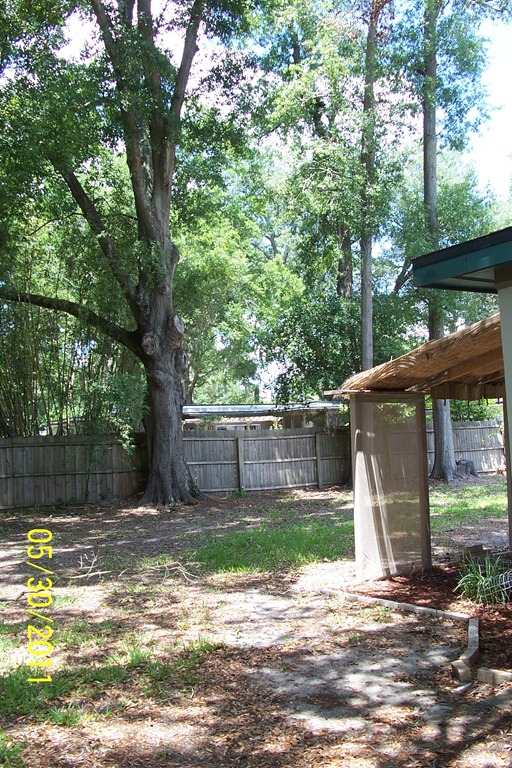
Millie- I recently moved to a new house, only about a block and a half away…but a big part of the decision to move was a very low maintenance yard. The back yard has huge oak trees with ground cover (Ivy, ferns) instead of grass… There is very little shrubbery. I have already planted low water flowers; lantana, Plumbago, Purple Queen. I moved my barrels with sweet potatoes from the other house…thank goodness I grow in self-watering containers that were easy to move. I have Swiss Chard going, Dill, tomatoes, lavender, cucumbers. I am sprouting onions and planting a kitchen herb garden…I’ll post pics soon….
Here’s the backyard;
Posted: July 6, 2011 Filed under: Food and it's Impact on Our Health Leave a comment

taking a pic of my cucumbers…
Posted: July 6, 2011 Filed under: Food and it's Impact on Our Health Leave a comment

Coconut oil is a healthy saturated fats that along with butter should be eaten at every meal.
Nourish with Chef and Nutrition Coach Millie Barnes
Posted: July 6, 2011 Filed under: Food and it's Impact on Our Health Leave a commentOffering A Meal Delivery Service and Nutrition Coaching in Jacksonville, FL, a Complete line of Gluten, Lactose and Soy Free Desserts, A Guide to Getting Well and Losing Weight and a Gluten and Lactose Free Cookbook with 800 Recipes.
Nourish with Chef and Nutrition Coach Millie Barnes
Nourish with Millie Barnes
Posted: July 6, 2011 Filed under: Food and it's Impact on Our Health Leave a commentMy Blog about Traditional Human Nutrition, the Environment, Organic Gardening, Homesteading, Lowering our Carbon Footprint, Living Simply and Naturally…and how all of these things Nourish us, each other and the planet.


 Meal Delivery Service by Millie Barnes