Getting Over Organic
Posted: August 18, 2009 Filed under: Food and it's Impact on Our Health, Non-Toxic Choices Leave a commentWhy many of our country’s best farmers will no longer even use the word
by Michael Pollan
Published in the July/August 2003 issue of Orion magazine
As a consumer who generally tries to do the right thing, I’ve always thought the decision to buy organic was a no-brainer. But in recent years organic has grown to include paradoxes such as the organic factory farm and the organic TV dinner. And now, there is even organic high-fructose corn syrup. We are not far from organic Coca-Cola.
Now these aren’t absolutely good or absolutely bad developments. As offensive a concept as organic high-fructose corn syrup may be, a product like organic Coke will sponsor a lot more organic acreage in this country. But this is certainly not what the founders of the organic movement had in mind.
It’s worth remembering what they did have in mind. There were three legs to the original organic dream. One was growing food in harmony with nature—a nonindustrial way of farming that treated animals humanely and did not use chemical pesticides. The second leg was that our system of food distribution should be different; food co-ops, farmer’s markets, and community supported agriculture could replace the national agricultural system. And the third leg was the food itself. We shouldn’t be eating red delicious apples; we should be eating ten different kinds of apples because biodiversity in the apple tart means biodiversity in the orchard.
For all sorts of reasons—some good, some mistaken—the organic community decided more than a decade ago that it needed federal recognition and regulations. Big companies wanted to sell organic products nationally, but they needed standard rules. And farmers thought that a standard label would give credibility to organic, which it did. But once we had an official federal organic standard, small farmers lost control of the niche.
Today the organic dream is in peril. In fact, many of the best farmers in this country no longer even use the word organic. The USDA developed a set of rules—and they got pesticides, hormones, and many drugs out of the system. All wonderful. But if you look at the new rules, that’s all they address. There is nothing written about the kind of food that may be called organic, or its distribution. There is no rule against high-fructose corn syrup. A myriad of synthetics are allowed in processed organic food. And we find ourselves with an organic transcontinental strawberry: 5 calories of food energy that use 435 calories of fossil-fuel energy to get to a supermarket near you. This is organic food forced through the industrial system, shorn of its holism. What has been lost is that one key insight about organic: that everything is connected. The organic dream has been reduced to a farming method.
The way we spend our food dollars is one of the most important votes we cast, and the choice we consumers are increasingly going to be faced with is not organic or conventional, but local or organic. I come down on the side of local. When you buy local, you’re voting for a short, highly legible food chain—one that supports all three legs of the original vision. This shorter food chain brings the consumer and producer together, and the producer gets to tell her story. Organic label or not, it had better be a good story: clean food, grown without pesticides, the animals being treated humanely. Another reason to buy local is that farms produce more than food—they produce a kind of landscape too, which your food dollars help to conserve.
The lesson to be learned is that consumers of all kinds, but especially eaters, are producers in the most important sense. With every food purchasing decision, we are helping to create the world we want to live in, one bite at a time.
Top 10 Benefits of Eating Organic
Posted: August 17, 2009 Filed under: Food and it's Impact on Our Health, Non-Toxic Choices Leave a commentGreen-living blogs, including mine, espouse the benefits of eating organic foods, but skeptics remain. While there are conflicting reports about whether organics offer more nutritional value than non-organic foods, there’s no doubt organic farming is better for human health, local wildlife and the planet in general.
There’s a picture that has been branded on my brain: A farm worker spraying fields with pesticides; he’s wearing a contamination suit and a gas mask. I remember being shocked when I first saw the image. I associated that sort of get-up with highly contagious viruses and industrial chemical leaks—not food.
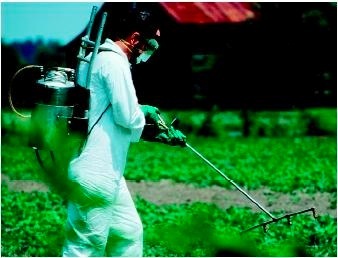
- Waterways aren’t contaminated by chemical run-off from farms.
- Pesticide-related health risks to farm workers (and anyone living in the area) are eliminated.
- You will dramatically reduce the amount of pesticide residue you ingest on a daily basis. Pesticides ingested by pregnant women may be linked to birth defects and health issues.
- Biodiversity is increased with the use of buffer crops, and by avoiding killing or harming insects and other wildlife that is not a threat to crops.
- Pesticides are responsible for a staggering amount of greenhouse gas emissions.
- You can avoid eating any genetically modified foods.
- Reduced reliance on chemical and agri-engineering corporations is good for farmers.
- Organic farming is healthier for the soil.
- Organic dairy cows are not injected with milk-boosting hormones such as recombinant bovine somatotrophin (rBST)—which may increase insulin levels in humans.
- Organics taste better. It’s just my humble opinion, but I’ve noticed a difference in the taste of strawberries, peaches, grapes and leafy greens, so if you’re still skeptical, I dare you to put your faith in conventionally grown foods to the test.
Cara Smusiak writes on behalf of Naturally Savvy.com about how to live a more natural, organic and green lifestyle.
Green Family Values: The Perfect Gift for Baby
Posted: August 17, 2009 Filed under: Non-Toxic Choices 1 CommentFrom Green Options
By Jennifer Lance • October 17, 2007
 When baby is born, it is so pure and natural, yet will soon be exposed to all of the harsh chemicals of the modern world. It is true that babies are exposed to some toxins in utero and through breastmilk, but this exposure is limited and mostly out of the control of parents. What is in the control of new parents are the kind of products they use on their baby, and of course, green products are better for baby.
As a new parent, I was very concerned about swaddling my newborn in synthetic, petroleum-based polyester blankets. Conventionally grown cotton baby blankets are not much better, as they are grown and produced with pesticides and chemicals. The solution: organically grown baby blankets. Unfortunately, six years ago the only organic fiber blanket I could find was a dull green color and unattractive. Today, babies can be swaddled in stylish, luxurious organic baby blankets by Robbie Adrian Luxury Organics, the perfect gift for baby.
After the recent barrage of recalls, many parents are looking for items made in the USA. Robbie Adrian Luxury Organics baby blankets are not only made in the USA, but the cotton used to make the fleece is also organically grown in the USA. The demand for non-food organic products is growing (27.5% in 2006), as people realize that it is not only the food we eat that comes into contact with our bodies. Robbie Adrian Luxury Organics are optimistic about this trend. Cofounder Susan Doris explains, "Part of our goal … is to help educate people about the impact on the environment from purchasing different fibers, and how they can really make a difference with what they buy."
Robbie Adrian Luxury Organics baby blankets are very beautiful and soft to the touch. The organically grown fleece is lined with silk, and worry-free for green parents. As cofounder Robbie Mahlman states, "Our blankets make green gorgeous." I can’t wait to give one to my new niece Tessa! All this green luxury comes at a price though, but as I have said before, sustainability is expensive in comparison to superstore shopping. The demand for cheap goods is one reason our environment is in its current condition.
What do you get for buying a sustainable company’s beautiful baby blanket? The company is honest in describing the green strengths and weakness of their product. They call this "baby steps" as they "try to run our business as sustainably as we can." The blankets are made of 100% certified organic cotton, grown in Texas, milled in South Carolina, and trimmed with natural silk. They are colored with low-impact, azo-free, non-heavy metal dyes. The company’s receipts are printed on seeded lotka paper, and all other paper products, such as hang-tags and stationary, are 100% post consumer fiber. The decorative tissue is handmade from kozo fiber. Robbie Adrian Luxury Organics uses plastic bags in packaging only when the destination expects wet weather. That is an awful lot of "baby steps," in my opinion!
There are a few areas the company identifies as needing sustainability improvement. Their labels are made from polyester fibers, because there are no US sources for woven cotton labels. The shipping boxes contain 55% recycled fiber content, rather than 100%. Furthermore, Robbie Adrian Luxury Organics would like to move from natural silk to "peace" silk. I have to admit, I had never heard of peace silk, even though I have taken many fiber arts classes. During conventional silk production, the silkworm is killed as it is boiled and the fiber unwound. Alternately, peace silk lets the moths emerge from their cocoons and complete their full life cycle before the silk fiber is removed. This product is rarely available for commercial uses.
You may not care about the life cycle of a silkworm, but Robbie Adrian Luxury Organics does, as they take "baby steps" towards combining sustainability, elegance, and beauty in their baby blankets. The company also cares about 15 pesticides used on cotton crops and their ecological impact. They care about providing green babies luxury, comfort, and health, something CEO Robbie Mahlman calls, "earth friendly elegance for discerning parents and their babies."


 Meal Delivery Service by Millie Barnes