A Sustainable Kitchen
Posted: June 1, 2011 Filed under: Going Green; How and Why..., In The Kitchen with Millie- How To's, Non-Toxic Choices 1 CommentOver at Apartment Therapy yesterday I was reading about sustainable kitchens. Their focus was on building the kitchen…
As I am moving to a new house with a kitchen half the size of the one I’m in now it set me to thinking about that subject. Except that what I think of when I think of sustainable kitchens is how to set up a kitchen that supports a sustainable lifestyle.
The house I live in now is set up to have a very very low carbon footprint; I grow most of my veggies and use a sawdust toilet that supports me practicing high heat composting. This allows me to have soil that is deeply rich in nutrients and microbes to grow in food in my grow buckets. It’s a closed system; I do not have to buy fertilizer’s as my yard waste, kitchen scraps and all paper can be composted. Composting this way gives me useable soil in a year without ever having to turn or stir the compost. This is huge as I only weigh 109 pounds and cannot turn large amounts of compost effectively. And I refuse to buy anything plastic so getting a tumbler is out.
I make all my food from scratch; coconut milk yogurt, Kombucha tea, bone stocks, juicing, rendering fats, canning or freezing vegetables… I need room and equipment but am now going to do all that in a kitchen half the size.
Let’s look at how I do this;
· I use a Hamilton Beach slow cooker with 3 stoneware bowls to make my coconut milk yogurt and to slow cook chickens or roasts.
· I use a 32 year old Champion Juicer that is a continuous feed juicer, will make nut butters, shaved ice and will homogenize and great sorbets.
· I use a stainless steel canister to put food scraps in.
· I have a six foot prep table that I had in my restaurant with a cutting board.
· I have a hand coffee grinder from Sweet Maria’s that rocks!

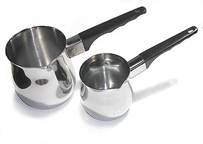
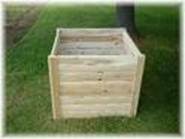








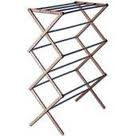
Top, left to right; mason jars for caning and storing food (with laundry soap made from Soap Nuts, Ibriki to make Turkish coffee, my compost bin, ceramic coffee filter holder.
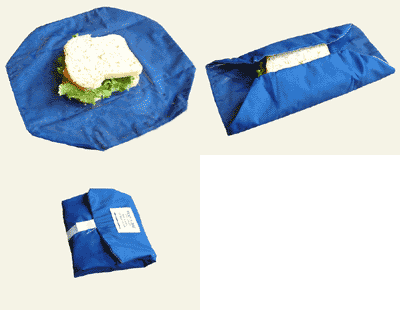
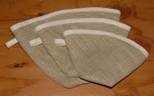
Second row; plastic free travel mug from, coffee grinder from Sweet Maria’s, Wrap n Mat instead of plastic bags, sawdust toilet, hemp coffee filters.
Third row; clothesline, Champion Juicer, Williams Sonoma dish cloths and cup towels, Soapnuts
Last row; indoor drying rack,
I recently commented to someone that I did not use a dryer. She was very puzzled and asked how I dried clothes without one! Yeah, she was young, about 22 or so…but was truly baffled! LOL!
All it takes is planning. Many people comment to me that I must spend an inordinate amount of time in the kitchen…but I really don’t. It takes 20 minutes to put on a batch of yogurt and it;’s done in 12 hours. It takes 45 minutes to get beef stock simmering, then it’s done in 72 hours without me touching it. The next day I render the fat and freeze stocks that will last me all month. After I roast a chicken and remove meat from the bones I put it in the slow cooker for 12 hours and I have stock that supplies me with all the iron and calcium I need to stay in perfect health!
I only take my trash can to the curb every third week because that all the trash my household generates..everything else is composted (bones, fats…all can be high-heat composted).
I make my own skin cleaners, toners, flower water and soaps but only do so a few times a year. Recipes are on my blog under skin care.
I use no paper products if I can help it; dish cloths and rags for the kitchen, baby wash cloths for the bathroom that get laundered, recycled toilet paper for guests (see No-Impact Man’s Blog entry on this).
Remember you do not have to dive in all at once…do the normal things people do nowadays…use CF bulbs, use less water…start here and take one one new sustainable choice a week.. It’s just habits and you will get use to them…
You’ll lower your bills as well as your carbon footprint!
Cool Tub
Posted: May 27, 2011 Filed under: Going Green; How and Why..., Non-Toxic Choices Leave a commentI’m thinking this is a good green choice..better than the plastic tubs they use nowadays..gorgeous!

Boston-based architecture & design firm Stern McCafferty created this custom bath based on an inspiration photo from owners Amy and Ethan d’Abelmont Burnes. They gut renovated their South End row house when they bought the property next door and decided to combine them. The couple wanted an open and modern sanctuary, and this tub definitely fits in with that aesthetic.
Vancouver-area mayor wants people to convert their lawns to vegetable gardens
Posted: May 5, 2011 Filed under: Food and it's Impact on Our Health, Gardening, Non-Toxic Choices 2 Comments
Mayor Darrell Mussatto wants to convert North Vancouver’s lawns to urban farmland.
"We don’t need a lot of expensive technical solutions like rooftop gardens. What about front yards and back yards?" Mussatto said. "That’s a huge land base, and how many of those yards are dedicated to turf?
"Twenty per cent of the people live on 80 per cent of the land, and most of their yards are lawn," he said. "It can easily be changed over to fruits and vegetables."
The City of North Vancouver is second in population density in the region, trailing only Vancouver. But Mussatto sees a lot of wasted space in people’s yards, space that could be producing food.
North Vancouver council has instructed staff to prepare an urban agriculture strategy.
"We want people to convert the yards of single family homes to gardens and even commercial farms," Mussatto said.
Vancouver already has several commercial yard-farming firms, including City Farm Boy.
Ward Teulon has been farming residential yards in Vancouver since 2006 and maintains a roster of 10 yards, including a rooftop garden near Yaletown.
Homeowners take a share of the vegetables that Teulon grows and the rest is distributed to his 38 shareholders, people who pay an annual fee of about $600 for a weekly basket of produce from May through mid-October.
"There was a lot of good soil that wasn’t being used, so I put up some posters trying to find yards," said Teulon. "Once I got a few yards, word of mouth did the rest."
North Vancouver is determined to wipe away all impediments to urban agriculture. Standards of maintenance bylaws were designed to encourage people to maintain a particular kind of landscaping and drive agriculture out of the urban environment, according to Coun. Craig Keating.
"People recognize that the way we are dealing with food in our society has got to change, we need to re-examine how we deal with public spaces and parks," Keating said. "We should be re-examining whether front yards should only be decorative, and commercial agriculture in the city is something I do support.
"We need to make sure there aren’t any obstacles to inhibit family yards from converting to agricultural uses," Keating said.
Keating has even volunteered to convert his own front yard to vegetable garden. The Edible Garden Project employs volunteers to plant and tend vegetable gardens for distribution to low-income residents.
A series of work parties have converted about one quarter of Keating’s 5,000-square-foot yard into raised beds for vegetables.
"We are working with volunteers from the Edible Garden Project, a class of social justice students from Nelson came in Thursday, and a group from Canucks Autism Network came on Saturday," Keating recounted.
"Up till now the front yard has been a monument to long grass and dog poop. Now we are doing something socially redeemable," Keating said.
Millie- I say make growing and fertilizing grass and other non-edibles illegal…we can’t afford the water waste..especially here in Florida!
Read the complete post at http://communities.canada.com/vancouversun/blogs/greenman/archive/2010/11/14/vancouver-area-mayor-wants-people-to-convert-their-lawns-to-vegetable-gardens.aspx
Study Adds Weight to Link Between Calcium Supplements and Heart Problems
Posted: April 20, 2011 Filed under: Food and it's Impact on Our Health, Non-Toxic Choices Leave a commentScienceDaily (Apr. 19, 2011) — New research published online in the British Medical Journal adds to mounting evidence that calcium supplements increase the risk of cardiovascular events, particularly heart attacks, in older women.
 The findings suggest that their use in managing osteoporosis should be re-assessed.
Calcium supplements are often prescribed to older (postmenopausal) women to maintain bone health. Sometimes they are combined with vitamin D, but it’s still unclear whether taking calcium supplements, with or without vitamin D, can affect the heart.
The Women’s Health Initiative (WHI) study — a seven-year trial of over 36,000 women — found no cardiovascular effect of taking combined calcium and vitamin D supplements, but the majority of participants were already taking personal calcium supplements, which may have obscured any adverse effects.
So a team of researchers, led by Professor Ian Reid at the University of Auckland, re-analysed the WHI results to provide the best current estimate of the effects of calcium supplements, with or without vitamin D, on the risk of cardiovascular events.
They analysed data from 16,718 women who were not taking personal calcium supplements at the start of the trial and found that those allocated to combined calcium and vitamin D supplements were at an increased risk of cardiovascular events, especially heart attack.
By contrast, in women who were taking personal calcium supplements at the start of the trial, combined calcium and vitamin D supplements did not alter their cardiovascular risk.
The authors suspect that the abrupt change in blood calcium levels after taking a supplement causes the adverse effect, rather than it being related to the total amount of calcium consumed. High blood calcium levels are linked to calcification (hardening) of the arteries, which may also help to explain these results.
Further analyses — adding data from 13 other trials, involving 29,000 people altogether — also found consistent increases in the risk of heart attack and stroke associated with taking calcium supplements, with or without vitamin D, leading the authors to conclude that these data justify a reassessment of the use of calcium supplements in older people.
But in an accompanying editorial, Professors Bo Abrahamsen and Opinder Sahota argue that there is insufficient evidence available to support or refute the association.
Because of study limitations, they say "it is not possible to provide reassurance that calcium supplements given with vitamin D do not cause adverse cardiovascular events or to link them with certainty to increased cardiovascular risk. Clearly further studies are needed and the debate remains ongoing."
Millie; There is almost no absorption from supplements, no enzymes that would allow digestion and assimilation. Supplementation with Iron and Calcium are dangerous, very hard on the organs and cause the body to dump calcium from the bones to protect the organs. They also wreak havoc on the digestion. Supplements basically give you expensive urine.. It’s better to use your hard earned cash to buy high quality food, real food…not stuff in bottles, packages and boxes. Not “health food junk food”…real food. It shouldn’t need a label for you to know what it is.
100% Mashed Potatoes??? NOT!
Posted: February 13, 2011 Filed under: Food and it's Impact on Our Health, In The Kitchen with Millie- How To's, Non-Toxic Choices Leave a commentFebruary 13th, 2011
From;  Fooducate

Who doesn’t love mashed potatoes? The smooth and creamy texture of hot potatoes mixed with salt and some butter. Unfortunately, this side dish requires some preparation, and many people have resorted to industrial solutions.
Here is an example of a relatively new product from Betty Crocker, “Loaded Mashed” promising:
100% mashed potatoes. Seasoned with naturally flavored bacon, cheese, chives and sour cream.
Sounds nice, until we took a look at the ingredient list…What you need to know:
Here is the list of “Loaded Mashed”’s 55(!) ingredients:
Potatoes (Dried), Salt, Maltodextrin, Imitation Bacon Bit (Vital Wheat Gluten, Salt Maltodextrin, Rendered Bacon Fat Colored with Caramel Color and Red 40 Lake, Monosodium Glutamate, Sugar, Cooked Bacon [Cured with Water, Salt Sodium Erythorbate, Sodium Nitrite, May Contain Smoke Flavors, Sugar, Dextrose, Brown Sugar, Sodium Phosphate, Potassium Chloride, Flavoring], Natural Flavor, Citric Acid, Sulfiting Agents), Sugar, Onion (Dried), Mono and Diglycerides, Partially Hydrogenated Soybean Oil, Whey, Natural Flavor, Buttermilk, Cheddar Cheese (Dried) (Milk, Cheese Cultures, Salt Enzymes), Enzyme Modified Milk, Chives (Dried), Parmesan Cheese (Dried) (Milk Cultures, Salt, Enzymes), Sour Cream (Dried) (Cream, Skim Milk, Cultures), Modified Corn Starch, Silicon Dioxide (Anticaking Agent), Rendered Bacon Fat, Bacon (Cured with Water, Salt Sugar, Sodium Nitrite, Sodium Erythorbate, Sodium Phosphate, Natural Smoke Flavor), Ricotta Cheese (Dried) (Whey, Milkfat, Lactic Acid, Salt), Lactic Acid.
So we’ve got a heavily processed product here, with some ingredients that we’ve highlighted:
Red 40 – a controversial artificial color that requires a warning label in the UK. It can cause hyperactivity in kids. MSG, Sodium Nitrite, and last but not least, trans-fat in the partially hydrogenated oils.
Why would anybody want to do this to themselves and their family?
Bottom line – “real” mashed potatoes are made from potatoes at home. They don’t come in a box.
What to do at the supermarket:
Why not make the real thing? Buy potatoes, sour cream, butter, milk, bacon, and chives. Or buy potatoes, olive oil, yogurt, and chives. Look up an online recipe, and get in the kitchen. A little effort will take your meal to a whole other level.
Alternatives to Plastic Wrap
Posted: January 24, 2011 Filed under: Non-Toxic Choices Leave a commentPosted on January 20, 2011 by Jen
The Eco Women have long advocated that it is vitally important to cut back on your plastic use as much as is possible. One area in which this is crucial is in the kitchen — many plastics leach chemicals into food, whether it’s during food storage or food preparation. Do you really want oil (the basis of plastic) and who-knows-what-else in your food?
Unfortunately, there are still plenty of people out there who either don’t know or don’t care. This was struck home for Recycla recently. She was in line at the grocery store and noticed a woman who was loading box upon box of plastic wrap onto the checkout counter to pay. The woman commented to the employee at the register that plastic wrap was on sale, so she was stocking up. Recycla cringed when she heard this, but kept her counsel.
What Recycla would have liked to have said is that there are several plastic-free methods of storing food and none of them are expensive:

- glass jars — This is Recycla’s favorite way of storing food in her pantry and fridge. She has a nice collection of empty food jars that she has washed and reused repeatedly, as well as several dozen Mason jars. This type of storage container is essentially free. If you need to buy glass jars, you’ll find that while they cost a little money up front, they quickly pay for themselves.
- glass food containers — These are different from jars in that the containers have lids made of different materials (including some food-safe plastic) and that they come in a variety of sizes. As with Mason jars, while they’ll cost more to purchase, they can be reused for years. Recycla has several large glass canisters that hold cereal, granola bars, crackers, and other foods in her pantry. Having everything in glass containers makes it easy to see what’s available.
 aluminum foil – While some people use glass jars in their freezers, Recycla doesn’t feel comfortable doing this, so she uses aluminum foil. It’s reusable and easily recycled and definitely not expensive.
 - parchment or wax paper — If you’ve been using plastic bags to wrap sandwiches, try a paper instead. Unless the sandwich is really goopy and runny, wax or parchment paper should do the trick. Recycla also uses wax paper to cover open containers in the fridge — rubber bands are the secret to holding the paper in place.
 plates – When Recycla puts a bowl in the fridge, she usually just covers the top with a plate.
 - nothing — Do you really need to package everything that goes in your fridge? Most fruits and veggies can just go in the crisper unwrapped.


These are just a few ideas to get you started. Recycla is sure that there are other options and is looking forward to hearing about them.
Tell the Eco Women: Do you use plastic wrap or plastic bags? If not, how do you store food?
Photo credits: Yahoo Images
London’s Unpackaged Grocery Store Eliminates Wasteful Packaging
Posted: September 28, 2010 Filed under: Food and it's Impact on Our Health, Going Green; How and Why..., Non-Toxic Choices 1 Comment

I have finally gotten the whole recycling/composting thing to a science. I have availed myself of the no-junk-mail registry, I’m as close as I can get to a paperless office, send documents to my iPhone instead of printing. I try to only buy food that doesn’t need packaging, recycle plastic bags if I get them, carry shopping bags with me. I put the paper that I do generate into my high heat compost bin. I buy in glass if at all possible, then use them for the food I make for clients (yogurt, bone and meat stocks, dressings, skin cleanser). I usually only take my one trash can to the road for pick-up about every three weeks. All leaves, grass clippings and yard clippings go in the compost,
But it is impossible to not avoid plastic at all, meat comes in plastic unless I drive all the way to Whole Foods, not the best choice for the planet, driving so far. But I can get all the meat in butcher paper.
Unpackaged, a small grocery store in London England, is operating with a unique concept; sell products without any wasteful packaging. Beginning it’s life as a small market stall in 2006 before soon expanding into a full fledged store, Catherine Conway started Unpackaged because she believes there’s a better way to sell food.
Unpackaged combines the best elements of a farmers market, a traditional store’s bulk bins, the convenience of a downtown shop, and extreme eco-friendliness. The premise of the store is simple; sell the highest quality local organic ingredients and products, without any wasteful packaging. This is accomplished by selling most items without any packaging at all, and using easily recyclable and/or reusable containers for the items that do require packaging.
From the Unpackaged website:
- Remember to bring your containers* from home
- Come to Unpackaged and say hello
- Choose the product and amount you want
- Take your goods home in your own containers (if you forget, we have reusable bags)
- When you’ve run out, come back for a refill, simple as that!
*Containers: bring anything you like, there’s nothing to date that we haven’t been able to refill (even our lovely friend who likes putting lentils in old water bottles!) Bring glass jars, Tupperware, old takeaway cartons, brown paper bags, plastic bags, old packaging.. if it’s heavy, we’ll weigh it first, if it’s light then just refill and we’ll weigh at the end.
Local organic food with no wasteful packaging is a match made in heaven, and it’s so obvious it’s a wonder why more businesses like this haven’t cropped up around the world.
Visit the Unpackaged website.
I read about health food stores that lets people bring thier own jars for juice, honey, grains in bulk, bulk spices. Get creative, pressure your health food store to do the same! One store had a big shelf where people could leave jars and take what they needed.
In Defense of the Cow: How Eating Meat Could Help Slow Climate Change
Posted: September 21, 2010 Filed under: Food and it's Impact on Our Health, Gardening, Non-Toxic Choices Leave a comment
Back to the Basics: Bison, Grass, and Healthy Soil
When the first plows turned the rich soils of the Midwest grasslands, some soils were 20% carbon. Now, after years of chemical farming and cultivation, many soils are 5% carbon or even less-some as low as 1%. As a result, that “lost” carbon now lives in our atmosphere as carbon dioxide (CO2). Furthermore, the loss of soil carbon can deplete the soil’s ability to manage water.
Prior to our cultivation of the Midwest, ruminants played an important role in healthy soil ecology. These former grasslands were historically populated by the American bison, which numbered at about 60 million. In contrast, there are about 96 million beef and dairy cattle in the US alone. As a ruminant, the bison grazed the plains for thousands of years. Moving in expansive herds, the bison ate the grasses down as they traveled in search of greener pastures. While migrating to new grazing areas, each ruminant would leave natural fertilizer: animal waste and plant litter. This natural process helped to build the rich and fertile soils of the Midwest.
Grass Grazers: More Than Your Average Hamburger
Similarly, well-managed cattle can greatly enhance the growth and propagation of grasses. These grasses can sequester huge amounts of carbon annually, especially when grazing practices include high density, short-term exposure efforts with the cattle eating the grasses down and moving on to let the grasses grow back. This sustainable grazing technique causes some root shedding below the soil line, leaving lots of organic matter, and thus, carbon. On just one acre of biologically healthy grassland soil, there can be between 0.5 – 1.5 tons of carbon deposited in the soil annually. This is equivalent to taking up to 5.5 tons of CO2 out of the atmosphere and sinking it into an acre of soil.
While this impressive level of carbon sequestration is impossible in the high desert of New Mexico with little rainfall, it is absolutely viable in Florida, the East and Midwest, as well as the North West where there is rain or available water to grow pasture. With proper management, ruminants can once again contribute to the life and water cycle supporting ecology of our biological system, where cattle may be absolutely critical to the health of our soils. This amazing ecological interaction on 11 billion global acres of grazed land would equate to sequestering 60% of human-caused CO2.
Furthermore, let’s not throw stones at cattle as methane culprits, when we have larger human-caused methane problems–namely from fossil fuel use and landfills. Our unrestrained use of coal, natural gas, oil, and petroleum products combined with our over-consumption of just-plain-stuff that ends up in landfills produces over three times the methane emissions as ruminants in this country. Cattle must be saying, “Stop pointing fingers! You single-stomached humans are contributing more methane emissions than our digestive systems could ever hope to!"
Well-managed beef and dairy cattle living on pasture are not only an asset to us all, but also to a bio-diverse earth.
Another great article from TreeHugger
Cancer IS Not a Death Sentence, It’s a Wake-Up Call
Posted: September 14, 2010 Filed under: Food and it's Impact on Our Health, Non-Toxic Choices 1 Comment
nour·ish- 1. to sustain with food or nutriment; supply with what is necessary for life, health, and growth. 2) to provide with the materials necessary for life and growth.
Cancer is preventable and curable. It’s not real complicated; it takes a healthy immune system to prevent it. It takes a healthy immune system to cure it. A healthy immune system is achieved by properly nourishing the body.
Sitting in Shand’s Science Building hospital lobby last week, in the food court I saw a Wendy’s, Subway, McDonalds, TCBY, Chick-Filet, didn’t pay any attention to the other 4 or 5. I was struck at how bizarre it was to be sitting watching people scarf fast food…one of the causes of cancer, while upstairs they are treating cancer. I was there to stay with my little sister while she underwent emergency brain surgery for a tumor. I glanced around…over 70% of the people sitting around me were overweight I saw a 6 months old swilling coke out of a straw not too long after the mom had breastfed her (figure that one out!?)

I heard the word nutrition used ONCE the whole time I was there; by the Oncologist while she mentioned treatment options to my sister. Meanwhile the nursing staff was delighted that my sis’s appetite was good…for milkshakes, fast food hamburgers..not once did my sister eat a veggie while we were in there…they did serve them; carrots, canned green beans. Breakfast the first morning was pancakes, juice, white bread was plentiful at each meal. Jell-O was dessert on several meals.
Aaarrrgghhh…I lost a friend last week to cancer. I lost my other sister two years ago, her doctor (she said) told her that nutrition had NOTHING to do with whether she recovered from cancer or not.
No one tries to make thier car work by putting water in the gas tank, yet we try to run our bodies on insufficient nutrition; the Standard American Diet (SAD). The average American diet is mostly empty carbs, too much sugar, too low in fat, to low in protein, not enough essential nutrients.
The dumbing down of America regarding their health is truly astounding! Most Americans do not have a context in which to place their individual health and tend to view statistics that report approximately 1.5 – 2.0 million Americans die every year of heart attacks, cancer, strokes, etc., as facts that don’t apply to them.
What is remarkable about this health crisis is that neither a famine nor starvation caused it since America is the breadbasket of the world. Nor is the health emergency due to a contagious plague, lack of medication, sanitation, or medical treatments, for we are the most technologically advanced nation on the face of the earth. The chief cause of this health crisis is poor and imbalanced diets.
Dying of an inadequate diet in a land where there is a surplus of food is unheard of in the annals of history! People classically died of plagues, famines, and wars, not of a poor and imbalanced diet.
This spiral downward in American’s health is even more pronounced because there appears no hope of reversing the trend, in spite of the fact that the U.S. spends $1.4 trillion dollars per year on heath, being the richest and most powerful country on the face of the earth.
America spends more money than any other nation on health. Yet America ranks the lowest of all the major industrial nations of the world in terms of its citizen’s life expectancy. According to the most recent World Health Organization report, the United States ranks 24th with a life expectancy of 70.0 years out of 191 nations. Japan ranks number 1 with a life expectancy of 74.5 years. Now the rest of the top 10 nations with high life expectancies follow: 2. Australia, 73.2 years; 3. France, 73.1; 4. Sweden, 73.0; 5. Spain, 72.8; 6. Italy, 72.7; 7. Greece, 72.5; 8. Switzerland, 72.5; 9. Monaco, 72.4; and 10. Andorra, 72.3.
Who can fix America’s health problems?
At the beginning of the 20th century the U.S. ranked 1st in health among the major industrial nations. As we will see later, the cause of our health decline is simply the American diet.
All major degenerative diseases are increasing for all ages, including children, and there is an explosion to occur with the babies born around WWII as they approach retirement age.
For example, the number of people getting cancer has increased from 1 in 33 in 1900 to 1 in 2.5 people today. It is estimated that in about 20 years 1 in 2 people will be diagnosed with cancer and half of them will die. According to the American Heart Association (AHA) statistics, there are 53 million Americans with cardiovascular diseases, which includes arteriolosclerosis, high blood pressure, and strokes.
What is startling about the increase in these diseases in America is that those individuals who are aware of the situation think that modern medicine will be able to turn the health crisis around. Many see allopathic medicine as the "silver bullet" or sole protocol necessary for health. However a few glaring issues need to be addressed.
First of all using modern technology to cure degenerative disease is very expensive. Some experts in the field of medicine realize that with all this technology, there has been no decline in the health crisis. Writing in June 1997 issue of the New England Journal of Medicine, Drs. John Bailar and Heather Gornick stated the following. "The effect of new treatments for cancer on mortality has been largely disappointing. The most promising approach to the control of cancer is a national commitment to prevention, with a re-balancing of the focus and funding of the research."
Second, Medicare is very near bankruptcy and most war-born babies have not reached retirement age.
Third, the primary cause for a majority of diseases running today rampant is the American diet. The former Surgeon General Dr. C. Everett Koop stated in 1988 in his Surgeon General Report that the American diet was the cause of approximately two-thirds of the deaths due to disease in America. He goes on to say that Americans are not starving from lack of food as people are in many foreign countries, but they are malnourished by simply not eating the proper food. Americans are eating food full of empty calories that make them fat.
Quoting from the Report he states the following. "Food sustains us,… Yet what we eat may affect our risk for several of the leading causes of death for Americans, notably, coronary heart disease, stroke, arteriolosclerosis, diabetes, and some types of cancer. These disorders together now account for more than two-thirds of all deaths in the United States. …
Here is the nutrition breakdown of one days nutrition I observed my sister eat one day in the hospital;

Protein- needed for growth and repair is dangerously low at only 13% of her intake. It should be at 30% of caloric intake for the day.
Vitamin A- crucial for development of an intact immune system, extremely low at 2553 IU. It needs to be a minimum of 50,000 IU a day!
Vitamin C is dangerously low at only 32 mg, you need 3000 mg a day! It’s crucial for healing, repair, a healthy immune system, for prevention of free radical production.
Fats are way too low, carbs are too high. Calories were way too high at 3369 calories. Dietary fiber is way too low.
We seem to accept that cancer is a death sentence except for those “lucky” few who go into remission, react well to chemo-therapy. We passively accept our doctors recommendations, never think about our responsibility to keep ourselves healthy.
re·spon·si·bil·i·ty –The ability to respond appropriately to a situation.
Cancer is a wake up call, it’s your bodies way of asking you to make changes, respond appropriately , change the conditions that led to the breakdown in the immune system. In other words, respond appropriately…nourish the body.
More Evidence that (Organic) Berries May Help Healthy Aging
Posted: September 9, 2010 Filed under: Food and it's Impact on Our Health, Non-Toxic Choices Leave a comment-
A new study shows the health benefits of polyphenolics, a compound contained in berries.

Thinkstock Images
We know berries have plenty of health benefits, but a new study may have added another:
Blueberries, strawberries, and acai berries (and possibly walnuts) may, finds a recent study discussed on Eureka, "activate the brain’s natural ‘housekeeper’ mechanism, which cleans up and recycles toxic proteins linked to age-related memory loss and other mental decline."
Berries contain polyphenolics, which likely protect against signs of aging that are associated with the body’s diminished ability to protect against inflammation and oxidative damage.
The doctor who presented the report said that microglia, which remove and recycle biochemical debris that would otherwise interfere with brain function, stop doing their job as a person gets older—and debris builds up. He continued:
"In addition, the microglia become over-activated and actually begin to damage healthy cells in the brain. Our research suggests that the polyphenolics in berries have a rescuing effect. They seem to restore the normal housekeeping function. These findings are the first to show these effects of berries."
Choose carefully
More reason to eat more berries—local and in season as much as possible. But it’s also important to eat organic, and not to increase certain health risks while reducing others.
Strawberries are well-known to be one of the most heavily-sprayed foods, but berries in general are important to eat organic—as are other thin-skinned fruits and veggies.
Because of their extremely thin and delicate skins, berries are especially prone to having large amounts of pesticides, including fungicides. Further, because of their delicacy, they require more pesticides than other types of fruit. Lastly, we eat the skins of berries, without exception.
So eat up and get your daily dose of polyphenolics—just be sure not to get an extra dose of pesticides along with them.


 Meal Delivery Service by Millie Barnes