So You Want to Grow Veggies Organically AND Be a Vegan?
Posted: April 22, 2012 Filed under: Gardening, Non-Toxic Choices 1 Comment Photo from All About Gardening
What do plants eat? They eat dead animals; that’s the problem. For me that was a horrifying realization. You want to be an organic gardener, of course, so you keep reading ‘Feed the soil, feed the soil, feed the soil…’
Alright. Well what does the soil want to eat? Well, it wants manure, and it wants urine, and it wants blood meal and bone meal. And I…could not face that. I wanted my garden to be pure and death-free. It didn’t matter what I wanted: plants wanted those things; they needed those things to grow…
So, I sort of played a moral hide-and-seek in my mind. I was left with this realization that I could eat an animal directly, or I could pass an animal through a plant and then eat it, but either way there were animals involved in this process. I could not remove animals from the equation.
I had to accept on some level that there was a cycle here, and it was very ancient, and ultimately very spiritual. It was really hard for me to accept the ‘death’ part of that equation. Years. It took me years to finally face it. But there wasn’t any way out of it if I was going to grow things.
Lierre Keith, on gardening as a vegan; October 8, 2009 on Underground Wellness Radio
If the Food’s in Plastic, What’s in the Food?
Posted: April 18, 2012 Filed under: Going Green; How and Why..., Non-Toxic Choices 1 CommentBy Susan Freinkel
In a study published last year in the journal Environmental Health Perspectives, researchers put five San Francisco families on a three-day diet of food that hadn’t been in contact with plastic. When they compared urine samples before and after the diet, the scientists were stunned to see what a difference a few days could make: The participants’ levels of bisphenol A (BPA), which is used to harden polycarbonate plastic, plunged — by two-thirds, on average — while those of the phthalate DEHP, which imparts flexibility to plastics, dropped by more than half.
The findings seemed to confirm what many experts suspected: Plastic food packaging is a major source of these potentially harmful chemicals, which most Americans harbor in their bodies. Other studies have shown phthalates (pronounced THAL-ates) passing into food from processing equipment and food-prep gloves, gaskets and seals on non-plastic containers, inks used on labels — which can permeate packaging — and even the plastic film used in agriculture.
What To Buy Organic…
Posted: April 17, 2012 Filed under: Food and it's Impact on Our Health, Non-Toxic Choices 1 Comment
Rethink Your Drink
Posted: April 17, 2012 Filed under: Food and it's Impact on Our Health, Non-Toxic Choices Leave a comment
The consumption of sugar-sweetened drinks is associated with obesity, type 2 diabetes, dental cavities, cardiovascular disease, low nutrient levels….
And ALL that plastic…ick!
Eau Good Water Bottle
Posted: April 10, 2012 Filed under: Going Green; How and Why..., Non-Toxic Choices Leave a comment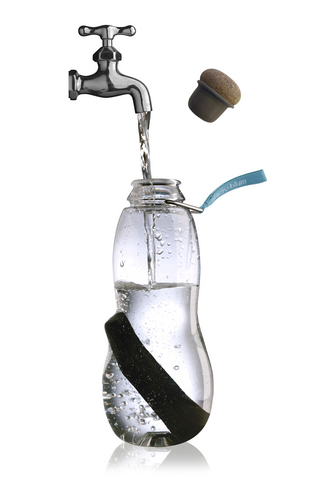
Binchotan active charcoal has been used in Japan as a water purifier since the 17th century. It reduces chlorine, mineralises the water and balances the pH. The binchotan active charcoal can be used for up to 6 months and amazingly recycles for many different uses after this.
Over 22 billion plastic water bottles are discarded around the world every year. We want to reduce this by making tap water taste better and encourage people to stop buying bottled water.
BPA free tritan, cork, stainless steel, silicon
includes x1 binchotan active charcoal filter (6 months life)
8.5 x 24cm – 800 ml / 27 floz


Vegan Diet with Soy Lowers Testosterone and Causes Erectile Dysfunction
Posted: April 9, 2012 Filed under: Food and it's Impact on Our Health, Non-Toxic Choices 2 Comments
This article in the journal Nutrition was pretty simple. A 19 year old male sought treatment for lack of libido and sexual dysfunction. He had voluntarily started a vegan diet previously. The study measured the effects of ceasing a vegan diet and removing soy from the diet.
Previous research has focused on the beneficial effects of soy and its active ingredients, isoflavones. For instance, soy consumption has been associated with lower cardiovascular and breast cancer risks. However, the number of reports demonstrating adverse effects of isoflavones due to their estrogen like properties has increased. We present the case of a 19-y-old type 1 diabetic but otherwise healthy man with sudden onset of loss of libido and erectile dysfunction after the ingestion of large quantities of soy-based products in a vegan-style diet. Blood levels of free and total testosterone and dehydroepiandrosterone (DHEA) were taken at the initial presentation for examination and continuously monitored up to 2 year after discontinuation of the vegan diet. Blood concentrations of free and total testosterone were initially decreased, whereas DHEA was increased. These parameters normalized within 1 year after cessation of the vegan diet. Normalization of testosterone and DHEA levels was paralleled by a constant improvement of symptoms; full sexual function was regained 1 year after cessation of the vegan diet. This case indicates that soy product consumption is related to hypogonadism and erectile dysfunction. To the best of our knowledge, this is the first report of a combination of decreased free testosterone and increased DHEA blood concentrations after consuming a soy-rich diet. Hence, this case emphasizes the impact of isoflavones in the regulation of sex hormones and associated physical alterations.
The negative effects of the vegan/soy diet show a measured decrease after two weeks, but continued to improve for (at least) 724 days after quitting the vegan/soy diet.
MORE….
The Case Against Gluten: For Everyone
Posted: April 8, 2012 Filed under: Food and it's Impact on Our Health, Non-Toxic Choices Leave a comment
In the U.S., public awareness of gluten free diets has reached widespread recognition, but largely in name only. For those suffering with celiac disease or acute wheat allergies, it’s critical. For those with known reactions to gluten, it’s of serious importance. For those who don’t really know what it’s about, but see it on packaging, it seems to evoke a similar response as being forced to “Press 1 for English”. Journalists tend to frame the gluten free approach as legit for celiac treatment, but ultimately a fad diet controlling minions of mindless Gwyneth Paltrow lovers (AP Article). The paleo diet community views it as more of a religion (that’s tongue-in-cheek hyperbole, people!). Before we continue, here are my biases: I experience repeatable, specific, and boring symptoms from gluten intake, but I do not have celiac disease or a “gluten allergy”. Evolutionary biology is a scientific fact and I believe the paleo diet provides ultimate explanations for why we shouldn’t eat grains. So what are the proximate explanations for going gluten free? Is it fad or for’ real?
A quick and dirty primer
Celiac (or coeliac) disease is an autoimmune disorder in which the small intestine is damaged by components of gluten, a protein found in wheat and other grains. The effects of celiac disease are numerous, serious, and varied. For a entertaining sobering look, check out Tim Ferriss’ How to Keep Feces Out of Your Bloodstream. Strictly speaking, a “wheat allergy” can be similar to something like a peanut allergy. Folks in this group experience rapid onset symptoms that are serious, including the potential of anaphylactic shock. It’s mainly for these folks that food is required to expose the presence of wheat content on packaging.
Less Than 1 in 6 Americans Frequently Washes Grocery Totes Increasing Risk for Food Poisoning
Posted: April 7, 2012 Filed under: Non-Toxic Choices Leave a commentScienceDaily (Apr. 3, 2012) — Reusable grocery totes are a popular, eco-friendly choice to transport groceries, but only 15 percent of Americans regularly wash their bags. Most users are inadvertently creating a breeding zone for harmful bacteria, according to a new survey by the Home Food Safety program, a collaboration between the Academy of Nutrition and Dietetics (formerly the American Dietetic Association) and ConAgra Foods.
“Cross-contamination occurs when juices from raw meats or germs from unclean objects come in contact with cooked or ready-to-eat foods like breads or produce,” says registered dietitian and Academy spokesperson Ruth Frechman. “Unwashed grocery bags are lingering with bacteria which can easily contaminate your foods.”
Each year, 48 million Americans are affected by food poisoning caused by foodborne pathogens such as salmonella, listeria and E. coli.
“Food poisoning can easily be prevented with practical steps, such as cleaning grocery totes and separating raw meats from ready-to-eat foods when shopping, cooking, serving and storing foods,” Frechman says.
According to Frechman, bacteria can be eliminated by: • Frequently washing your grocery tote, either in the washing machine or by hand with hot, soapy water; • Cleaning all areas where you place your totes, such as the kitchen counter; • Storing totes in a clean, dry location; and • Avoiding leaving empty totes in the trunk of a vehicle.
Monsanto Threatens to Sue Vermont if Legislators Pass a Bill Requiring GMO Food to Be Labeled
Posted: April 5, 2012 Filed under: Gardening, Non-Toxic Choices Leave a commentApril 4, 2012 |

The world’s most hated corporation is at it again, this time in Vermont.
Despite overwhelming public support and support from a clear majority of Vermont’s Agriculture Committee, Vermont legislators are dragging their feet on a proposed GMO labeling bill. Why? Because Monsanto has threatened to sue the state if the bill passes.
The popular legislative bill requiring mandatory labels on genetically engineered food (H-722) is languishing in the Vermont House Agriculture Committee, with only four weeks left until the legislature adjourns for the year. Despite thousands of emails and calls from constituents who overwhelmingly support mandatory labeling, despite the fact that a majority (6 to 5) of Agriculture Committee members support passage of the measure, Vermont legislators are holding up the labeling bill and refusing to take a vote.
Instead, they’re calling for more public hearings on April 12, in the apparent hope that they can run out the clock until the legislative session ends in early May.
What happened to the formerly staunch legislative champions of Vermont’s “right to know” bill? They lost their nerve and abandoned their principles after Monsanto representative recently threatened a public official that the biotech giant would sue Vermont if they dared to pass the bill. Several legislators have rather unconvincingly argued that the Vermont public has a “low appetite” for any bills, even very popular bills like this one, that might end up in court. Others expressed concern about Vermont being the first state to pass a mandatory GMO labeling bill and then having to “go it alone” against Monsanto in court.
What it really comes down to this: Elected officials are abandoning the public interest and public will in the face of corporate intimidation.
Monsanto has used lawsuits or threats of lawsuits for 20 years to force unlabeled genetically engineered foods on the public, and to intimidate farmers into buying their genetically engineered seeds and hormones. When Vermont became the first state in the nation in 1994 to require mandatory labels on milk and dairy products derived from cows injected with the controversial genetically engineered Bovine Growth Hormone, Monsanto’s minions sued in Federal Court and won on a judge’s decision that dairy corporations have the first amendment “right” to remain silent on whether or not they are injecting their cows with rBGH – even though rBGH has been linked to severe health damage in cows and increased cancer risk for humans, and is banned in much of the industrialized world, including Europe and Canada.
Monsanto wields tremendous influence in Washington, DC and most state capitals. The company’s stranglehold over politicians and regulatory officials is what has prompted activists in California to bypass the legislature and collect 850,000 signatures to place a citizens’ Initiative on the ballot in November 2012. The 2012 California Right to Know Act will force mandatory labeling of GMOs and to ban the routine practice of labeling GMO-tainted food as “natural.”
All of Monsanto’s fear mongering and intimidation tactics were blatantly on display in the House Agriculture Committee hearings March 15-16.
During the hearings the Vermont legislature was deluged with calls, letters, and e-mails urging passage of a GMO labeling bill – more than on any other bill since the fight over Civil Unions in 1999-2000. The legislature heard from pro-labeling witnesses such as Dr. Michael Hansen, an expert on genetic engineering from the Consumers Union, who shredded industry claims that GMO’s are safe and that consumers don’t need to know if their food is contaminated with them.
On the other side of the fence, Monsanto’s lobbyist and Vermont mouthpiece, Margaret Laggis employed inaccurate, unsubstantiated, fear-mongering claims to make Monsanto’s case. She warned during the hearings that if this law were passed, there would not be enough corn, canola, and soybean seed for Vermont farmers to plant.
Laggis lied when she said that the U.S. Food and Drug Administration (FDA) had done exhaustive feeding tests on genetically modified foods. Hansen corrected her, testifying that all of the GMO feeding tests submitted to the FDA were conducted by Monsanto and other GMO corporations and that the FDA had not done any GMO testing of its own.
Laggis lied again when she claimed that a recent Canadian study showing that more than 90% pregnant women had high levels of a genetically modified bacterial pesticide in their blood resulted from them “eating too much organic food” during pregnancy. Again, Hansen refuted this nonsense by pointing out that the Bacillus thuingensis (Bt) bacterium spray used by organic growers is chemically and materially different from the GMO Bt bacterium which showed up in the pregnant women’s blood and the umbilical cords of their fetuses. Hanson pointed that the high levels of Monsanto’s mutant Bt in the women’s blood was due to the widespread cultivation of GMO corn, cotton, soy, and canola.
The committee heard testimony that European Union studies have been conducted which showed that even short-term feeding studies of GMO crops caused 43.5% of male test animals to suffer kidney abnormalities, and 30.8% of female test animals to suffer liver abnormalities. Studies also have shown that the intestinal lining of animals fed GMO food was thickened compared to the control animals. All of these short-term results could become chronic, and thus precursors to cancer.
Studies like these have prompted 50 nations around the world to pass laws requiring mandatory labels on GMO right foods.
In the end, none of the scientific testimony mattered. Monsanto operatives simply reverted to their usual tactics: They openly threatened to sue the state.
Unfortunately in the US, industry and the government continue to side with Monsanto rather than the 90% of consumers who support labeling. Monsanto’s biotech bullying is a classic example of how the 1% control the rest of us, even in Vermont, generally acknowledged as the most progressive state in the nation.
Vermont activists are organizing a protest at the state capital on April 12 to coincide with the next round of hearings on H-722, and are asking residents to write letters, make calls, and e-mail their legislators and the Governor. For more information, please go to the website http://www.vtrighttoknow.org or the Facebook page http://www.facebook.com/vtrighttoknow of the Vermont Right to Know Campaign.
Will Allen is the co-manager of Cedar Circle Farm in East Thetford, Vermont. He is also the Author of The War on Bugs, a history of farm pesticides and fertilizers since 1810. He is on the policy advisory boards of The Organic Consumers Association and Willing Hands. He has attended all of the agriculture committee hearings on H-722, where the testimony referred to above was delivered.
Ronnie Cummins is the National Director of the Organic Consumers Association and its Millions Against Monsanto campaign. He also is a member of the Steering Committee of the California Ballot Initiative to Label Genetically Engineered Foods, and co-author of the book, Genetically Engineered Food: A Self-Defense Guide for Consumers.
Luxurious Skin Butter
Posted: April 4, 2012 Filed under: Non-Toxic Choices, Skin Care Leave a comment
Shea Butter Beeswax Beef fat Sweet Almond Oil
I made a great balm for my feet; melted equal parts organic beef fat from gas fed cows, shea butter, bees wax and sweet almond oil, let it harden almost all the way, formed it into egg shape, placed in small glass jar……heavenly, I walk, a lot, garden, go barefoot..this has made my feet so soft like nothing I have used before.


 Meal Delivery Service by Millie Barnes