Why Second Hand is Healthier for Your Baby
Posted: July 21, 2009 Filed under: Going Green; How and Why... Leave a commentFrom Treehugger
by Christine Lepisto, Berlin  on 07.19.09

Hand-me-downs. The very thought brings terror to any new parent who remembers the taunting children suffered for the sin of not having new possessions. We are uncertain already in the face of the daunting task of raising a tiny life to health, wealth and wisdom, without even the benefit of an owner’s manual! How do parents react? Consumerism. Buying new for the baby is a ritual of modern childbirth: new nursery, new car seats, new clothing.
Think again. The German Bundesinstituts für Risikobewertung (BfR, or National Institute for Risk Assessment) has warned that newborns need better consumer protection advocacy. Pediatrician Axel Hahn of the BfR explained: Many parents completely remodel the room for the nursery, without giving thought to the amount of harmful substances newborns face from the new furniture, paint and carpet. The conclusion? Second hand–even for baby clothing–is often the healthier choice.
Second hand articles have had time to naturally lose the dangerous chemicals which are most easily emitted or leached from the articles to which babies are exposed. New furniture, much of which emits formaldehyde from the glues and particle board constituents or chemicals added as flame retardants, will have rid itself of most of the harmful emissions by the time it comes up for second hand sale. Baby clothing has been through enough wash cycles to ensure the chemicals added during textile manufacturing and distribution are gone. And who can remember being upset by a few smudges in the paint or carpeting of their nursery?
The discussion was raised in the context of the seventh Forum for Consumer Protection in Berlin. Children are especially sensitive. They have a much larger ratio of skin surface to body size, respirate more quickly and have faster metabolic rates. Attendees of the forum were unified in the opinion that risk assessments done for adults can no longer be applied also for children.
Specialists at the Forum also discussed better labelling of chemical contents. Currently, only toxic product recipes are required to be reported to the BfR, for example from cleaners. But often the risks of chemicals are due to the sum amount of the exposure, of to exposure to a combination of different substances. The BfR proposes a coded system of disclosure of all chemicals in the products
No more tears……just cancer causing chemicals
Posted: June 5, 2009 Filed under: Going Green; How and Why... Leave a commentThis is from http://www.enviroblog.org/
May 28, 2009

Baby products should not contain toxic ingredients, according to common sense as well as 40 + organizations lead by the Environmental Working Group (EWG) co-founded Campaign for Safe Cosmetics.
Just last week, the Campaign sent a letter to Johnson and Johnson asking that its products made for children don’t contain hidden carcinogenic contaminants 1,4-dioxane and formaldehyde.
No More Toxic Tub
The action comes after a recent Campaign-sponsored No More Toxic Tub report that found those two contaminants in over 60 percent of the 48 products tested. Both 1,4-dioxane and formaldehyde are known carcinogens and formaldehyde can also trigger skin rashes. Like other toxic ingredients often found in your shampoo, lotion and deodorant, they are not limited in personal care products. In addition, since they are contaminants and not ingredients, they are not disclosed on product labels.
Not breaking the law isn’t good enough when the law is weak
The line of defense for the manufacturers has been the typical "we didn’t break the law" as well as the usual "small doses are insignificant." It is true that companies did not break the law. But it’s also true that the law –
the Toxic Substances Control Act (TSCA) – is so weak that under it, the federal government wasn’t able to ban asbestos! A chemical responsible for at least 10,000 deaths a year in the U.S.
Low doses matter
The small doses are not insignificant because we are all exposed to chemicals in personal care products every day, several times a day. Those exposures are there in addition to exposures to other toxics in food we eat, water we drink, air we breathe and so forth. All of these exposures add up, and could lead to diseases later in life.
The companies don’t have to use the toxic ingredients, as alternatives are available. Even Johnson and Johnson can make formaldehyde-free products, as they do in Japan.
Tell Johnson & Johnson to get rid of the toxic chemicals
Without a tough federal law that would require the chemicals in personal care products be safe, consumers are left out on their own to make the best purchasing decisions.
That’s why we created Skin Deep, a cosmetics database that can help you make informed decisions when it comes to toxic contained in personal care products you use.
Until the law is changed, you can join us and tell Johnson and Johnson that you don’t want these toxic chemicals in your baby’s shampoo and they should take it out!
Website for checking the toxicity of products you use
Posted: June 4, 2009 Filed under: Going Green; How and Why..., Skin Care Leave a comment Four years ago, my daughter Rachel started school to become an esthetician. She brought home info on the new studies showing just how toxic parabans were and their link to breast cancer. I immediately went through my beauty products and shampoos and conditioners. Almost all of them had parabans and they were all from the health food store! I went to work researching toxicity in cosmetics, ending up switching products and in time developed my own skin cleanser. During that next year almost every product line in the health food store reformulated their products to remove this cheap and toxic preservative.
One of the tools I used for my research was the Environmental Working Groups’ website, Skin Deep. It has the white papers (toxicity reports) on almost every product I was using.
Skin Deep is a safety guide to cosmetics and personal care products brought to you by researchers at the Environmental Working Group.
Skin Deep pairs ingredients in more than 42,000 products against 50 definitive toxicity and regulatory databases, making it the largest integrated data resource of its kind. Why did a small nonprofit take on such a big project? Because the FDA doesn’t require companies to test their own products for safety.
Get started here to learn what’s in your personal care products:
Dishwasher vs.. Hand washing dishes
Posted: June 3, 2009 Filed under: Going Green; How and Why... Leave a commentA few months ago, Colin Beaven printed a article I wrote on his fabulous blog, No Impact Man. You can read the whole article here- Thirty-one tips for reducing your impact while saving money. A reader made this comment….
Alison said… Thanks so much for the tips! I work with Electrolux and in the spirit of conserving water, have another tip to share: use your dishwasher instead of washing dishes by hand!
I was shocked to find out that it takes an average of 27 gallons of water to wash a load of dishes by hand but only 5 gallons to wash the same size load in a modern dishwasher! That means that a household can save 4,730 gallons of water per year by leaving hand washing in the dust! The Water Savings calculator from Electrolux breaks down results to show the effects of conserving water on a household, town, state and national level: http://www.electrolux.com/watersavings_us. Hope this helps your readers! 🙂
I wanted to address the fact, as I said in my article, that I use tow dishpans, each with slightly more than a gallon of water in each one. When I am through with that water I pour it on my flower bed. I use organic dish soap, but still do not use the water on veggies. Here is a picture of the flower bed, just outside my kitchen where the water goes. I have never turned on the outside spigot to water these flowers.
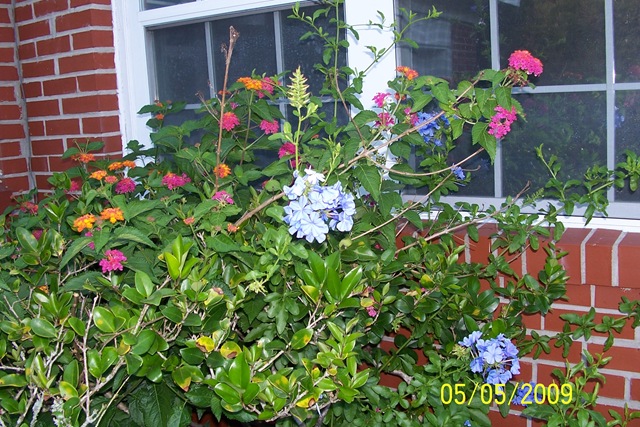
I am not using any electricity while I am washing those dishes, I supply the energy!
It is FAR more economical to do the dishes this way; no cost of manufacturing that dishwasher, no paying to transport it to the store, no electricity to run it. I run my hot water heater a half hour a day, during off-peak hours, it is fully insulated. This gives me a quick shower, normal use of water for dishwashing, etc. Most of the year I use the solar shower in my back yard. I do not use a flush toilet, I use a sawdust toilet. My water bill is a 1/10 of what it used to be, and I have always been careful!
There’s no comparison!
The Economic impact of eating organically
Posted: June 2, 2009 Filed under: Food and it's Impact on Our Health, Going Green; How and Why... Leave a comment
or·gan·ic;
1. Of, relating to, or derived from living organisms: organic matter.
2. Of, relating to, or affecting a bodily organ: an organic disease.
3. Having properties associated with living organisms.
4. Resembling a living organism in organization or development; interconnected.
Someone commented to me that it wasn’t frugal to eat organically. I guess that is true for most people who decide to eat the same, the only change being buying all the same “products”, just switching to the organic version. That will definitely cause a huge increase in the amount you spend each week.
When I say organic I mean it on a different level than simply switching brands. I think of it as doing things on the most basic levels, making things from scratch. In other words I buy FOOD, not products. A bottle of organic salad dressing is expensive. Make it from scratch and the price falls substantially. I am also not paying for the packaging it came in. I often get to Friday, trash day in my neighborhood, with nothing in my trash can to take to the curb. I buy in bulk, take my cloth bags to the store, use muslin bags for bulk items. A mango or avocado needs no package, no label. I feel disconnected from myself and the earth when I buy a box of cereal. And it’s not organic, not live. When I hold a mango in my hand, it has energy, live nutrients, it screams at you to dive in. Real organic grass fed beef gives us vitamins and minerals not present in feed-lot animals. To conserve, remember to conserve, feels like loving the earth, myself, all people. I used cloth diapers for all my kids because the cost was insane in every way, financially, environmentally, how comfy they are. To buy plastic just to throw it away has always felt like blasphemy to me! Then there is the money difference, no comparison.
But buying all organics, buying food that is intensely nutritious is really a great way to save! The huge difference is in your health. I have had very few doctor bills since I began eating to truly meet my nutrient needs. Up until 1986, when I stopped eating grains and dairy, I had constant health problems. At that point I was eating what everyone considered a perfect vegetarian diet. I got well, and have stayed well, have not had to take any antibiotics whatsoever for anything except when I had ankle surgery. Not one of my children, who range from 8 to 37, has ever had a cavity. They have rarely needed to go to the doctor.
68% of Americans are over weight. That means they are malnourished. When we eat a traditional human diet, healthy fats, meats, eggs and fruits and vegetables, we meet our nutrient needs, we don’t get sick…which saves a tremendous amount of money on doctor bills, prescriptions, lost days from work. When we eat well we have plenty of energy which impacts how effective we are as people. It impacts our relationships. It effects how mentally alert we are, how organized we are…and how happy we are. Not getting enough healthy saturated fats leads to depression, hormone imbalances, an impaired immune system, obesity. Foods that are nutrient deficient (grains, flours, dairy) take the place in the body from foods that actually make us healthier.
Eating organically, simply, is good for us and the planet.
My latest switch to non-electric appliances…
Posted: May 27, 2009 Filed under: Going Green; How and Why... Leave a comment
Ta Daaaaa…
 Isn’t it a beauty? A Zazzenhaus coffee mill. The truth of the matter is that by the time I get the coffee ground I am wide awake! Great for the biceps! Check out Sweet Maria’s Coffee site. Organic green coffee beans, half the price of roasted. You can roast your own coffee in popcorn air-popper. A great site, a blog, an education in coffee.
After I took the picture, I noticed the bottle behind the grinder..
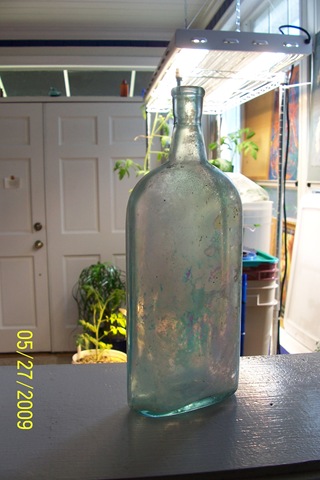 Notice the plant lights above all the veggies…
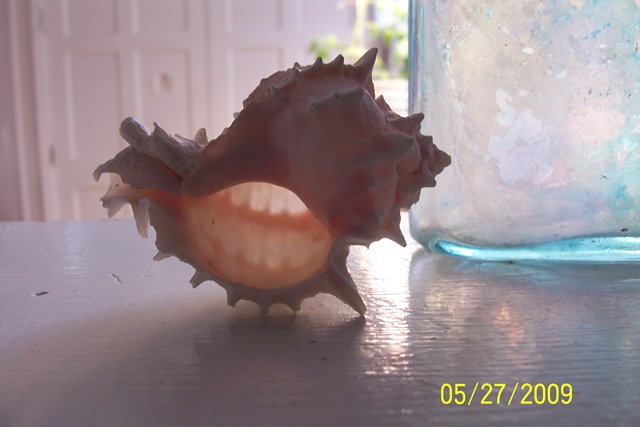
And the shell beside it… I found this about 2 feet down in my garden…
When Local Goes Industrial
Posted: May 23, 2009 Filed under: Going Green; How and Why... Leave a commentFrom the Organic Consumers Association;
Sustainability Tip of the Week

The local food movement is gaining enough popularity to capture the interest of big business. Some of the biggest corporate food companies are looking for ways to greenwash their products. Although it sure beats sourcing their crops from overseas and is a step in the right direction, the following marketing claims can be misleading since the actual processing of these often factory-farm grown products may be anything but local:
–Frito-Lay North America owned by PepsiCo is trying to portray Lay’s potato chips as a local food in the regions where the potatoes are grown.
–ConAgra is trying to say that because Hunt’s canned tomatoes are mostly grown within 120 miles of its processing plant in Oakdale, California, that makes them "local" for Oakdale, and maybe even Californians.
–Kraft is trying to figure out whether people in Wisconsin will buy more pickles if they know the cucumbers that go into a jar of Claussen’s are grown there.
Microwaves are a great way to conserve in the kitchen
Posted: May 23, 2009 Filed under: Going Green; How and Why..., In The Kitchen with Millie- How To's Leave a commentI have worked at several natural foods kitchens over the years who refused to use microwaves. They considered then unnatural, dangerous, harmful to food.
I disagree. Microwaves are a great way to cut down on energy use and heat in the kitchen. That’s because its energy goes straight into heating the food, not the air or a pan which surrounds it. Now, don’t get me wrong, I am not cooking tender greens in there, nor trying to bake weird microwavable brownies, or food in plastic bags (yecchhh)..
But a microwave is awesome for; melting chocolate, heating up a cup of water for tea (then the mug is warm, too!), softening butter or coconut oil. It is also great for getting a baking potato or sweet potato piping hot to then finish in the oven. Same for winter squashes, or eggplant for Baba Ganoush. But never for cooking broccoli, tender greens, cooking meats.
Water-Saving Sub-irrigation on a Cairo Rooftop
Posted: May 19, 2009 Filed under: Gardening, Going Green; How and Why... Leave a commentThis is from Inside Urban Green…
The Solar Cities blog is about rooftop solar water heaters that are an energy efficient alternative to electric heaters.
This photo of a Cairo, Egypt rooftop with a solar water heater included the vegetable garden benches to the right. It looks to me that the containers on the vegetable benches are watered the same way that container plants are sub-irrigated in green houses around the world.
It is a little known fact in the consumer market that most container plants are watered by sub-irrigation using an ebb and flow system, either on benches or on a concrete floor.
There is no narrative on the blog about the vegetable garden but the robust health of these plants leads me to believe that the containers are sub-irrigated.
Note the plastic liners. Water collected in these basins (or added to them) will rise up by capillary action though the drain holes in the nursery pots. It is a far more efficient and water-conserving method then either hose watering or drip-irrigation.
If sub-irrigation is a more productive, water-conserving method in the greenhouse, why aren’t we all using it for our houseplants and container vegetables? Think about it.
Even though my garden outside is thriving, I keep moving plants inside…they grow faster, the sub-irrigated containers were all recycled from restaurants or friends, and the health food store. They droop for a day and then take off…I am getting one cherry tomato a day right now, Up from one a week for the last month. I fought back the spider mites with Neem oil, the strawberries are flowering again. And there is something very powerful about creating an inside environment…controlling all aspects (except the millions of microbial activities)..
My house feel more alive, I love living with more plants. There was never time but for a few at a time as I was raising my kids.
The lettuces are an inch high, I’m nibbling. The Swiss chard is 2 inches tall…yummmm, I can’t wait. The beets are aggressively popping out of the soil, they all germinated!
And I swear the plant lights must be great light therapy for me too, I find myself dancing a lot, again….maybe it’s the growing stuff…the peace…no kids at home…whoops, did I say that out loud. I love ya’ll…
The plants are thriving…so am I…my desserts are selling well in Riverside…Sheff’s Everyday Gourmet
Florida Friendly Landscaping
Posted: May 17, 2009 Filed under: Gardening, Going Green; How and Why... Leave a commentI found this great site that lets you do a search according to your individual criteria (soil, light, annual, etc.)

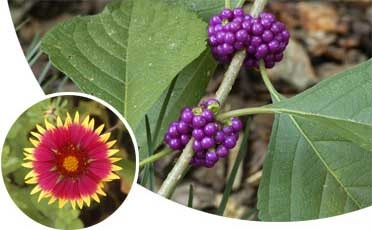
Identify the Florida-friendly plants, including Florida native plants, that will work in your yard or landscape design. The database contains nearly 380 trees, palms, shrubs, flowers, groundcovers, grasses and vines that are recommended by University of Florida/IFAS horticulture experts. The plants included in the database are available at nurseries throughout Florida.
Check it out- Florida Friendly Landscaping


 Meal Delivery Service by Millie Barnes