Growing potatoes
Posted: June 1, 2009 Filed under: Gardening Leave a commentI use a barrel cut in half to grow sweet potatoes, so far, but I am going to build one of these…
Article from Green Roof Growers

Potato Box
I have a small strip of land that gets 6 hours of sun a day. It’s the perfect spot to try growing potatoes. Vertically. In a box.
I got the idea from this article in the Seattle Times. The hook is that you can grow a lot of potatoes in a tiny space; just what I need.
Greg Lutovsky, who has been growing potatoes as a business since 1993, says you can grow 100 pounds of potatoes in 4 square feet. All it takes is some lumber, seed potatoes and careful attention to watering.
The story was enough to get me started, but it’s a little short on practical advice. For that I turned to Sinfonian, who meticulously documented his potato-in-a-box efforts last year.
The idea is to pile up soil around the growing potato vine, adding more soil–and boards to the side of the box–as the vines get taller. Potatoes will grow between the seed piece and the above ground plant.
When the plants start flowering, after about 100 days, you can remove a board or two from the bottom and fish out a couple of potatoes. Or you can wait until frost kills the plant in the fall and harvest them all at once. There are plenty of sites that explain
how to store potatoes. With a bit of luck, I’ll be doing that this fall.
If you want to grow vertically, there are several alternatives to choose from: grow bags, wire cages, stacked tires, large containers. All had drawbacks, so I chose to make my 3’x3′ bin out of cedar fencing boards and southern yellow pine. I gave all the pieces a coat of linseed oil, hoping that this will protect the wood from rotting.
I bought, and then chitted, 3 pounds of Inca Gold seed potatoes from Ronniger Potato Farm. Inca Gold are late season potatoes, an important detail for this type of growing. According to Sinfonian, early season varieties only set fruit once, making them bad candidates for potato towers. You’ll end up with a few at the bottom of the box and that’s it.
I just planted my seed potatoes today. As they grow, I’ll add more cedar boards to the sides of my box and cover them with dirt. 
Green Style: Patrick Blanc’s Vertical Gardens
Posted: May 30, 2009 Filed under: Gardening Leave a comment
Patrick Blanc is a French botanist, and his vertical gardens served as inspiration for Matthew and Emma’s Plant Wall (see our House Tours). Here is an example of a vertical garden he planted on the Quai Branly Museum in Paris.
garden update
Posted: May 27, 2009 Filed under: Gardening Leave a comment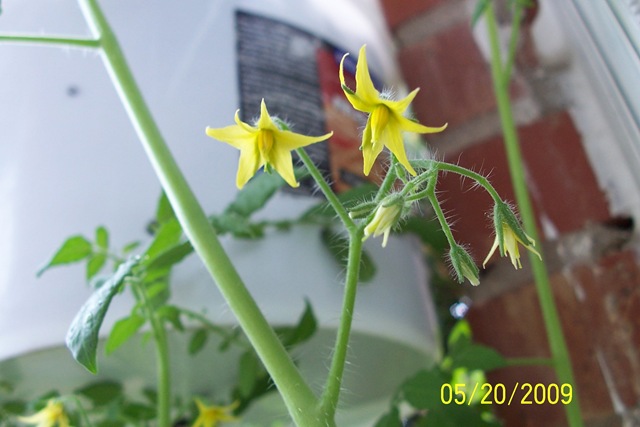 The tomatoes are very happy after 4 days of rain…
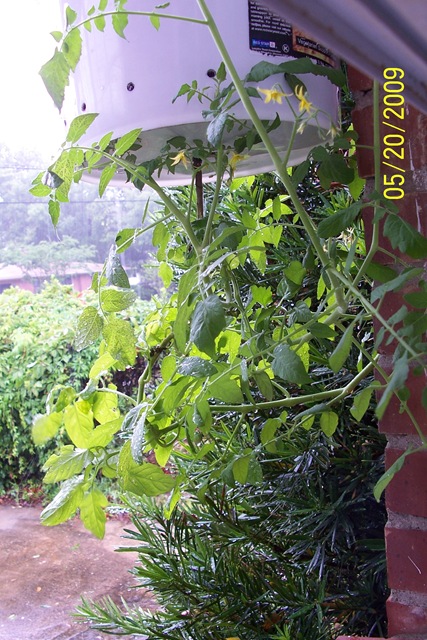 The are upside down tomatoes-
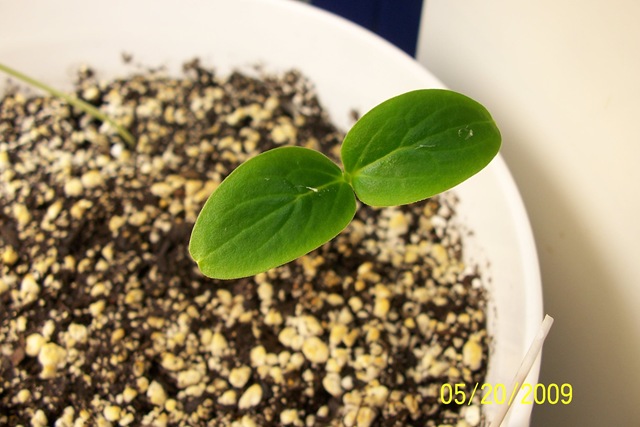 Cucumbers are 3 days old, I love how fast they grow!
It has rained for a week here, almost without stopping. Some call it a tropical disturbance…but whatever..it’s the most rain I have seen since about 3 hurricanes back. Ah, Florida weather.
But the garden is sooo happy..look;
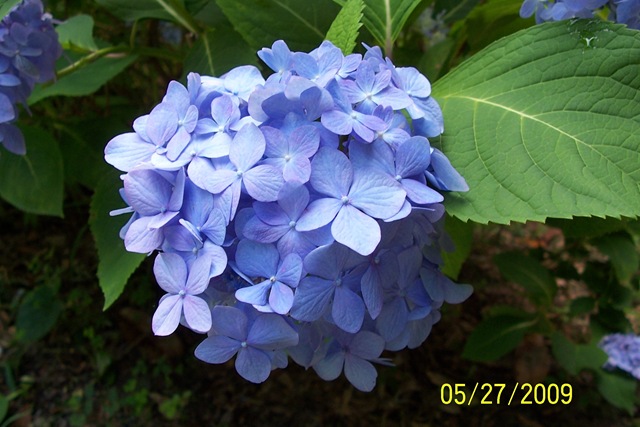 I don’t think there could be a more beautiful flower than a hydrangea.
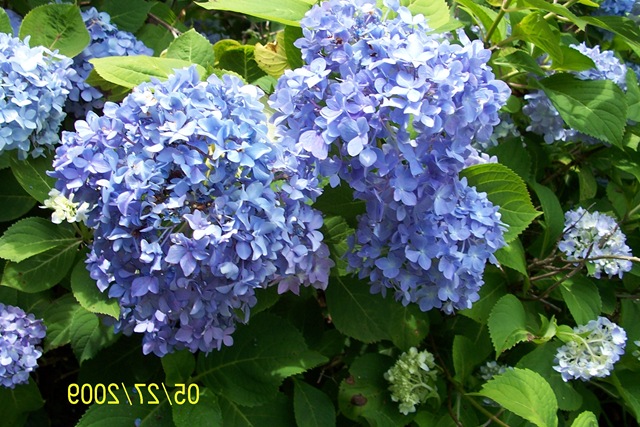
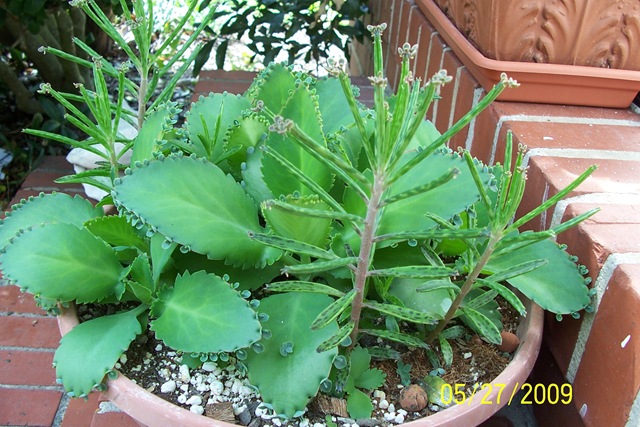
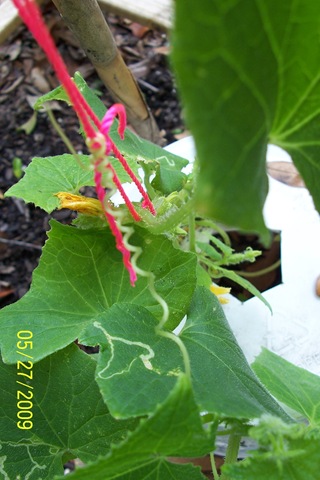 Cucumber plants are so cool, I love the little tendrils…
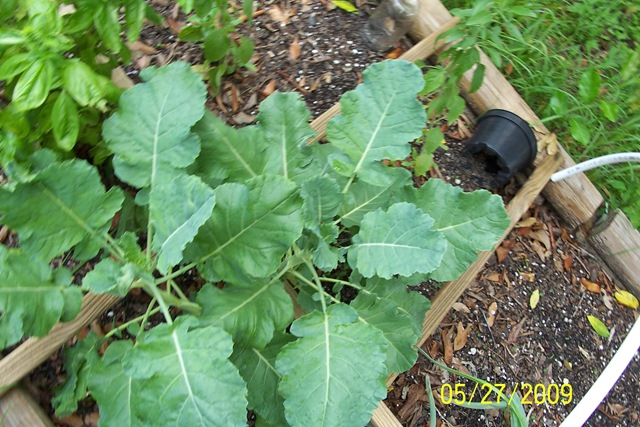 Broccoli is doing good, so is the basil to the left…I’m in the mood for pesto!
I came home this afternoon and grabbed a camera, flew outside..the sky was incredible… storms moving in again…
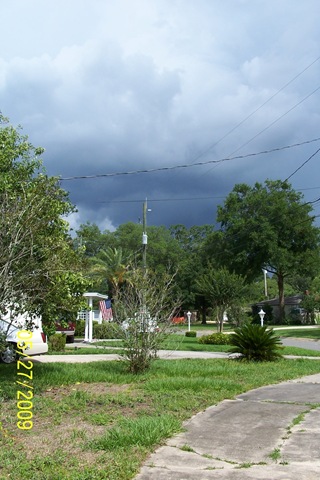 Then I realized the light was perfect for pictures….. New passion of mine. Well, not new, re-found. No times while raising kids, now it’s fun to have time to do things just for fun…and at a leisurely pace.
Veggie swapping- what a great idea
Posted: May 22, 2009 Filed under: Gardening Leave a comment

This reminds me of the post that Colin Beaven did on his blog- No Impact Man– a few weeks ago. Check it out;
Growing your own food, Japanese style
As you may know, Japan has lower per capita carbon emissions than any Western European country. For that reason, I asked my friend, Sean Saskamoto, who recently moved to Japan and who blogs at I’d Rather Be In Japan, to check in with us every so often. I thought we might be able to learn a little something about "happier planet, happlier people" lifestyles from Sean’s experience there.
Here is Sean’s latest dispatch:
Growing Your Own Food, Japanese-style
by Sean Sakamoto
No matter where you go in Japan, one thing you’ll notice are the gardens. Even in fairly dense suburbs, every plot of land is meticulously tended, usually by the stooped figure of a grandmother or grandfather. My in-laws live in a tall apartment building in a packed suburb, with a wheat field on one side and a rice paddy on the other.
When people get old in this country, they work in their gardens. It doesn’t matter what time of year it is, or how bad the weather is. They’re out there in the brutal heat of summer, pulling weeds in the bone chilling damp of winter, planting tomatoes while surrounded by the spring cherry blossoms, and picking pumpkins as the Autumn leaves turn fiery red.
When vegetables ripen, it’s common to have a neighbor drop off a bag filled with cucumbers, beans or whatever bounty their garden has brought. It’s amazing 70 to 90 year old folks working so hard outside, and their vitality is inspiring.
During lunch time at the school where I work, the conversation invariably turns to what food is in season, and it goes beyond the garden to the forest. On weekends we go out in the woods with friends to pick whatever wild vegetables are in season. Last weekend we picked wild onions, ferns, and wasabe leaves. The weekend before that we picked bamboo shoots.
Everyone seems to have a relative with a plum tree, a chestnut tree, or some other kind of bush or shrub that gives up something to munch on at some time of the year. This close connection to nature reminds that food is part of a natural rhythm. Every meal is like a party, celebrating whatever came in that week. I like eating by the calendar.
Anticipating the grapes that come in late summer makes them that much sweeter when they finally burst in my mouth. The food that is grown locally, and eaten locally, also tastes so good because it’s so fresh. It isn’t bred for toughness over taste, or built to withstand weeks in passage to my plate. Anyone whose eaten a tomato at the peak of ripeness knows what I’m talking about. The same holds true for daikon, potatoes, squash, you name it. Just like bread is best the day it was baked, vegetables are best the day they were picked.
I wonder if the focus on fresh vegetables and the value of working hard in a garden is what keeps these senior Japanese neighbors of mine able to hoe a row at the age of 90? Is there a connection between a healthy old age and a deep interest in gardening and eating fresh fruit and vegetables year round? Even if there isn’t, the benefits of staying fit and eating well are plenty enough for me to give it a try.
The city rents out plots to garden for $50 a year. My family rented one (that’s my wife Noriko and my son Kazu in our plot in the picture above), and the first day we went out there and poked around, we had a bunch of old men giving us advice. People lent us tools, gave us drinks, and showed us how it’s done.
My son, Kazu, likes to play in the nearby stream while Noriko and I pull weeds and plant seedlings in the mud. It’s a nice, practically free way for a family to spend an afternoon. So far, we’re doing OK. Some bean plants and spinach are already starting to grow. With any luck, I’ll have a few bags of veggies to share with my neighbors by August.
Note from Millie;
 I signed up for the Veggie Exchange webpage, alas…there is no one else signed up near me…but I am going to my next neighborhood Association meeting and let them know that I want to use my front yard for a community garden..
This shows the possibilities. My oldest daughter, Heather, commented last week that she does not eat eggplant, but would live to grow it. I spoke right up and told her to grow it, please, that I ate it…and so it goes, if we all start growing food, we can trade, barter…form community…. 
Slow Food Founder Carlo Petrini On Local Eating
Posted: May 21, 2009 Filed under: Gardening Leave a comment
This is from Treehugger–
by Kelly Rossiter, Toronto  on 05.15.09
“A gastronome who is not an environmentalist is stupid. An environmentalist who is not a gastronome is boring.”
 Thus spoke Carlo Petrini, the founder of the Slow Food movement. It was just one of his quotable bon mots of the evening discussion I attended. It was his first time in Toronto and there was a lot of buzz about his appearance. The programme was presented by Planet in Focus, an organization that uses film and video to "explore social and ecological focal points", and the Italian Cultural Institute. Billed as "An Evening of Conversation" with Petrini, it turned out to be more of a lecture than a conversation, but it was fascinating for anyone who is interested in food, culture and society.
Mr. Petrini’s message is pretty simple: buy good locally grown ingredients, cook your own dinner and don’t waste anything. We are just now, as a larger society, starting to seriously look at issues that he has been talking about for twenty years, but there is still a long way to go. He talks about food as a building block of family, of community, of culture. For nay sayers who think that we should always move with the times he says that a tradition that works well is always modern.
In his book, in Defense of Food, Michael Pollan talked about the spending habits of Americans,where they traditionally spent more on food than health care and now the figures are almost completely reversed. Mr. Petrini points out that Italians used to spend 32% of their income on food. Now they spend 14% on food and 12% on their mobile phones. As he says, people complain about the cost of a tomato, but not about the cost of a mobile phone.
He believes that we have to reappraise our values. We want things quickly, we want things we don’t need and when we are bored with them, we throw them away. He advocates consuming less of everything, including food, but to choose wisely and to use everything you purchase. Lloyd pointed out in a Planet Green post that small refrigerators make good cities, because you buy what you can use for a day or two, and you shop in your own community more. Mr. Petrini agrees. He points out that people no long use their refrigerators for preserving food, they are "halls of death" because we let too much go to waste there.
Mr. Petrini also talks about other kinds of waste in our rush to make money and consume goods. He points out that people used to take their children to the country for a picnic, now they take them to the mall. Children used to play freely, now they have organized after school programmes and they have to book time to play with friends. As he says, "we are burning the time of our children". For those who say they don’t have time to shop locally and cook (or spend time with their kids, for that matter), Michael Pollan points out that it wasn’t so long ago that we didn’t have email, but we’ve all managed to make plenty of time for that.
Mr. Petrini is all too aware that there are people who say it’s too expensive or elitist to use local ingredients, but if we bought good local ingredients in the quantities we really require, then we can eat very well for less money. If we paid farmers a fair price then we would attract more young people to work in agriculture. In Ontario, where I live, we’ve paved over a lot of farm land over the last fifty years. When I was a child, Ontario produce was quite inexpensive in season, but you had to pay a lot for things like oranges and grapefruit and pineapple that don’t grow here. Now the pricing is reversed, and imported vegetables from Mexico or Peru are often cheaper. Personally, if something grows in Ontario, than I buy the local produce only in season. If it doesn’t grow in Ontario, than I buy it sparingly, or not at all.
Water-Saving Sub-irrigation on a Cairo Rooftop
Posted: May 19, 2009 Filed under: Gardening, Going Green; How and Why... Leave a commentThis is from Inside Urban Green…
The Solar Cities blog is about rooftop solar water heaters that are an energy efficient alternative to electric heaters.
This photo of a Cairo, Egypt rooftop with a solar water heater included the vegetable garden benches to the right. It looks to me that the containers on the vegetable benches are watered the same way that container plants are sub-irrigated in green houses around the world.
It is a little known fact in the consumer market that most container plants are watered by sub-irrigation using an ebb and flow system, either on benches or on a concrete floor.
There is no narrative on the blog about the vegetable garden but the robust health of these plants leads me to believe that the containers are sub-irrigated.
Note the plastic liners. Water collected in these basins (or added to them) will rise up by capillary action though the drain holes in the nursery pots. It is a far more efficient and water-conserving method then either hose watering or drip-irrigation.
If sub-irrigation is a more productive, water-conserving method in the greenhouse, why aren’t we all using it for our houseplants and container vegetables? Think about it.
Even though my garden outside is thriving, I keep moving plants inside…they grow faster, the sub-irrigated containers were all recycled from restaurants or friends, and the health food store. They droop for a day and then take off…I am getting one cherry tomato a day right now, Up from one a week for the last month. I fought back the spider mites with Neem oil, the strawberries are flowering again. And there is something very powerful about creating an inside environment…controlling all aspects (except the millions of microbial activities)..
My house feel more alive, I love living with more plants. There was never time but for a few at a time as I was raising my kids.
The lettuces are an inch high, I’m nibbling. The Swiss chard is 2 inches tall…yummmm, I can’t wait. The beets are aggressively popping out of the soil, they all germinated!
And I swear the plant lights must be great light therapy for me too, I find myself dancing a lot, again….maybe it’s the growing stuff…the peace…no kids at home…whoops, did I say that out loud. I love ya’ll…
The plants are thriving…so am I…my desserts are selling well in Riverside…Sheff’s Everyday Gourmet
Top 10 Cosmetic Toxins To Avoid.
Posted: May 18, 2009 Filed under: Gardening Leave a commentMay 14th, 2008 • Related • Filed Under
My wife Amy uses Alima mineral makeup, and with her last order they sent a card that outlined the top 10 cosmetic toxins to avoid and why to avoid them. I figured I would share with those of you looking for healthier and safer makeup choices!
BHA – (Butylated hydroxyanisole) Toxic to the liver, immune and nervous systems; possible carcinogen
BHT – (Butylated hydroxytoluene) Toxic to the brain, nervous, and respiratory systems; possible carcinogen and endocrine disruptor (See what I wrote before about BHT)
D & C Colorants – Toxic to nervous and reproductive systems
Eugenol – Toxic to the immune and nervous systems, endocrine disruptor
Formaldehyde – Toxic to the immune and respiratory systems; carcinogen
Nitrosamines – endocrine disruptor; possible carcinogen
P-Phenylenediamine – Toxic to the immune, respiratory, and nervous systems
Parabens – Endocrine disruptor, neurotoxic; possible carcinogen
Phthalates – Toxic to the immune, nervous, and reproductive systems
Triethanolamine – Toxic to the immune and respiratory systems; possible carcinogen
It’s amazing what they put in cosmetics that people are supposed to use on their skin!
Check out some of my favorite Natural Products; (click on images)
 great powders…
 Best Moisturizers in the world!
 Pricey, but awesome, best powders!
 Their Rosa Mosqueta Shampoo and Conditioner is the BEST!!!
 Burt’s Bees Nutritive Carrot Body Lotions smells of vanilla and feels like silk on your skin. It really moisturizes but doesn’t leave your skin feeling sticky.
 mmmmmmm, cocoa butter…to bake with, to rub on my lips, to rub on my feet…to moisturize my hair with…
 One of the “greenest” things I did last year was to swear off a razor with disposable blades. I hated throwing away blades and the cost off blades has gotten absurd! I have now spent $1.48 on blades in that last 16 months. No matter how many blades they keep adding to the “Ultra” razors (4 on ONE razor, jeeez!).. no shave comes anywhere as close to a safety razor. Switch, save tons of money, and feel what smooth really feels like.. And sure it cost $32.00 but last time I bought ultra blades, they were 17.00 for 8..crazy. And it’ll last you the rest of your life.
 I made my own shaving cream;
1/2 Cup grated Dr. Bronner’s Castile Soap
1/2 Cup Rose Water (I distill my own organic flowers)
4 T. Cocoa Butter
4 T. Vegetable Glycerin
5 drops Essential Lavender Oil
1-2 Tbl. Sweet Almond Oil
Emulsify in the food processor, pour into wide mouth jar.
I make my own facial cleanser.
Florida Friendly Landscaping
Posted: May 17, 2009 Filed under: Gardening, Going Green; How and Why... Leave a commentI found this great site that lets you do a search according to your individual criteria (soil, light, annual, etc.)

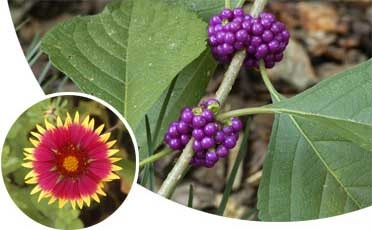
Identify the Florida-friendly plants, including Florida native plants, that will work in your yard or landscape design. The database contains nearly 380 trees, palms, shrubs, flowers, groundcovers, grasses and vines that are recommended by University of Florida/IFAS horticulture experts. The plants included in the database are available at nurseries throughout Florida.
Check it out- Florida Friendly Landscaping
My front yard
Posted: May 16, 2009 Filed under: Gardening Leave a commentI’ve been ignoring it. I mean, really ignoring it. I stopped watering it 3 years ago. My landlord had had the sprinkler system set to water every day at 5:30 am. It encouraged weed growth like crazy. He sprayed. I hated it. He turned off the sprinkler system. I gave up. Here is my poor lawn after zero-scaping itself over the last few years. I do mow when it gets ridiculous.
The grass is trying to hang in there, the azaleas are overgrown and full of Virginia Creeper, to which I am allergic. I have decided to Xeri-scape as much as possible, but use the front half circle as a community garden. Several families have expressed interest in using the space. My front yard get full sun all day. I already have the blueberry bushes that are going in. It’s a start. Here is how it looks now.
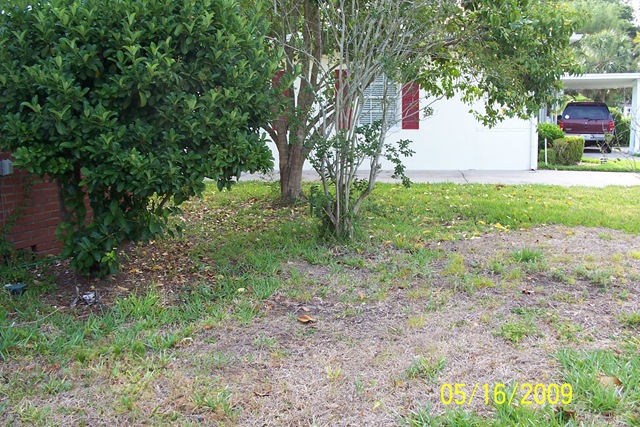 A serious dry patch.
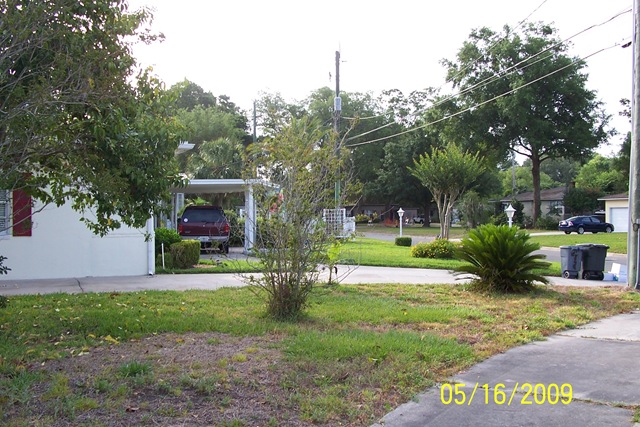 Quite a contrast to the immaculately manicured, sprayed, heavily watered yard next door…
I’ll keep you informed of the progress..
Growing Food inside
Posted: May 15, 2009 Filed under: Gardening Leave a commentMy backyard and inside of my house is producing food really well. I have not bought greens, basil or lettuce since November. I am eating cherry tomatoes and strawberries out of the living room. Baby lettuce sprouted 3 days ago. Today I planted beets, purple tomatoes, more Swiss chard. Here’s a pic from the living room, looking into the sunroom;
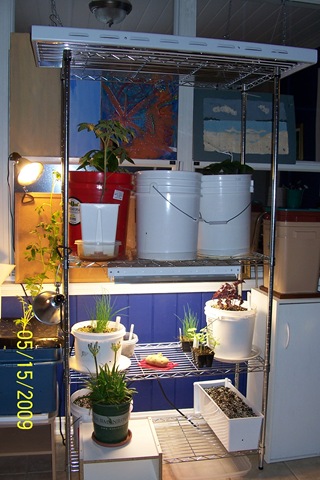
Clockwise from the left; cherry tomatoes-rescued from outside. I started them too early. On the top shelf is strawberries, tomato, purple bell pepper, strawberry Middle shelf has garlic, empty pot. Second self- chives, watermelon, purple basil, a potato that has started sprouting…it will go in a barrel outside. Bottom shelf; garlic, lettuce just planted, cucumbers. The Waterfarm has a nasturtium. It was a drip system, which I don’t like, I converted it into a bubbler that also sprays the roots every 30 minutes. All the artwork is in the windows because I have yet to get shades.
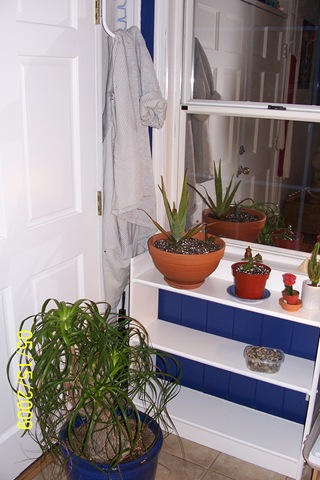
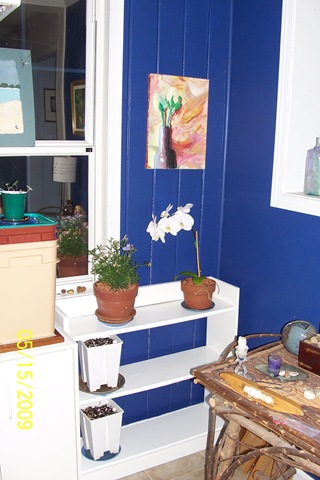
To the left of this is succulent, plus a Bonsai pony tail palm, about 30 years old. To the right is a orchid, and purple tomatoes waiting to sprout.
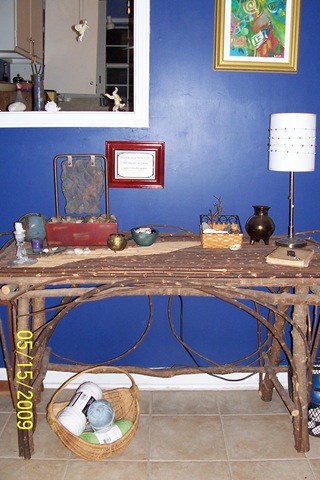
This is to the left of all that, a table my friend Bim Willow made.


 Meal Delivery Service by Millie Barnes