Strange Fruit in my Backyard…
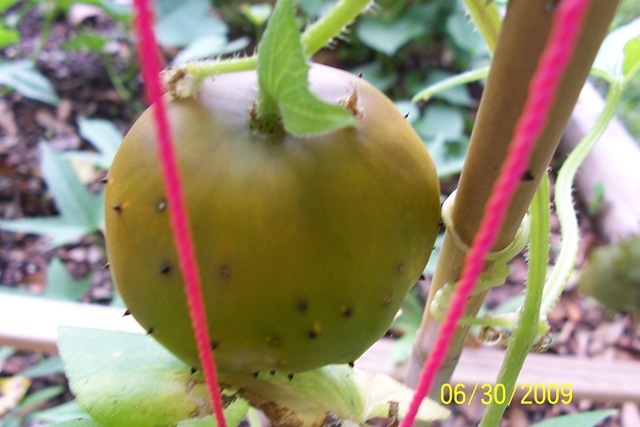
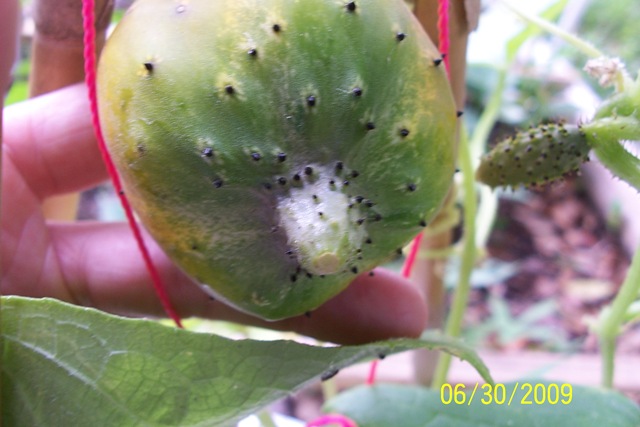
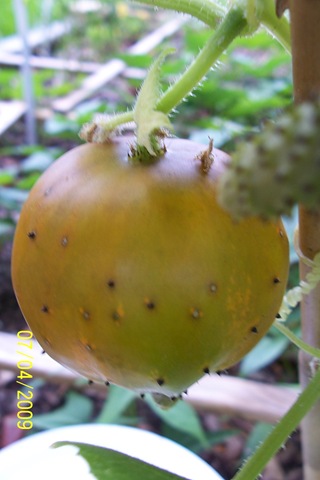
Posted: July 23, 2009 Filed under: Gardening Leave a commentIn March I planted a cucumber in my square foot garden, after sprouting it indoors. It took off, grew nicely, but slowly, during the winter…tucked under row covers through a few hard freezes. Spring came, I staked it as it grew. By MAy and June when it was raining (A LOT!) here everyday I got busy and ignored it for a while, after all, it was getting watered! So a few weeks ago I go out and find THIS (see that first picture?)….
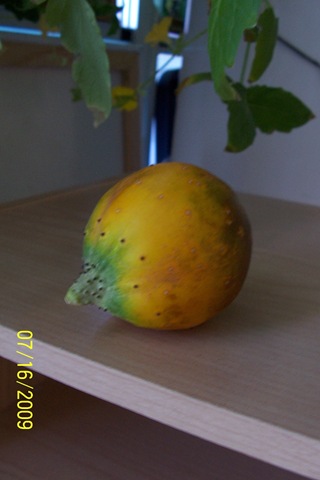
My tomatoes and cucumber had, well, mixed somehow. Most info I could find out was that if they cross pollinated, it wouldn’t affect the first fruit, only the next generation.
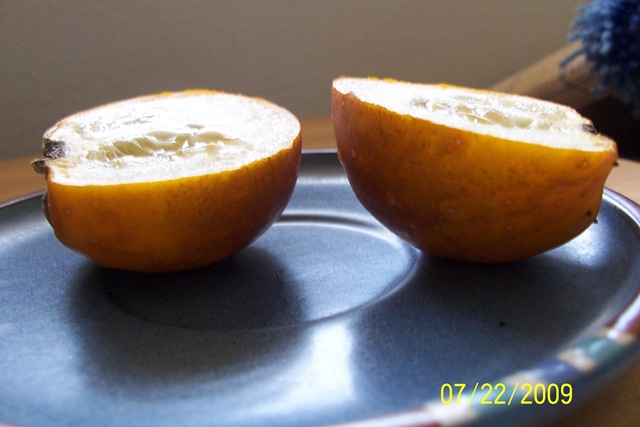
Well, obviously something happened. So I have been watching it…and watching it. Finally today, I cut it open. It’s smells deeply of cucumber, hhhmmmm, should I have it on my salad tonight? I don’t know….
Wooly Pockets
Posted: July 20, 2009 Filed under: Gardening 1 CommentI found these today, they are way cool. I’m thinking these would be easy to make, would cool the patio, and look gorgeous in front of the bricks. Oh, yeah!
Woolly Wally Vertical Gardening System
The Woolly Wally System is the best way to vertically garden on just about any type of wall or fence, indoors or out. Like building blocks, Woolly Wallys are easy to install and totally modular and love to hang out in any combination, alone or with friends. Woolly Wally Three and Five don’t mind sharing, and will let roots grow from Pocket to Pocket. All the Woolly Wallys love a good party, and they’ll even keep things quieter by absorbing sound when their Pockets are full.
The Lined Woolly Wally System helps protect walls and fences from getting wet with their impermeable moisture barrier. Unlined Woolly Wallys are available for exposed outdoor gardening when maximum drainage is desired.
The Woolly Wally System comes in three modular sizes to accommodate almost any wall size and three colors to play nicely in any environment.

Me taking a pic of cucumbers.
Posted: July 11, 2009 Filed under: Gardening Leave a comment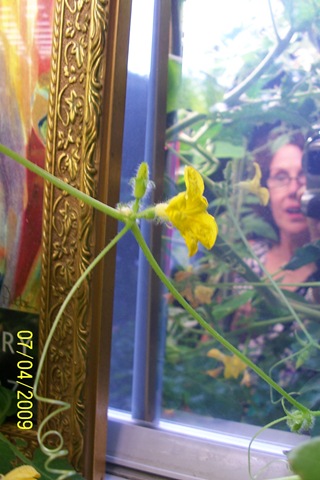
I’ll do a garden update this afternoon, too much rain yesterday!
Garden Update…
Posted: July 4, 2009 Filed under: Gardening Leave a commentI finally have a cucumber! I have TONS of flowers on the plant inside under grow lights…and it’s finally fruiting!!!
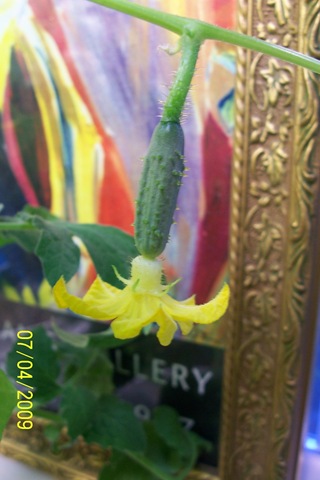
Here’s a pic from a few days ago…
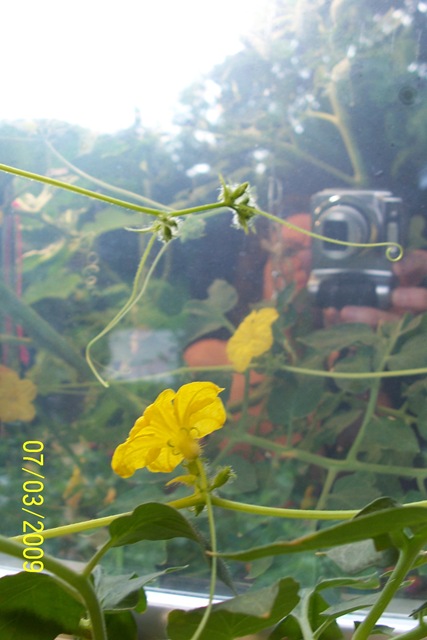
Here’s an update on that silly cucumber-tomato cross I got outside…weird science experiment, eh?
Stop throwing food scraps away, build up your soil!!!
Posted: June 29, 2009 Filed under: Gardening Leave a commentHere’s an article from Reuters today on mandatory composting of food scraps on a city wide scale. But it is so easy to do it yourself whether you live in a home or apartment. There’s Bokashi composting for ya’ll who are in apartments, worm farming for indoors or out, yard clippings and food scraps and a sawdust toilets for those with a yard and/or garden.
S.F. Mayor Signs First Mandatory Composting Law in U.S.

By Gavin Newsom – Gavin Newsom
Composting will prevent tons of material from going to the landfill, create healthy soil for our local farms and help us fight global warming.
Today at the Farmer’s Market in front of San Francisco’s iconic Ferry Building I am signing the nation’s first mandatory composting law. It’s the most comprehensive recycling and composting legislation in the country and the first to require residents and businesses to compost food scraps.
A number of years ago, San Francisco set a lofty green goal — we wanted to divert 75 percent of our resources from the landfill by 2010 and achieve zero waste by 2020. At the time, many people thought our targets were overly ambitious. However, San Francisco is poised to meet these goals. We are currently keeping 72 percent of recyclable material out of our landfill.
We recently conducted a waste-stream analysis and discovered that about two thirds of the garbage people throw away — half a million tons each year — could have been recycled or turned to compost. If we were able to capture everything, we’d be recycling 90 percent — preventing additional waste material from going to the landfill, and creating hundreds of green-collar jobs.
San Francisco already converts over 400 tons of food scraps and other compostable discards into high-grade organic compost every day. It’s so nutrient-rich that the final product is almost jet black in color. It’s snapped up by farms and vineyards across the Bay Area, we can barely keep up with the demand. By requiring all residents and businesses to compost, we’ll increase the amount of “black gold” available for sustainable regional agriculture and improve our environment.
When food scraps break down in an oxygen-starved landfill it creates large quantities of methane gas, a greenhouse gas 72 times more potent than carbon dioxide when measured over a 20 year period. It also creates acids that can leach toxins from the landfill.
Composting food scraps produces little to no methane because there is sufficient oxygen in the process. And using the resulting compost reduces greenhouse gases by returning carbon to the soil, increasing plant growth, and reducing emissions associated with chemical fertilizers, pesticides and irrigation. Recent studies show that farming one acre of land using conventional industrial methods releases 3,700 pounds of carbon into the atmosphere each year. Farmed sustainably, with compost and cover crops, that same acre will put 12,000 pounds of carbon back into the earth.
I believe that composting will become second nature for Americans, just like sorting bottles and paper. It will take time, but I believe mandatory composting will spread across the country — improving the air we breathe and reducing our need for landfills.
For more info on our recycling programs please visit www.sfenvironment.org/
Gavin Newsom is the 42nd mayor of the city and county of San Francisco.
Cucumbers flowers are so beautiful!
Posted: June 23, 2009 Filed under: Gardening Leave a commentI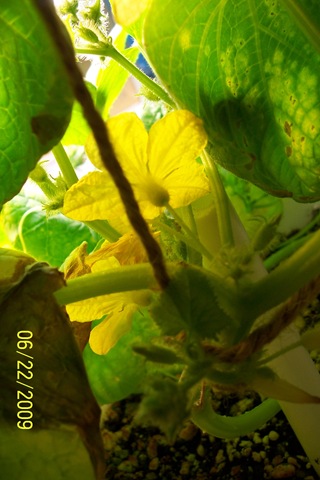 I had the best of intentions; change the water in the hydro tomatoes, add fertilizer.. And then I saw then sky get dark, a thunderstorm moving in..and the living room took on that golden glow and I grabbed the camera; this pic is the cucumbers, they are a mass of blooms.
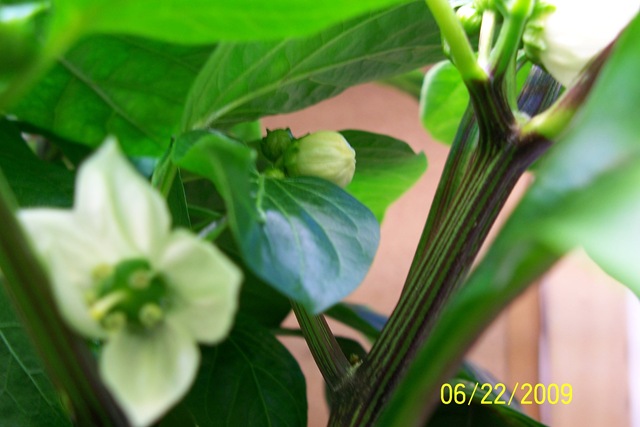 This is a purple bell pepper, see the baby peppers?
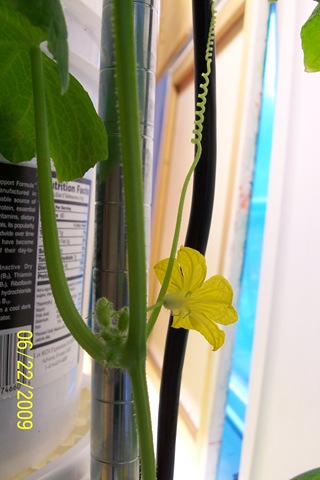 The cucumber is growing up the cord for the grow light.
 I ate blueberries with rain dripping off of them….
 I was sooo happy to feel the rain coming, we have had 100 degree days and no rain for a week.
The tomatoes inside are flowering like crazy, so are the cukes.
Wahooo, two days off to catch up around here; change water in bubblers, transplant 4 new tomato plants into sub-irrigated containers, start new crop of lettuce..
Urban gardening and connecting to nature
Posted: June 19, 2009 Filed under: Gardening Leave a commentYa’ll must have noticed how often I quote No Impact Man. I discovered his blog about 2 or 3 months after he started it..and fell in love. Of course I became a even bigger fan after he published an article I wrote!! LOL! Just Kiddin’. If you haven’t had the pleasure, please check it out! (you can read the article here- 31 Tips for Reducing for Reducing Your Impact While Saving Money)
Here’s another good one-

There are all sorts of reasons to farm food in the cities–reduction of the heat island effect, local food production, keeping storm water out of the waterways. But something happened to me the other day as a result of growing vegetables in my new garden plot that I wasn’t counting on.
It’s been a dark winter and a pretty rainy spring. I’ve been waiting for the sun. And still the rain comes.
When I was little, when it rained, my grandmother would always say, "Well, it’s good for the farmers." And I would give lip service and say, "That’s true," and then I’d feel bad about the fact that I really didn’t care about the farmers. I just wanted sun.
For thirty years, I pretty much just wanted sun.
But the other day, when it rained, I wasn’t disappointed. I’d seen the difference to my new community garden plot after watering with a hose versus a soaking with a good rain. One keeps it alive. The other makes it thrive.
Living in the city, we don’t have as much connection to nature as we should. But keeping my new vegetable plot at Laguardia Community Gardens, the thing I wasn’t counting on was that I suddenly discovered a new gratitude for the cycles of nature. I was grateful for how the world works. I was grateful for the rain.
Pee-cycling
Posted: June 17, 2009 Filed under: Gardening 2 Comments- 20 December 2006 by Graham Lawton
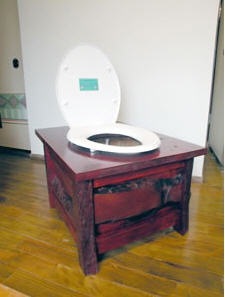
You recycle your household waste. You buy locally grown food, fit low-energy light bulbs and try not to use the car unnecessarily. Maybe you even irrigate the garden with your bath water. But you’ve still got an environmental monster in your house. Your toilet is wrecking the planet.
Before you point to the brick you’ve put in the cistern, it’s not about the water – well, not entirely. The big problem is pee. Your pee. Do you flush it away without a second thought? Tsk, tsk. Lose the green halo.
At first sight urine looks like an unlikely environmental menace. What harm could come from flushing away a fluid that is mostly water, plus a smidge of proteins and salts? Surprisingly, the answer is "a lot".
The problem with urine is that it is the main source of some of the chemical nutrients that have to be removed in sewage treatment plants if they are not to wreck ecosystems downstream. Despite making up only 1 per cent of the volume of waste water, urine contributes about 80 per cent of the nitrogen and 45 per cent of all the phosphate. Peeing into the pan immediately dilutes these chemicals with vast quantities of water, making the removal process unnecessarily inefficient.
To be fair, if you use conventional western plumbing there’s not an awful lot you can do about your personal pee-print right now. A lucky few, however, live or work in one of the buildings in continental Europe where you can find a future must-have eco-accessory: the urine separation toilet. These devices divert urine away from the main sewage stream, allowing the nutrients to be recycled rather than treated as waste. They could solve all the environmental problems associated with urine and even turn sewage plants into net producers of green, clean energy.
If you use conventional plumbing There’s not a lot you can do about your personal pee-print right now
So how do standard sewage systems deal with urine? Known in the business as "yellow water", urine enters the sewage system and mixes with solid waste ("black water"), "grey water" from household sinks and baths, and sometimes rainwater. It eventually arrives at a treatment plant, where it must be cleaned up enough to be discharged into a river.
The first step is to filter the sewage to remove large objects such as condoms, tampons and a random assortment of dead goldfish and false teeth. What remains flows into settlement tanks, to allow the feces to sink to the bottom. This solid sludge is separated off and stored in oxygen-free tanks, which are gently warmed for about two weeks. Bacteria break it down, generating methane gas that can be burned to produce electricity. The end product is an inert solid that is usually burned or dumped in landfill.
Meanwhile, the liquid portion of the sewage flows into oxygenated "aeration tanks". Here microbes guzzle the nutrient-rich organic material and multiply like crazy, converting nutrients into biomass. This eventually sinks to the bottom of settlement tanks as yet more sludge, while the liquid heads off for a final, energy-intensive "polishing", which strips out any leftover nitrogen and phosphate that the aeration stage couldn’t get rid of.
Minority pursuit
The whole process is very good at converting yellow, black and grey water into more or less clear water, but all that pumping, stirring, aeration and heating uses a lot of power – about 11.5 watts per head of population. That’s only a tiny portion of your personal daily energy consumption, but it mounts up. In the UK, population 65 million, it means waste water treatment consumes 65,000 gigajoules a day – about a quarter of the output of the country’s largest coal-fired power station. In a world where energy efficiency is ever more important, that’s not to be dismissed.
According to civil engineer and urine-separation expert Jac Wilsenach, it’s highly inefficient. Wilsenach spent six years at Delft University of Technology in the Netherlands working on the intricacies of sewage systems, and according to his calculations, today’s methods mean we are literally flushing energy down the pan.
In a paper published last March, Wilsenach calculated that if we were to separate out just half of our urine, the microbes in the aeration tanks could eat up almost all the nitrogen and phosphate (Journal of Environmental Engineering, vol 132, p 331). The energy-intensive polishing stage would become completely unnecessary.
There’s another, even bigger gain to be had from separating out the urine. Lower starting levels of nitrogen and phosphate mean that the microbes in the aeration tanks can do their job much more efficiently, taking just one day compared with about 30, thus reducing the energy demand of the aeration tanks. What’s more, the resulting sludge is richer in organic matter and generates more than three times as much methane. In fact, says Wilsenach, separating out 50 to 60 per cent of the urine could turn sewage works from net consumers to net producers of energy to the tune of about 2.5 watts per person.
So far so good. But how do you stop pee from getting into sewage in the first place? The answer is to install a special WC called a "urine-separation toilet" or often just a NoMix, after one of the leading brands.
On casual inspection a NoMix toilet looks pretty much like a normal one. But peer into the bowl and you’ll see that there are two waste pipes – a small front one and a larger rear one. The front one collects urine and diverts it into a storage tank (sometimes aided by a tiny trickle of water) to await its fate. The rear works like a standard flush toilet.
You don’t even have to do anything special to make this separation happen – apart from one thing. "The toilet is constructed in a way that if a man or woman sits on the toilet most of the urine is collected," says Bjartur Swart of engineering firm Grontmij in Drachten, the Netherlands, which is conducting urine separation trials across the country. Yep, that’s right. In the urine-separating future, men will sit down to pee.
Although small-scale urine separation has been practised for centuries (pee has been used in industries ranging from textile dyeing to blacksmithing, for example), it is something of a minority pursuit today. Modern experiments started in Sweden in 1994 with the founding of two "ecovillages" – Understenshöjden in Stockholm and Björsbyn in the far north – whose houses and apartments were fitted with urine-separation toilets. There, the urine is stored for collection by local farmers who use it as a fertiliser.
Other villages have followed suit and Sweden is now the urine-separation centre of the western world, with around 3000 NoMix toilets in use. Denmark has also set up urine-separation projects including one at the Svanholm Gods farming collective near Skibby, the largest producer of organic vegetables in the country (bear that in mind if you ever buy organic vegetables from Denmark).
The urine from all these projects ends up being sprayed directly onto fields, which works fine as long as only a few people are contributing. It doesn’t take much, though, for supply to start outstripping demand. "Recycling urine directly is not feasible in cities, but that is where the focus should be because that’s where the biggest amount of waste comes from," says Wilsenach, now at South Africa’s national research institute CSIR in Stellenbosch.
So what to do with the urine? The answer is, recycle it indirectly – in other words, extract the nutrients and turn them into fertiliser. In the Netherlands, Grontmij trucks the stored urine to a special treatment plant where the phosphate is precipitated out as a mineral called struvite (ammonium magnesium phosphate). This is a useful fertiliser and can help reduce demand for mined phosphate, which can only be a good thing: phosphate rocks are often contaminated with heavy metals, and mining and refining them generates waste and uses lots of energy. Some estimates suggest the world’s phosphate mines will be exhausted in 100 years. Yet at the moment we literally pour tons and tons of perfectly good phosphate down the drain.
Green halo
The other nutrients in urine can also be turned into fertiliser. Novaquatis, a branch of the Swiss Federal Institute of Aquatic Science and Technology (EAWAG) on the outskirts of Zürich, is experimenting with extracting nitrogen and potassium in forms that can be sprayed directly onto crops. Once the urine is treated it is clean enough to go directly into a river.
Crucially, these methods of extracting nutrients directly from urine consume much less energy than dealing with its vastly diluted form in general waste water. There’s an extra energy cost from trucking the urine in, but Wilsenach says it’s minuscule compared with the savings.
If all these benefits weren’t enough, using a NoMix toilet saves water too. According to research done by EAWAG, it reduces your use of flush water by 80 per cent, cutting the average household’s overall water use by about 25 per cent. Bear in mind that the water that fills up the toilet cistern is clean enough to drink: "We use good quality drinking water to flush away urine," says Wilsenach.
So where next for urine separation? Grontmij and Novaquatis have set up pilot projects across the Netherlands and Switzerland, and a handful of places are now doing it for real, including the public library in Liestal, Switzerland. Swiss citizens can even buy their very own NoMix toilets and storage tanks if they want, even though the sewage system is not yet ready and the urine ends up flowing into the waste water stream as normal. Urine separation is also taking root in Austria and Germany.
In surveys, people say they would be happy to use NoMix toilets and buy vegetables fertilized with processed urine. There is even a way round what could seem the biggest obstacle to widespread acceptance. "If a man doesn’t like sitting, he can urinate just in a normal way and use the [front] hole as a target," says Swart.
One day we may look back at our habit of flushing pee away with drinking water as staggeringly wasteful. "Water and waste are two of the greatest challenges the world faces at the moment," says Jacob Tompkins, director of Water-wise, a London-based water efficiency campaigning group. "Anything that looks at our low-efficiency way of dealing with the waste stream is extremely important."
Of course it would take time and money to convert existing sewage systems. But even if urine separation isn’t coming to your area any time soon, that’s not an excuse for inaction. Keeping urine out of the waste stream any way you can pays dividends. So what are you waiting for? Next time you need to take a leak, give the bathroom a miss and head straight for the flower beds. Then you can replace your green halo.
They can be very simple;

Or more esthetically pleasing;
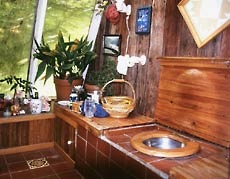
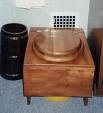
The one above is at the top of the article is a beautiful Japanese sawdust toilet.
Here is a link to Joseph Jenkins wonderful book- The Humanure Handbook.
Here are exact instructions. Building a sawdust toilet
I paid 18.00 at Lowe’s for a wooden toilet seat. I got the buckets free from a local sub-shop. It feels SO good to not be flushing an average of 40 GALLONS a day of water. My water bill has dropped considerably, my compost is baking away and the plants love the fertilizer. Between Bokashi composting, growing my own veggies and recycling all yard clipping and leaves, I am getting more and more “off the grid”. It is deeply satisfying.
Picking dinner out of the back yard rocks!
Posted: June 16, 2009 Filed under: Gardening 1 CommentEverything I ate tonight I grew, except for the chicken. It’s organic, free range, now it’s in the oven. I am using organic butter, thyme and scallions and sweet potatoes I grew, Cherry tomatoes I picked this afternoon. When I went to the backyard just now I noticed a bunch of blueberries were ripe. I have been eating a few a week, but all of the sudden I had to come back in and get a bowl..there were so many! I love this! I have only been seriously gardening since last July. that’s when the square foot garden went in. But then I became fascinated with hydroponics and it took off from there… but today was the first time that everything I grew all the veggies and fruit for dinner!!!
Here’s an update; This is the sunroom at the end of the living room. Almost everything is in sub-irrigated containers I built.
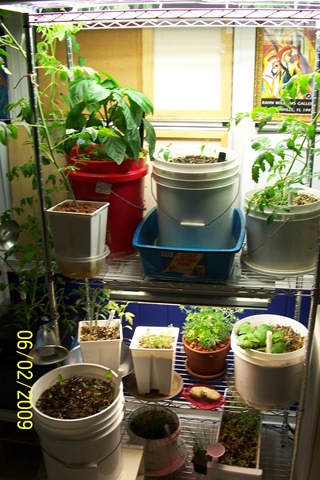 The tomatoes have vined up to the ceiling! Next time I know to use patio type tomatoes. In the red bucket is purple bell peppers, Clockwise from there; purple tomatoes, cucumbers, beets, garlic, lettuce, chives, beets.
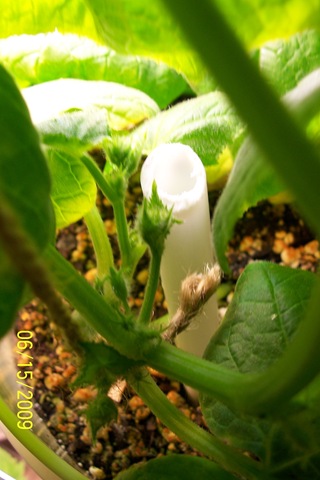 Cucumbers

Outside something attacked my broccoli, I sprayed with Neem oil.
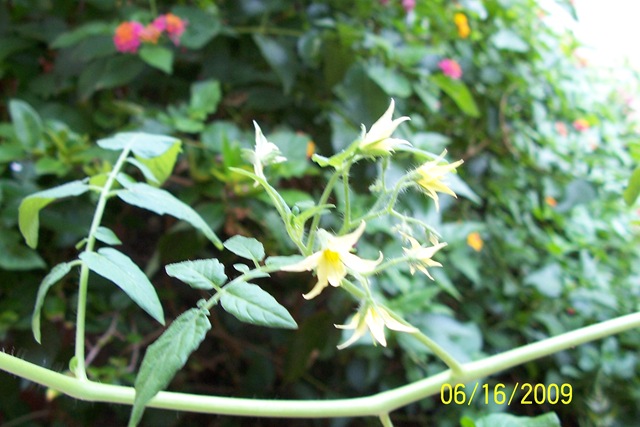 Flowers on the upside down tomatoes, hanging outside my kitchen window. I can open the window and pick tomatoes!
Is Peeing in Public Green?
Posted: June 15, 2009 Filed under: Gardening Leave a comment
by Sami Grover, Carrboro, NC
Peeing in Public Saves Water – But is it Gross?
I seem to be in the habit of sharing my bathroom habits with the world – whether it’s the Selective Flush or the Navy Shower. (Perhaps worryingly) people seem to enjoy reading about what I get up to in the privacy of my own home – or at least it usually stirs up a vigorous debate. So here’s another one I’ve been musing about lately – peeing in public is an environmentally responsible thing to do.
OK – so maybe I’m not really talking about peeing in public, but rather peeing outdoors. I mean, the folks that dirty our underpasses and stink out our phone booths are hardly paragons of treehugging virtue. But it seems to me that a discreet pee behind a bush is in many ways more sensible than spoiling perfectly good drinking water and then whisking it away for expensive, energy and water intensive ‘treatment’.
So what can we do to remedy the situation? For those of us in the country, the at-home solution is easy enough. I regularly pee in my yard. Not only does this save water – but it has other uses too. A quick sprinkle of the compost heap helps start the decomposition process, and let’s not forget that urine is an important source of phosphate. I also pee around the flower beds and chicken coop to keep deer and raccoons away. And if you want to do more, check out how to use urine as a fertilizer.
But what about townies? I actually know plenty of town folk who occasionally use a secluded corner of their yard as a temporary toilet. And I see nothing wrong with using our parks for relief when you are caught short – though you probably want to find some dense undergrowth to spare the social outrage (and any possible legal issues!). And in large crowds, it’s probably best to stick to the toilets – eutrophication of waterways is a real problem at major events like music festivals etc.
Back in my home town of Bristol in the UK, and many other cities in Europe, where Friday night revelers are not always the best behaved bunch, they often set up temporary public urinals in the street, saving shopkeepers the unpleasant task of cleaning up after anti-social drunks. (I’ll save readers the unpleasant sight – head over to LIFE if you really want to see what temporary urinals look like). But what if those urinals were not just glorified (and wall-less) chemical toilets, but rather a method for collecting a valuable resource that could be distributed to phosphate hungry farms in the region? After all, the New York Times has already identified "yellow as the new green" – arguing for urine separation in all of our toilets.
It looks like Umbra has been exploring some similar philosophical issues over at Grist – pondering whether it’s polite to let it mellow when not at home, and putting her support behind peeing in public. It must be OK then…


 Meal Delivery Service by Millie Barnes
