MY FAVORITE TIPS/PRACTICES IN THE KITCHEN
Posted: April 9, 2012 Filed under: Food and it's Impact on Our Health Leave a commentMY FAVORITE TIPS/PRACTICES IN THE KITCHEN
Let’s Build a Worm Farm!
Posted: April 9, 2012 Filed under: Food and it's Impact on Our Health Leave a commentVEGAN DIET WITH SOY LOWERS TESTOSTERONE AND CAUSES ERECTILE DYSFUNCTION
Posted: April 9, 2012 Filed under: Food and it's Impact on Our Health Leave a commentVEGAN DIET WITH SOY LOWERS TESTOSTERONE AND CAUSES ERECTILE DYSFUNCTION
Vegan Diet with Soy Lowers Testosterone and Causes Erectile Dysfunction
Posted: April 9, 2012 Filed under: Food and it's Impact on Our Health, Non-Toxic Choices 2 Comments
This article in the journal Nutrition was pretty simple. A 19 year old male sought treatment for lack of libido and sexual dysfunction. He had voluntarily started a vegan diet previously. The study measured the effects of ceasing a vegan diet and removing soy from the diet.
Previous research has focused on the beneficial effects of soy and its active ingredients, isoflavones. For instance, soy consumption has been associated with lower cardiovascular and breast cancer risks. However, the number of reports demonstrating adverse effects of isoflavones due to their estrogen like properties has increased. We present the case of a 19-y-old type 1 diabetic but otherwise healthy man with sudden onset of loss of libido and erectile dysfunction after the ingestion of large quantities of soy-based products in a vegan-style diet. Blood levels of free and total testosterone and dehydroepiandrosterone (DHEA) were taken at the initial presentation for examination and continuously monitored up to 2 year after discontinuation of the vegan diet. Blood concentrations of free and total testosterone were initially decreased, whereas DHEA was increased. These parameters normalized within 1 year after cessation of the vegan diet. Normalization of testosterone and DHEA levels was paralleled by a constant improvement of symptoms; full sexual function was regained 1 year after cessation of the vegan diet. This case indicates that soy product consumption is related to hypogonadism and erectile dysfunction. To the best of our knowledge, this is the first report of a combination of decreased free testosterone and increased DHEA blood concentrations after consuming a soy-rich diet. Hence, this case emphasizes the impact of isoflavones in the regulation of sex hormones and associated physical alterations.
The negative effects of the vegan/soy diet show a measured decrease after two weeks, but continued to improve for (at least) 724 days after quitting the vegan/soy diet.
MORE….
Let’s Build a Worm Farm!
Posted: April 9, 2012 Filed under: Gardening Leave a commentMarch 22, 2012 by Soulsby Farm – A Very Small Farm
Step by Step Instructions on how to build your very own Worm Composting Bin. This is a 5 minute project. I completed it in 3 minutes with a cold beer in one hand. You can buy worms locally or from several sources online. I purchased 2lbs of Red Wigglers online for $29.99.

Here’s all you need:
2 Rubbermaid tubs (or cheap knock-off like these) or some old 5 gal buckets.
2 blocks (in this case a couple 2×4 pieces)
Shredded Paper (I find that worms like bill collection letters the best)
Kitchen Scraps (no meat or dairy products just veggies)
Crushed egg shells (provide calcium)
Cheerios and coffee grounds (with filter)
Worms (Red Wigglers or Eisenia foetida, are the best compost worms)
Drill (2 bits 1/8″ and 1/4″)
Step 1: Drill 1/8″ holes in the top (for oxygen) and 1/4″ holes in the bottom for worm juices. In 1 tub.


Step 2: Place a couple of 2×4′s (as spaces) in the bottom of the nu-drilled tub. Place Drilled tub on to the spacers, fill drilled tub about a third with shredded paper.

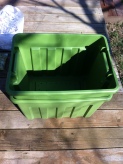

Step 3: Add crushed egg shells (great source of slow release calcium and can also act as a buffer, essentially helping to prevent excessively acidic conditions from developing.) and Cheerios (Worms like Cheerios).


Step 4: Add kitchen scraps (no meat, nothing greasy, no citrus,) veggie scraps and worms.
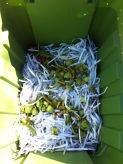

Step 5: Add some water. Worms like it moist and dark. Drill holes in top and leave em alone. In 90 Days you’ll have the best organic fertilizer and your plants will love you for it.


Interesting Worm Facts:
- There are over 4,000 species of earthworms.
- There are only about 6 species that are used for vermicomposting.
- Earthworms don’t have lungs, but instead breathe through their skin as long as it stays moist.
- Red Wigglers can consume up to 50% of their body weight per day
- Earthworms are hermaphrodites yet it still takes two worms to reproduce.
- Worms don’t have eyes , but are sensitive to light.
- Worms have no teeth for chewing food. They grind food in their gizzard by muscle action.
- A worm’s mouth is in the first anterior segment. There is a small protruding lip just over the mouth, called prostomium. When the worm is foraging, this lip is stretching out. The prostomium is for sensing food.
- You’ll be able to compost your kitchen scraps 10 times faster when compared to composting without them.
- One pound (16 ounces) of worms equals about 1,000 worms
- One pound of Red Wiggler worms can eat about half pound of organic matter every day.
Why should you start a Worm Farm?
- Remove excess waste from landfills & reduce your carbon footprint.
- Worms produce the best organic fertilizer
- Worm castings are five times richer in nutrients than the best topsoil and worm castings are pH neutral.
- Great treats for chickens and great for fishing.
- Worms make great friends. They just listen to you all day and never interrupt.
- If you’ve read this far, you’re crazy enough to do it.
What is Vermicomposting?
Worms and microorganisms convert organic materials to a beneficial soil amendment. The worms breakdown food scraps into nutrient rich compost.
Feed Worms:
- Vegetable scraps
- Fruit scraps and peels (mold/rot is fine)
- Bread and grains
- Coffee grounds (+ filters) and tea bags
- Crushed egg shells
- Napkins, paper towels
Don’t Feed Worms:
- Citrus
- Meats, fish
- Greasy foods
- Dairy products
- Twigs and branches
- Dog/cat feces, cat litter
You can leave the bin inside your house (there’s no smell) or you can build up a small army of worms and take over the world or just add them to your compost pile mid-summer. Or even better, start a Worm Farm (like Harry and Lloyd in ‘Dumb & Dumber‘) and call it I Got Worms.
My Favorite Tips/Practices in the Kitchen
Posted: April 9, 2012 Filed under: In The Kitchen with Millie- How To's 2 Comments
Most important; Shoes off, music on, favorite beverage in hand — enjoy your time in the kitchen.
1) USE a spatula- the single most important tool in your kitchen to avoid waste…many people do not take the time to get the last bit of mayo or sauce or even cookie dough out of the bowl…
2) When you’re browning meat, you should blot the surface dry with a paper towel so the meat doesn’t release moisture when it hits the hot oil. Too much moisture makes the meat steam instead of sear, and you will lose that rich brown crust.
3) After working with garlic, rub your hands vigorously on your stainless steel sink for 30 seconds before washing them. It will remove the odor.
4) After making eggs sunny-side up, deglaze the pan with sherry vinegar, or beef or chicken stock then drizzle the sauce on the eggs to add another dimension to the dish.
5) Remember schmaltz? Your mom and grandmother probably used a lot of it in their home cooking. Schmaltz, or chicken fat, has a great flavor and richness; it has a deeper flavor than duck fat and can be used on nearly everything. I also love poaching fish in it. Just make sure you are using organic chickens…otherwise it’s better to not eat the fat…too toxic.
6) Always season meat and fish evenly; sprinkle salt and pepper as though it’s “snowing.” This will avoid clumping or ending up with too much seasoning in some areas and none in others.
7) For best results when you’re baking, leave butter and eggs at room temperature overnight.
8) For an easy weeknight meal, save and freeze leftover sauces from previous meals in ice cube trays. The cubes can be reheated in a sauté pan when you need a quick sauce.
9) Instead of placing a chicken on a roasting rack, cut thick slices of onion, put them in an oiled pan, then place the chicken on top. The onion will absorb the chicken juices. After roasting, let the chicken rest while you make a sauce with the onions by adding a little stock or water to the pan and cooking it for about 3 minutes on high heat.
10) A braised or slow-roasted whole beef roast or pork shoulder can be made into several dishes and sandwiches all week.
11) Fresh basil keeps much better and longer at room temperature with the stems in water.
12) When you grill, or pan fry, pull your steaks out of the refrigerator one hour ahead of time so they can come to room temperature.
13) To optimize the juice you get from a lemon or lime, roll it hard under your palm for a minute before juicing.
14) Don’t be afraid to ask the butcher or fishmonger to see the products up close and to smell for freshness. Fish should never smell fishy.
15) When baking cookies, be sure your dough is thoroughly chilled when it goes on your baking pan. This will allow the leavening ingredients to work before the butter flattens out and your cookies lose their textural distinctions
16) Wash potatoes after you peel them, they will be way easier to peel when dry.
Traditional Bone Broth in Modern Health and Disease
Posted: April 8, 2012 Filed under: Food and it's Impact on Our Health Leave a comment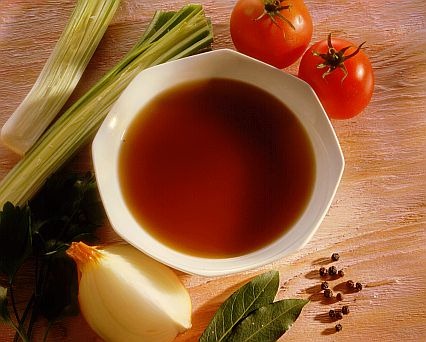
Broth, made from the bones of animals, has been consumed as a source of nourishment for humankind throughout the ages. It is a traditional remedy across cultures for the sick and weak. A classic folk treatment for colds and flu, it has also been used historically for ailments that affect connective tissues such as the gastrointestinal tract, the joints, the skin, the lungs, the muscles and the blood. Broth has fallen out of favor in most households today, probably due to the increased pace of life that has reduced home cooking in general. Far from being old-fashioned, broth (or stock) continues to be a staple in professional and gourmet cuisine, due to its unsurpassed flavor and body. It serves as the base for many recipes including soup, sauces and gravy. Broth is a valuable food and a valuable medicine, much too valuable to be forgotten or discounted in our modern times with our busy ways and jaded
Nutritional Contents
Basically then, broth will contain the ingredients that are in bone. Covering and adhering to the ends of bones to form a joint, is cartilage. Therefore broth will also contain the ingredients that are in cartilage. Bone and cartilage are both classified as connective tissue. Connective tissue is one of the four basic tissue types that exist in animals. It functions to bind or hold together and to support and strengthen the body. Connective tissue consists of a matrix, and cells that secrete the matrix. The matrix is the material that fills the space between the cells and is therefore referred to as the extracellular matrix. It is composed of protein fibers, and ground substance, which can be a liquid, a gel or a solid. Since the cells are few, it is the valuable nutrients from the matrixes of bone and cartilage, which create the substance called broth.
The Case Against Gluten: For Everyone
Posted: April 8, 2012 Filed under: Food and it's Impact on Our Health, Non-Toxic Choices Leave a comment
In the U.S., public awareness of gluten free diets has reached widespread recognition, but largely in name only. For those suffering with celiac disease or acute wheat allergies, it’s critical. For those with known reactions to gluten, it’s of serious importance. For those who don’t really know what it’s about, but see it on packaging, it seems to evoke a similar response as being forced to “Press 1 for English”. Journalists tend to frame the gluten free approach as legit for celiac treatment, but ultimately a fad diet controlling minions of mindless Gwyneth Paltrow lovers (AP Article). The paleo diet community views it as more of a religion (that’s tongue-in-cheek hyperbole, people!). Before we continue, here are my biases: I experience repeatable, specific, and boring symptoms from gluten intake, but I do not have celiac disease or a “gluten allergy”. Evolutionary biology is a scientific fact and I believe the paleo diet provides ultimate explanations for why we shouldn’t eat grains. So what are the proximate explanations for going gluten free? Is it fad or for’ real?
A quick and dirty primer
Celiac (or coeliac) disease is an autoimmune disorder in which the small intestine is damaged by components of gluten, a protein found in wheat and other grains. The effects of celiac disease are numerous, serious, and varied. For a entertaining sobering look, check out Tim Ferriss’ How to Keep Feces Out of Your Bloodstream. Strictly speaking, a “wheat allergy” can be similar to something like a peanut allergy. Folks in this group experience rapid onset symptoms that are serious, including the potential of anaphylactic shock. It’s mainly for these folks that food is required to expose the presence of wheat content on packaging.
Easy Durable Raised Bed Trellising
Posted: April 8, 2012 Filed under: Gardening 1 CommentClimbing towards the sun.
Many of our favorite vegetables in the Beekman Heirloom Vegetable Garden require some sort of trellising – tomatoes, beans, peas, melons, cucumbers. When we put in our raised garden two years ago, we were determined to devise a trellising system that was easy to assemble, and would last for years. We were sick of weaving together bamboo sticks, and snapping together plastic cages. We learned that if something was cheap, it wouldn’t last more than a month, and if it had any sort of moving parts, it wouldn’t last more than a week. (If we could figure it out in the first place.)
We think we’ve perfected the perfect solution – and it’s relatively inexpensive to boot. (especially considering that we haven’t had to replace anything in three years.)
Our secret weapon? Livestock panels.
These lengths of panels are 12′ long, and come in a variety of heights. Made of thick welded galvanized steel, they don’t get rusty or bent out of shape very easily. (If only the same could be said for us.) How do we use them? In many different ways…
Our most ingenious discovery was that if we inserted one end of the panel into the soil on one end of the bed, and then bent it over, we could insert the other end of the panel into the opposite end of the bed. This forms a sort of “hoop” over the bed. We call it our “Calistoga Wagon Trellis.”

By mid-summer, this trellis is covered with bean vines.


 Meal Delivery Service by Millie Barnes