Millie’s Energy Bar
Posted: May 11, 2012 Filed under: Non-Toxic Choices Leave a comment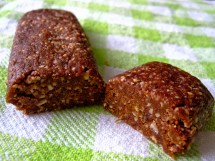
These energy bars are way healthier than any prepackaged products and let’s you not have to deal with all that packaging too! They are easy to make or you can order them from me. They come by the dozen for $12.00 a dozen.
1 cup almonds
1 cup cashews
3 T Almond Butter
2 cups dried cherries
1 cup grated coconut
2 T. Coconut Cream – Available from Tropical Traditions or at your health food store, called coconut butter.
1 T. Raw Chia Seeds
½ t. Stevia
½ T. cinnamon
1 t. vanilla
1 T. orange zest- use a microplaner and you will get just zest, none of the pith that is bitter.
Pinch Sea Salt
- Heat the oven to 350°F and arrange a rack in the middle. Place parchment paper in an 8-by-8-inch baking pan; set aside.
- Place almonds on a rimmed baking sheet in a single layer and bake, stirring halfway through, until fragrant and light golden brown, about 10 minutes. Transfer to a wire rack to cool completely.
- Place apricots and dried cherries in the bowl of a food processor fitted with a blade attachment and process until finely chopped, about 1 minute. Transfer to a small bowl.
- Place cooled almonds and the cashews in the food processor and pulse until finely chopped and the texture of fine meal, about 25 (1-second) pulses. Add dried fruits and process, stopping to scrape down the sides as needed, until nuts and fruits are combined are finely chopped, about 45 seconds. Add almond butter, orange zest, vanilla, cinnamon, salt, and process until evenly combined, about 45 seconds. Transfer mixture to a large bowl.
- Using your hands, knead the coconut into the mixture until evenly mixed, about 3 minutes.
- Transfer mixture to the prepared baking pan and, using your hands, pat it into an even layer to the edges of the pan. Fold the waxed or parchment paper over and press down on it with the bottom of a measuring cup or a flat-bottomed cup until the mixture is firmly packed and the top is smooth. Freeze for 30 minutes or refrigerate overnight.
What to Eat for Breakfast? Bacon and Mushroom Omelet!
Posted: May 11, 2012 Filed under: Food and it's Impact on Our Health Leave a commentIn the series on “What to Eat for Breakfast”, here is another recipe!
Bacon and Mushroom Omelet
1 Tablespoon Organic Butter
2 slices diced bacon
3/4 cup thinly sliced mushrooms
3 eggs
salt and pepper
1 medium tomato- sliced
1) Melt butter in 6 inch well seasoned iron skillet over low heat. Add bacon and cook two minutes, add mushrooms and cook 2 minutes.
2) In a small bowl, combine eggs with salt and pepper. Pour over cooking mushrooms and bacon and lay tomato slices on top. As eggs cook, lift edges so that uncooked egg can run underneath.
3) When top is set, fold one half of omelet over other half. Serve topped with mushrooms, if desired.
Burled Wood Bowls
Posted: May 11, 2012 Filed under: Non-Toxic Choices Leave a commentWe have something called the Riverside Arts Market here in Jacksonville. I was recently looking for something to put salt in to sit beside the stove. I have recently found a place here locally that has an amazing array of slats from around the world and have added to my salt collection…That place is Green Man Gourmet.in Avondale.
I found bowls I loved at a vendor at the Arts Market but the bowls were too big. They made me some to my specifications. I love them and they are so beautiful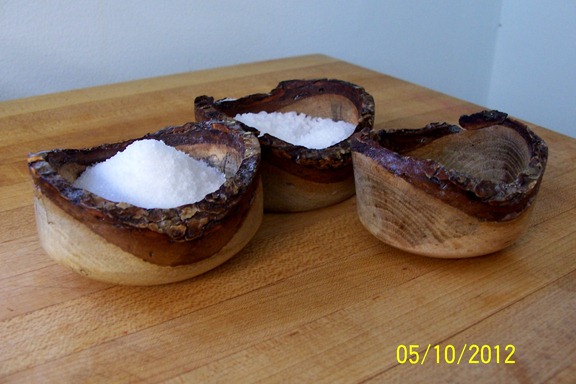 .
.
I keep course and fine sea salt and a smoked salt from Green Man Gourmet in them.
Find Wood Turning by Jerry Vaughan at the RAM every Saturday from 10 to 4! Contact them to order by emailing them at jerryandstella@bellsouth.net.
Why You Should Stop Wasting Money on Body Detox Products
Posted: May 10, 2012 Filed under: Non-Toxic Choices Leave a comment
The world is filled with plenty of myths about health and your body, many of which have been productized. One of the worst offenders is body detoxification, which attempts to sell you products based on the idea that your body is toxic. It’s not, and buying related products is an attempt to fix an issue that doesn’t exist.Brian Dunning of the myth-busting show inFact explains why:
Our bodies have kidneys and livers that remove toxins and other waste from our systems, but in the past few years, clever marketers have said "Forget all that, you need our magic pills and potions to detoxify your body." It should be very telling that they never happen to mention what these supposed "toxins" are, or what your doctor should look for in a blood test to see whether you have them. They simply assert that we’re all full of toxins, and that buying their miracle product is the key to health.
The above video goes on to explain how several detoxifying products actually work to fool you into thinking that something is happening. In reality, the best you can hope for is a placebo effect. So if you’re currently wasting money on this myth, or considering it, now’s a good time to stop worrying about body toxins and just concentrate on a healthy diet.
From Lifehacker
Ladybugs and Your Garden
Posted: May 9, 2012 Filed under: Gardening, Non-Toxic Choices 2 Comments
In many countries, it is considered good luck if a ladybug (or ladybird) lands on you and then flies away of its own will. In England and Germany, it’s thought that the number of spots has a bearing on the luck she will bring. But the best thing that can actually be proven about ladybugs is that they are a gardener’s best friend and an aphid’s worst enemy. MORE
Storing Your Harvest: Root Vegetable Bins
Posted: May 9, 2012 Filed under: Gardening Leave a commentFrom Apartment Therapy

Even though my vegetable garden is just starting to sprout, I can’t help but think about storing this summer’s bounty in these simple wire and jute bins. MORE
Will You Change Your Sunscreen Habits Because of Recent Reports?
Posted: May 9, 2012 Filed under: Non-Toxic Choices Leave a commentFrom Mother Earth News
Right on the heels of estimates of widespread vitamin D deficiencies in the U.S. population — which most of us get from exposing our skin, sans sunscreen, to the sun — comes the Environmental Working Group’s (EWG) 2010 Sunscreen Guide. For this year’s report, the EWG reviewed 500 sunscreens to test the safety of their ingredients and the veracity of their marketing claims. Of those 500, EWG researchers recommend only 39 products. The guide cites false product claims and evidence that some ingredients may even accelerate the growth of skin cancer for those that didn’t make the cut.
Sunscreen ingredient may pose skin cancer risk, researchers find
Posted: May 9, 2012 Filed under: Non-Toxic Choices 2 Comments(Phys.org) — As vacationers prepare to spend time outdoors this summer, many of them will pack plenty of sunscreen in hopes it will protect their bodies from overexposure, and possibly from skin cancer. But researchers at Missouri University of Science and Technology are discovering that sunscreen may not be so safe after all.
Cell toxicity studies by Dr. Yinfa Ma, Curators’ Teaching Professor of chemistry at Missouri S&T, and his graduate student Qingbo Yang, suggest that when exposed to sunlight, zinc oxide, a common ingredient in sunscreens, undergoes a chemical reaction that may release unstable molecules known as free radicals. Free radicals seek to bond with other molecules, but in the process, they can damage cells or the DNA contained within those cells. This in turn could increase the risk of skin cancer.
Ma also found that the longer zinc oxide is exposed to sunlight, the greater the potential damage to human cells.
"Zinc oxide may generate free radicals when exposed to UV (ultraviolet) sunlight," May says, "and those free radicals can kill cells."
Ma studied how human lung cells immersed in a solution containing nano-particles of zinc oxide react when exposed to different types of light over numerous time frames. Using a control group of cells that were not immersed in the zinc oxide solution, Ma compared the results of light exposure on the various groups of cells. He found that zinc oxide-exposed cells deteriorated more rapidly than those not immersed in the chemical compound.
Even when exposed to visible light only, the lung cells suspended in zinc oxide deteriorated. But for cells exposed to ultraviolet rays, Ma found that "cell viability decreases dramatically."
When exposed to ultraviolet long-wave light (ultraviolet A or UVA) for 3 hours, half of the lung cells in the zinc oxide solution died. After 12 hours, 90 percent of the cells in that solution died, Ma found.
Why does zinc oxide, an ingredient used in sunscreen to help block harmful UV rays, cause cells to deteriorate when exposed to sunlight? According to Ma, when the zinc oxide nano-particles in the solution absorb the UV rays, the reaction releases electrons, which in turn may produce unstable free radical molecules in the zinc oxide solution. Those free radical molecules then bond with other molecules and act as parasites, damaging the other molecules in the process.
Ma and his colleagues at Missouri S&T published their initial research results in the January 2009 edition of the Journal of Nanoparticle Research. The paper, titled "Toxicity of nano- and micro-sized ZnO particles in human lung epithelial cells," was the first comprehensive study ever published on this subject. Lead author Weisheng Lin was Ma’s Ph.D. student at the time. Other authors of the paper were Chuan-Chin Huang, a graduate student in biological sciences at the time, and two members of S&T’s biological sciences faculty, Dr. Katie Shannon (assistant professor) and Dr. Yue-Wern Huang (associate professor).
Now, Ma is preparing to publish his latest research results in the journal Toxicology and Applied Pharmacology. A publication date has not been determined.
Ma’s research on zinc oxide’s effect on cells is still in the early stages, so he cautions people from drawing conclusions about the safety or dangers of sunscreen based on this preliminary research.
"More extensive study is still needed," May says. "This is just the first step."
For instance, Ma plans to conduct electron spin resonance tests to see whether zinc oxide truly does generate free radicals, as he suspects. In addition, clinical trials will be needed before any conclusive evidence may be drawn from his studies.
In the meantime, Ma advises sunbathers to use sunscreen and to limit their exposure to the sun.
"I still would advise people to wear sunscreen," he says. "Sunscreen is better than no protection at all."
Besides sunscreen, zinc oxide is used in many commercial products, including plastics, paints, ointments and sealants.
Provided by Missouri University of Science and Technology (news : web)
Garden Inspiration: Espaliered Fruit Trees
Posted: May 8, 2012 Filed under: Gardening Leave a commentFrom Apartment Therapy


Espalier refers to the practice of tying the branches of trees to some sort of flat support (a wall or trellis, for example), creating formal, geometric patterns. The use of espaliered trees isn’t reserved for formal gardens, but are a great way to get a high fruit yield in a very limited space. And it’s a very graceful way to liven up a boring or unsightly wall or fence without fear of the tree getting out of control the way a vine would.
One huge advantage of espalier, is that it in cooler climates, it allows warmer weather species of trees to grow well because they absorb as much sunlight as untrained trees. This method can be very high maintenance, so you might want to limit how many you plant. But if you’re up for the challenge and work, it could make for a very striking and bountiful garden.
You can either completely DIY the training of the branches via tutorials from sites like Vintage Garden Gal or Gardening Know How, or you can purchase a tree from a local grower like Flowering Shrub Farm, where they’ve started the training for you.
Soy is Not a Health Food
Posted: May 8, 2012 Filed under: Food and it's Impact on Our Health, Non-Toxic Choices Leave a comment
The mainstream media has got news for you these days: Overweight? Try soy! Hot-flashes? Eat soy! Blotchy skin? Rub on some soy! Lactose intolerant? Soy!
With all the ads on TV and all the products popping up everywhere, you’d think soy foods were the answer to everything that ails you. Unfortunately, nothing could be further from the truth. Despite the well-crafted, expensive PR campaign, soy is not a health food, and people need to know the havoc it has wrought on both our bodies and the environment.


 Meal Delivery Service by Millie Barnes