High Glycemic Index Foods and Dairy Products Linked to Acne
Posted: April 2, 2013 Filed under: Food and it's Impact on Our Health, Skin Care 3 Comments
This article shows studies that high carbs and dairy intake cause acne, but those dietary practices also lead to obesity, poor health, a compromised immune system, and malnutrition.
Feb. 20, 2013 — A study published in the Journal of the Academy of Nutrition and Dietetics has determined that there is increasing evidence of a connection between diet and acne, particularly from high glycemic load diets and dairy products, and that medical nutrition therapy (MNT) can play an important role in acne treatment.
17 million Americans suffer from acne, mostly during their adolescent and young adult years. Acne influences quality of life, including social withdrawal, anxiety, and depression, making treatment essential. Since the late 1800s, research has linked diet to this common disease, identifying chocolate, sugar, and fat as particular culprits, but beginning in the 1960s, studies disassociated diet from the development of acne.
"This change occurred largely because of the results of two important research studies that are repeatedly cited in the literature and popular culture as evidence to refute the association between diet and acne," says Jennifer Burris, MS, RD, of the Department of Nutrition, Food Studies, and Public Health, Steinhardt School of Culture, Education, and Human Development, New York University. "More recently, dermatologists and registered dietitians have revisited the diet-acne relationship and become increasingly interested in the role of medical nutritional therapy in acne treatment."
Burris and colleagues, William Rietkerk, Department of Dermatology, New York Medical College, and Kathleen Woolf, of New York University’s Department of Nutrition, Food Studies, and Public Health, conducted a literature review to evaluate evidence for the diet-acne connection during three distinctive time periods: early history, the rise of the diet-acne myth, and recent research.
Culling information from studies between 1960 and 2012 that investigated diet and acne, investigators compiled data for a number of study characteristics, including reference, design, participants, intervention method, primary outcome, results and conclusions, covariate considerations, and limitations.
They concluded that a high glycemic index/glycemic load diet and frequent dairy consumption are the leading factors in establishing the link between diet and acne. They also note that although research results from studies conducted over the last 10 years do not demonstrate that diet causes acne, it may influence or aggravate it.
The study team recommends that dermatologists and registered dietitians work collaboratively to design and conduct quality research. "This research is necessary to fully elucidate preliminary results, determine the proposed underlying mechanisms linking diet and acne, and develop potential dietary interventions for acne treatment," says Burris. "The medical community should not dismiss the possibility of diet therapy as an adjunct treatment for acne. At this time, the best approach is to address each acne patient individually, carefully considering the possibility of dietary counseling."
Bacon Fat Gingersnaps
Posted: April 2, 2013 Filed under: Recipes | Tags: #Paleo Dessert, Paleo Leave a commentGotta try these!
 [Photograph: Evan Sung]
From Serious Eats
3/4 cup bacon fat (from 1 1/2 to 2 pounds bacon), at room temperature
1 cup sugar, plus 1/4 cup for rolling
1/4 cup molasses (not blackstrap)
1 large egg
1 cup sweet rice flour
½ cup Tapioca Flour
½ cup teff flour
1 1/2 teaspoons kosher salt
2 teaspoons baking soda
2 teaspoons ground ginger
1/2 teaspoon ground cloves
1/2 teaspoon ground cinnamon
Combine all the ingredients in a food processor, and pulse until a smooth, stiff dough forms. Wrap the dough in plastic and chill in the refrigerator for a few hours.
Preheat the oven to 350°F. Line two baking sheets with parchment paper.
Put the 1/4 cup sugar in a shallow bowl. Breaking off 1-tablespoon lumps, roll the dough into balls, drop into the sugar, roll to coat, and place 2 inches apart on the baking sheets
Bake for 10 to 12 minutes, until the cookies are dark brown. Let cool on the baking sheets for a few minutes, then transfer to a rack to cool completely.
Luscious Truffles- Low Carb!
Posted: March 31, 2013 Filed under: Food and it's Impact on Our Health, Recipes | Tags: #Healthy, #Low Carb, dairy free, Paleo Leave a comment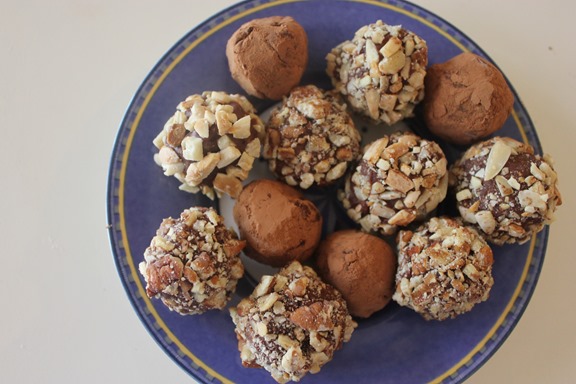
These luscious truffles are only 73 Calories apiece and get only 16% of their calories from carbs…this makes them a great Paleo snack. Use raw chocolate and get way more anti-oxidants!
Raw chocolate can promote cardiovascular function & health- The antioxidant power of flavonoids and essential minerals and vitamins found in cacao can support healthy heart functioning by lowering blood pressure, improving blood flow, lowering LDL cholesterol, and reducing plaque buildup on artery walls.
Raw chocolate Can Neutralize free radicals- High levels of antioxidants protect the body from a buildup of free radicals from sun exposure, pollution, cigarette smoking, etc., which may damage healthy body tissue giving rise to cancer and cardiovascular disease.
Truffles
2 cups (12 ounces) bittersweet chocolate, roughly chopped- preferably raw
1/2 cup coconut cream
1 tablespoons honey
2 Tablespoons Kahlua
1/2 teaspoons vanilla extract
Pinch salt
1 1/2 tablespoons unsalted butter, cut into 8 pieces and softened
For coating;
About 1 cup (3 ounces) raw cocoa powder
1 Teaspoon Stevia
About 1 cup of crushed nuts, if you’re using them
Lightly coat 8-inch baking dish with butter. Make parchment sling by folding 2 long sheets of parchment (or non-stick foil) so that they are as wide as baking pan. Lay sheets of parchment in pan perpendicular to each other, with extra hanging over edges of pan. Push parchment into corners and up sides of pan, smoothing flush to pan.
Microwave chocolate in medium bowl at 50 percent power, stirring occasionally, until mostly melted and few small chocolate pieces remain, 2 to 3 minutes; set aside. Microwave coconut cream in measuring cup until warm to touch, about 30 seconds. Stir honey, vanilla, and salt into coconut cream and pour mixture over chocolate. Cover bowl with plastic wrap, set aside for 3 minutes, and then stir with wooden spoon to combine. Stir in butter, one piece at a time, until fully incorporated.
Using rubber spatula, transfer ganache to prepared pan and set aside at room temperature for 2 hours. Cover pan and transfer to refrigerator; chill for at least 2 hours. (Can be stored, refrigerated, for up to 2 days.)
For coating; Sift cocoa and sugar through fine-mesh strainer into large bowl. Sift again into large cake pan and set aside. If using nuts, crush them up.
Gripping overhanging parchment, lift ganache from pan. Cut ganache into sixty-four 1-inch squares (8 rows by 8 rows). (If ganache cracks during slicing, let sit at room temperature for 5 to 10 minutes and then proceed.) Dust hands lightly with cocoa mixture to prevent ganache from sticking and roll each square into ball. Transfer balls to cake pan with cocoa mixture and roll to evenly coat. Lightly shake truffles in hand over pan to remove excess coating. Transfer coated truffles to airtight container and repeat until all ganache squares are rolled and coated. Cover container and refrigerate for at least 2 hours or up to 1 week. Let truffles sit at room temperature for 5 to 10 minutes before serving.
Why Fish Is Better Than Supplements: Omega-3s from Fish Vs. Fish Oil
Posted: March 19, 2013 Filed under: Food and it's Impact on Our Health | Tags: Paleo Leave a comment
Mar. 5, 2013 — Omega-3 fatty acids found in oily fish may have diverse health-promoting effects, potentially protecting the immune, nervous, and cardiovascular systems. But how the health effects of one such fatty acid — docosahexaenoic acid (DHA) — works remains unclear, in part because its molecular signaling pathways are only now being understood.
Toshinori Hoshi, PhD, professor of Physiology, at the Perelman School of Medicine, University of Pennsylvania, and colleagues showed, in two papers out this week in the Proceedings of the National Academy of Sciences, how fish oils help lower blood pressure via vasodilation at ion channels. In vascular smooth muscle cells, such as those that line blood vessels, ion channels that span the outer membrane of a cell to let such ions as sodium, calcium, and potassium in and out, are critical to maintaining proper vessel pressure.
The researchers found that DHA rapidly and reversibly activates these channels by increasing currents by up to 20 fold. DHA lowers blood pressure in anesthetized wild type mice but not in mice genetically engineered without a specific ion channel subunit.
In comparison, the team found that a dietary supplement, DHA ethyl ester, found in most fish oil pills fails to activate the same channels, and even antagonizes the positive effect of DHA from natural sources, on the cells. The DHA ethyl ester seems to compete with the natural form of DHA for binding sites on the ion channel.

The team concluded that these channels have receptors for long-chain omega-3 fatty acids, and that DHA — unlike its ethyl ester cousin — activate the channels and lower blood pressure.
The findings have practical implications for the use of omega-3 fatty acids as nutraceuticals for the general public and also for critically ill patients who may receive omega-3-enriched formulas as part of their nutrition.
Michael Bauer from Jena University Hospital in Germany, who studies sepsis in a clinical setting, says the findings may encourage physicians to have a closer look at the specific formulations given to sepsis patients as they may contain either the free omega-3 acid or the ester.
The findings also underscore the importance of obtaining omega-3 fatty acids from natural food sources such as oily fish.
Remember also that the less we heat these oils the healthier they are for us. So eat Sushi!!
Gene Discovery Reveals Importance of Eating Your Greens
Posted: March 19, 2013 Filed under: Food and it's Impact on Our Health Leave a comment
From Science Daily
Mar. 3, 2013 — Eating your greens may be even more important that previously thought, with the discovery that an immune cell population essential for intestinal health could be controlled by leafy greens in your diet.
The immune cells, named innate lymphoid cells (ILCs), are found in the lining of the digestive system and protect the body from ‘bad’ bacteria in the intestine. They are also believed to play an important role in controlling food allergies, inflammatory diseases and obesity, and may even prevent the development of bowel cancers.
Dr Gabrielle Belz, Ms Lucie Rankin, Dr Joanna Groom and colleagues from the Walter and Eliza Hall Institute’s Molecular Immunology division have discovered the gene T-bet is essential for producing a population of these critical immune cells and that the gene responds to signals in the food we eat.
Dr Belz said the research team revealed T-bet was essential for generating a subset of ILCs which is a newly discovered cell type that protects the body against infections entering through the digestive system. “In this study, we discovered that T-bet is the key gene that instructs precursor cells to develop into ILCs, which it does in response to signals in the food we eat and to bacteria in the gut,” Dr Belz said. “ILCs are essential for immune surveillance of the digestive system and this is the first time that we have identified a gene responsible for the production of ILCs.”
The research was published today in the journal Nature Immunology.
Dr Belz said that the proteins in green leafy (cruciferous) vegetables are known to interact with a cell surface receptor that switches on T-bet, and might play a role in producing these critical immune cells. “Proteins in these leafy greens could be part of the same signaling pathway that is used by T-bet to produce ILCs,” Dr Belz said. “We are very interested in looking at how the products of these vegetables are able to talk to T-bet to make ILCs, which will give us more insight into how the food we eat influences our immune system and gut bacteria.”
ILCs are essential for maintaining the delicate balance between tolerance, immunity and inflammation. Ms Rankin said the discovery had given the research team further insight into external factors responsible for ILC activation. “Until recently, it has been difficult to isolate or produce ILCs,” Ms Rankin said. “So we are very excited about the prospect for future research on these cells which are still poorly understood.”
ILCs produce a hormone called interleukin-22 (IL-22), which can protect the body from invading bacteria, Dr Belz said. “Our research shows that, without the gene T-bet, the body is more susceptible to bacterial infections that enter through the digestive system. This suggests that boosting ILCs in the gut may aid in the treatment of these bacterial infections,” she said.
ILCs help to maintain a ‘healthy’ environment in the intestine by promoting good bacteria and healing small wounds and abrasions that are common in the tissues of the gut. They may also have a role in resolving cancerous lesions. “The discovery of these immune cells has thrown open a completely new way of looking at gut biology,” Dr Belz said. “We are just starting to understand how important these immune cells are in regulating allergy and inflammation, and the implications for bowel cancer and other gastrointestinal disorders such as Crohn’s disease,” she said.
“Understanding the biology of ILCs and the genes that are essential for generating them will help us to develop methods of targeting these cells,” Dr Belz said. “This might include boosting ILCs in situations where they may not be active enough, such as infections or some cancers, or depleting them in situations where they are overactive, such as chronic inflammatory disease,” she said.
Coffee, Green Tea, May Help Lower Stroke Risk, Research Shows
Posted: March 19, 2013 Filed under: Food and it's Impact on Our Health Leave a comment
From Science Daily
Mar. 14, 2013 — Green tea and coffee may help lower your risk of having a stroke, especially when both are a regular part of your diet, according to research published in Stroke: Journal of the American Heart Association.
“This is the first large-scale study to examine the combined effects of both green tea and coffee on stroke risks,” said Yoshihiro Kokubo, M.D., Ph.D., F.A.H.A., F.A.C.C., F.E.S.C., lead author of the study at Japan’s National Cerebral and Cardiovascular Center. “You may make a small but positive lifestyle change to help lower the risk of stroke by adding daily green tea to your diet.”
Researchers asked 83,269 Japanese adults about their green tea and coffee drinking habits, following them for an average 13 years. They found that the more green tea or coffee people drink, the lower their stroke risks.
- People who drank at least one cup of coffee daily had about a 20 percent lower risk of stroke compared to those who rarely drank it.
- People who drank two to three cups of green tea daily had a 14 percent lower risk of stroke and those who had at least four cups had a 20 percent lower risk, compared to those who rarely drank it.
- People who drank at least one cup of coffee or two cups of green tea daily had a 32 percent lower risk of intracerebral hemorrhage, compared to those who rarely drank either beverage. (Intracerebral hemorrhage happens when a blood vessel bursts and bleeds inside the brain. About 13 percent of strokes are hemorrhagic.)
Participants in the study were 45 to 74 years old, almost evenly divided in gender, and were free from cancer and cardiovascular disease.
During the 13-years of follow-up, researchers reviewed participants’ hospital medical records and death certificates, collecting data about heart disease, strokes and causes of death. They adjusted their findings to account for age, sex and lifestyle factors like smoking, alcohol, weight, diet and exercise.
Green tea drinkers in the study were more likely to exercise compared to non-drinkers.
Previous limited research has shown green tea’s link to lower death risks from heart disease, but has only touched on its association with lower stroke risks. Other studies have shown inconsistent connections between coffee and stroke risks.
Initial study results showed that drinking more than two cups of coffee daily was linked to increasing coronary heart disease rates in age- and sex-adjusted analysis. But researchers didn’t find the association after factoring in the effects of cigarette smoking — underscoring smoking’s negative health impact on heart and stroke health.
A typical cup of coffee or tea in Japan was approximately six ounces. “However, our self-reported data may be reasonably accurate, because nationwide annual health screenings produced similar results, and our validation study showed relatively high validity.” Kokubo said. “The regular action of drinking tea, coffee, largely benefits cardiovascular health because it partly keeps blood clots from forming.”
Tea and coffee are the most popular drinks in the world after water, suggesting that these results may apply in America and other countries.
It’s unclear how green tea affects stroke risks. A compound group known as catechins may provide some protection. Catechins have an antioxidant anti-inflammatory effect, increasing plasma antioxidant capacity and anti-thrombogenic effects.
Some chemicals in coffee include chlorogenic acid, thus cutting stroke risks by lowering the chances of developing type 2 diabetes.
Further research could clarify how the interaction between coffee and green tea might help further lower stroke risks, Kokubo said.
Great Info To Have While Shopping!
Posted: March 17, 2013 Filed under: Food and it's Impact on Our Health, Non-Toxic Choices | Tags: #organic, Paleo 2 CommentsFrom Wholesome Style

Slice Onions a Specific Way to Affect Their Flavor and Intensity
Posted: March 16, 2013 Filed under: Recipes Leave a comment
Another Great Post from Lifehacker
Sometimes you want full-on onion flavor and odor, sometimes you want to tone that intensity down (like when you’re adding onions to a salad). Cook’s Illustrated, via Cool Tools, says with scientific authority the way you cut an onion can control that intensity.
Cool Tools excerpts this part of Cook’s Illustrated’s Science of Good Cooking book:
The way you cut an onion affects its flavor. To prove the point, we took eight onions and cut each two different ways: pole to pole (with the grain) and parallel to the equator (against the grain). We then smelled and tasted pieces from each onion cut each way. The onions sliced pole to pole were clearly less pungent in taste and odor than those cut along the equator.
So cut with the grain if you don’t want the onion to overwhelm your dish. If you need chopped onions, an alternative is to either soak onions in water before cutting or de-flame them with boiling water.
The Science of Good Cooking | Cool Tools
Note; This is true for celery also. Cut on a deep diagonal and it tastes milder. Cut it straight across and it has a peppery taste.
Balancing Carbs with Fats and Proteins
Posted: March 13, 2013 Filed under: Food and it's Impact on Our Health, Recipes | Tags: Paleo 3 Comments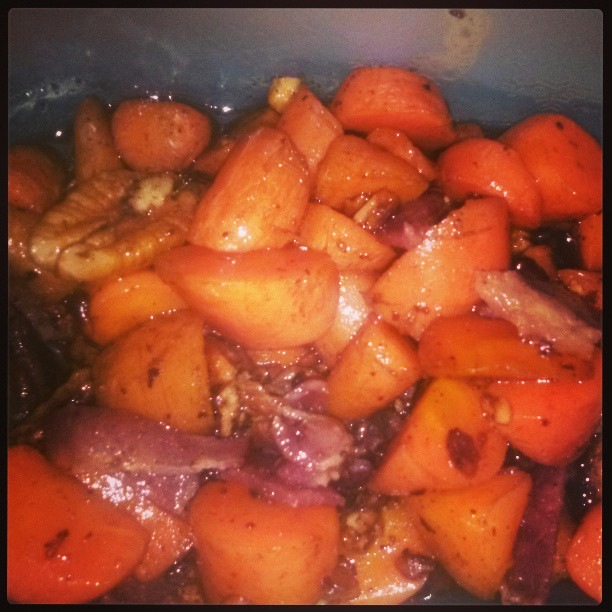
Eating a healthy diet that allows you to lose or maintain weight requires balancing carbohydrates, fats and proteins. You need 50% of your daily caloric intake of 2000% a day to come from fat, 30% from protein and 20% from carbs.
You should never eat carb alone. When eaten on their won your blood sugar rises rapidly, then plunges…leaving you tired and hungry. And craving more carbs. And it causes weight gain. Eat those carbs with plenty of healthy fats and protein…and you ingest and burn them nice and slow.
Though the following recipe is a carrot dish, and carrots being very high in carbs (97% of it’s calories are from carbs), when combin3ed with butter, pecans and bacon, it reduces the carb load to a acceptable percentage.
Glazed Carrots With Bacon And Pecans
4 slices of thick cut bacon
1/2 cut pecans- coarsely chopped
1 pound carrots- roll cut
2 tablespoons honey
1/2 cup chicken stock
1 teaspoon thyme
2 Tablespoons butter
2 teaspoons lemon juice
salt and pepper to taste
1. Cook the bacon in a 12-inch iron skillet over medium-high heat until crisp. Transfer the cooked bacon to a paper towel-lined plate to drain. Add the pecans and cook until fragrant and slightly browned, about 3 minutes. Transfer the pecans to the plate with the bacon.
2. Add the carrots, salt, honey, the chicken broth, and thyme to the skillet. Bring to a boil, covered, over medium-high heat. Reduce the heat to medium and simmer, stirring occasionally, until the carrots are almost tender when poked with the tip of a paring knife, about 7 minutes. Uncover, increase the heat to high, and simmer rapidly, stirring occasionally, until the liquid is reduced to about 2 tablespoons, 1 to 2 minutes.
3. Add the butter to the skillet. Toss the carrots to coat and cook, stirring frequently, until the carrots are completely tender, about 3 minutes. Off heat, add the lemon juice and toss to coat. Transfer the carrots to a serving dish, scraping the glaze from the pan into the dish. Season to taste with pepper, sprinkle the bacon and pecans on top and serve immediately.
Chicken Fried Steak with Gravy- Gluten and Dairy Free!
Posted: March 11, 2013 Filed under: Recipes Leave a commentWhat a fun day! I went to our local Riverside Arts Market today to buy grass fed meat and shank bones today. I got some grass fed cube steaks today. I grew up eating it and something I had forgotten about until a few years ago. Many people consider it an inferior cut of beef, but I can tell you when it is cooked right it is a heavenly flavored dish! I feel the same about flank steak. Both cuts of meat are amazing when cooked right, wonderful flavor!
If you still have reservations about chicken-fried steak, consider these words from the late Fort Worth Star-Telegram columnist Jerry Flemmons: “As splendid and noble as barbecue and Tex-Mex are, both pale before that Great God Beef dish, chicken-fried steak. No single food better defines the Texas character; it has, in fact, become a kind of nutritive metaphor for the romanticized, prairie-hardened personality of Texans.” High praise, indeed!
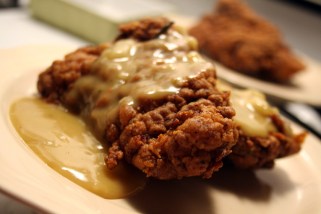
Chicken-Fried Steak
1 1/2 pounds top-round steak or cube steak
2 cups sweet rice flour flour
3 large eggs
1/2 cup coconut milk
2 teaspoon coarse salt
1 teaspoon freshly ground black pepper
1/4 teaspoon cayenne
1 cups sweet rice flour
1 large Vidalia onion, cut in half moons
Place flour in a large bowl and season with salt and pepper. Mix eggs in another large bowl with coconut milk. Dip the cube steak to coat in flour. Dip coated beef into egg mixture and then dip back into flour again.
Heat the pan until medium hot or a little higher. Then add the butter and add steaks when the butter is hot and bubbly.
Heat on medium enough butter to fill halfway up the sides of a of each steak, using a cast-iron skillet. Take the coated beef and place it in the skillet. When the blood starts bubbling out of the top of the steak (about 3 to 4 minutes) gently turn it over with a long fork as using a spatula can cause the oil to splash out of the skillet. Cook another 5 minutes and then take the chicken-fried steak out of the pan and place on a plate in the oven to stay warm.
Sauté the onions in the pan with the butter until soft and golden brown.
Add two or three Tablespoons of sweet rice flour and stir quickly, keep stirring until flour is cooked and browned a bit. You may need to add some more butter. Deglaze the pan with reduced beef stock (Demi Glace) and scrape the bottom of the pan. Stir until thickened. Pour over steaks and serve.


 Meal Delivery Service by Millie Barnes