Worst Snacks Ever!
Posted: January 22, 2009 Filed under: Food and it's Impact on Our Health Leave a commentWhen you find yourself hungry on the run, don’t get trapped by these snacks
By: Abby Lerner
Anyone can stock a kitchen with healthy food- but what happens when your diet arsenal is out of reach? We’ll tell you: When you’re on the run and in need of some fuel, you’re more likely to pick up seemingly nutritious prepared foods that often abound with added sugars, preservatives, and dangerous, belt-breaking fats. Or you’ll just forfeit all hopes for being healthy and order the grease-soaked fries. But you don’t have to cross over to the dark side of the drive-thru—the next time hunger calls, veto these 15 dietary phonies and opt for the smarter picks we’ve suggested instead. They’ll quash your hunger without making you fat.
The 20 Worst Foods in America 2009
Posted: January 22, 2009 Filed under: Food and it's Impact on Our Health Leave a commentAnother Great Article from Men’s Health
Can an appetizer with the caloric equivalent of 13 Krispy Kreme doughnuts be justified? No. The 2,710-calorie Awesome Blossom has been purged from Chili’s menu—maybe the fat-drenched appetizer couldn’t withstand the scrutiny of being named one of the worst foods in America last year. No matter the reason, we applaud this waist-expanding starter’s retirement.
The deep-fried onion wasn’t the only thing to withdraw from this year’s race—seven other items from 2008’s lineup have been removed from menus. That’s a step in the right direction, and it’s good news for your waistline.
But three gut-bombs remain: Uno Chicago Grill’s individual 2,310-calorie Classic Deep Dish is still the worst pizza that could pass your lips. Romano’s Macaroni Grill’s 2,430-calorie spaghetti and meatballs is a truly lethal plate of pasta. And Bob Evans’ 1,543-calorie banana pecan pancakes won’t just break your fast—they’ll destroy it. What’s more, we found 17 more deplorable dishes worthy of spots on our “worst” list. For now, be sure to avoid them—but here’s to hoping these are 20 foods we won’t see on restaurant menus next year.
- 20. Worst Breakfast Sandwich of 2009
- 19. Worst Supermarket Meal of 2009
- 18. Worst “Healthy” Sandwich of 2009
- 17. Worst Kids’ Meal of 2009
- 16. Worst Fast-Food Chicken Meal of 2009
- 15. Worst Salad of 2009
- 14. Worst Breakfast of 2009
- 13. Worst Fish Entrée of 2009
- 12. Worst Dessert of 2009
- 11. Worst Surf and Turf of 2009
- 10. Worst Chinese Entrée of 2009
- 9. Worst Mexican Entrée of 2009
- 8. Worst Burger of 2009
- 7. Worst Sandwich of 2009
- 6. Worst Chicken Entrée of 2009
- 5. Worst Ribs of 2009
- 4. Worst Pizza of 2009
- 3. Worst Starter of 2009
- 2. Worst Pasta of 2009
- 1. The Worst Food in America of 2009
Shredded-Beef Salad with Chipotle Dressing
Posted: January 22, 2009 Filed under: Food and it's Impact on Our Health, In The Kitchen with Millie- How To's 1 Comment
Serves 6 to 8
1 5-lb.grass-fed top-cut beef brisket, trimmed
2 large yellow onions, peeled and sliced
4 cups beef stock
4 fresh poblano chiles (or 6 fresh anaheims)
1 7-oz. can chipotle chiles en adobo
2/3 cup organic coconut oil, melted
1/2 cup fresh lime juice
1/3 cup white wine vinegar
Salt
2 cloves garlic, peeled and minced
1/2 lb. rice mozzarella, cubed
1 medium red onion, peeled and diced
3/4 cup finely chopped fresh cilantro
1 head romaine lettuce, separated into leaves
3 medium tomatoes, cut into wedges
2 avocados, peeled and cut into wedges
5 radishes, thinly sliced
1. Place brisket in a large pot and scatter with yellow onions. Add stock and enough cold water to cover by 3”. Bring to a boil over medium-high heat, then reduce heat to low, cover, and simmer until fork-tender, about 4 hours, turning midway through cooking time.
2. Remove pot from heat and let stand uncovered until brisket is cool enough to handle, about 25 minutes. Transfer brisket to cutting surface and shred with two forks or your fingers. Set aside.
3. Char poblanos over an open flame or under a broiler, turning to blacken all over. Place in a paper bag, close, and steam 15 minutes. Rub off skin and remove stems. Slice open, scrape out veins and seeds, and cut into strips.
4. Drain chipotles, reserving adobo sauce. Seed and chop chipotles, then whisk with oil, lime juice, vinegar, salt, and garlic in a large mixing bowl. If sauce is not spicy enough, add reserved adobo sauce. Stir in beef, poblanos, cheese, red onions, and cilantro.
5. To serve, arrange salpicón on a bed of romaine leaves, and garnish with tomatoes, avocados, and radishes.
KAHLÚA CRÈME BRULÉE
Posted: January 22, 2009 Filed under: In The Kitchen with Millie- How To's Leave a comment
You can also use coconut milk in this!
7 large egg yolks
1/4 cup granulated sugar
4 cups almond milk
1 tablespoon freeze-dried instant coffee granules
1/2 cup Kahlua liqueur
1 tablespoon vanilla extract
2/3 cup packed light brown sugar
Position an oven rack in center of oven and preheat oven to 325 degrees F. In a medium bowl, whisk together egg yolks and sugar.
In a medium-size saucepan, stir together the heavy cream and coffee. Set over medium heat and bring to a boil, stirring to dissolve the coffee granules. Slowly whisk the hot cream into the yolks. Whisk in the Kahlúa and vanilla extract. Ladle the mixture into 8 round shallow broiler-proof serving dishes about 3 inches wide and about 1 inch deep. Set dishes in a shallow baking pan. Add boiling water to the pan to come halfway up the sides of the dishes. Bake until the tops are set, about 30 minutes. The custards will remain jiggly until they are completely chilled. Remove from the water bath and cool to room temperature. Cover and chill overnight.
Preheat broiler. With your fingers, press the brown sugar through a strainer onto the custards in an even, fluffy layer. Wipe any excess sugar from the edges of the dishes. Broil 5 to 6 inches from the heat source until the sugar liquefies and begins to caramelize, rotating dishes to brown evenly and watching carefully to avoid burning. Refrigerate the finished Crème Brûlée for at least for hour before serving.
ALMOND SHORTBREAD COOKIES
Posted: January 22, 2009 Filed under: In The Kitchen with Millie- How To's Leave a comment
Try these tender butter cookies with some spring or summer fruit for a refreshing finale to any meal.
Makes 16
12 tablespoons (1 1/2 stick) chilled organic unsalted butter, cut into 16 pieces
1/2 cup (packed) golden brown sugar
1 1/2 teaspoon vanilla extract
Pinch of salt
1 1/2 cup tapioca flour
2 tablespoon arrowroot
1/2 cup sliced almonds (about 1 ounce)
Preheat oven to 375°F. Place 9-inch-diameter metal pie pan in freezer to chill. Combine butter, brown sugar, vanilla and salt in processor. Blend until smooth, about 20 seconds. Add flour and arrowroot. Using on/off turns, process until dough clumps together. Press dough evenly onto bottom of chilled pie pan. Sprinkle almonds over; press almonds lightly into dough to adhere. Freeze until chilled, about 5 minutes.
Bake shortbread until edges are golden brown, about 22 minutes. Transfer pan to rack. Cut warm shortbread into 8 wedges; cool completely in pan. (Can be prepared 1 day ahead. Cover; store at room temperature.)
Splendor in the Grass
Posted: January 22, 2009 Filed under: Food and it's Impact on Our Health 1 CommentThis is from Nourish Magazine
By Sally Fallon and Mary Enig, PhD
And I will send grass in thy fields for thy cattle, that thou mayest
eat and be satisfied. — Deut 11:15
Before the industrialization of agriculture, cattle grazed on pasture during all but the harshest weather. In winter, they ate hay (which is dried grass) or silage (which is fermented grass) or root vegetables; chickens and other fowl roamed freely in the barnyard; and pigs enjoyed the open air, either in pens or verges or woodlands.
The basis of this system was grass, consumed by ruminant animals who turned it into milk. Pigs were fattened on milk by-products, such as whey and skimmed milk. Chickens and fowl feasted on bugs that hid under cow paddies and in composted manure from healthy grass-fed animals. Grain from mature grass was an adjunct in animal diets, given to chickens to induce more frequent laying and to cattle to fatten them just before butchering.
Today’s system is based on grains (including legumes like soybeans) given to animals in confinement. In the US, almost 90 percent of dairy cattle live their entire lives in sheds with cement floors, never once feeding on green grass under an open sky. Most beef cattle spend more time in feed lots eating grain than on pasture eating green grass. Chickens have been removed from the farm to be crowded together in enormous enclosed pens. Pigs are housed in CAFO’s (Confined Animal Feeding Operations), breeding grounds for stench and disease.
Splendid Health
During the time when the cultivation of our animal foods has been transferred from farms to factories, the incidence of chronic disease has risen precipitously. Cancer and heart disease were rare 100 years ago and today allergies and autoimmune problems make life miserable for millions of people. Can the trend towards confinement feeding be cited as a cause for the upsurge in these diseases?
Almost seventy years ago, Dr. Weston Price published an interesting paper in the Journal of the American Dental Association..1 (See page 19) For years, Dr. Price had been analyzing the amount of vitamin A and Activator X in butterfat. (Activator X, which Price discovered, is similar in structure to vitamin A and a powerful catalyst to mineral absorption. It is now believed to be the fat-soluble vitamin K2; read Chris Masterjohn’s article to see how this 60-year mystery was finally solved.) He noted that these nutrients were most plentiful in the spring and fall, when cows had access to rapidly growing green grass. During the winter and the dry summer months, levels of these vitamins in butterfat declined or disappeared completely.
Dr. Price also tabulated the number of deaths from heart attacks and pneumonia in local hospitals. When he plotted these two variables against time on the same graph he found that deaths from heart disease were inversely proportional to the vitamin content in the butter. In other words, when levels of vitamins in butterfat were high, deaths from heart disease were low; and when nutrient levels were low in the winter and summer, deaths from heart disease were high. He found this pattern in many different localities, even in areas in the far north where there was only one vitamin peak, in midsummer, due to the short growing season.
Heart disease researchers have largely ignored the possible role of vitamin A and D in protecting the heart, probably because these fat-soluble vitamins are found only in the foods they have demonized—animal fats. Yet both nutrients play numerous important roles in the body chemistry, principally as catalysts for the assimilation of protein and minerals needed for a healthy cardiovascular system.
Two of the latest theories about the origins of heart disease are chronic inflammation in the arteries and thyroid insufficiency. The fat-soluble vitamins (vitamin A, vitamin D and vitamin K2/activator X), which occur in the fat of grass-fed animals, support endocrine function and protect against inflammation. Stress has also been cited as a cause of heart disease. Vitamin A is needed for the conversion of cholesterol into steroid hormones and, in fact, is rapidly depleted by stress. Vitamin D helps prevent high blood pressure and protects against spasms that can lead to a heart attack. As vitamin D is needed for calcium absorption, it contributes to a healthy nervous system and helps prevent arrythmias.
During the 1930s and 1940s, Price traveled throughout the world studying isolated groups of human beings. Those that consumed the products of land animals—meat and milk—put great emphasis on the quality of pasture. The Swiss recognized that the butter from their cows contained the most life-giving properties when the cows were feeding on the brilliant green pasture of early Spring. In Africa, the Masai and related tribes set fire to the savannas so that their cattle could eat newly emerging green grass. These peoples enjoyed splendid health, not just freedom from infectious and chronic disease, but also splendid bone structure and strength. They were free from tooth decay and had wide dental palates and straight teeth.
The fat-soluble vitamins in butterfat from grass-fed ruminant animals aid mineral absorption and support endocrine function, allowing optimum physical development and lifelong good health.
Chickens and pigs cannot thrive exclusively on grass, but when integrated into a system that has its basis in grass-feeding of livestock, their eggs and fat will provide fat-soluble vitamins in abundance. Pigs have skin like humans, which produces vitamin D when exposed to natural light. Pasture-raised pigs will store plentiful amounts of vitamin D in the fat under their skin, compared to lard from confinement pigs.
Pasture-raised animals have better mineral status. The diets of animals in confinement are fortified with synthetic vitamins, which are more poorly absorbed..2
Conjugated linoleic acid (CLA) is another nutrient found in the fat of ruminant animals that feed on green grass. CLA has been found to be highly protective against cancer when added to the diets of laboratory animals..3 In addition, CLA promotes the deposition of muscle rather than fat. In a double-blind study with human volunteers, those given CLA had a significant 15 to 20 percent decline in body fat compared to those given a placebo..4 In another study, men enrolled in a bodybuilding program were given either CLA or a placebo. After 28 days, the placebo group could lift nine more pounds; but the CLA group could bench-press 30 pounds more than they had at the beginning of the program..5
It’s no accident that the New Zealand All Blacks, the national rugby team composed of players who grew up on pasture-fed New Zealand butter, is so hard to beat, even though most of the teams they play come from countries with a much larger population base.
The discovery of CLA in the fat of grass-fed animals—in butterfat, tallow and suet—and the emerging revelations as to its benefits, has posed an embarrassing dilemma for apologists of the factory farming system. Scientists are looking for feed supplements that induce confinement cows to produce CLA and for ways to produce CLA in the laboratory so it can be sold in supplement form. The solution, of course, is to phase out confinement feeding and put cows back on green pasture where they belong. As a nation that has always depended on dairy products, this is the only way to regain the robust good health we enjoyed just a generation or two ago.
Splendid Animals
Cows on pasture typically live through eight to ten lactations (or births) for a total of ten to 12 years. Cows in confinement, fed grain and soybeans, average 1.8 lactations. When they become unable to produce milk, or when their ankles can no longer hold up on the cement floors, they are shipped off to the butcher. About 25 percent of the meat consumed in America comes from these “downer” cows. The problem of downer cows in confinement dairies is increasing, even though antibiotics, drugs and nutrient supplements are routinely added to animal feed. We hear that in some confinement dairies, the typical cow is milked through one long lactation and then slaughtered. This eats into profits and has the vets throwing up heir hands in defeat.
Soil specialist Jerry Brunetti..6 explains why the way cows are fed today causes them to suffer from a range of health problems. Dairy cows are fed grains and soybeans, which have high caloric and nitrogen values. Sometimes rations even include bakery waste, such as out-of-date donuts, candy and pastries. These foodstuffs upset the delicately balanced ecosystem in the cow’s rumen. As rumen microbes digest the foods eaten by the cow, they produce waste products which inhibit the growth of other microbes. One of these metabolic wastes, acetic acid (vinegar), is used as an energy source by cattle. But the waste from microbial digestion of starches—like corn and bakery waste—is lactic acid, which has no value to ruminant. It also lowers the pH in the rumen, causing acidosis. The colostrum (first milk) of such acidic cows has very few antibodies because they are immunosuppressed.
Another serious consequence of grain feeding is that cows on grain absorb lower amounts of fat-soluble vitamins A, D and E, even when these vitamins are added to feed; and, consequently, less of these vital nutrients show up in the milk..7
Of all the cull cows taken to slaughter today, only about 5 percent have livers that can be salvaged. Damage to the liver is attributed to high levels of protein in soy-based feed. Brunetti also faults the practice of spraying manure back onto fields, resulting in very high levels of free nitrogen in the hay grown on these pastures. He cites a large “progressive” dairy in a high rainfall area of western Washington state that could not get its cows to breed or produce much milk. They thought their hay was high in protein because analysis showed high nitrogen values. But much of the nitrogen was free nitrogen which had an adverse effect on both fertility and milk production. When the farm ran out of its own hay and fed apparently lesser quality hay grown in eastern Washington state, milk production improved.
When cows eat high quality forage in green pastures, the pH of the rumen returns to normal and the cows enjoy good health and produce superior quality milk.
Confinement chickens and hogs suffer from the same problems. Antibiotics and other drugs are fed to keep the animals alive until the moment of slaughter and steroids are used to get them to that point as soon as possible. (Athletes consuming meat from hormone treated chickens have actually failed their urine tests for drugs!..8 So delicate are the immune systems of confinement pigs that workers must shower and don sterile garments and masks before entering the facility.
Confinement operations could not make a profit if their animals were subject to strict health standards. Cows with mastitis are milked anyway. Poultry inspectors used to condemn all birds with air sacculitus, a disease that causes yellow fluids and mucus to break up into the lungs. Today, many of these birds are approved. “I’ve had birds that had yellow pus visibly coming out of their insides,” reported one USDA inspector, “and I was told to save the breast meat off them and even save the second joint of the wing.”..9
The government’s answer to the problems of confinement feeding is to speed up the process for drug approval. In fact, drug manufacturers are now allowed to supervise the testing procedure for their own animal drugs in order to get them to market as soon as possible. Their solution to the growing problem of salmonella and other pathogens in meat products is formaldehyde rinses and irradiation; pasteurization is no longer sufficient to destroy many of the pathogens in milk, so ultra-pasteurization is recommended.
The only long-term solution to these problems is pasture-feeding. Farmers who have gone from confinement to pasture feeding have been amazed at the improved health and increased fertility of their herds. Vet bills and drug bills decline, especially over the long run as the animals accustom themselves to traditional forage.
And production need not suffer. Joel Salatin..10 and other farmers have developed pasture feeding systems for chickens and other fowl that result in high egg yields and good growth. Hog farmers who have reverted to the old ways have seen fertility go up and diseases go down. Solar-powered moveable electric fences, pioneered in New Zealand, allow farmers to move their animals every day to new pasture, thereby preventing overgrazing and ensuring continuous fresh forage.
The highest milk and butterfat yields have come not from cows in confinement but from cows on pasture. In 1952, Carnation Milk Farms’s herd of 135 cows produced at least 1000 pounds of butterfat each per year. Its champion milker produced 42,000 pounds of milk and 1,500 pounds of butterfat. These yields came from cows eating green grasses, with supplements of silage, root vegetables, hay, minerals and molasses. Less than 2 percent of the diet came from a diverse mixture of grains.
Splendid Profits
In 1997, Roman Stoltzfoos, owner of Spring wood Farm in Kinzers, Pennsylvania spent almost $87,000 per year on feed, mostly grain, for his dairy cattle, amounting to 38 percent of gross operating expenses of over $225,000. When he told his neighbors that he was going back to grass feeding in order to eliminate grain purchases, they said it couldn’t be done. In two years he brought his feed costs down to about $36,000 and now they don’t believe him. He also lowered his vet bills by 50 percent and made almost $8,000 on sales of composted manure. In spite of reducing calorie-rich grain feeding, his herd actually produced slightly more milk. Operating costs went from $12.95 per hundred weight to $11.76. By the year 2001, Roman reckons his feed costs will be down to $10,000, mostly for mineral supplements, while composting will net him $12,000. If production continues to climb, his net operating costs can be reduced to under $6 per hundred weight.
Alan Yegerlehner of Clay City, Indiana switched to a grazing dairy operation a few years ago and has seen his profits rise. When he had a confinement dairy, he spent $30,000 yearly for grain; now he spends just a couple of thousand, mostly for kelp and mineral supplements. Vet bills have also declined and fertility has gone up. He even has hopes of paying off all the debts he incurred while running a confinement dairy. And, he says, he is having a lot more fun.
Joel Salatin raises pastured beef cattle, poultry and pigs on 100 acres of mediocre soil quality in Swoope Virginia. He nets about $750 per acre. His biggest expense is still grain, which he buys from local farmers. He notes that cows can be raised on 100 percent grass, but hogs, turkeys and chickens need supplements, especially chickens, which require grain to grow quickly and lay abundantly. Nevertheless, the system Joel has developed completely eliminates the need for antibiotics or hormones.
Increased profitability is not just the stuff of anecdotes. A study of dairy farmers in Vermont revealed that cows on well-managed pasture earned $579 net income per cow over two years, compared to $451 per cow in the most profitable confinement dairies..11
Long range benefits to farmers who graze their animals include reduced exposure to toxic chemicals, reduced medical bills for their families, elimination of orthodontist bills for their children and higher energy levels for all who work on the farm. The increase in productivity that occurs when farmers put their livestock on grass applies not only to the animals on the farm, but to the people who work there as well.
Splendid Landscapes
The success of pasture-feeding operations depends on the quality of pasture, as many farmers have discovered. Cows have difficulty going onto pasture land that has formerly been intensively cultivated with monocrops such as corn or soy. It takes a few years for fields to rebuild plant diversity and healthy root structure.
According to Brunetti, high quality forage (hay or pasture) requires soil with adequate amounts of calcium in balance with other elements. Humus, which is stable organic matter in the soil, mobilizes the needed calcium and makes other minerals more available. Humus is produced largely by earthworms and is encouraged by perennial polycultures. Joel Salatin likes to say that every square yard of pasture should contain at least 40 varieties of plants.
In his classic work, Soil, Grass and Cancer, André Voisin delineates how soil mineral balance affects both the animals who graze and the people who consume the milk and meat from those animals. Soil with a high clay content may be rich in minerals, but the plants cannot assimilate them until they are incorporated into humus by earthworms and microscopic soil organisms.
Properly organized, with rotation of grazing areas as well as rotation of types of animals grazed, grass-feeding can actually improve pasture quality, encouraging diverse species and stimulating biological activity below the soil.
Cows will self-medicate if they have a sufficient variety of plants in their pastures. A number of “weeds” and hedgerow trees and shrubs are extremely rich in nutrients as well as medicinal characteristics. When fields are divided with rows of shrubs and trees, the need for pesticides is reduced.
Thus, wise grazing practices ultimately result in the division of large fields into paddocks, each sown with a variety of seeds at different times of the year, and separated by rows of trees or shrubs. The result is splendid landscapes, pleasing to the eye and the soul, the kind of landscapes that inspired the Impressionist painters in France and the idyllic descriptions of visitors to the hedgerow country in England.
The focal point of beauty in the American farm landscape has been the barn, red-sided or topped with cupolas. In the corn and soy wasteland that fills much of the American plains, beautiful old barns are falling down with neglect. Instead, grain goes to huge cement silos to be fed to animals housed in row upon row of ugly sheds. But grazing operations have barns, and income to keep their barns in good repair.
Splendid Communities
Grain feeding of confinement animals has spawned a system of agribusiness that has gradually consolidated into a handful of mega-corporations. In 1999, for example, Cargill, the largest privately held company in the world, announced a buy-out of its major competitor, Continental Grain Company. Dupont paid $7.7 billion for the largest seed company in the world, Pioneer Hi-Bred International. Food processors like Unilever are buying up small companies, like Ben and Jerry’s, at ever increasing rates.
The current situation has been compared to an hour glass, with lots of farmers producing food on the top, very few processors in the middle and many consumers at the bottom. The bottleneck in the middle gives agribusiness almost unlimited control over what food is produced, what farmers receive for it and what it is sold for. Banking interests argue that consolidation makes agriculture more efficient, but once the competitive market has been eliminated, the rule of efficiency no longer applies. The new coinage is not efficiency but power—and it is a power that has turned once thriving communities throughout America into ghost towns and has fostered urban sprawl. This same power has subverted university research and food safety oversight, resulting the degradation of our food supply and a health crisis of major proportions. Individuals and families are not only cut off from the land that nourishes them; they also must spend an inordinate amount of their time and budget dealing with disease and disability.
Grass feeding is the first step toward the rebuilding of small towns, the restoration of health and the return of that sense of community America has lost. For grazing operations to prosper and flourish, consumers must be willing to buy from the source as much as possible. Modern technology that gives us freezers and refrigerators—and trucks and airplanes—makes it possible to buy meat, butter and cheese directly from farmers, even if these farmers are thousands of miles away; vegetables, eggs, milk and cream should come directly from a local farm, through a co-op or share system.
Splendor From the Grass
Though nothing can bring back the hour
Of splendour in the grass, of glory in the flower;
So wrote the poet Wordsworth and so argue the apologists for agribusiness. Pasture-feeding is an inefficient and antiquated system, they say. Monoculture and confinement feeding is the only way to provide food for earth’s millions.
The next decade will prove such arguments false. So precarious is the confinement system that we risk an epidemic of untreatable animal disease and true famine if we do not return to a saner, safer system of animal husbandry. So weary are Americans of bad health and poor quality food that they are becoming willing to support local farms with their food dollars.
Wordsworth can be written to reflect more optimism:
Man and Nature will bring back the hour
Of splendor from the grass and glory of the bower,
That new our farms will cultivate;
We will not grieve but rather find
New wealth, new health, new paradigms;
The time is ripe and not too late
For splendid herds and splendid yields
And splendid children born of splendid fields.
Omega-3 Fatty Acids
The American diet tends to be deficient in omega-3 fatty acids, a type of fat that is vitally important for the health of the brain and nervous system and for numerous biochemical processes, including those that protect us against heart disease and cancer. One of the claims made for grass-fed beef is that the fat from grass-fed animals is much richer in omega-3 fatty acids than the fat from animals that have spent many weeks in the feed lot. This notion has even led to programs entailing special feeding for beef cattle to raise the levels of omega-3 fatty acids in their fat.
But this is one claim that should NOT be made for pasture-fed beef. Chickens raised on pasture or given special feed will have more omega-3 fatty acids in their skin and egg yolks than chickens fed exclusively grain, but ruminant animals like cattle are designed to produce saturated fats. No matter what they are fed, cattle will store about 7 percent of the various types of omega-3 fatty acids in their cell membranes and less than 1 percent of omega-3 fatty acids in their adipose tissue, that is, in the fat in and around their muscles.
When cattle get fat—as they do very quickly in feed lots—they put on a lot of adipose fat so that the overall percentage of omega-3 fatty acids compared to the other types of fat goes down. But the absolute amount of omega-3 fatty acids continues to climb. And the saturated fats that accumulate in the fatty tissues actually help the body assimilate the omega-3 fatty acids more efficiently.
Hunter-gatherers hunted older ruminant animals because they wanted the fat that was built up and stored under their skin. They never ate lean meat and for very good reason. The fats that come with meat help the body utilize both protein and minerals. When circumstances forced indigenous populations to eat only lean meat, they quickly developed diarrhea, followed by weakness, lethergy and death.
If there is a danger in the move towards grass feeding, it is the danger of eating meat too lean. Grass-fed beef cattle can be fattened by leaving cattle longer in the field, or by supplementing their diets with grain in the final weeks before slaughter. After all, much of the goodness from grass feeding is carried in the fat—from CLA to fat-soluble vitamins to a variety of important minerals.
Facts About Factory Farming
The areas of most intensive factory farming are New York and California (dairy farms); the Chesapeake Bay area (poultry farms) and North Carolina and Iowa (hog farms).
In the cattle industry, 2 percent of feed operations account for over 40 percent of all cattle sold.
Many confinement operations are owned by multinational corporations. For example, Texas Farms, an operation of 2 million hogs, is owned by Nippon, a Japanese corporation.
Three jobs are lost for every one created by a new factory farm. Small farms produce more revenue for local and state governments than large confinement operations and put much less strain on local sewer and water services.
Over 70 percent of pork producers use a carcinogenic drug called sulfamethazine as a growth stimulant and to control rampant diseases; another toxic hormone called PST is used to reduce the high fat content of pork.
Properly composted animal manure can be a valuable source of crop nutrients; but when manure is improperly applied to the land, imbalances occur; manure runoff carries nitrogen, phosphorus and other harmful substances into surface and groundwater.
The 1,600 confinement dairies in the Central Valley of California produce more waste than a city of 21 million people.
On large factory hog farms, excrement from as many as 12,000 animals confined in metal buildings longer than football fields is stored in open pits with capacities sometimes exceeding 25 million gallons.
Spill from waste pits and underground seepage have caused serious environmental problems; odor and swarming flies often create noxious conditions for residents within a 2-mile radius.
Wastes from huge factory farms threaten water supplies with parasites, bacteria and viruses including streptococcus, giardia, salmonella, listeria and chlamydia.
Chicken wastes spilled into rivers and bays cause “algae bloom” which adversely affects fish populations; in 1997, outbreaks of the toxic microbe Pfiesteria piscicida killed approximately 450,000 fish in North Carolina and approximately 30,000 fish in the Chesapeake Bay; in the Gulf of Mexico, farm runoff including animal waste is linked to the formation of a “dead zone” of up to 7,000 square miles of water that cannot support most aquatic life.
About the Author…
Sally Fallon is the author of Nourishing Traditions: The Cookbook that Challenges Politically Correct Nutrition and the Diet Dictocrats (with Mary G. Enig, PhD), a well-researched, thought-provoking guide to traditional foods with a startling message: Animal fats and cholesterol are not villains but vital factors in the diet, necessary for normal growth, proper function of the brain and nervous system, protection from disease and optimum energy levels. She joined forces with Enig again to write Eat Fat, Lose Fat, and has authored numerous articles on the subject of diet and health. The President of the Weston A. Price Foundation and founder of A Campaign for Real Milk, Sally is also a journalist, chef, nutrition researcher, homemaker, and community activist. Her four healthy children were raised on whole foods including butter, cream, eggs and meat. Mary G. Enig, PhD is an expert of international renown in the field of lipid biochemistry. She has headed a number of studies on the content and effects of trans fatty acids in America and Israel, and has successfully challenged government assertions that dietary animal fat causes cancer and heart disease. Recent scientific and media attention on the possible adverse health effects of trans fatty acids has brought increased attention to her work. She is a licensed nutritionist, certified by the Certification Board for Nutrition Specialists, a qualified expert witness, nutrition consultant to individuals, industry and state and federal governments, contributing editor to a number of scientific publications, Fellow of the American College of Nutrition and President of the Maryland Nutritionists Association. She is the author of over 60 technical papers and presentations, as well as a popular lecturer. Dr. Enig is currently working on the exploratory development of an adjunct therapy for AIDS using complete medium chain saturated fatty acids from whole foods. She is Vice-President of the Weston A Price Foundation and Scientific Editor of Wise Traditions as well as the author of Know Your Fats: The Complete Primer for Understanding the Nutrition of Fats, Oils, and Cholesterol, Bethesda Press, May 2000. She is the mother of three healthy children brought up on whole foods including butter, cream, eggs and meat.
The 11 Best Foods You Aren’t Eating
Posted: January 21, 2009 Filed under: Food and it's Impact on Our Health Leave a commentHere is another great article from Men’s Health;
 Maybe you should be eating more beets, left, or chopped cabbage. (Credit: Evan Sung for The New York Times, left)
(This post was originally published on June 30, 2008, and recently appeared on The New York Times’s list of most-viewed stories for 2008.)
Nutritionist and author Jonny Bowden has created several lists of healthful foods people should be eating but aren’t. But some of his favorites, like purslane, guava and goji berries, aren’t always available at regular grocery stores. I asked Dr. Bowden, author of “The 150 Healthiest Foods on Earth,” to update his list with some favorite foods that are easy to find but don’t always find their way into our shopping carts. Here’s his advice.
- Beets: Think of beets as red spinach, Dr. Bowden said, because they are a rich source of folate as well as natural red pigments that may be cancer fighters.
How to eat: Fresh, raw and grated to make a salad. Heating decreases the antioxidant power. - Cabbage: Loaded with nutrients like sulforaphane, a chemical said to boost cancer-fighting enzymes.
How to eat: Asian-style slaw or as a crunchy topping on burgers and sandwiches. - Swiss chard: A leafy green vegetable packed with carotenoids that protect aging eyes.
How to eat it: Chop and saute in olive oil. - Cinnamon: May help control blood sugar and cholesterol.
How to eat it: Sprinkle on coffee or oatmeal. - Pomegranate juice: Appears to lower blood pressure and loaded with antioxidants.
How to eat: Just drink it. - Dried plums: Okay, so they are really prunes, but they are packed with antioxidants.
How to eat: Wrapped in prosciutto and baked. - Pumpkin seeds: The most nutritious part of the pumpkin and packed with magnesium; high levels of the mineral are associated with lower risk for early death.
How to eat: Roasted as a snack, or sprinkled on salad. - Sardines: Dr. Bowden calls them “health food in a can.” They are high in omega-3’s, contain virtually no mercury and are loaded with calcium. They also contain iron, magnesium, phosphorus, potassium, zinc, copper and manganese as well as a full complement of B vitamins.
How to eat: Choose sardines packed in olive or sardine oil. Eat plain, mixed with salad, on toast, or mashed with dijon mustard and onions as a spread. - Turmeric: The “superstar of spices,” it may have anti-inflammatory and anti-cancer properties.
How to eat: Mix with scrambled eggs or in any vegetable dish. - Frozen blueberries: Even though freezing can degrade some of the nutrients in fruits and vegetables, frozen blueberries are available year-round and don’t spoil; associated with better memory in animal studies.
How to eat: Blended with yogurt or chocolate soy milk and sprinkled with crushed almonds. - Canned pumpkin: A low-calorie vegetable that is high in fiber and immune-stimulating vitamin A; fills you up on very few calories.
How to eat: Mix with a little butter, cinnamon and nutmeg.
You can find more details and recipes on the Men’s Health Web site, which published the original version of the list last year.
In my own house, I all of these items except sardines. I have beets, swiss chard, flowering kale growing — pumpkin seeds,
How about you? Have any of these foods found their way into your shopping cart?
How to Save Tomato Seeds
Posted: January 14, 2009 Filed under: Gardening Leave a comment
It’s nice to be able to save your own tomato seeds!
You may have brought home a particularly delicious tomato from the supermarket, or gotten an heirloom tomato from a Farmer’s Market, or grown one in your own garden that is so wonderful you want to save the seeds from it and grow them next year. Nothing ever tastes quite as good as a home-grown tomato!
So, how do you save the seeds? The method is easy to do….it’s a little gloppy, and it’s a little funky, but you’ll be able to save seeds in a manner that will lesson the occurence of tomato disease while giving you plenty of seeds to germinate, and with left-overs to share or trade. This seed saving process is a process of fermentation.
Select to save seeds from a tomato that has a flavor that you love….if you’re a home gardener and saving seeds from tomatoes that are growing in your garden
Technorati Tags: square Foot Gardeningchoose tomatoes from the very healthiest looking plants.
Take your chosen tomato and slice it in half across the middle (it’s “equator”). With a spoon or your well-washed fingers scoop out the seeds and their gelatinous “goo” into a clean cup or container. Add a couple of tablespoons of water to the seeds. Cover the container with a piece of plastic-wrap and then poke the plastic-wrap with a paring knife or pen point to put a small hole in it…this is to allow for air-transpiration. (A little fresh air needs to get in and out of the cup to help foster fermentation.)
Place the container of seeds in a warm location; a sunny windowsill or the top of the refrigerator are both excellent sites to place the container of seeds. Now Mother Nature will take over and begin to ferment the seed and water mixture. This takes about two or three days. Each night remove the plastic-wrap, stir the seed and water mixture, and then replace the plastic-wrap, if you use a new sheet of plastic-wrap then don’t forget to put a small hole in it for air-transpiration. The top of the liquid will look “scummy” when the fermentation process has separated the “goo” from the seeds. It also helps destroy many of the possible tomato diseases that can be harbored by seeds.
Take the container of fermented seeds to the sink and with a spoon carefully remove the scummy surface. Then pour the container’s contents into a fine kitchen sieve and rinse the seeds with water several times…stir them while they’re in the sieve to assure that all surfaces are thoroughly rinsed. Give a few sharp taps to the sieve to help remove as much loose water as possible from the seeds.
Line an open plate with a piece of waxed paper or a large automatic-drip coffee filter. Place the rinsed seeds onto the wax paper or coffee filter and spread them about so they are in a single layer. Place the plate in a safe location where the seeds can dry for a few days. Stir the seeds a few times during the drying process to assure that all their surfaces are evenly dry. Spread them out again into a single layer after each time you’ve stirred them. Tomato seeds are thick and can take up to a week to dry thoroughly. If you’re having a rainy week that drying time may lengthen by a few days.
How do I know when the seeds are dry? Dried seeds move quickly and easily across a plate, they do not stick to each other.
How do I store them?
I like paper packets or some folks like plastic. Whichever envelope style you choose is a matter of personal preferance. If you choose to store your seeds in plastic the seeds must be BONE DRY….otherwise any moisture in the seeds will be transferred to all seeds inside the plastic packet, it will foster mildew and rotting and the seeds will be ruined.
If you’re going to plant the seed right away, you don’t need to do all that stuff.
Just put them in a strainer, wash the jelly off, and plant.I squeeze the tomato seeds on paper towels, let them dry and label them. When I want to plant, I tear off some seeds and shred the paper onto the soil (too lazy to grow starters in little pots) and water it in. They sprout just like that.
OR…I just squeeze the seeds right out onto the dirt and water them in. Works like a charm.
Garden Pics
Posted: January 6, 2009 Filed under: Gardening Leave a commentHere are pics of my garden, new grow boxes and solar shower (in progress) and my rain barrel.
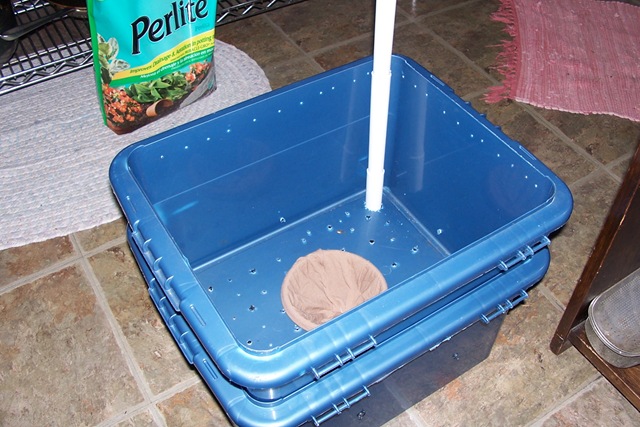 My Newest Growbox. 2 tomato plants will go in here.
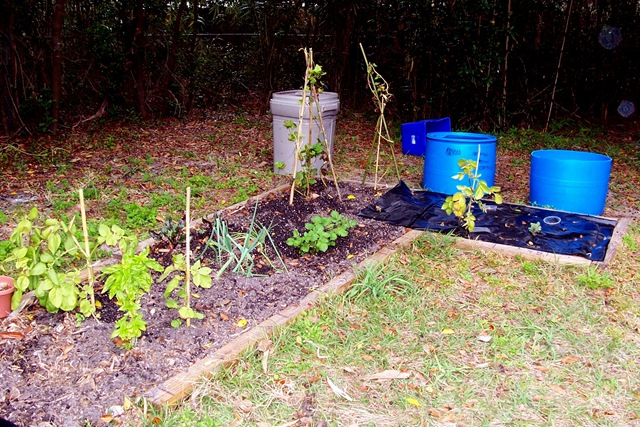 The blue half barrels are sweet potatoes and red potatoes. Instead of letting the vines cover the ground, or trellis, I add soil as they grow. This gives a large yield and keeps the plants energy in the root growing.
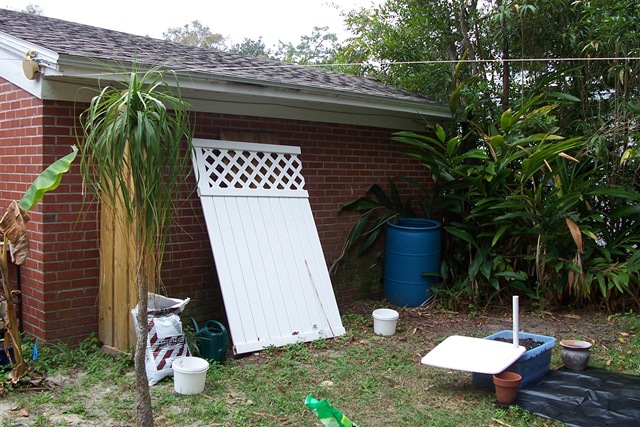 Newest grow box has lettuce planted. Fencing is for solar shower in progress and the blue rain barrel is where I water my garden from, by hand. I am in the middle of converting my row garden into a Square Foot Garden.
Grow Boxes. A self watering container is a container that has a water reservoir built in. This reservoir waters the plants sometimes for several days. These containers can also contain a fertilizer band to feed the plants for the season. This makes the process of growing almost any flower or vegetable very easy to do and is very productive. Another advantage is it can be placed somewhere where there is no garden such as a deck or patio.
I thought Earth Boxes were too expensive for what you get. So I make mine. Here is the instructable- Do It Yourself Grow Box
QUICK (EXCEPT FOR OVEN TIME) POT ROAST
Posted: January 4, 2009 Filed under: Food and it's Impact on Our Health Leave a commentServes at least 6
1 medium or 2 small bay leaves
1/2 teaspoon dried leaf thyme
1/2 teaspoon black peppercorns
3/4 teaspoon salt
1 t. minced garlic (I buy a small jar and keep in fridge, you can use fresh)
1 boneless beef pot roast (about 3 pounds; see “Beef 101: Buying a Pot Roast,” below, for preferred cuts), patted dry with paper towels and tied with twine
2 1/2 tablespoons coconut oil
1 medium onion, chopped fine (1 cup)
1/2 small carrot, diced fine (1/4 cup)
1/2 small celery stalk, diced fine (1/4 cup)
2–5 tablespoons water, black coffee, or dry red or white wine
2 tablespoons tapioca flour
1. Mix salt, pepper and other herbs with garlic. Rub mixture over meat. Preheat oven to 325 degrees.
2. Heat oil in a heavy pot (about 4 to 6 quarts, preferably cast iron) over medium-high heat. Put roast in pot; brown thoroughly on all sides, maintaining heat so fat sizzles briskly but does not smoke, 15 to 20 minutes. Make sure to brown meat well, then remove to a plate. Sauté vegetables until brown and crispy around edges but not blackened, 10 to 15 minutes.
3. Remove veggies from pot. scrape with a wooden spoon to loosen browned bits. Add small amount of water. Reduce heat to lowest point; return roast to pot. Cover roast ½ way with water, add veggies. Cover pot and place in oven. Using spoons rather than forks to minimize juice loss, turn steak-shaped roasts every 20 minutes, loaf-shaped roasts every 30 minutes. Roast is done when internal temperature is 120 for rare, 128 for medium and 140 for well done. I know, I know….the USDA says cook to 140, but that is for people who like well done, the meat will be too dry and overdone. Buy grass-fed beef, it safer to eat with no fear of mad cow disease.
4. Remove meat; wrap in aluminum foil. Tilt pot and skim off fat, set aside. Pour juices and vegetables into a blender jar or workbowl of a food processor fitted with steel blade; process to a coarse puree. Pour into a 2-cup measure; add enough stock or broth to make 2 cups. Return juices to pot; bring to a simmer. Mix 1 1/2 tablespoons reserved cooking fat with flour. Whisk flour mixture into simmering juices, 1 teaspoon at a time, adding only as much as is necessary for the gravy to coat a spoon. Simmer to fully cook flour, about 2 minutes; adjust seasonings.
5. Unwrap meat, pouring accumulated juices into gravy. Cut meat into very thin slices — 1/8-inch, if possible — and arrange on a platter. Pour some of gravy over meat; sprinkle with parsley. Serve immediately with gravy passed separately.


 Meal Delivery Service by Millie Barnes