Monsanto Shill Trying to Make Backyard Gardens Illegal
Posted: April 21, 2009 Filed under: Food and it's Impact on Our Health, Gardening 3 CommentsWednesday, 11 March 2009 10:57 by John Young


Monsanto
Representative Rosa DeLauro, whose husband Stanley Greenburg works for Monsanto, has introduced H.R. 875, a very bad piece of legislation that promises to put every backyard gardener in jeopardy of property seizure.
A human being’s most fundamental needs in this world are food, clothing, shelter and self-defense. As long as you have the ability to provide for these yourself, you are free. But when you must depend upon government (or the government’s designated global corporation) for these — nay, when it is even illegal for you to provide these for yourself — you are a slave.
Representative Rosa DeLauro, whose husband Stanley Greenburg works for Monsanto, has introduced H.R. 875, a very bad piece of legislation that promises to put every backyard gardener in jeopardy of property seizure.
Monsanto is a monster corporation that sinks its controlling tentacles deep into the minds of every presidential administration and every Congress. Just last year, I described the corruption Monsanto engendered in a fair amount of depth. And how very convenient to have their very own pet member of Congress!
Naturally, like all monstrous attacks on our freedom, this attack is made in the name of “safety.” If you understand the intention of the legislation, and carefully read sections 3, 103, 206 and 207 in their entirety, you’ll see that the danger I am reporting is quite real. This is essentially a bill to restructure agriculture in this country along lines suitable for Monsanto’s profitability, at the cost of the impoverishment of both our material well-being and our health.
Let me be clear.
A human being’s most fundamental needs in this world are food, clothing, shelter and self-defense. As long as you have the ability to provide for these yourself, you are free. But when you must depend upon government (or the government’s designated global corporation) for these — nay, when it is even illegal for you to provide these for yourself — you are a slave. Any attempt to outlaw our ability to grow our own foods in our own gardens using our own methods or to save our own seeds or cooperate in seed banks — any attempt along these lines should be seen as nothing less than an attempt to drop the chains of slavery across our shoulders.
This legislation is currently in committee, and I strongly encourage you to contact the members of that committee at this link and let them know in no uncertain terms that this legislation is unacceptable and should never make it to the floor.
Seeds and home gardens are as important as your right of self-defense, because without them you eat whatever a global corporation tells you to eat. Your diet determines your health, mental acuity, longevity, level of energy and much more.
Just because you may not grow a garden currently doesn’t mean you shouldn’t, or that you wouldn’t be better off growing one in the future. Just like your neighbor owning a gun can protect you, your neighbor owning seeds can protect you.
So take this seriously and contact the members of the committee considering this legislation. Let’s get this bad special-interest legislation shut down in a hurry!
The ostensible purpose of this legislation is to enhance the safety of food in the wake of numerous deaths due to e. coli and salmonella contamination. Almost all of this contamination was caused on large factory farms, and practically none occurred in smaller, family-run, organic or Certified Naturally Grown farms.
In one case, the contamination was due to the violation of existing standards regarding the use of fresh manure on crops that come into contact with the ground. In another case, it was due to a peanut processor knowingly allowing contaminated machinery to be used rather than lose a few dollars by shutting down the line for a thorough cleaning. In yet other cases, the products came from Mexico where sanitation — as we understand it — hardly exists.
All of these practices are a violation of not only existing laws and standards, but violations of common sense and basic moral decency. A new federal law that takes away your right to raise your own food will not inspire people who will already endanger your life in pursuit of profit to be any more diligent.
In fact, the very companies whose influence spawned this legislation have already had legislation passed that denies you the right to even know when you are eating genetically modified Franken-foods that have been proven to be dangerous to laboratory animals. They don’t care one iota about your safety, and the idea that they will suddenly grow a conscience in the face of legislation they wrote to put their competition out of business is laughable.
If Representative DeLauro really cared about the safety of our food, she would make the following proposals:
1. No importation of food from any country whose standards of sanitation are less than our own. (This would include China, where raw human waste is dumped onto fields or Mexico where basic facilities to flush human waste and wash hands afterwards are unavailable to the workers.)
2. No importation of agricultural workers or workers in food processing plants from countries whose sanitation standards are less than our own.
3. If a company executive knowingly allows the violation of a safety standard such that he could reasonably expect that harm could result, he should be charged with manslaughter for each death he caused and the sentences should be served serially rather than concurrently.
4. An enforcement of the same standards that apply to organic certification upon all commercial agriculture over $100M/annum in size as it pertains to the use of animal wastes.
5. Mandate that genetically modified foods be disclosed, and that they be subjected to the same safety trials applicable for newly developed drugs before being cleared for human consumption.
None of these proposals require a whole new government department, and none threatens our freedom.
We shouldn’t have to give up our freedom to garden just because a bunch of greedy global corporatists won’t shut down a contaminated assembly line or insist on employing filthy laborers under abominable conditions where basic human sanitation isn’t even possible.
So contact the committee members, and let them know you won’t stand for this!
House Committee on Agriculture
1301 Longworth House Office Building
Washington, DC 20515
Phone: 202-225-2171
Fax: 202-225-8510
Eat Like It’s 1975 to Save the Planet: New Report Links Obesity, Energy Consumption & Climate Change
Posted: April 21, 2009 Filed under: Food and it's Impact on Our Health 2 Commentsby Matthew McDermott, New York, NY on 04.20.09

image: Joe 13 via flickr
You’ve undoubtedly seen umpteen reports detailing the myriad health problems associated with obesity, and probably have read how our industrial food system sure supplies calories, but not so many that are actually healthy. Now a new report goes one step further, linking increased energy consumption and people being overweight:
The report, done by the London School of Hygiene and Tropical Medicine, looks at energy usage in the UK and obesity. It suggests that people in the UK are consuming 19% more food than 40 years ago.
In the 1970s the UK saw “normal” rates of obesity—about 3.5% of the adult population being significantly overweight—but by 2010 it’s predicted that about 40% of the population will be obese. That’s similar to what is already seen in the United States.
1 Gigatonne of Additional Greenhouse Gases Released by Highly Obese Population
All that means that because of the increased use of fuel needed to carry all that extra weight around—both bodily and because of the additional food consumption—an additional 1.0 Gigatonnes of greenhouse gas emissions per billion people are released into the atmosphere.
Staying Slim Good For Health & The Planet
Report authors Dr Phil Edwards and Prof Ian Roberts say that,
When it comes to food consumption, moving about in a heavy body is like driving around in a gas guzzler. The heavier our bodies become the harder and more unpleasant it is to move about in them and the more dependent we become on our cars. Staying slim is good for health and for the environment. We need to be doing a lot more to reverse the global trend towards fatness, and recognize it as a key factor in the battle to reduce emissions and slow climate change.
via: BBC News
My first strawberry!!!
Posted: April 20, 2009 Filed under: Gardening, Going Green; How and Why... Leave a commentI told ya’ll that I was learning how to grow hydroponically.. Two weeks ago I put a new strawberry plant in the Hydro bucket and 4 days later I had a flower, which slowly turned into a strawberry! Today I got home from work and found this!
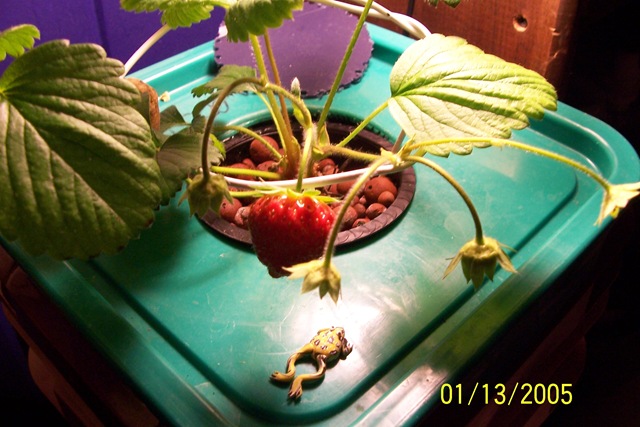
I’m going to dip this one in dark chocolate….mmmmm…can’t wait!
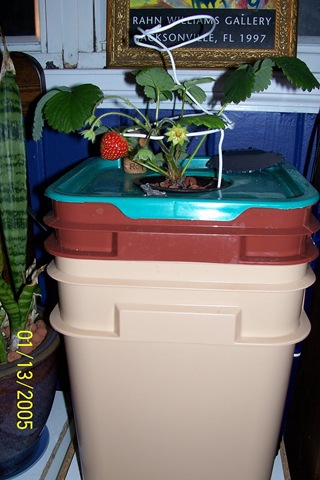
I have been amazed at easy growing hydro is; faster than soil or outside, all organic and NO BUGS!!! What more could you ask for? This plant is growing under two 25 Watt CFL bulbs.
It is growing in a Hydrofarm, which is a drip method of hydro. I do not like the drip method, it contributes to root rot, the roots do not row as abundantly or as fast as if fed from below. So I took and turned the Hydrofarm into a bubbler (airstones in the water with organic nutrients), then took the dripper ring, turned in upside down, used a kitty litter lid to cover it, then set a timer so it sprays the roots 15 minutes out of every hour. I set up another one just like it as a plant hospital, if my plants are not looking so good, a day or so in the Hydrofarm and they perk right up!
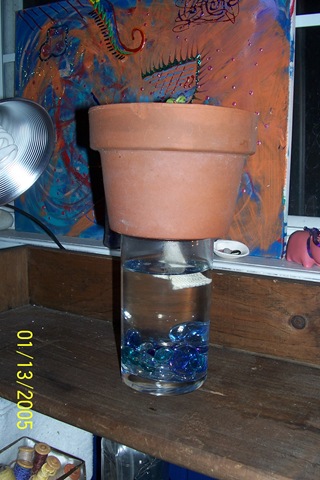
Here is the nasturtiums just sprouting. It is in a self-watering system. The wick runs up into the perlite that the plant is in and stays constant moist, yet allows air to get to the roots…they love it!
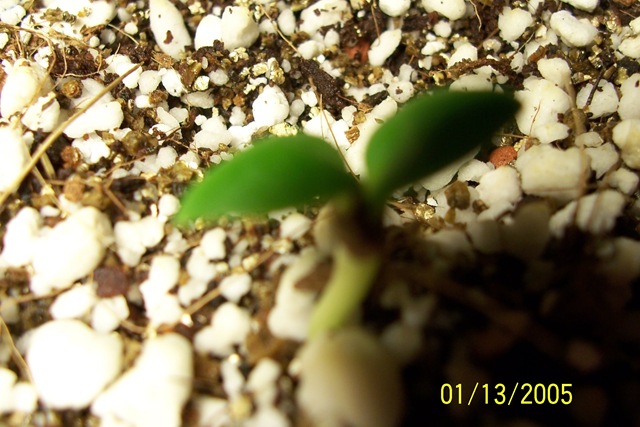
The nasturtium sprout;
Great article on Mother Earth News
Posted: April 16, 2009 Filed under: Food and it's Impact on Our Health, Going Green; How and Why... 1 CommentI came across this article in the archives of MotherEarthNews (another favorite web site!).. It says perfectly what motivates me to conserve, make do, recycle…and long to homestead….
You — yes, you! — can learn the skills you need to be more self-sufficient. Here’s how one modern homesteader discovered the joys of a self-reliant life.
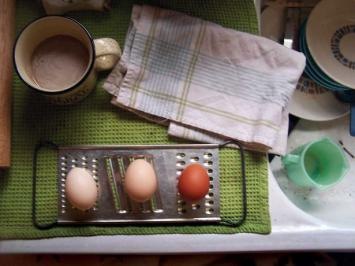
A good place to start thinking about self-reliant living is in your own kitchen. Where does the food you eat come from, and could you produce more of it right in your own backyard?
When you start to comprehend something as basic as how food gets to your plate, you start thinking about how other items find their way to you, too — things such as clothing, electronics and especially energy. The bloodshed and national security threats caused by depending on foreign oil were loud and clear on the daily news. The scary thing was that I was completely dependent on fossil fuels, and so was everyone I knew. My gas-heated apartment, my groceries from the supermarket, my station wagon parked outside — everything was part of the system. And if the system broke, I was going to be hungry, cold and immobile. So I threw my hands in the air. I was done with Wal-Mart and Wonder bread. I wanted something real. I wanted a lifestyle that was no longer a part of the problem, or at the very least was constantly striving to be less involved in it. I wanted a more sustainable life.
Read the whole article here
No impact man blog published an article of mine yesterday!
Posted: April 16, 2009 Filed under: Going Green; How and Why... Leave a comment
I am soooo excited! One of my all time favorite bloggers, Colin Beavan, published an article from my blog! His blog, NoImpactMan.com, is a blog that I follow religiously. I have always been a a serious environmentalist, way before it was cool the first time around..and I am talking back in 1972 when I decided to use cloth diapers instead of that new product (Pampers) everyone else was sooo excited about. I still chose to use a clothesline with the first 4 kids diapers (until I moved to a neighborhood (yuck!) that forbid clotheslines.
Colin’s’ blog made me realize there was a LOT more I could be doing. Hence, the list he published….
April 14, 2009
Thirty-one tips for reducing your impact while saving money
I was reading through comments here on the blog last night and I found this great list of tips by reader Millie Barnes, who writes a blog about health and gardening called Optimum Nutrition. Her tips were just too comprehensive to let them languish in the comments. So here they are (I don’t even mind including the plug for her products). Thanks Millie!
My Level of Living Green
by Millie Barnes
1) Air dry all laundry–had to put a lock on the dryer cord to convince my daughters I was serious–they have learned to plan ahead! I wash all laundry in cold water, always wash full loads, and use a drying rack inside if it is raining. It’s good for the earth and great for your skin, a free humidifier in the house. Which also makes it feel a few degrees warmer in winter, and cooler in summer. I use soapnuts for laundry. http://www.zamuta.com/
2) Buy all organic.
3) Buy all organic non-toxic beauty care products and make-up. I make my own skin care cleanser and moisturizers. I make my own soap. My beauty products can be purchased at http://ezchef.net/spacuisine/
4) Use baking soda and vinegar for cleaning the bathroom. I use Ms. Meyer Clean Day for dishes, Citri-Clean for counters and general purpose cleaning. I use a loofah for scrubbing dishes (I am growing my own right now so I won’t have to buy them anymore!) My sister is making scrubbies by crocheting them, we will offer these for sale soon!
5) Take cloth bags to store for groceries and all other purchases. Take muslin bags I made to grocery store for produce.
6) Recycle, re-use, make my own and have stopped buying anything I don’t really need.
7) Don’t use paper towels, never have. Used cloth diapers for all 5 kids.
8) Don’t buy stuff in plastic, I try to buy all glass. Store all food in glass. Re-use glass jars. I mostly buy real food (meat, produce) try to not buy anything that needs a label, so no packaging.
9) Have been using recycled toilet paper for years but am considering switching to cloth at home. (don’t freak, we all used that same choice when we used cloth diapers and wash clothes on our baby’s tushes!)
10) Make my own gluten free granola, make my own mayonnaise, salad dressings, spice blends.
11) I use a compost toilet, no toilet paper (think cloth baby wash clothes).
13) Bokashi (a way to deal with indoor kitchen scraps with NO odor and yields compost WAY faster). I have been using the Bokashi method of dealing with kitchen waste for about 3 weeks now…I love it!
14) Use very low flow shower heads. Ace Hardware has a 1.5 GPM with a shut-off valve.
15) Use all CF light bulbs…and use them as little as possible. I have one evening a week that I use no lights..on Shabbat! Dinner by candlelight!
16) Use grey water from shower (I keep a 3 gallon bucket in shower and use it throughout the day to flush the toilet, take what’s left to the flower beds.
17) Use water from rinsing dishes to water flower beds.
18) Use a broom on all my wooden floors instead of using vacuum cleaner.
19) Run as few errands as possible, car pool and combine trips.
20) Use micro-cloths to clean with, even on glass you do not need cleaning products!
21) NEVER buy bottled water. I bought a Kleen Kanteen for each person in the family, we refill and take with us. I’ve had mine over a year.
22) Go paperless or CD-less as much as possible. I provide my clients with emails of my book, but still put cookbook software on CD.
23) Unplug all appliances not being used. Yes, that cell phone charger and TV are using power when you aren’t using them! I use power strips to keep them plugged in, turn them off at night, or when I’m gone all day.
24) Use only a hurricane lamp when we sit outside at night. It gives enough light to read by…but is perfect turned low …for just hanging out. Very romantic, too!
25) Use candlelight at dinner, not just on Shabbat!
26) I have an outdoor solar heated shower that I built.
27) I put in a raised bed garden, square foot garden I have green leaf lettuce in a grow box, cherry and big sweet tomatoes, basil, thyme. I have sweet potatoes growing, beets (mmmm, beet greens), onions, Swiss chard, purple flowering kale, nasturtiums, broccoli, cucumbers, peppers, red potatoes, a banana tree. Inside I am growing cucumbers and strawberries hydroponically.
28) I use a non-disposable razor, an old-fashioned stainless steel, very high quality razor that uses double edged blades. It was 24.00 from ClassicShaving.com. The blades are 10 for 5.99, and they are double edged! They give the closest, smoothest shave you can imagine! No disposable blade can compare.
29) Wash dishes with 2 dish pans in the sink, one for hot soapy water, one with warm rinse water. Do glasses first, pause a moment to let the soapy water drip off, then move to rinse water. Stop when rinse water is almost full and rinse quickly. Repeat with silver, plates, then pots and utensils. All with 2 dishpans full of water. Then I pour the soapy water, with all that organic matter, onto my plants in the garden. It helps repel pests and loosens the soil. And good for the biceps when you carry it outdoors.
30)
I water my garden with buckets from the rain barrels that are under the eaves of my garage. 10 feet from my garden. The front flower garden gets watered entirely from the dish water.
30) I work out at home, no expensive gym memberships that I never used anyway. I save all the expense of membership, and gas and time driving. I have a set of weights, two exercise balls, a yoga mat and a chin-up bar.
If you would like to go to his site and read the comments or follow his site (an get motivated!!)- No Impact Man- Millie Barnes’ article.
7 Foods Banned in Europe Still Available in the U.S.
Posted: April 7, 2009 Filed under: Food and it's Impact on Our Health, Going Green; How and Why... Leave a commentby Christine Lepisto, Berlin on 04. 2.09
=
Image credit: Getty Images
How many times do you hear people say: “Well, it must be safe because the government allows it?” But can you rely on that? Maybe a look as some of the foods and food practices which are permitted in the U.S. and banned in Europe could shed light on how governments judge safety in the food chain.
Genetically Modified Foods
Although the E.U. is continuously coming under attack for policies banning GM foods, the community is highly suspicious of genetically modified foods, and the agro-industrial pressures that drive their use. The problem with GM foods is that there is simply not sufficient research and understanding to inform good public policy. In spite of widespread GM use without apparent negative impacts in other countries, the recent public reaction to trans-fats are reason enough to support a precautionary principle for the food supply chain.
Pesticides in Your Food
The E.U. has acted against the worst pesticides typically found as residuals in the food chain. A ban on 22 pesticides was passed at the E.U. level, and is pending approval by the Member States. Critics claim the ban with raise prices and may harm malaria control, but advocates of the ban say action must be taken against the pesticides which are known to cause harm to health and nevertheless consistently found in studies of food consumption.

Image credit: Getty Images
Bovine Growth Hormone
This drug, known as rBGH for short, is not allowed in Europe. In contrast, U.S. citizens struggle even for laws that allow hormone-free labelling so that consumers have a choice. This should be an easy black-and-white decision for all regulators and any corporation that is really concerned about sustainability: give consumers the information. We deserve control over our food choice.

Image credit: Getty Images
Chlorinated Chickens
Amid cries that eating American chickens would degrade European citizens to the status of guinea pigs, the E.U. continued a ban on chickens washed in chlorine. The ban effectively prevents all import of chickens from the U.S. into Europe. If chicken chlorination is “totally absurd” and “outrageous” for Europeans, what does that mean for Americans?

Food Contact Chemicals
Phthalates and Bisphenols in plastic are really beneficial. They help manufacturers create plastic products with the softness and moldability needed to fulfill consumer needs. But when the food contact additives are found in the food and liquids contained by those plastics, trouble starts. Both the U.S. and Europe stringently regulate food contact use of chemicals. However, the standard of approval is different. In Europe, the precautionary principle requires that the suppliers of chemicals prove their additives safe, or they will be banned. Of course, although the E.U. has banned phthalates in toys, both phthalates and bisphenol-A remain approved for food contact uses — subject to strict regulations on their use.

Image via: Cargill
Stevia, the natural sweetener
The U.S. recently approved this “natural” sweetener as a food additive. Previously, it was sold in the U.S. under the less stringent dietary supplement laws. It has been embraced in Japan for over three decades, but E.U. bans still stand — pointing to potential disturbances in fertility and other negative health impacts. But the sweetener is credited with potentially positive health effects too. Is this a case where consumer choice should prevail?

Image credit: Getty Images
Planned Ban: Food Dyes
Many food dyes previously recognized as safe are suspected of contributing to attention deficit disorder. Action is afoot as the UK evaluates a ban on synthetic food colors. Regulation in the E.U. often starts through the leadership of one Member State, which pushes the concepts up to Brussels after a proof-of-concept pilot phase. Red 40, Yellow 5, Yellow 6, Blue 1, Blue 2, Green 3, Orange B, and Red 3 are among the food colors associated with hyperactivity.
Note from Millie- Of course reading labels is crucial to knowing what is in your food. Eat only organic grass fed beef, organic free range chickens, breast feed instead of bottle feed. Let your food manufacturers know how you feel. Go to your grocery store managers and let them know what you want!
Quote of the Day: Vivienne Westwood on Buying Nothing
Posted: April 7, 2009 Filed under: Food and it's Impact on Our Health Leave a commentby Jasmin Malik Chua, Jersey City, USA on 04. 4.09

Photo credit: Mattia Passeri
If you ask me what I think people should be getting next season. I’ll tell you what I’d like them to buy—nothing. I’d like people to stop buying and buying and buying…
There’s this idea that somehow you’ve got to keep changing things, and as often as possible. Maybe if people just decided not to buy anything for a while, they’d get a chance to think about what they wanted; what they really liked.
—Legendary fashion designer Vivienne Westwood in the Oct. 4, 2007 edition of The Telegraph
Article continues: Quote of the Day: Vivienne Westwood on Buying Nothing
Bottled water isn’t the answer
Posted: April 6, 2009 Filed under: Going Green; How and Why... 2 Comments
Another great post from No Impact Man
On Monday, the Associated Press released a report on the discovery of trace amounts of various types of pharmaceuticals in drinking water around the country.
I got invited to discuss the subject on WNYC’s Brian Lehrer Show (go here if you’d like to listen). The conversation quickly turned to bottled water as a possible solution, which it is not.
Here’s why bottled water doesn’t help, according to Food and Water Watch:
- 40% of the bottled water sold in the United States is tap water anyway.
- The Environmental Protection Agency (EPA) requires hundreds of tests each month on municipal water supplies, but the Food and Drug Administration (FDA), which regulates bottled water, requires only one test a week on bottled water.
- Only 40% of bottled water–that which is sold across state lines–is regulated by the FDA in the first place.
- Plastic bottles in the United States require some 1.5 million barrels of oil to manufacture each year–enough to power 100,000 cars.
- 86% of plastic bottles in the United States never get recycled.
- Tap water costs about a penny a gallon and bottled waters costs up to $10 a gallon.
- Chemicals that leach from plastic water bottles may affect our health.
- If people abandon the use of municipal drinking water, then there will be no political will to ensure that we invest the necessary resources in the water infrastructure.
- The United States has some of the best drinking water in the world and we must keep it that way.
The real answer, at least for me, is to:
- Continue drinking tap water. You can contact your local water utility to ask for a copy of your area’s Annual Water Quality Report (the EPA keeps many of them here).
- Choose a filter, if necessary, with the help of these Food and Water Watch guidelines.
- Most importantly, ask Congress to provide the funds to keep our water safe.
- Support Food and Water Watch’s campaign to create a national Clean Water Trust Fund (similar to the trust fund used to pay for our highways) by clicking here.
Read Food and Water Watch’s new report on bottled water here.
Read their argument for a Clean Water Trust Fund here.
Image courtesy of Food and Water Watch.
This is From No Impact Man
Posted: April 6, 2009 Filed under: Going Green; How and Why... Leave a comment42 ways to not make trash
In the last, for a while, of the LV GRN posts about how to bring No Impact measures to your own life, I’ve decided to list 42 ways we adopted to avoid making trash. If you’ve been reading for a while, you’ll have seen these before. But I thought the newer readers might like to take a look. The list is in no particular order:
- No soda in cans (which means we’re probably less likely to get cancer from aspartame).
- No water in plastic bottles (which means we get to keep our endocrines undisrupted).
- No coffee in disposable cups (which means we don’t suffer from the morning sluggishness that comes from overnight caffeine withdrawal).
- No throwaway plastic razors and blade cartridges (I’m staging the straightedge razor comeback).
- Using non-disposable feminine-hygiene products that aren’t bad for women and are good for the planet.
- No Indian food in throwaway takeout tubs.
- No Italian food in plastic throwaway tubs.
- No Chinese food in plastic throwaway tubs.
- Taking our own reusable containers to takeout joints (except that now we’re eating local so this tip is out for us).
- Admitting that we sometimes miss Indian, Italian and Chinese takeout.
- Hopping on the scale and celebrating the loss of my 20-pound spare tire since I stopped eating bucketsful of Indian, Italian and Chinese takeout.
- Buying milk in returnable, reusable glass bottles.
- Shopping for honey and pickled veggies and other goods in jars only from merchants who will take back the jars and reuse them.
- Returning egg and berry cartons to the vendors at the farmers’ market for reuse.
- Using neither paper nor plastic bags and bringing our own reusable bags when grocery shopping.
- Canceling our magazine and newspaper subscriptions and reading online.
- Putting an end to the junk mail tree killing.
- Carrying my ultra-cool reusable cup and water bottle (which is a glass jar I diverted from the landfill and got for free).
- Carrying reusable cloths for everything from blowing my nose to drying my hands to wrapping up a purchased bagel.
- Wiping my hands on my pants instead of using a paper towel when I forget my cloth.
- Politely asking restaurant servers to take away paper and plastic napkins, placemats, straws, cups and single-serving containers.
- Explaining to servers with a big smile that I am on a make-no-garbage kick.
- Leaving servers a big tip for dealing with my obsessive-compulsive, make-no-garbage nonsense, since they can’t take the big smile to the bank.
- Pretending McDonalds and Burger King and all their paper and plastic wrappers just don’t exist.
- Buying no candy bars, gum, lollypops or ice cream (not even Ben and Jerry’s peanut butter cup) that is individually packaged.
- Making my own household cleaners to avoid all the throwaway plastic bottles.
- Using baking soda from a recyclable container to brush my teeth.
- Using baking soda for a deodorant to avoid the plastic containers that deodorant typically comes in (cheap and works well).
- Using baking soda for shampoo to avoid plastic shampoo bottles.
- Using the plastic bags that other people’s newspapers are delivered in to pick up Frankie the dog’s poop.
- Keeping a worm bin to compost our food scraps into nourishment that can be returned to the earth instead of toxins that seep from the landfills.
- Switching to real—meaning cloth—diapers which Isabella, before she was potty-trained, liked much better.
- Not buying anything disposable.
- Not buying anything in packaging (and count the money we save because that means pretty much buy nothing unless it’s second hand).
- Shopping for food only from the bulk bins and from the local farmer’s market where food is unpackaged and fresh.
- Forgetting about prepackaged, processed food of any description.
- Being happy that the result is that we get to eat food instead of chemicals.
- Giving our second-hand clothes away to Housing Works or other charities.
- Offering products we no longer need on Freecycle instead of throwing them away.
- Collecting used paper from other people’s trash and using the other side.
- Using old clothes for rags around the apartment instead of paper towels.
- Talking with humor about what we’re doing because making a little less trash is a concrete first step everyone can take that leads to more and more environmental consciousness.
Subscribe to this feed • Digg This! (3 Diggs) • Email this • Save to del.icio.us (30 saves, tagged: environment green trash) • Technorati Links • Stumble It! (3 Reviews) • Add to Technorati Favorites!
Posted by Colin Beavan aka No Impact Man at 03:00 AM in Green living, Living Green, Waste not, want not | Permalink | Comments (43) | TrackBack (0)
Technorati Tags: green living, sustainable living, Trash
My Garden update
Posted: March 30, 2009 Filed under: Gardening Leave a commentI know, it’s been forever, seems like, since I posted…and especially since my garden is bustin’ out… I LOVE SPRING!!!
Here is my brand new strawberry flower. I am growing it in a hydro bucket that I turned into a hydro-bubble hybrid.
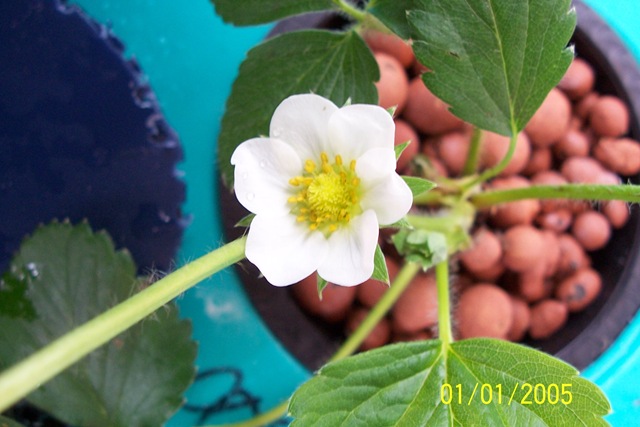 (I know, the date is wrong….) I took it today…
Here is the outdoor garden;
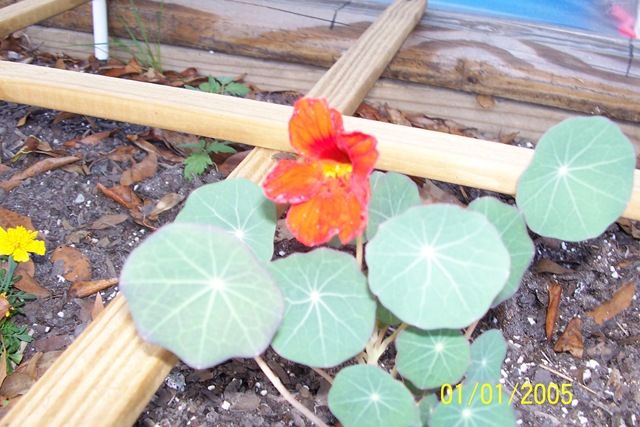 Nasturtium
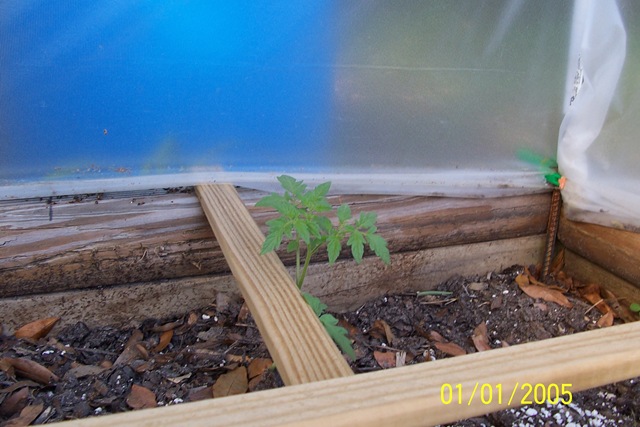 My tomato already grew about 18 inches tall. I bent her over and planted the whole,stalk, I will get more tomatoes this way…gotta get the trellis’s up soon!!!
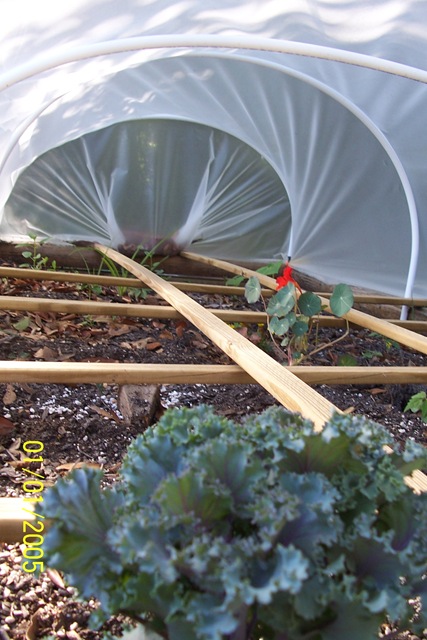 Flowering kale in foreground, nasturtium just in back, cucumbers at the back.
 Swiss Chard, broccoli, a few weeds….
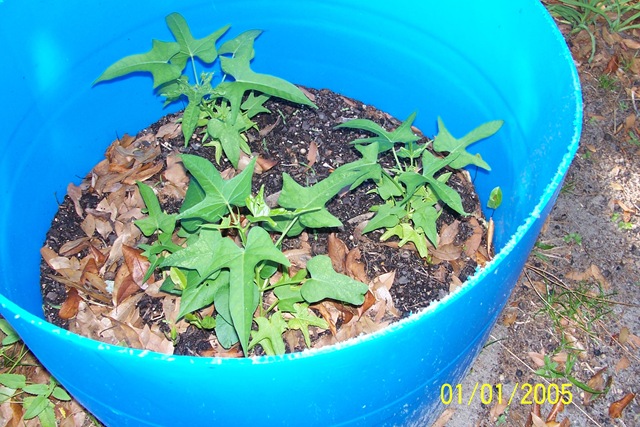 Sweet Potatoes are growing good now that the weather has warmed up. These were planted in November!!


 Meal Delivery Service by Millie Barnes
