Another Reason To Not Buy Processed Food
Posted: May 17, 2009 Filed under: Food and it's Impact on Our Health, Going Green; How and Why... Leave a commentI tell my nutrition client to not buy foods that need labels. It is easy to hold a mango in your hands and know what it is, how it grew. Not so with boxed or packaged “products”.
Read on…
Food Companies Are Placing the Onus for Safety on Consumers
By MICHAEL MOSS in the NY Times
Published: May 14, 2009
The frozen pot pies that sickened an estimated 15,000 people with salmonella in 2007 left federal inspectors mystified. At first they suspected the turkey. Then they considered the peas, carrots and potatoes.
The pie maker, ConAgra Foods, began spot-checking the vegetables for pathogens, but could not find the culprit. It also tried cooking the vegetables at high temperatures, a strategy the industry calls a “kill step,” to wipe out any lingering microbes. But the vegetables turned to mush in the process.
So ConAgra — which sold more than 100 million pot pies last year under its popular Banquet label — decided to make the consumer responsible for the kill step. The “food safety” instructions and four-step diagram on the 69-cent pies offer this guidance: “Internal temperature needs to reach 165° F as measured by a food thermometer in several spots.”
Increasingly, the corporations that supply Americans with processed foods are unable to guarantee the safety of their ingredients. In this case, ConAgra could not pinpoint which of the more than 25 ingredients in its pies was carrying salmonella. Other companies do not even know who is supplying their ingredients, let alone if those suppliers are screening the items for microbes and other potential dangers, interviews and documents show.
Yet the supply chain for ingredients in processed foods — from flavorings to flour to fruits and vegetables — is becoming more complex and global as the drive to keep food costs down intensifies. As a result, almost every element, not just red meat and poultry, is now a potential carrier of pathogens, government and industry officials concede.
In addition to ConAgra, other food giants like Nestlé and the Blackstone Group, a New York firm that acquired the Swanson and Hungry-Man brands two years ago, concede that they cannot ensure the safety of items — from frozen vegetables to pizzas — and that they are shifting the burden to the consumer. General Mills, which recalled about five million frozen pizzas in 2007 after an E. coli outbreak, now advises consumers to avoid microwaves and cook only with conventional ovens. ConAgra has also added food safety instructions to its other frozen meals, including the Healthy Choice brand.
Peanuts were considered unlikely culprits for pathogens until earlier this year when a processing plant in Georgia was blamed for salmonella poisoning that is estimated to have killed nine people and sickened 27,000. Now, white pepper is being blamed for dozens of salmonella illnesses on the West Coast, where a widening recall includes other spices and six tons of frozen egg rolls.
The problem is particularly acute with frozen foods, in which unwitting consumers who buy these products for their convenience mistakenly think that their cooking is a matter of taste and not safety.
Federal regulators have pushed companies to beef up their cooking instructions with the detailed “food safety” guides. But the response has been varied, as a review of packaging showed. Some manufacturers fail to list explicit instructions; others include abbreviated guidelines on the side of their boxes in tiny print. A Hungry-Man pot pie asks consumers to ensure that the pie reaches a temperature that is 11 degrees short of the government-established threshold for killing pathogens. Questioned about the discrepancy, Blackstone acknowledged it was using an older industry standard that it would rectify when it printed new cartons.
Government food safety officials also point to efforts by the Partnership for Food Safety Education, a nonprofit group founded by the Clinton administration. But the partnership consists of a two-person staff and an annual budget of $300,000. Its director, Shelley Feist, said she has wanted to start a campaign to advise consumers about frozen foods, but lacks the money.
Estimating the risk to consumers is difficult. The industry says that it is acting with an abundance of caution, and that big outbreaks of food-borne illness are rare. At the same time, a vast majority of the estimated 76 million cases of food-borne illness every year go unreported or are not traced to the source.
Home Cooking
Some food safety experts say they do not think the solution should rest with the consumer. Dr. Michael T. Osterholm, director of the Center for Infectious Disease Research and Policy at the University of Minnesota, said companies like ConAgra were asking too much. “I do not believe that it is fair to put this responsibility on the back of the consumer, when there is substantial confusion about what it means to prepare that product,” Dr. Osterholm said.
And the ingredient chain for frozen and other processed foods is poised to get more convoluted, industry insiders say. While the global market for ingredients is projected to reach $34 billion next year, the pressure to keep food prices down in a recession is forcing food companies to look for ways to cut costs.
Ensuring the safety of ingredients has been further complicated as food companies subcontract processing work to save money: smaller companies prepare flavor mixes and dough that a big manufacturer then assembles. “There is talk of having passports for ingredients,” said Jamie Rice, the marketing director of RTS Resource, a research firm based in England. “At each stage they are signed off on for quality and safety. That would help companies, if there is a scare, in tracing back.”
But government efforts to impose tougher trace-back requirements for ingredients have met with resistance from food industry groups including the Grocery Manufacturers Association, which complained to the Food and Drug Administration: “This information is not reasonably needed and it is often not practical or possible to provide it.”
Now, in the wake of polls that show food poisoning incidents are shaking shopper confidence, the group is re-evaluating its position. A new industry guide produced by the group urges companies to test for salmonella and cites recent outbreaks from cereal, children’s snacks and other dry foods that companies have mistakenly considered immune to pathogens.
Research on raw ingredients, the guide notes, has found salmonella in 0.14 percent to 1.3 percent of the wheat flour sampled, and up to 8 percent of the raw spices tested.
ConAgra’s pot pie outbreak began on Feb. 20, 2007, and by the time it trailed off nine months later 401 cases of salmonella infection had been identified in 41 states, according to the Centers for Disease Control and Prevention, which estimates that for every reported case, an additional 38 are not detected or reported.
It took until June 2007 for health officials to discover the illnesses were connected, and in October they traced the salmonella to Banquet pot pies made at ConAgra’s plant in Marshall, Mo.
While investigators who went to the plant were never able to pinpoint the salmonella source, inspectors for the United States Department of Agriculture focused on the vegetables, a federal inspection document shows.
ConAgra had not been requiring its suppliers to test the vegetables for pathogens, even though some were being shipped from Latin America. Nor was ConAgra conducting its own pathogen tests.
The company says the outbreak and management changes prompted it to undertake a broad range of safety initiatives, including testing for microbes in all of the pie ingredients. ConAgra said it was also trying to apply the kill step to as many ingredients as possible, but had not yet found a way to accomplish it without making the pies “unpalatable.”
Its Banquet pies now have some of the most graphic food safety instructions, complete with a depiction of a thermometer piercing the crust.
Pressed to say whether the meals are safe to eat if consumers disregard the instructions or make an error, Stephanie Childs, a company spokeswoman, said, “Our goal is to provide the consumer with as safe a product as possible, and we are doing everything within our ability to provide a safe product to them.”
“We are always improving food safety,” Ms. Childs said. “This is a long ongoing process.”
The U.S.D.A. said it required companies to show that their cooking instructions, when properly followed, would kill any pathogens. ConAgra says it has done such testing to validate its instructions.
Getting to ‘Kill Step’
But attempts by The New York Times to follow the directions on several brands of frozen meals, including ConAgra’s Banquet pot pies, failed to achieve the required 165-degree temperature. Some spots in the pies heated to only 140 degrees even as parts of the crust were burnt.
A ConAgra consumer hotline operator said the claims by microwave-oven manufacturers about their wattage power could not be trusted, and that any pies not heated enough should not be eaten. “We definitely want it to reach that 165-degree temperature,” she said. “It’s a safety issue.”
In 2007, the U.S.D.A.’s inspection of the ConAgra plant in Missouri found records that showed some of ConAgra’s own testing of its directions failed to achieve “an adequate lethality” in several products, including its Chicken Fried Beef Steak dinner. Even 18 minutes in a large conventional oven brought the pudding in a Kid Cuisine Chicken Breast Nuggets meal to only 142 degrees, the federal agency found.
Besides improving its own cooking directions, ConAgra says it has alerted other frozen food manufacturers to the food safety issues.
But in the absence of meaningful federal rules, other frozen-dinner makers that face the same problem with ingredients are taking varied steps, some less rigorous. Jim Seiple, a food safety official with the Blackstone unit that makes Swanson and Hungry-Man pot pies, said the company tested for pathogens, but only after preliminary tests for bacteria that were considered indicators of pathogens — a method that ConAgra abandoned after its salmonella outbreak.
The pot pie instructions have built-in margins of error, Mr. Seiple said, and the risk to consumers depended on “how badly they followed our directions.”
Some frozen food companies are taking different approaches to pathogens. Amy’s Kitchen, a California company that specializes in natural frozen foods, says it precooks its ingredients to kill any potential pathogens before its pot pies and other products leave the factory.
Using a bacteriological testing laboratory, The Times checked several pot pies made by Amy’s and the three leading brands, and while none contained salmonella or E. coli, one pie each of two brands — Banquet, and the Stouffer’s brand made by Nestlé — had significant levels of T. coliform.
These bacteria are common in many foods and are not considered harmful. But their presence in these products include raw ingredients and leave open “a potential for contamination,” said Harvey Klein, the director of Garden State Laboratories in New Jersey.
A Nestlé spokeswoman said the company enhanced its food safety instructions in the wake of ConAgra’s salmonella outbreak.
Danger in the Fridge
ConAgra’s episode has raised its visibility among victims like Ryan Warren, a 25-year-old law school student in Washington. A Seattle lawyer, Bill Marler, brought suit against ConAgra on behalf of Mr. Warren’s daughter Zoë, who had just turned 1 year old when she was fed a pot pie that he says put her in the hospital for a terrifying weekend of high fever and racing pulse.
“You don’t assume these dangers to be right in your freezer,” said Mr. Warren, who settled with ConAgra. He does not own a food thermometer and was not certain his microwave oven met the minimum 1,100-wattage requirement in the new pot pie instructions. “I do think that consumers bear responsibility to reasonably look out for their well-being, but the entire reason for this product to exist is for its convenience.”
Public health officials who interviewed the Warrens and other victims of the pot-pie contamination found that fewer than one in three knew the wattage of their microwave ovens, according to the C.D.C. report on the outbreak. The report notes, however, that nearly one in four of the victims reported cooking their pies in conventional ovens.
For more than a decade, the U.S.D.A. has also sought to encourage consumers to use food thermometers. But the agency’s statistics on how many Americans do so are discouraging. According to its Web site, not quite half the population has one, and only 3 percent use it when cooking high-risk foods like hamburgers. No data was available on how many people use thermometers on pot pies.
Note from Millie- I find myself teaching clients how to use a food thermometer to learn to cook meat correctly. Most people do not know how to use one or do not own one. This is a prime example where we put our lives in big business’ hands. Personally, I make all my food from scratch; real mayonnaise, salad dressings, tortillas…you know what the ingredients are!
Some very important first steps;
1) buy only organic FREE RANGE meat, NOT feed lot meat.
2) avoid packaged, boxed, canned foods. Eat whole, real, unprocessed food; meat, healthy saturated fats (buuter, coconut oil), fruits and veggies.
3) start growing your own in sub-irrigated 5 gallon buckets.
What can you do? Eat only locally grown food, buy from the Farmers Market, start growing your own…..read more;

http://www.slowfoodusa.org/index.php
My front yard
Posted: May 16, 2009 Filed under: Gardening Leave a commentI’ve been ignoring it. I mean, really ignoring it. I stopped watering it 3 years ago. My landlord had had the sprinkler system set to water every day at 5:30 am. It encouraged weed growth like crazy. He sprayed. I hated it. He turned off the sprinkler system. I gave up. Here is my poor lawn after zero-scaping itself over the last few years. I do mow when it gets ridiculous.
The grass is trying to hang in there, the azaleas are overgrown and full of Virginia Creeper, to which I am allergic. I have decided to Xeri-scape as much as possible, but use the front half circle as a community garden. Several families have expressed interest in using the space. My front yard get full sun all day. I already have the blueberry bushes that are going in. It’s a start. Here is how it looks now.
 A serious dry patch.
 Quite a contrast to the immaculately manicured, sprayed, heavily watered yard next door…
I’ll keep you informed of the progress..
Growing Food inside
Posted: May 15, 2009 Filed under: Gardening Leave a commentMy backyard and inside of my house is producing food really well. I have not bought greens, basil or lettuce since November. I am eating cherry tomatoes and strawberries out of the living room. Baby lettuce sprouted 3 days ago. Today I planted beets, purple tomatoes, more Swiss chard. Here’s a pic from the living room, looking into the sunroom;
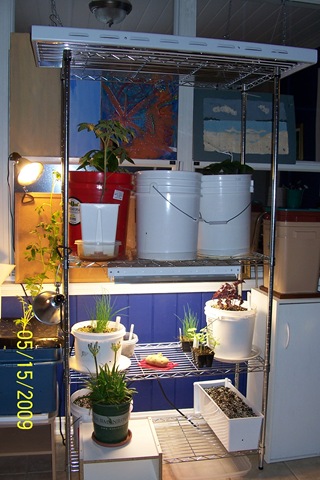
Clockwise from the left; cherry tomatoes-rescued from outside. I started them too early. On the top shelf is strawberries, tomato, purple bell pepper, strawberry Middle shelf has garlic, empty pot. Second self- chives, watermelon, purple basil, a potato that has started sprouting…it will go in a barrel outside. Bottom shelf; garlic, lettuce just planted, cucumbers. The Waterfarm has a nasturtium. It was a drip system, which I don’t like, I converted it into a bubbler that also sprays the roots every 30 minutes. All the artwork is in the windows because I have yet to get shades.
To the left of this is succulent, plus a Bonsai pony tail palm, about 30 years old. To the right is a orchid, and purple tomatoes waiting to sprout.
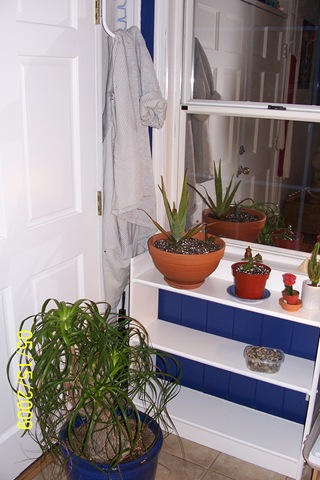

This is to the left of all that, a table my friend Bim Willow made.

New York To Stop Buying Bottled Water For State Agencies.
Posted: May 13, 2009 Filed under: Going Green; How and Why... Leave a commentI found this at The Good Human

May 11th, 2009 • david •
Hurray! Another state will stop with the bottled water nonsense! San Francisco banned the use of city money to buy single-serving plastic bottles of water back in 2007, and now New York is following suit. Governor David Patterson signed an Executive Order that will phase out the purchase and use of bottled water at state agency facilities. This is amazing news, and one that I hope will encourage other states and state agencies to ban the purchase of water in plastic bottles with state monies. From Water & Wastewater:
The Executive Order will phase out the expenditure of state funds for the purchase of single serve bottles and larger, cooler-sized bottles for water consumed at agency facilities. The measure requires each executive agency to develop and implement a plan to phase out expenditures for bottled water and provide alternative water sources such as ordinary tap water fountains and dispensers.
“Taxpayers have spent billions of dollars to ensure that we have clean drinking water supplies,” said Paterson. “If we are going to make such significant investments, we should reap the benefits and use that water. Our efforts will serve as an example for local governments, businesses, and residents to follow.”
I couldn’t agree more with Paterson’s statement, and hope it will truly have an impact on others to follow his (and Mayor Newsom’s) lead on this. I have written many times before about why we should not be buying bottled water, but just as a reminder, here are a few reasons…
- By drinking tap water, you can avoid the fertilizer, pharmaceuticals, disinfectants, and other chemicals that studies have found in bottled water.
- On a weekly basis, 37,800 18-wheelers are driving around the country delivering water.
- It can take nearly 7 times the amount of water in the bottle to actually make the bottle itself. Buy a reusable bottle that lasts for a very long time instead
- Tap water costs about $0.002 per gallon compared to the $0.89 to $8.26 per gallon charge for bottled water. If the water we use at home cost what even cheap bottled water costs, our monthly water bills would run $9,000.
Kudos to Governor Patterson for signing this order!
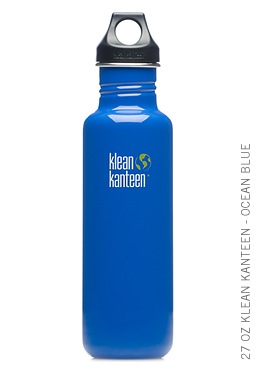
I know ya’ll are sick of me haranguing you about not using disposable water bottles ever again. If you can’t find a “green” alternative, I personally love my Kleen Kanteen. I’m going on 2 years now with it.
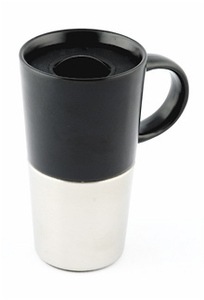
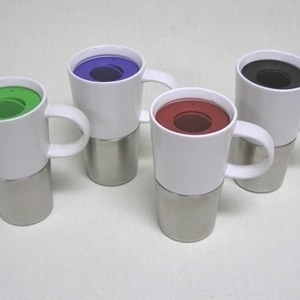
Another product I really enjoy every day is my non-plastic travel mug from High Wave. Made with pottery and stainless steel, it is beautiful and the lid is silicone. That means no smell or taste of old coffee after the first few uses. Plastic seals always taste bad. And the best thing is really keeps coffee or tea hot, real hot! And the 12.00 price tag makes it real sweet.

I do not like to expose my food to any plastic at all, or use disposables, so sandwich bags are out. These container from Sigg are great for lunches. I found them at Reusablebags.com.
The Single Best Way to Be Happy: Choose To!
Posted: May 12, 2009 Filed under: Food and it's Impact on Our Health Leave a comment
This was on the Giaim Blog
“Everything’s amazing. Nobody’s happy.” We heard this line from a comedian named Louis CK. If you get a chance, check out this clip of an appearance he made on Conan O’Brien. It is a wake up call put in a very funny package.
I don’t know about you, but I am sick of complaining. We live in an amazing time, but there seems to be a lack of gratitude. There are so many vehicles for communication, but how many words are being wasted talking about what is wrong?
What would happen if we could stop complaining for a whole day? Then we could add gratitude to our day of non-complaining. Our reality would be very different. Suffering in the form of selfishness, anxiety, and despair might dissipate. Maybe our minds would have a chance to settle. And what if we also added a service component to our day of non-complaining and gratitude? Swami Satchidananda says that all we have to do to be happy is to feed people. I believe that at the end of this day, we would crawl into bed with a peaceful heart and a calm mind — and maybe feel tempted to do it again.
Last week, I taught a women’s retreat in Mexico. This was the 9th year with the same group of women. There is one woman who has attended all nine retreats. She has a large tumor on her spine, and is in an enormous amount of pain. She has little to no feeling in her limbs. She, laughingly, says that she wakes up every morning feeling like a scarecrow, wondering which limbs she will be able to feel today. The point is that I have never heard her complain about anything. It is very obvious that her life is all about service. She is constantly amazed, and finds humor in every situation. She has chosen to be happy.
Louis CK points out that the next time we fly, we should be holding onto our seats, screaming with delight at the miracle of sitting in a chair in the sky and flying like a bird across the sky. So let’s not complain the next time we have a two-hour delay, or sit on the runway for an hour, or get suck in the middle seat. Let’s live in constant awe and gratitude. Everything is amazing and we can choose to be happy.
With gratitude,
Colleen
I loved this article, it really is that simple. My best friend I ever had, Rick O’Shea, was in a wheelchair for 36 years. I met him when I was 27 years old. He taught me how to be happy, to laugh at myself, and how to grow up. I asked him at one point, after knowing him for about 5 years, how he kept so positive, how he could be so happy. He looked at me, smiled and said, “I fake it.” Something in me changed at that point, I got it… I just needed to decide to be happy.
Three of my favorite quotes;
“Happiness is an inward power of the soul.”
“The secret of happiness is freedom, the secret of freedom is courage.”
“Gratitude unlocks the key to life, then takes what we have and makes it what we need.”
don’t allow garlic to flower
Posted: May 12, 2009 Filed under: Gardening Leave a commentAnd another….from American Potager
I love her photos…and she lo9ves blue as much as I do…:)..

Prune the flowers from garlic so that all of the energy of the plant goes into the bulb and not into flowering. These garlic flowers are great in arrangements or they are edible as well and can go into soups or salads.

blue bamboo poles
Posted: May 12, 2009 Filed under: Gardening Leave a commentI discovered a great garden blog today, thanks to Apartment Therapy.. a wonderful design blog!
This is the post that led me to her blog, what a great idea!

I am often asked about the royal blue bamboo poles that I use in my potager. Don’t be fooled by the photo; spring has not come to my garden…. yet. This was taken a few years ago, but it’s a good reminder to get structures ready now. Here is what I did and maybe it will be helpful for you.
A Very Green Greenhouse
Posted: May 11, 2009 Filed under: Gardening, Going Green; How and Why... Leave a commentMarch 11, 2009
What a cool idea for building your own greenhouse. There are many sun-lit spaces in the city where this could work, maybe even on a rooftop. One of the resource we have in abundance in the city is used building material. There is demolition material everywhere.
You will need some DIY carpentry skills for this project but it seems like one worth doing.
Could it be any more green? Yes, if you fill it with sub-irrigated grow boxes or buckets. With adequate structural support, it could even have a sub-irrigated green roof. What a food production factory you could have!
Source: Instructables
Via: re-nest an Apartment Therapy blog
I love spring!
Posted: May 11, 2009 Filed under: Gardening Leave a commentThis is my first spring doing any serious gardening and I am in heaven. The lush flowers outside, my ripening tomatoes and yummy purple basil in my living room…how cool is that?

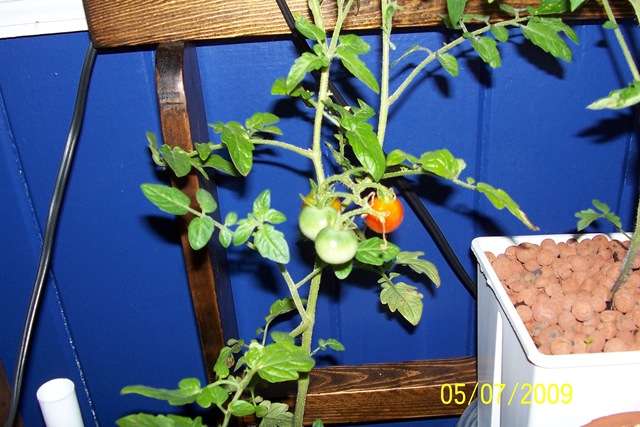
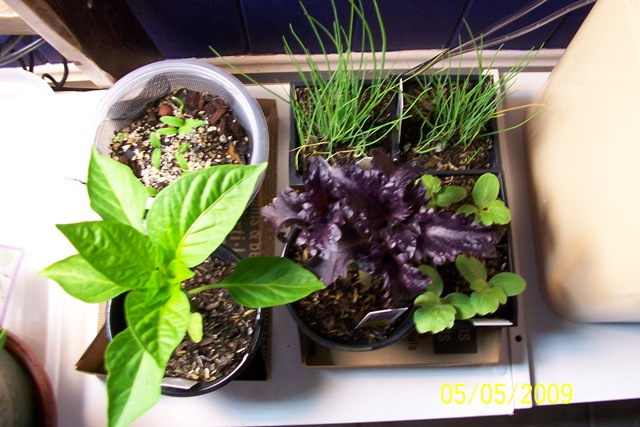 Purple basil, a purple pepper plant, chives, .
I’m building more grow buckets right now for tomatoes, peppers and lettuce. I have two tomato plants growing upside down, they seem pretty happy,.. I will post pics later today..
I hope you had a great Mother’s Day. My and my daughters danced to Reggae to King Eddie and Pili Pili.
Keeping kids healthy by eating local and unprocessed food
Posted: May 7, 2009 Filed under: Food and it's Impact on Our Health Leave a commentAnother great article from NoImpactMan
 A big part of the No Impact project was to eat only local, seasonal, unpackaged food. That meant, basically, lots of fresh vegetables. Michelle and I both lost a lot of weight.
As though to prove how good eating a local-food diet is for kids, too, Business Week writer Cathy Arnst has posted a story, which comes from the processed food end of things, called "How Mac ‘n’ Cheese Is Like a Cigarette." She writes:
Two thirds of adults are considered overweight or obese, as is one out of every three children under age 18. Those numbers have been rising steadily since the 1980s, when the average weight took a dramatic spike upwards for all races, age groups and genders. For example, in 1960 women aged 20 to 29 weighed an average of 128 pounds. By 2000 the average weight had jumped to 157.
Our national weight gain is not, as many people assume, because we are far less active; studies have found little difference in energy expended now than in the 1950s. It is because we are eating far, far more calories than ever before, in the form of soda, junk food, sweets, fat and salt laden meals, and huge portions. We have become addicted to food, and that addiction starts in very early childhood.
Kessler [author of the new book The End of Overeating] lays out how sugar, fat and salt stimulates the reward centers of the brain in much the same way as cigarettes, alcohol and illicit drugs. By eating food that is extremely palatable, we keep wanting more, whether or not we are hungry. Since highly palatable junk food is socially acceptable, and often cheaper than the healthy stuff, we keep going back for more. The food industry knows this better than anyone. Kessler quotes an industry consultant who says that food manufacturers try to hit the “three points of the compass”:
Sugar, fat and salt make a food compelling, said the consultant. They make it indulgent. They make it high in hedonic value, which gives us pleasure. “Do you design food specifically to be highly hedonic,” I asked. “Oh, absolutely,” he replied without a moment’s hesitation. “We try to bring as much of that into the equation as possible.
Here’s the good news about local eating. None of the farmers I talk to at the farmers’ market try to jam their food with salt, fat or sugar to get my little Isabella addicted.


 Meal Delivery Service by Millie Barnes