No more tears……just cancer causing chemicals
Posted: June 5, 2009 Filed under: Going Green; How and Why... Leave a commentThis is from http://www.enviroblog.org/
May 28, 2009

Baby products should not contain toxic ingredients, according to common sense as well as 40 + organizations lead by the Environmental Working Group (EWG) co-founded Campaign for Safe Cosmetics.
Just last week, the Campaign sent a letter to Johnson and Johnson asking that its products made for children don’t contain hidden carcinogenic contaminants 1,4-dioxane and formaldehyde.
No More Toxic Tub
The action comes after a recent Campaign-sponsored No More Toxic Tub report that found those two contaminants in over 60 percent of the 48 products tested. Both 1,4-dioxane and formaldehyde are known carcinogens and formaldehyde can also trigger skin rashes. Like other toxic ingredients often found in your shampoo, lotion and deodorant, they are not limited in personal care products. In addition, since they are contaminants and not ingredients, they are not disclosed on product labels.
Not breaking the law isn’t good enough when the law is weak
The line of defense for the manufacturers has been the typical "we didn’t break the law" as well as the usual "small doses are insignificant." It is true that companies did not break the law. But it’s also true that the law –
the Toxic Substances Control Act (TSCA) – is so weak that under it, the federal government wasn’t able to ban asbestos! A chemical responsible for at least 10,000 deaths a year in the U.S.
Low doses matter
The small doses are not insignificant because we are all exposed to chemicals in personal care products every day, several times a day. Those exposures are there in addition to exposures to other toxics in food we eat, water we drink, air we breathe and so forth. All of these exposures add up, and could lead to diseases later in life.
The companies don’t have to use the toxic ingredients, as alternatives are available. Even Johnson and Johnson can make formaldehyde-free products, as they do in Japan.
Tell Johnson & Johnson to get rid of the toxic chemicals
Without a tough federal law that would require the chemicals in personal care products be safe, consumers are left out on their own to make the best purchasing decisions.
That’s why we created Skin Deep, a cosmetics database that can help you make informed decisions when it comes to toxic contained in personal care products you use.
Until the law is changed, you can join us and tell Johnson and Johnson that you don’t want these toxic chemicals in your baby’s shampoo and they should take it out!
Website for checking the toxicity of products you use
Posted: June 4, 2009 Filed under: Going Green; How and Why..., Skin Care Leave a comment Four years ago, my daughter Rachel started school to become an esthetician. She brought home info on the new studies showing just how toxic parabans were and their link to breast cancer. I immediately went through my beauty products and shampoos and conditioners. Almost all of them had parabans and they were all from the health food store! I went to work researching toxicity in cosmetics, ending up switching products and in time developed my own skin cleanser. During that next year almost every product line in the health food store reformulated their products to remove this cheap and toxic preservative.
One of the tools I used for my research was the Environmental Working Groups’ website, Skin Deep. It has the white papers (toxicity reports) on almost every product I was using.
Skin Deep is a safety guide to cosmetics and personal care products brought to you by researchers at the Environmental Working Group.
Skin Deep pairs ingredients in more than 42,000 products against 50 definitive toxicity and regulatory databases, making it the largest integrated data resource of its kind. Why did a small nonprofit take on such a big project? Because the FDA doesn’t require companies to test their own products for safety.
Get started here to learn what’s in your personal care products:
EWG’s Tips to avoid BPA exposure
Posted: June 4, 2009 Filed under: Food and it's Impact on Our Health Leave a commentBy Lisa Frack
May 28, 2009
 EWG is working hard to pass laws that limit or ban the dangerous chemical bisphenol-A (BPA).
But until they pass, we think you should have the latest info on sources of exposure and our tips to avoid them on your own. Because before the personal becomes political it’s, well, still personal.
Who’s affected by BPA??
- The developing fetus and baby are the most vulnerable to BPA’s toxic effects. Unfortunately they also have the most intense BPA exposure of any age group.
Many parents who have replaced their polycarbonate baby bottles are unaware that BPA contaminates liquid baby formula sold in metal cans. Since formula can make up 100% of a baby’s diet over her first 6 months of life, parents should choose BPA-free types. - Adults ingest much less BPA than babies. But a recent study linking BPA exposures in adults to heart disease and diabetes raises concerns about the safety of current exposures.
Adult exposure comes primarily from canned foods and polycarbonate food containers, but BPA-containing medical devices could also be a source. Pregnant women and older children should avoid BPA. Eat a varied diet, avoid canned foods, and don’t use polycarbonate plastics for warm food or drinks.
How are we exposed??
EWG Senior Scientist Olga Naidenko wrote a recent post here on Enviroblog summarizing all the ways we can be exposed to BPA.
In short, BPA has countless uses, several of which have been highlighted as an exposure risk. BPA is a component of non-metal dental fillings, it is in thermal paper for many receipts, and it is increasingly used in medical devices. There is little research about the magnitude of exposures from these products.
EWG’s Tips for avoiding BPA
Although completely eliminating exposure to bisphenol A (BPA) may not be possible, there are steps you can take to reduce your family’s exposure to this chemical by avoiding common sources and limiting exposure for the highest risk groups.
- BPA in formula and baby bottles: Check our BabySafe guide to bottles and formula and a previous Enviroblog post specifically about choosing and using infant formula safely.
- BPA in canned foods: Almost all canned foods sold in the United States have a BPA-based epoxy liner that leaches BPA into the food. EWG tested 97 canned foods and found detectable levels of BPA in more than half of the foods. The highest concentrations were in canned meats, pasta and soups. Only 1 manufacturer claims to use no BPA. Eden Foods uses an alternative technology for canned beans but not for its tomato-based products. Pregnant women and children should limit their consumption of canned foods to avoid BPA. Rinsing canned fruit or vegetables may reduce the amount of BPA you ingest.
- BPA in water and food containers: Less BPA leaches from plastic water bottles and food containers than from cans into canned foods and baby formula. Nevertheless it is good to take simple precautions to reduce your exposure.
Polycarbonate plastics are rigid, transparent and used for food storage containers and water bottles, among other things. Trace amounts of BPA can migrate from these containers, particularly if used for hot food or liquids. Soft or cloudy-colored plastic does not contain BPA.
When possible, avoid polycarbonate, especially for children’s food and drinks. This plastic might be marked with the recycling code #7 or the letters "PC". Plastics with the recycling labels #1, #2 and #4 on the bottom are better choices because they do not contain BPA. Avoid putting any plastic containers in microwaves. Wash plastics on the top shelf of your dishwasher or by hand.
Some metal water bottles lined with an epoxy-based enamel coating could leach BPA. Look for stainless steel bottles that do not have a liner. Avoid using old and scratched plastic bottles.
And keep your eyes on Enviroblog and your inbox for upcoming e-advocacy on BPA legislation. We plan to beat this chemical at home and in the halls of Congress.
We caught Coca-Cola and Del Monte plotting to deceive you about the dangers of BPA.
Posted: June 4, 2009 Filed under: Food and it's Impact on Our Health Leave a commentThis is from the Environmental Working Groups’ Eviroblog
We caught Coca-Cola and Del Monte plotting to deceive you about the dangers of BPA.
Last week food and chemical lobbyists met in Washington, DC to save BPA – they’re desperate to block state and federal efforts to regulate their $6 billion industry.
We were shocked when we read  internal meeting minutes that revealed an unethical strategy to keep your family eating and drinking from BPA-laden containers. To get the full story, see our Enviroblog.
QUESTION: Which of these tactics did BPA industry lobbyists concoct?
- Employing fear tactics like threatening consumers with limited access to affordable baby food.
- Using a "pregnant young mother who would be willing to speak around the country about the benefits of BPA" as their ‘holy grail’ spokesperson.
- Focusing fear tactics on historically exploited populations including "Hispanic and African Amercians and the poor."
- "Befriending people that are able to manipulate the legislative process."
- All of the above.
ANSWER: (E) All of the above. Ready to fight back? So are we.
Call now to demand no BPA
Coca-Cola: 1-800-GET-COKE, ext. 2
Del Monte: 1-800-543-3090
Sample script:
"Hello, My name is ______________. I’m shocked and disappointed in your unethical approach to business when it comes to BPA – placing profits ahead of my family’s health and using fear tactics to placate consumers about a clearly dangerous chemical. BPA needs to go – NOW. Thank you."
After you call. . .
- Tell us about it. Send EWG an email describing the conversation.
- Get your friends to call. Use our tell-a-friend to ask your friends to call today.
- Donate to EWG so we can keep these big corporations from profiting off your family’s health.
Thank you for calling. Now the BPA industry lobbyists know that yet another consumer will not stand for their unethical tactics.
Dishwasher vs.. Hand washing dishes
Posted: June 3, 2009 Filed under: Going Green; How and Why... Leave a commentA few months ago, Colin Beaven printed a article I wrote on his fabulous blog, No Impact Man. You can read the whole article here- Thirty-one tips for reducing your impact while saving money. A reader made this comment….
Alison said… Thanks so much for the tips! I work with Electrolux and in the spirit of conserving water, have another tip to share: use your dishwasher instead of washing dishes by hand!
I was shocked to find out that it takes an average of 27 gallons of water to wash a load of dishes by hand but only 5 gallons to wash the same size load in a modern dishwasher! That means that a household can save 4,730 gallons of water per year by leaving hand washing in the dust! The Water Savings calculator from Electrolux breaks down results to show the effects of conserving water on a household, town, state and national level: http://www.electrolux.com/watersavings_us. Hope this helps your readers! 🙂
I wanted to address the fact, as I said in my article, that I use tow dishpans, each with slightly more than a gallon of water in each one. When I am through with that water I pour it on my flower bed. I use organic dish soap, but still do not use the water on veggies. Here is a picture of the flower bed, just outside my kitchen where the water goes. I have never turned on the outside spigot to water these flowers.

I am not using any electricity while I am washing those dishes, I supply the energy!
It is FAR more economical to do the dishes this way; no cost of manufacturing that dishwasher, no paying to transport it to the store, no electricity to run it. I run my hot water heater a half hour a day, during off-peak hours, it is fully insulated. This gives me a quick shower, normal use of water for dishwashing, etc. Most of the year I use the solar shower in my back yard. I do not use a flush toilet, I use a sawdust toilet. My water bill is a 1/10 of what it used to be, and I have always been careful!
There’s no comparison!
Reprieve
Posted: June 3, 2009 Filed under: Food and it's Impact on Our Health Leave a comment
June 2, 2009, 9:38 pm
By Tim Kreider
Fourteen years ago I was stabbed in the throat. This is kind of a long story and it’s not the point of this essay. The point is that after my unsuccessful murder I wasn’t unhappy for an entire year.
Winston Churchill’s quote about the exhilaration of being shot at without result is verifiably true. I was reminded of an old Ray Bradbury story, “The Lost City of Mars,” in which a man finds a miraculous machine that enables him to experience his own violent death over and over again, as many times as he likes — in locomotive collisions, race car crashes, exploding rockets — until he emerges flayed of all his free-floating guilt and unconscious longing for death, forgiven and free, finally alive. I started brewing my own dandelion wine in a big Amish crock. I listened to old pop songs too stupid to name in print.
I’m not claiming I was continuously euphoric the whole time; it’s just that, during that grace period, nothing much could bother me or get me down. The sort of horrible thing that I’d always dreaded was going to happen to me had finally happened. I figured I was off the hook for a while. In a parallel universe only two millimeters away from this one (the distance between the stiletto and my carotid), I had been flown home in the cargo hold instead of in coach. Everything in this one, as far as I was concerned, was gravy.
My friends immediately mocked me out of my self-consciousness about the nerve damage that had left me with a lopsided smile. I started brewing my own dandelion wine in a big Amish crock. I listened to old pop songs too stupid to name in print. And I developed a strange new laugh that’s stayed with me to this day — a loud, raucous, barking thing that comes from deep in the diaphragm and makes people in bars or restaurants look over at me for a second to make sure I’m not about to open up on the crowd with a weapon.
I wish I could recommend this experience to everyone. It’s a cliché that this is why people enjoy thrill-seeking pastimes ranging from harmless adrenaline fixes like roller coasters to suicide attempts with safety nets, like bungee jumping. The catch is that to get the full effect you have to be genuinely uncertain that you’re going to survive. The best approximation would be to hire an incompetent hit man to assassinate you.
It’s one of the maddening perversities of human psychology that we only notice we’re alive when we’re reminded we’re going to die, sort of the same way some of us only appreciate our girlfriends after they’re exes. I saw the same thing happen, in a more profound and lasting way, to my father when he was terminally ill, and then to my mother after he died; an almost literal lightening, a flippant indifference to the silly, quotidian nonsense that preoccupies most of us and ruins so much of our lives. A neighbor was suing my father for some reason or other during his illness, but if you tried to talk to him about such “serious” matters he’d just sing you old songs like “A Bird In a Gilded Cage” in a high, quavering old-man falsetto. When my mother, who’s now a leader in her church, sees people squabbling over minutiae or personal politics, she reminds them, diplomatically I’m sure, to focus on the larger context.
It’s easy now to dismiss that year as nothing more than a sort of hysterical high. But you could also try to think of it as a glimpse of grace.
It didn’t last, of course. You can’t feel grateful to be alive your whole life any more than you can stay passionately in love forever — or grieve forever, for that matter. Time forces us all to betray ourselves and get back to the busywork of living in the world. Before a year had gone by the same dumb everyday anxieties and frustrations began creeping back. I’d be disgusted to catch myself yelling in traffic, pounding on my computer, lying awake at night wondering what was going to become of me.
Once a year on my stabbiversary I remind myself that this is still my bonus life, a free round. But now that I’m back down in the messy, tedious slog of everyday emotional life, I have to struggle to keep things in what I still insist is their true perspective. I know intellectually that all the urgent, pressing items on our mental lists — taxes, car repairs, our careers, the headlines — are so much idiot noise, and that what matters is spending time with people you love. It’s just hard to bear in mind when the hard drive crashes.
I was not cheered, a few years ago, to read about psychological studies suggesting that most people inevitably return to a certain emotional baseline after circumstantial highs and lows. You’d like to think that nearly getting killed would be a major, permanently life-altering experience, but in truth it was less painful, and occasioned less serious reflection, than certain breakups I’ve gone through. If anything, it only reinforced the illusion that in the story of my life only supporting characters would die, while I, its protagonist and first-person narrator, would survive. I’ve demonstrated an impressive resilience in the face of valuable life lessons, and the main thing I seem to have learned from this one is that I am capable of learning nothing from almost any experience.
I don’t know why we take our worst moods so much more seriously than our best ones, crediting depression with more clarity than euphoria. It’s easy now to dismiss that year as nothing more than the same sort of shaky, hysterical high you’d experience after being clipped by a taxi. But you could also try to think of it as a glimpse of grace. It’s like the revelation I had when I was a kid the first time I ever flew in an airplane: when you break through the cloud cover you realize that above the passing squalls and doldrums there is a realm of eternal sunlight, so keen and brilliant you have to squint against it, a vision to hold onto and take back with you when you descend once more beneath the clouds, under the oppressive, petty jurisdiction of the local weather.
Here is the link to his website- The Pain Comics
Let the Kid Be
Posted: June 2, 2009 Filed under: Food and it's Impact on Our Health Leave a commentFrom the NYTimes today…
May 31, 2009
By LISA BELKIN
Perhaps you know it by its other names: helicoptering, smothering mothering, alpha parenting, child-centered parenting. Or maybe there’s a description you’ve coined on your own but kept to yourself: Overly enmeshed parenting? Get-them-into-Harvard-or-bust parenting? My-own-mother-never-breast-fed-me-so-I-am-never-going-to-let-my-kid-out-of-my-sight parenting?
There are, similarly, any number of theories as to why 21st-century mothers and fathers feel compelled to micromanage their offspring: these are enlightened parents, sacrificing their own needs to give their children every emotional, intellectual and material advantage; or floundering parents, trying their best to navigate a changing world; or narcissistic parents, who see their children as both the center of the universe and an extension of themselves.
But whatever you call it, and however it began, its days may be numbered. It seems as though the newest wave of mothers is saying no to prenatal Beethoven appreciation classes, homework tutors in kindergarten, or moving to a town near their child’s college campus so the darling can more easily have home-cooked meals. (O.K., O.K., many were already saying no, but now they’re doing so without the feeling that a good parent would say yes.) Over coffee and out in cyberspace they are gleefully labeling themselves “bad mommies,” pouring out their doubts, their dissatisfaction and their dysfunction, celebrating their own shortcomings in contrast to their older sisters’ cloying perfection.
After all, that is the way it is with parenting — which I bet was never used as a verb before the 20th century, when medicine reached the point where parents could assume their babies would survive. At its core, raising children is about instinct and biology, yes, but on top of that, we build an artificial scaffold, which supports what we have come to think of as parenting truths but are really only parenting trends.
Going way back, the Spartans probably thought they were oh, so modern when they left defenseless infants on wild mountain slopes. So did wealthy Norse mothers who had poor women foster their children, and European aristocrats who employed wet nurses. More recently, as Ann Hulbert chronicles in her book “Raising America: Experts, Parents, and a Century of Advice About Children,” rigid feeding schedules were all the rage in the United States in the 1920s. The next two decades brought an emphasis on discipline.
In 1946, Dr. Spock came along and told parents to trust their instincts. Later, parents became buddies with their kids, and by the end of the last century, the debate was about the quality versus the quantity of time spent with your children. That was followed by the concept of mothering as an all-consuming identity. Mothers chose their gurus — T. Berry Brazelton (touchy-feely parenting), William Sears (attachment parenting) and John Rosemond (Christian parenting) — then diligently wore their babies in slings and nursed them into toddlerhood, all the while judging (and feeling judged by) those who did not do the same.
After a decade of earnest immersion in parenting, though, the times are ripe for a change. The first sign was the wave of confessionals — from anonymous Web sites like truumomconfessions.com (where mothers admit to transgressions like feigning stomach cramps to steal quiet time hiding in the bathroom) to bylined blogs like the wildly popular dooce.com (where Heather B. Armstrong chronicled her postpartum depression and continues to write about her struggles as the mother of a charming but somewhat high-strung 5-year-old) to memoirs like Ayelet Waldman’s (in which she cops to such “sins” as using disposable diapers and loving her husband more than her children).
But in the past few months, a second wave has taken hold — writers are moving past merely venting and are trying to gather the like-minded into a new movement. Carl Honoré is one. He calls it “slow parenting” — no more rushing around physically and metaphorically, no more racing kids from soccer to Suzuki. Lenore Skenazy is another. She calls it “free-range parenting,” a return to the days when childhood was not ruled by the fear (overblown, she says, with statistics to prove it) that children would be maimed, kidnapped or killed if they did something as simple as riding their bikes alone to the park.
By far the most chipper is Tom Hodgkinson, whose book “The Idle Parent: Why Less Means More When Raising Kids” was just published in England, and whose cover — Mum and Dad lounging with martinis while their well-trained toddler sits on the floor mixing up the next batch — illustrates his message that parents should just chill. Pay attention to your own needs, he writes, back off on your children and everyone will be happier and better adjusted.
All this certainly dovetails nicely with new economic realities. When you can’t afford those violin lessons or a baby sitter to accompany your 10-year-old to the park, you can turn guilt on its head and call it a parenting philosophy. But is it fundamental change? Or is the apparent decline of overparenting (and its corollaries: feelings of competition and inadequacy) actually the same obsession donning a new disguise?
The one constant over the past century has been parents’ determination to find the right answers when it comes to raising their children. In this latest chapter, we have replaced the experts who told us what a good parent worries about with experts who tell us that a good parent doesn’t worry so much. We may even see parents stop aiming to prove how perfect they are and start trying to prove how nonchalant they are. But worry is worry. The search to keep from messing up goes on.
Lisa Belkin, a contributing writer for the magazine, writes The Times’s Motherlode blog.
Debunking the Low-Fat Myth
Posted: June 2, 2009 Filed under: Food and it's Impact on Our Health, In The Kitchen with Millie- How To's Leave a commentIf you want to live a long, healthy life, forget about modern recommendations to eat like a rabbit and avoid fat. The best diet for man is the one we were eating for eons.
You have a natural desire for a diet rich in protein and fat. When you fuel your body with the foods for which it was designed, you will find that losing weight comes easier and faster and you will wake up with energy that will last the whole day.
The American Heart Association claims that the path to good health is a low-fat diet. This is exactly the wrong advice, and their "solution" has actually made the problem worse.
A low-fat diet is a prescription for losing vital muscle and turning your body into flab. When you eat low-fat, you neglect the most important nutrient, protein. Even worse, low-fat diets are loaded with the real saboteur of modern diets, processed carbohydrates.
 It’s time to put an end to counting calories and grams of fat. So now I am going to tell you:
- Why avoiding dietary fat is dangerous.
- Why carbohydrates increase your body fat.
- How protein makes you strong, lean, and disease-resistant.
- Why cholesterol is not the threat you’ve been told.
I’ve helped hundreds of people use this approach, and I’ve watched them make a remarkable transition to become lean, healthy, and disease-free.
There are certain fats that are essential to every cell in your body, which is why they’re called "essential" fatty acids. Your body cannot manufacture these fats. You must consume them in your diet or you will suffer disease. But there are many other reasons why low-fat intake can be detrimental. Fat is also critical to help your body absorb certain vitamins and nutrients – such as CoQ10 and vitamins A, D, E, and K – which cannot be properly absorbed without fat.
So, what are the origins of the modern dietary nightmare? About 10,000 years ago, people began to domesticate plants and animals. There was a gradual switch from hunting and gathering to farming and raising livestock. These methods could support a larger population, but quality was traded for quantity.
When humans made the switch from hunter-gatherers to farmers, their protein intake went down, while carbohydrate intake went up. And the incidence of malnutrition and disease began to rise.
Archaeologists can even identify the Agricultural Revolution in fossil records. Hunter-gatherer skeletons in Greece show the average height for men was about 5′9". Upon the advent of agriculture, the height of the average Greek man suddenly shrank to a mere 5′3".
The record of native people in the Illinois and Ohio River valleys also show the health consequences of agriculture. In an article for Discover Magazine, Jared Diamond elaborates on a study by the University of Massachusetts of 800 skeletons excavated there. He writes: ". . . when a hunter-gatherer culture gave way to intensive maize farming. . . the farmers had a nearly 50% increase. . . in malnutrition, a fourfold increase in iron-deficiency anemia. . . [and] a threefold rise in infectious disease."
The Over-Consumption of Carbohydrates Gets Worse
In 1977, a Senate Committee led by George McGovern released its "Dietary Goals for the United States." Without real evidence, it identified fat as the culprit. They didn’t know that native diets contained more fat than modern diets do.
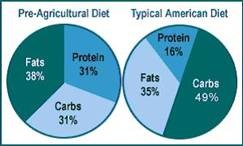
Information from The Paleo Diet (2002) by L. Cordain
The National Institutes of Health jumped on the "ban fat" wagon. In 1984, the NIH announced that Americans must cut their fat intake. The food industry quickly produced a slew of "low-fat" products. But without the tasty fat, the food produced was bland, and high amounts of sugar became a common additive. Americans replaced fat with refined carbohydrates and sugar.
The Real Cause of American Obesity
There is no question that Americans now face a health crisis. We’re too fat. But why? Any plausible answer would have to explain why rates of obesity were constant at about 13% through the 60’s and 70’s, and then suddenly began to rise. Today, 25% of the U.S. population is considered obese, while 70% of Americans are considered overweight. These rates began rising at the time the health authorities told us we must eat low-fat. There was an explosion not only of obesity, but also of related diseases like diabetes, hypertension, and heart disease.
The Growing Percentage of Overweight and Obese American Adults
Add to this mistaken low-fat theory the reality of economics, and you get a recipe for a health disaster. How much profit can you make selling an egg when everyone else can sell the exact same product? But carbs can be processed into proprietary blends. The mark-up can be much greater.
If we can divorce ourselves from the prejudice about dietary fat, it’s really quite simple. Your body controls fat building, and hormones are used to set the controls. The hormone that controls fat is insulin. And how much insulin do you secrete in response to a fat-laden meal? Zero. Insulin is secreted in response to carbohydrates, not fat. Eat more carbohydrates and you will secrete more insulin and build more fat, all other things being equal.
The Solution: Using Modern Science to Emulate the Past
The good news is that fixing this mess is not as hard as you might think. Follow a few simple rules for selecting your food, and you will be able to eat better-tasting foods, reduce your risk of disease, and feel more satisfied.
And don’t worry that eating meat is going to drive up your cholesterol. Recent studies have proven that the incorporation of lean grass-fed meat into the diet helps reduce bad LDL cholesterol and raise good HDL cholesterol levels. And it didn’t matter if it was white or red meat.
Your Simple Plan for Healthy Eating
- Make quality protein the centerpiece of every meal. This should include non-contaminated fish such as wild salmon, sardines, or young tuna, as well as grass-fed meats, poultry, and eggs.
- Eat a wide variety of herbs, leafy greens, and vegetables every day, and a moderate amount of fruit.
- Eat plenty of healthy fats. The best fats is coconut oil. Nuts, eggs, and grass-fed beef also have good fats. Use coconut oil for sautéing, searing and braising. Use raw butter for flavor and for baking., Use olive oil or coconut oil for dressings and mayonnaise. Avoid ALL vegetable oils.
- Avoid processed carbohydrates. You can make this simple: Don’t eat anything made from grains. Period.
The notion that all of us should consume lowfat diets with the same ratios of macronutrients is ridiculous. If you suffer from hypoglycemia or diabetes, or are prone to seizures, you will need more fat in your diet to keep blood sugar levels stable. If you want to lose weight, you will need to cut back on carbs. This will be easier to do if you eliminate a large portion of the carbohydrates and keep the fat percentage relatively high. If you are an athlete, farmer or laborer burning up large amounts of energy, you can eat more carbohydrates than the rest of us without gaining weight.
If you are eliminating most carbohydrate foods from your diet, then it is important to consume plenty of fat. Several researchers have reported that a diet of lean meat leads to nausea in three days, symptoms of starvation and ketosis in 7-10 days, severe debilitation in 12 days and possibly death in a few weeks. Vilhjalmur Stefansson lived for many years among the Eskimos and thrived in a diet that was 20 percent protein and 80 percent fat. When he and his colleagues tried to eat lean meat, they quickly developed diarrhea and a lack of energy.
We are a nation of severely malnourished people. Our cancer rates, heart disease, obesity, degenerative disease are all related to our very poor nutrition.
The latest research shows that we need to return to the traditional diets we have eaten for thousands of years, a diet dense in proteins, fats and lowered carbs. When the foods we eat are dense in nutrients, fewer calories are needed to maintain optimum health. Humans are not designed to exist on purified macronutrients, but need a wide variety of nutrients found in the proteins, carbohydrates and fats in real foods. In fact, animal fats are the most important of all.
Benefits of Animal Fats
Foods containing transfats sell because the American public is afraid of the alternative—saturated fats found in butter, palm and coconut oil, fats traditionally used for frying and baking. Yet the scientific literature delineates a number of vital roles for dietary saturated fats—they enhance the immune system, are necessary for healthy bones, provide energy and structural integrity to the cells, protect the liver and enhance the body’s use of essential fatty acids. Stearic acid, found in butter, has cholesterol lowering properties and is a preferred food for the heart. As saturated fats are stable, they do not become rancid easily, do not call upon the body’s reserves of antioxidants, do not initiate cancer, do not irritate the artery walls.
Your body makes saturated fats, and your body makes cholesterol—about 2000 mg per day. In general, cholesterol that the average American absorbs from food amounts to about 100 mg per day. So, in theory, even reducing animal foods to zero will result in a mere 5% decrease in the total amount of cholesterol available to the blood and tissues. In practice, such a diet is likely to deprive the body of the substrates it needs to manufacture enough of this vital substance; for cholesterol, like saturated fats, stands unfairly accused. It acts as a precursor to vital corticosteroids, hormones that help us deal with stress and protect the body against heart disease and cancer; and to the sex hormones like androgen, testosterone, estrogen and progesterone; it is a precursor to vitamin D, a vital fat-soluble vitamin needed for healthy bones and nervous system, proper growth, mineral metabolism, muscle tone, insulin production, reproduction and immune system function; it is the precursor to bile salts, which are vital for digestion and assimilation of fats in the diet. Recent research shows that cholesterol acts as an antioxidant. This is the likely explanation for the fact that cholesterol levels go up with age. As an antioxidant, cholesterol protects us against free radical damage that leads to heart disease and cancer. Cholesterol is the body’s repair substance, manufactured in large amounts when the arteries are irritated or weak. Blaming heart disease on high serum cholesterol levels is like blaming firemen who have come to put out a fire for starting the blaze.
Cholesterol is needed for proper function of serotonin receptors in the brain. Serotonin is the body’s natural "feel-good" chemical. This explains why low cholesterol levels have been linked to aggressive and violent behavior, depression and suicidal tendencies. Dietary cholesterol plays an important role in maintaining the health of the intestinal wall, which is why low-cholesterol vegetarian diets can lead to leaky gut syndrome and other intestinal disorders.
Putting together this information and applying it will help you heal and give you high clear energy for the rest of your life. It has allowed me to heal, get rid of allergies, and gain very high energy. People find their relationships improving, their sex lives get better, they return to that high, playful energy they had as a child.
I have a cookbook called In The Kitchen with Millie. It has 780 lactose, gluten and soy free recipes, and a 62 day meal. It is in software form, it lets you scale recipes and menu plans, gives nutrition analysis of each recipe and meal plan, lets you add a cookbook and recipes. Check it out here.
The Economic impact of eating organically
Posted: June 2, 2009 Filed under: Food and it's Impact on Our Health, Going Green; How and Why... Leave a comment
or·gan·ic;
1. Of, relating to, or derived from living organisms: organic matter.
2. Of, relating to, or affecting a bodily organ: an organic disease.
3. Having properties associated with living organisms.
4. Resembling a living organism in organization or development; interconnected.
Someone commented to me that it wasn’t frugal to eat organically. I guess that is true for most people who decide to eat the same, the only change being buying all the same “products”, just switching to the organic version. That will definitely cause a huge increase in the amount you spend each week.
When I say organic I mean it on a different level than simply switching brands. I think of it as doing things on the most basic levels, making things from scratch. In other words I buy FOOD, not products. A bottle of organic salad dressing is expensive. Make it from scratch and the price falls substantially. I am also not paying for the packaging it came in. I often get to Friday, trash day in my neighborhood, with nothing in my trash can to take to the curb. I buy in bulk, take my cloth bags to the store, use muslin bags for bulk items. A mango or avocado needs no package, no label. I feel disconnected from myself and the earth when I buy a box of cereal. And it’s not organic, not live. When I hold a mango in my hand, it has energy, live nutrients, it screams at you to dive in. Real organic grass fed beef gives us vitamins and minerals not present in feed-lot animals. To conserve, remember to conserve, feels like loving the earth, myself, all people. I used cloth diapers for all my kids because the cost was insane in every way, financially, environmentally, how comfy they are. To buy plastic just to throw it away has always felt like blasphemy to me! Then there is the money difference, no comparison.
But buying all organics, buying food that is intensely nutritious is really a great way to save! The huge difference is in your health. I have had very few doctor bills since I began eating to truly meet my nutrient needs. Up until 1986, when I stopped eating grains and dairy, I had constant health problems. At that point I was eating what everyone considered a perfect vegetarian diet. I got well, and have stayed well, have not had to take any antibiotics whatsoever for anything except when I had ankle surgery. Not one of my children, who range from 8 to 37, has ever had a cavity. They have rarely needed to go to the doctor.
68% of Americans are over weight. That means they are malnourished. When we eat a traditional human diet, healthy fats, meats, eggs and fruits and vegetables, we meet our nutrient needs, we don’t get sick…which saves a tremendous amount of money on doctor bills, prescriptions, lost days from work. When we eat well we have plenty of energy which impacts how effective we are as people. It impacts our relationships. It effects how mentally alert we are, how organized we are…and how happy we are. Not getting enough healthy saturated fats leads to depression, hormone imbalances, an impaired immune system, obesity. Foods that are nutrient deficient (grains, flours, dairy) take the place in the body from foods that actually make us healthier.
Eating organically, simply, is good for us and the planet.
Growing potatoes
Posted: June 1, 2009 Filed under: Gardening Leave a commentI use a barrel cut in half to grow sweet potatoes, so far, but I am going to build one of these…
Article from Green Roof Growers

Potato Box
I have a small strip of land that gets 6 hours of sun a day. It’s the perfect spot to try growing potatoes. Vertically. In a box.
I got the idea from this article in the Seattle Times. The hook is that you can grow a lot of potatoes in a tiny space; just what I need.
Greg Lutovsky, who has been growing potatoes as a business since 1993, says you can grow 100 pounds of potatoes in 4 square feet. All it takes is some lumber, seed potatoes and careful attention to watering.
The story was enough to get me started, but it’s a little short on practical advice. For that I turned to Sinfonian, who meticulously documented his potato-in-a-box efforts last year.
The idea is to pile up soil around the growing potato vine, adding more soil–and boards to the side of the box–as the vines get taller. Potatoes will grow between the seed piece and the above ground plant.
When the plants start flowering, after about 100 days, you can remove a board or two from the bottom and fish out a couple of potatoes. Or you can wait until frost kills the plant in the fall and harvest them all at once. There are plenty of sites that explain
how to store potatoes. With a bit of luck, I’ll be doing that this fall.
If you want to grow vertically, there are several alternatives to choose from: grow bags, wire cages, stacked tires, large containers. All had drawbacks, so I chose to make my 3’x3′ bin out of cedar fencing boards and southern yellow pine. I gave all the pieces a coat of linseed oil, hoping that this will protect the wood from rotting.
I bought, and then chitted, 3 pounds of Inca Gold seed potatoes from Ronniger Potato Farm. Inca Gold are late season potatoes, an important detail for this type of growing. According to Sinfonian, early season varieties only set fruit once, making them bad candidates for potato towers. You’ll end up with a few at the bottom of the box and that’s it.
I just planted my seed potatoes today. As they grow, I’ll add more cedar boards to the sides of my box and cover them with dirt. 


 Meal Delivery Service by Millie Barnes