The Hadza- What We Can Learn From Them
Posted: November 17, 2009 Filed under: Food and it's Impact on Our Health 3 CommentsAgriculture’s sudden rise, however, came with a price. It introduced infectious-disease epidemics, social stratification, intermittent famines, and large-scale war. Jared Diamond, the UCLA professor and writer, has called the adoption of agriculture nothing less than "the worst mistake in human history"—a mistake, he suggests, from which we have never recovered.
(Notice GRAINS are NOT part of the diet!)
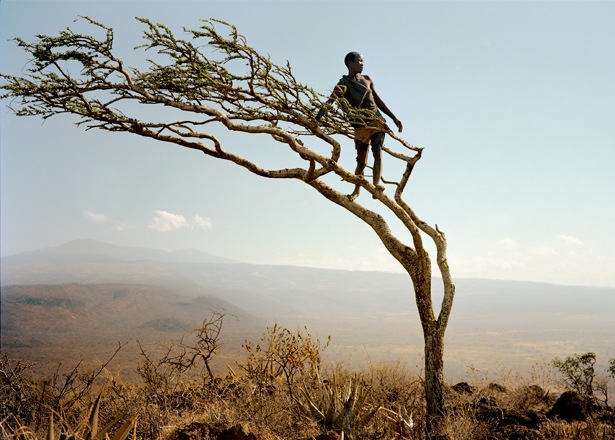
The Hadza
They grow no food, raise no livestock, and live without rules or calendars. They are living a hunter-gatherer existence that is little changed from 10,000 years ago. What do they know that we’ve forgotten?
 By Michael Finkel at National Geographic
"I’m hungry," says Onwas, squatting by his fire, blinking placidly through the smoke. The men beside him murmur in assent. It’s late at night, deep in the East African bush. Singing, a rhythmic chant, drifts over from the women’s camp. Onwas mentions a tree he spotted during his daytime travels. The men around the fire push closer. It is in a difficult spot, Onwas explains, at the summit of a steep hill that rises from the grassy plain. But the tree, he adds, spreading his arms wide like branches, is heavy with baboons. There are more murmurs. Embers rise to a sky infinite with stars. And then it is agreed. Everyone stands and grabs his hunting bow.
Onwas is an old man, perhaps over 60—years are not a unit of time he uses—but thin and fit in the Hadza way. He’s maybe five feet tall. Across his arms and chest are the hieroglyphs of a lifetime in the bush: scars from hunts, scars from snakebites, scars from arrows and knives and scorpions and thorns. Scars from falling out of a baobab tree. Scars from a leopard attack. Half his teeth remain. He is wearing tire-tread sandals and tattered brown shorts. A hunting knife is strapped to his hip, in a sheath made of dik-dik hide. He’s removed his shirt, as have most of the other men, because he wants to blend into the night.
Onwas looks at me and speaks for a few moments in his native language, Hadzane. To my ear it sounds strangely bipolar—lilting and gentle for a phrase or two, then jarring and percussive, with tongue clicks and glottic pops. It’s a language not closely related to any other that still exists: to use the linguists’ term, an isolate.
I have arrived in the Hadza homeland in northern Tanzania with an interpreter, a Hadza woman named Mariamu. She is Onwas’s niece. She attended school for 11 years and is one of only a handful of people in the world who can speak both English and Hadzane. She interprets Onwas’s words: Do I want to come?
Merely getting this far, to a traditional Hadza encampment, is not an easy task. Years aren’t the only unit of time the Hadza do not keep close track of—they also ignore hours and days and weeks and months. The Hadza language doesn’t have words for numbers past three or four. Making an appointment can be a tricky matter. But I had contacted the owner of a tourist camp not far outside the Hadza territory to see if he could arrange for me to spend time with a remote Hadza group. While on a camping trip in the bush, the owner came across Onwas and asked him, in Swahili, if I might visit. The Hadza tend to be gregarious people, and Onwas readily agreed. He said I’d be the first foreigner ever to live in his camp. He promised to send his son to a particular tree at the edge of the bush to meet me when I was scheduled to arrive, in three weeks.
Sure enough, three weeks later, when my interpreter and I arrived by Land Rover in the bush, there was Onwas’s son Ngaola waiting for us. Apparently, Onwas had noted the stages of the moon, and when he felt enough time had passed, he sent his son to the tree. I asked Ngaola if he’d waited a long time for me. "No," he said. "Only a few days."
At first, it was clear that everyone in camp—about two dozen Hadza, ranging from infants to grandparents—felt uncomfortable with my presence. There was a lot of staring, some nervous laughs. I’d brought along a photo album, and passing it around helped mitigate the awkwardness. Onwas was interested in a picture of my cat. "How does it taste?" he asked. One photo captured everyone’s attention. It was of me participating in a New Year’s Day polar bear swim, leaping into a hole cut in a frozen lake. Hadza hunters can seem fearless; Onwas regularly sneaks up on leopards and races after giraffes. But the idea of winter weather terrified him. He ran around camp with the picture, telling everyone I was a brave man, and this helped greatly with my acceptance. A man who can leap into ice, Onwas must have figured, is certainly a man who’d have no trouble facing a wild baboon. So on the third night of my stay, he asks if I want to join the hunting trip.
I do. I leave my shirt on—my skin does not blend well with the night—and I follow Onwas and ten other hunters and two younger boys out of camp in a single-file line. Walking through Hadza country in the dark is challenging; thorn bushes and spiked acacia trees dominate the terrain, and even during the day there is no way to avoid being jabbed and scratched and punctured. A long trek in the Hadza bush can feel like receiving a gradual full-body tattoo. The Hadza spend a significant portion of their rest time digging thorns out of one another with the tips of their knives.
At night the thorns are all but invisible, and navigation seems impossible. There are no trails and few landmarks. To walk confidently in the bush, in the dark, without a flashlight, requires the sort of familiarity one has with, say, one’s own bedroom. Except this is a thousand-square-mile bedroom, with lions and leopards and hyenas prowling in the shadows.
For Onwas such navigation is no problem. He has lived all his life in the bush. He can start a fire, twirling a stick between his palms, in less than 30 seconds. He can converse with a honeyguide bird, whistling back and forth, and be led directly to a teeming beehive. He knows everything there is to know about the bush and virtually nothing of the land beyond. One time I showed Onwas a map of the world. I spread it open on the dirt and anchored the corners with stones. A crowd gathered. Onwas stared. I pointed out the continent of Africa, then the country of Tanzania, then the region where he lived. I showed him the United States.
I asked him what he knew about America—the name of the president, the capital city. He said he knew nothing. He could not name the leader of his own country. I asked him, as politely as possible, if he knew anything about any country. He paused for a moment, evidently deep in thought, then suddenly shouted, "London!" He couldn’t say precisely what London was. He just knew it was someplace not in the bush.
About a thousand Hadza live in their traditional homeland, a broad plain encompassing shallow, salty Lake Eyasi and sheltered by the ramparts of the Great Rift Valley. Some have moved close to villages and taken jobs as farmhands or tour guides. But approximately one-quarter of all Hadza, including those in Onwas’s camp, remain true hunter-gatherers. They have no crops, no livestock, no permanent shelters. They live just south of the same section of the valley in which some of the oldest fossil evidence of early humans has been found. Genetic testing indicates that they may represent one of the primary roots of the human family tree—perhaps more than 100,000 years old.
What the Hadza appear to offer—and why they are of great interest to anthropologists—is a glimpse of what life may have been like before the birth of agriculture 10,000 years ago. Anthropologists are wary of viewing contemporary hunter-gatherers as "living fossils," says Frank Marlowe, a Florida State University professor of anthropology who has spent the past 15 years studying the Hadza. Time has not stood still for them. But they have maintained their foraging lifestyle in spite of long exposure to surrounding agriculturalist groups, and, says Marlowe, it’s possible that their lives have changed very little over the ages.
For more than 99 percent of the time since the genus Homo arose two million years ago, everyone lived as hunter-gatherers. Then, once plants and animals were domesticated, the discovery sparked a complete reorganization of the globe. Food production marched in lockstep with greater population densities, which allowed farm-based societies to displace or destroy hunter-gatherer groups. Villages were formed, then cities, then nations. And in a relatively brief period, the hunter-gatherer lifestyle was all but extinguished. Today only a handful of scattered peoples—some in the Amazon, a couple in the Arctic, a few in Papua New Guinea, and a tiny number of African groups—maintain a primarily hunter-gatherer existence. Agriculture’s sudden rise, however, came with a price. It introduced infectious-disease epidemics, social stratification, intermittent famines, and large-scale war. Jared Diamond, the UCLA professor and writer, has called the adoption of agriculture nothing less than "the worst mistake in human history"—a mistake, he suggests, from which we have never recovered.
The Hadza do not engage in warfare. They’ve never lived densely enough to be seriously threatened by an infectious outbreak. They have no known history of famine; rather, there is evidence of people from a farming group coming to live with them during a time of crop failure. The Hadza diet remains even today more stable and varied than that of most of the world’s citizens. They enjoy an extraordinary amount of leisure time. Anthropologists have estimated that they "work"—actively pursue food—four to six hours a day. And over all these thousands of years, they’ve left hardly more than a footprint on the land.
Traditional Hadza, like Onwas and his camp mates, live almost entirely free of possessions. The things they own—a cooking pot, a water container, an ax—can be wrapped in a blanket and carried over a shoulder. Hadza women gather berries and baobab fruit and dig edible tubers. Men collect honey and hunt. Nighttime baboon stalking is a group affair, conducted only a handful of times each year; typically, hunting is a solo pursuit. They will eat almost anything they can kill, from birds to wildebeest to zebras to buffalo. They dine on warthog and bush pig and hyrax. They love baboon; Onwas joked to me that a Hadza man cannot marry until he has killed five baboons. The chief exception is snakes. The Hadza hate snakes.
The poison the men smear on their arrowheads, made of the boiled sap of the desert rose, is powerful enough to bring down a giraffe. But it cannot kill a full-grown elephant. If hunters come across a recently dead elephant, they will crawl inside and cut out meat and organs and fat and cook them over a fire. Sometimes, rather than drag a large animal back to camp, the entire camp will move to the carcass.
Hadza camps are loose affiliations of relatives and in-laws and friends. Each camp has a few core members—Onwas’s two sons, Giga and Ngaola, are often with him—but most others come and go as they please. The Hadza recognize no official leaders. Camps are traditionally named after a senior male (hence, Onwas’s camp), but this honor does not confer any particular power. Individual autonomy is the hallmark of the Hadza. No Hadza adult has authority over any other. None has more wealth; or, rather, they all have no wealth. There are few social obligations—no birthdays, no religious holidays, no anniversaries.
People sleep whenever they want. Some stay up much of the night and doze during the heat of the day. Dawn and dusk are the prime hunting times; otherwise, the men often hang out in camp, straightening arrow shafts, whittling bows, making bowstrings out of the ligaments of giraffes or impalas, hammering nails into arrowheads. They trade honey for the nails and for colorful plastic and glass beads that the women fashion into necklaces. If a man receives one as a gift, it’s a good sign he has a female admirer.
There are no wedding ceremonies. A couple that sleeps at the same fire for a while may eventually refer to themselves as married. Most of the Hadza I met, men and women alike, were serial monogamists, changing spouses every few years. Onwas is an exception; he and his wife, Mille, have been with each other all their adult lives, and they have seven living children and several grandchildren. There was a bevy of children in the camp, with the resident grandmother, a tiny, cheerful lady named Nsalu, running a sort of day care while the adults were in the bush. Except for breast-feeding infants, it was hard to determine which kids belonged to which parents.
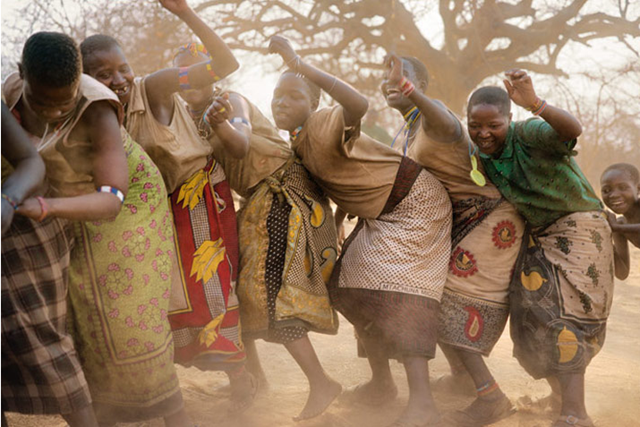
Gender roles are distinct, but for women there is none of the forced subservience knit into many other cultures. A significant number of Hadza women who marry out of the group soon return, unwilling to accept bullying treatment. Among the Hadza, women are frequently the ones who initiate a breakup—woe to the man who proves himself an incompetent hunter or treats his wife poorly. In Onwas’s camp, some of the loudest, brashest members were women. One in particular, Nduku, appointed herself my language teacher and spent a good percentage of every lesson teasing me mercilessly, often rolling around in laughter as I failed miserably at reproducing the distinct, tongue-tricky clicks.
Onwas knows of about 20 Hadza groups roaming the bush in his area, constantly swapping members, like a giant square dance. Most conflicts are resolved by the feuding parties simply separating into different camps. If a hunter brings home a kill, it is shared by everyone in his camp. This is why the camp size is usually no more than 30 people—that’s the largest number who can share a good-size game animal or two and feel decently sated.
I was there during the six-month dry season, May through October, when the Hadza sleep in the open, wrapped in a thin blanket beside a campfire—two to six people at each hearth, eight or nine fires spread in a wide semicircle fronting a brush-swept common area. The sleep groupings were various: families, single men, young women (with an older woman as minder), couples. During the rainy season, they construct little domed shelters made of interwoven twigs and long grasses: basically, upside-down bird’s nests. To build one takes no more than an hour. They move camp roughly once a month, when the berries run low or the hunting becomes tough or there’s a severe sickness or death.
No one sleeps alone in Onwas’s camp. He assigned his son Ngaola, the one who had waited a few days by the tree, to stay with me, and Ngaola recruited his friend Maduru to join us. The three of us slept in a triangle, head to toe to head around our fire, though when the mosquitoes were fierce, I slept in my tent.
Ngaola is quiet and introspective and a really poor hunter. He’s about 30 years old and still unmarried; bedeviled, perhaps, by the five-baboon rule. It pains him that his older brother, Giga, is probably the most skilled archer in camp. Maduru is a solid outdoorsman, an especially good honey finder, but something of a Hadza misfit. When a natural snakebite remedy was passed around camp, Maduru was left out of the distribution. This upset him greatly, and Onwas had to spend an hour beside him, an arm slung avuncularly over his shoulder, calming him down.
Maduru is the one who assumes responsibility for me during the nighttime baboon quest. As we move through the bush, he snaps off eye-level acacia branches with thorns the size of toothpicks and repeatedly checks to make sure I’m keeping pace. Onwas leads us to the hill where he’d seen the tree full of baboons.
Here we stop. There are hand signals, some clipped chatter. I’m unsure of what is going on—my translator has remained back at camp. The hunt is only for men. But Maduru taps me on the shoulder and motions for me to follow. The other hunters begin fanning out around the base of the hill, and I tail Maduru as he plunges into the brush and starts to climb. The slope seems practically vertical—hands are required to haul yourself up—and the thickets are as dense as Brillo pads. Thorns slice into my hands, my face. A trickle of blood oozes into my eye. We climb. I follow Maduru closely; I do not want to become separated.
Finally, I understand. We are climbing up, from all sides, toward the baboons. We are trying to startle them, to make them run. From the baboons’ perch atop the hill, there is no place to go but down. The Hadza have encircled the hill; therefore, the baboons will be running toward the hunters. Possibly toward Maduru and me.
Have you ever seen a baboon up close? They have teeth designed for ripping flesh. An adult male can weigh more than 80 pounds. And here we are, marching upward, purposely trying to provoke them. The Hadza are armed with bows and arrows. I have a pocketknife.
We move higher. Maduru and I break out of the undergrowth and onto the rocks. I feel as though I’ve emerged from beneath a blanket. There is a sickle of moon, a breeze. We are near the summit—the top is just over a stack of boulders, maybe 20 feet above our head. The baboon tree is up there, barely out of eyesight.
Then I hear it—a crazed screeching sound. The baboons are aware that something is amiss. The sound is piercing, panicked. I do not speak baboon, but it is not difficult to interpret. Go away! Do not come closer! But Maduru clambers farther, up onto a flat rock. I follow. The baboons are surrounded, and they seem to sense it.
Abruptly, there’s a new sound. The crack of branches snapping overhead. The baboons are descending, shrieking. Maduru freezes, drops to one knee, slides an arrow into position, pulls back the bowstring. He is ready. I’m hiding behind him. I hope, I fervently hope, that no baboons run at us. I reach into my pocket, pull out my knife, unfold it. The blade is maybe two inches long. It feels ridiculous, but that is what I do.
The screeching intensifies. And then, directly over us, in stark silhouette against the backdrop of stars, is a baboon. Scrambling. Moving along the rock’s lip. Maduru stands, takes aim, tracking the baboon from left to right, the arrow slotted, the bowstring at maximum stretch. Every muscle in my body tenses. My head pulses with panic. I grip my knife.
The chief reason the Hadza have been able to maintain their lifestyle so long is that their homeland has never been an inviting place. The soil is briny; fresh water is scarce; the bugs can be intolerable. For tens of thousands of years, it seems, no one else wanted to live here. So the Hadza were left alone. Recently, however, escalating population pressures have brought a flood of people into Hadza lands. The fact that the Hadza are such gentle stewards of the land has, in a way, hurt them—the region has generally been viewed by outsiders as empty and unused, a place sorely in need of development. The Hadza, who by nature are not a combative people, have almost always moved away rather than fight. But now there is nowhere to retreat.
There are currently cattle herders in the Hadza bush, and goat herders, and onion farmers, and corn growers, and sport hunters, and game poachers. Water holes are fouled by cow excrement. Vegetation is trampled beneath cattle’s hooves. Brush is cleared to make way for crops; scarce water is used to irrigate them. Game animals have migrated to national parks, where the Hadza can’t follow. Berry groves and trees that attract bees have been destroyed. Over the past century, the Hadza have lost exclusive possession of as much as 90 percent of their homeland.
None of the other ethnic groups living in the area—the Datoga, the Iraqw, the Isanzu, the Sukuma, the Iramba—are hunter-gatherers. They live in mud huts, often surrounded by livestock enclosures. Many of them look down on the Hadza and view them with a mix of pity and disgust: the untouchables of Tanzania. I once watched as a Datoga tribesman prevented several Hadza women from approaching a communal water hole until his cows had finished drinking.
Dirt roads are now carved into the edges of the Hadza bush. A paved road is within a four-day walk. From many high points there is decent cell phone reception. Most Hadza, including Onwas, have learned to speak some Swahili, in order to communicate with other groups. I was asked by a few of the younger Hadza hunters if I could give them a gun, to make it easier to harvest game. Onwas himself, though he’s scarcely ventured beyond the periphery of the bush, senses that profound changes are coming. This does not appear to bother him. Onwas, as he repeatedly told me, doesn’t worry about the future. He doesn’t worry about anything. No Hadza I met, in fact, seemed prone to worry. It was a mind-set that astounded me, for the Hadza, to my way of thinking, have very legitimate worries. Will I eat tomorrow? Will something eat me tomorrow? Yet they live a remarkably present-tense existence.
This may be one reason farming has never appealed to the Hadza—growing crops requires planning; seeds are sown now for plants that won’t be edible for months. Domestic animals must be fed and protected long before they’re ready to butcher. To a Hadza, this makes no sense. Why grow food or rear animals when it’s being done for you, naturally, in the bush? When they want berries, they walk to a berry shrub. When they desire baobab fruit, they visit a baobab tree. Honey waits for them in wild hives. And they keep their meat in the biggest storehouse in the world—their land. All that’s required is a bit of stalking and a well-shot arrow.
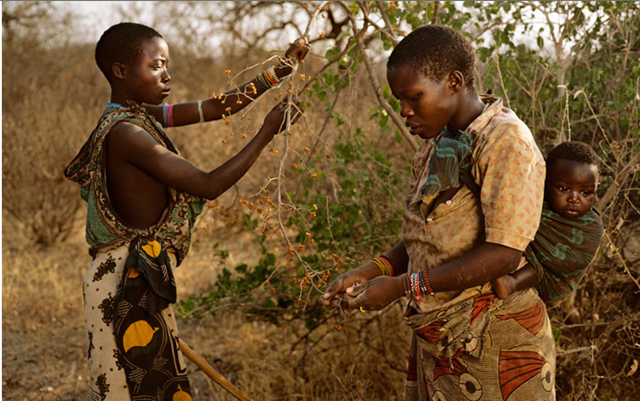
There are other people, however, who do ponder the Hadza’s future. Officials in the Tanzanian government, for starters. Tanzania is a future-oriented nation, anxious to merge into the slipstream of the global economy. Baboon-hunting bushmen is not an image many of the country’s leaders wish to project. One minister has referred to the Hadza as backward. Tanzania’s president, Jakaya Kikwete, has said that the Hadza "have to be transformed." The government wants them schooled and housed and set to work at proper jobs.
Even the one Hadza who has become the group’s de facto spokesperson, a man named Richard Baalow, generally agrees with the government’s aims. Baalow, who adopted a non-Hadza first name, was one of the first Hadza to attend school. In the 1960s his family lived in government-built housing—an attempt at settling the Hadza that soon failed. Baalow, 53, speaks excellent English. He wants the Hadza to become politically active, to fight for legal protection of their land, and to seek jobs as hunting guides or park rangers. He encourages Hadza children to attend the regional primary school that provides room and board to Hadza students during the academic year, then escorts them back to the bush when school is out.
The school-age kids I spoke with in Onwas’s group all said they had no interest in sitting in a classroom. If they went to school, many told me, they’d never master the skills needed for survival. They’d be outcasts among their own people. And if they tried their luck in the modern world—what then? The women, perhaps, could become maids; the men, menial laborers. It’s far better, they said, to be free and fed in the bush than destitute and hungry in the city.
More Hadza have moved to the traditionally Hadza area of Mangola, at the edge of the bush, where, in exchange for money, they demonstrate their hunting skills to tourists. These Hadza have proved that their culture is of significant interest to outsiders and a potential source of income. Yet among the Hadza of Mangola there has also been a surge in alcoholism, an outbreak of tuberculosis, and a distressing rise in domestic violence, including at least one report of a Hadza man who beat his wife to death.
Though the youngsters in Onwas’s group show little interest in the outside world, the world is coming to them. After two million years, the age of the hunter-gatherer is over. The Hadza may hold on to their language; they may demonstrate their abilities to tourists. But it’s only a matter of time before there are no more traditional Hadza scrambling in the hills with their bows and arrows, stalking baboons.
Up on the hill Onwas has led us to, clutching my knife, I crouch behind Maduru as the baboon moves along a fin of rock. And then, abruptly, the baboon stops. He swivels his head. He is so close we could reach out to each other and make contact. I stare into his eyes, too frightened to even blink. This lasts maybe a second. Maduru doesn’t shoot, possibly because the animal is too close and could attack us if wounded—it’s often the poison, not the arrow, that kills. An instant later the baboon leaps away into the bushes.
There is silence for a couple of heartbeats. Then I hear frantic yelping and crashing. It’s coming from the far side of the rock, and I can’t tell if it is human or baboon. It’s both. We thrash through bushes, half-tumbling, half-running, until we reach a clearing amid a copse of acacias.
And there it is: the baboon. On his back, mouth open, limbs splayed. Shot by Giga. A nudge with a toe confirms it—dead. Maduru whistles and shouts, and soon the other hunters arrive. Onwas kneels and pulls the arrow out of the baboon’s shoulder and hands it back to Giga. The men stand around the baboon in a circle, examining the kill. There is no ceremony. The Hadza are not big on ritual. There is not much room in their lives, it seems, for mysticism, for spirits, for pondering the unknown. There is no specific belief in an afterlife—every Hadza I spoke with said he had no idea what might happen after he died. There are no Hadza priests or shamans or medicine men. Missionaries have produced few converts. I once asked Onwas to tell me about God, and he said that God was blindingly bright, extremely powerful, and essential for all life. God, he told me, was the sun.
The most important Hadza ritual is the epeme dance, which takes place on moonless nights. Men and women divide into separate groups. The women sing while the men, one at a time, don a feathered headdress and tie bells around their ankles and strut about, stomping their right foot in time with the singing. Supposedly, on epeme nights, ancestors emerge from the bush and join the dancing. One night when I watched the epeme, I spotted a teenage boy, Mataiyo, sneak into the bush with a young woman. Other men fell asleep after their turn dancing. Like almost every aspect of Hadza life, the ceremony was informal, with a strictly individual choice of how deeply to participate.
With the Hadza god not due to rise for several hours, Giga grabs the baboon by a rear paw and drags the animal through the bush back to camp. The baboon is deposited by Onwas’s fire, while Giga sits quietly aside with the other men. It is Hadza custom that the hunter who’s made the kill does not show off. There is a good deal of luck in hunting, and even the best archers will occasionally face a long dry spell. This is why the Hadza share their meat communally.
Onwas’s wife, Mille, is the first to wake. She’s wearing her only set of clothes, a sleeveless T-shirt and a flower-patterned cloth wrapped about her like a toga. She sees the baboon, and with the merest sign of pleasure, a brief nod of her chin, she stokes the fire. It’s time to cook. The rest of camp is soon awake—everyone is hungry—and Ngaola skins the baboon and stakes out the pelt with sharpened twigs. The skin will be dry in a few days and will make a fine sleeping mat. A couple of men butcher the animal, and cuts of meat are distributed. Onwas, as camp elder, is handed the greatest delicacy: the head.
The Hadza cooking style is simple—the meat is placed directly on the fire. No grill, no pan. Hadza mealtime is not an occasion for politeness. Personal space is generally not recognized; no matter how packed it is around a fire, there’s always room for one more, even if you end up on someone’s lap. Once a cut of meat has finished cooking, anyone can grab a bite.
And I mean grab. When the meat is ready, knives are unsheathed and the frenzy begins. There is grasping and slicing and chewing and pulling. The idea is to tug at a hunk of meat with your teeth, then use your knife to slice away your share. Elbowing and shoving is standard behavior. Bones are smashed with rocks and the marrow sucked out. Grease is rubbed on the skin as a sort of moisturizer. No one speaks a word, but the smacking of lips and gnashing of teeth is almost comically loud.
I’m ravenous, so I dive into the scrum and snatch up some meat. Baboon steak, I have to say, isn’t terrible—a touch gamy, but it’s been a few days since I’ve eaten protein, and I can feel my body perking up with every bite. Pure fat, rather than meat, is what the Hadza crave, though most coveted are the baboon’s paw pads. I snag a bit of one and pop it in my mouth, but it’s like trying to swallow a pencil eraser. When I spit the gob of paw pad out, a young boy instantly picks it up and swallows it.
Onwas, with the baboon’s head, is comfortably above the fray. He sits cross-legged at his fire and eats the cheeks, the eyeballs, the neck meat, and the forehead skin, using the soles of his sandals as a cutting board. He gnaws the skull clean to the bone, then plunges it into the fire and calls me and the hunters over for a smoke.
It is impossible to overstate just how much Onwas—and most Hadza—love to smoke. The four possessions every Hadza man owns are a bow, some arrows, a knife, and a pipe, made from a hollowed-out, soft stone. The smoking material, tobacco or cannabis, is acquired from a neighboring group, usually the Datoga, in exchange for honey. Onwas has a small amount of tobacco, which is tied into a ball inside his shirttail. He retrieves it, stuffs it all into his pipe, and then, holding the pipe vertically, plucks an ember from the fire and places it atop his pipe. Pulsing his cheeks in and out like a bellows, he inhales the greatest quantity of smoke he possibly can. He passes the pipe to Giga.
Then the fun begins. Onwas starts to cough, slowly at first, then rapidly, then uncontrollably with tears bursting from his eyes, then with palms pushing against his head, and then, finally, rolling onto his back, spitting and gasping for air. In the meantime, Giga has begun a similar hacking session and has passed the pipe to Maduru, who then passes the pipe to me. Soon, all of us, the whole circle of men, are hacking and crying and rolling on our backs. The smoke session ends when the last man sits up, grinning, and brushes the dirt from his hair.
With the baboon skull still in the fire, Onwas rises to his feet and claps his hands and begins to speak. It’s a giraffe-hunting story—Onwas’s favorite kind. I know this even though Mariamu, my translator, is not next to me. I know because Onwas, like many Hadza, is a story performer. There are no televisions or board games or books in Onwas’s camp. But there is entertainment. The women sing songs. And the men tell campfire stories, the Kabuki of the bush.
Onwas elongates his neck and moves around on all fours when he’s playing the part of the giraffe. He jumps and ducks and pantomimes shooting a bow when he’s illustrating his own role. Arrows whoosh. Beasts roar. Children run to the fire and stand around, listening intently; this is their schooling. The story ends with a dead giraffe—and as a finale, a call and response.
"Am I a man?" asks Onwas, holding out his hands.
"Yes!" shouts the group. "You are a man."
"Am I a man?" asks Onwas again, louder.
"Yes!" shouts the group, their voices also louder. "You are a man!"
Onwas then reaches into the fire and pulls out the skull. He hacks it open, like a coconut, exposing the brains, which have been boiling for a good hour inside the skull. They look like ramen noodles, yellowish white, lightly steaming. He holds the skull out, and the men, including myself, surge forward and stick our fingers inside the skull and scoop up a handful of brains and slurp them down. With this, the night, at last, comes to an end.
The baboon hunt, it seems, was something of an initiation for me. The next day, Nyudu hacks down a thick branch from a mutateko tree, then carefully carves a bow for me, long and gracefully curved. Several other men make me arrows. Onwas presents me with a pipe. Nkulu handles my shooting lessons. I begin to carry my bow and arrows and pipe with me wherever I go (along with my water-purification kit, my sunscreen, my bug spray, and my eyeglass-cleaning cloth).
I am also invited to bathe with the men. We walk to a shallow, muddy hole—more of a large puddle, with lumps of cow manure bobbing about—and remove our clothes. Handfuls of mud are rubbed against the skin as an exfoliant, and we splash ourselves clean. While Hadza have a word for body odor, the men tell me that they prefer their women not to bathe—the longer they go between baths, they say, the more attractive they are. Nduku, my Hadza language teacher, said she sometimes waits months between baths, though she can’t understand why her husband wants her that way. I also discover, by listening to Mille and Onwas, that bickering with one’s spouse is probably a universal human trait. "Isn’t it your turn to fetch water?" "Why are you napping instead of hunting?" "Can you explain why the last animal brought to camp was skinned so poorly?" It occurs to me that these same arguments, in this same valley, have been taking place for thousands of years.
There are things I envy about the Hadza—mostly, how free they appear to be. Free from possessions. Free of most social duties. Free from religious strictures. Free of many family responsibilities. Free from schedules, jobs, bosses, bills, traffic, taxes, laws, news, and money. Free from worry. Free to burp and fart without apology, to grab food and smoke and run shirtless through the thorns.
But I could never live like the Hadza. Their entire life, it appears to me, is one insanely committed camping trip. It’s incredibly risky. Medical help is far away. One bad fall from a tree, one bite from a black mamba snake, one lunge from a lion, and you’re dead. Women give birth in the bush, squatting. About a fifth of all babies die within their first year, and nearly half of all children do not make it to age 15. They have to cope with extreme heat and frequent thirst and swarming tsetse flies and malaria-laced mosquitoes.
The days I spent with the Hadza altered my perception of the world. They instilled in me something I call the "Hadza effect"—they made me feel calmer, more attuned to the moment, more self-sufficient, a little braver, and in less of a constant rush. I don’t care if this sounds maudlin: My time with the Hadza made me happier. It made me wish there was some way to prolong the reign of the hunter-gatherers, though I know it’s almost certainly too late.
It was my body, more than anything, that let me know it was time to leave the bush. I was bitten and bruised and sunburned and stomachachy and exhausted. So, after two weeks, I told everyone in camp I had to go.
There was little reaction. The Hadza are not sentimental like that. They don’t do extended goodbyes. Even when one of their own dies, there is not a lot of fuss. They dig a hole and place the body inside. A generation ago, they didn’t even do that—they simply left a body out on the ground to be eaten by hyenas. There is still no Hadza grave marker. There is no funeral. There’s no service at all, of any sort. This could be a person they had lived with their entire life. Yet they just toss a few dry twigs on top of the grave. And they walk away.
PRETTY Quick Dutch Apple Crisp- gLUTEN fREE
Posted: November 16, 2009 Filed under: In The Kitchen with Millie- How To's Leave a commentThis quick variation on Dutch Apple Pie eliminates the pie crust, allowing you to have dessert on the table in less than an hour.

Apple Filling
2 1/2 pounds Granny Smith apples (about 5 medium)
2 pounds McIntosh apples (about 4 medium)
1/4 cup granulated sugar
1/2 teaspoon ground cinnamon
1/8 teaspoon table salt
2 tablespoons unsalted butter
3/4 cup golden raisins
1/2 cup coconut cream or buy canned coconut milk, use just the creamy part, after letting the can settle.
Streusel Topping
1 cup Rice flour
1/4 cups Tapioca flour
1/3 cup packed light brown sugar
1/3 cup granulated sugar
1 tablespoon cornmeal
7 tablespoons unsalted butter , melted
1. Adjust oven rack to lower-middle position and heat oven to 425 degrees.
2. For the apple filling: Peel, quarter, and core apples; slice each quarter crosswise into pieces 1/4-inch thick. Toss apples, sugar, cinnamon, and salt in large bowl to combine. Heat butter in large Dutch oven over high heat until foaming subsides; add apples and toss to coat. Reduce heat to medium-high and cook, covered, stirring occasionally, until apples are softened, about 5 minutes. Stir in raisins; cook, covered, stirring occasionally, until Granny Smith apple slices are tender and McIntosh apple slices are softened and beginning to break down, about 5 minutes longer.
3. Set large colander over large bowl; transfer cooked apples to colander. Shake colander and toss apples to drain off as much juice as possible. Bring drained juice and coconut cream to boil in now-empty Dutch oven over high heat; cook, stirring occasionally, until thickened and wooden spoon leaves trail in mixture, about 5 minutes. Transfer apples to 8-inch square baking dish; pour reduced juice mixture over and smooth with rubber spatula.
4. For the streusel topping: Combine flour, sugars, and cornmeal in medium bowl; drizzle with melted butter and toss with fork until evenly moistened and mixture forms many large chunks with pea-sized pieces mixed throughout. Line rimmed baking sheet with parchment paper and spread streusel in even layer on baking sheet. Bake streusel until golden brown, about 5 minutes; cool baking sheet with streusel on wire rack until cool enough to handle, about 5 minutes. Sprinkle streusel evenly over pie filling. Set pie plate on now-empty baking sheet and bake until streusel topping is deep golden brown, about 10 minutes. Cool on wire rack and serve.
Too Much Fructose Could Leave Dieters Sugar Shocked
Posted: November 14, 2009 Filed under: Food and it's Impact on Our Health Leave a commentFrom Science Daily

Millie; This article say, “Dieters should focus on limiting the amount of fructose they eat instead of cutting out starchy foods such as bread, rice and potatoes, report the researchers, who propose using new dietary guidelines based on fructose to gauge how healthy foods are”.
ARE THEY CRAZY?? This is awful advice! They should cut out fructose INSTEAD of bread, pastas and potatoes. surely they mean IN ADDITION TO.
ScienceDaily (Dec. 14, 2007) — Here’s one tip for how to eat at the holidays: Don’t take your cues from Santa. The sugary cookies and fat-laden fruitcakes the mythical North Pole resident eats are a no-no. But you don’t have to go no-carb to stay fit at the holidays, either, University of Florida researchers say.
In fact, many dieters may actually be cutting out the wrong foods altogether, according to findings from a UF paper published recently in the European Journal of Nutrition. Dieters should focus on limiting the amount of fructose they eat instead of cutting out starchy foods such as bread, rice and potatoes, report the researchers, who propose using new dietary guidelines based on fructose to gauge how healthy foods are.
"There’s a fair amount of evidence that starch-based foods don’t cause weight gain like sugar-based foods and don’t cause the metabolic syndrome like sugar-based foods," said Dr. Richard Johnson, the senior author of the report, which reviewed several recent studies on fructose and obesity. "Potatoes, pasta, rice may be relatively safe compared to table sugar. A fructose index may be a better way to assess the risk of carbohydrates related to obesity."
They are dead wrong here, those foods ARE converted to sugar almost immediately and then to fats. Part of the reason is that Americans LIVE ON CARBS! Start looking in people grocery carts. Over 50% will tell you they do low fat and don’t eat red meat. What’s in thier carts? Bread, cereal, granola, granola bars, nuts, chips, cookies, sodas, energy drinks, baked goods, sports drinks..all mostly carbs. Son they eat low fat, low protein and high carb…and they are overweight, obese even…68% of them.
Many diets — including the low-carb variety — are based on the glycemic index, which measures how foods affect blood glucose levels. Because starches convert to glucose in the body, these diets tend to limit foods such as rice and potatoes.
While table sugar is composed of both glucose and fructose, fructose seems to be the more dangerous part of the equation, UF researchers say. Eating too much fructose causes uric acid levels to spike, which can block the ability of insulin to regulate how body cells use and store sugar and other nutrients for energy, leading to obesity, metabolic syndrome and type 2 diabetes, said Johnson, the division chief of nephrology and the J. Robert Cade professor of nephrology in the UF College of Medicine. UF researchers first detailed the role of uric acid on insulin resistance and obesity in a 2005 study in rats.
"Certainly we don’t think fructose is the only cause of the obesity epidemic," Johnson said. "Too many calories, too much junk food and too much high-fat food are also part of the problem. But we think that fructose may have the unique ability to induce insulin resistance and features of the metabolic syndrome that other foods don’t do so easily."
About 33 percent of adults in the United States are overweight or obese, according to the Centers for Disease Control and Prevention.
Studies at other institutions have shown that following a low-glycemic diet can reduce the risk for diabetes and heart disease, but the effect could occur because these dieters often are unintentionally limiting fructose as well by cutting out table sugar, Johnson said.
"Processed foods have a lot of sugar," Johnson said. "Probably the biggest source (of fructose) is soft drinks."
Johnson also noted that, in relation to obesity, the type of fructose found in foods doesn’t seem to matter. For example, the fructose in an apple is as problematic as the high-fructose corn syrup in soda. The apple is much more nutritious and contains far less sugar, but eating multiple apples in one sitting could send the body over the fructose edge.
In another UF paper, published in October in the American Journal of Clinical Nutrition, Johnson and his collaborators tracked the rise of obesity and diseases such as diabetes with the rise in sugar consumption. The rates of hypertension, diabetes and childhood obesity have risen steadily over the years.
"One of the things we have learned is this whole epidemic brought on by Western diet and culture tracks back to the 1800s," he said. "Nowadays, fructose and high-fructose corn syrup are in everything."
Aside from soft drinks, fructose can be found in pastries, ketchup, fruits, table sugar and jellies and in many processed foods, including the sugar substitute high fructose corn syrup.
UF researchers plan to test a low-fructose diet in patients soon, Johnson said.
I can tell you how a low fructose diet works; beautifully! My clients, and myself, follow a low glycemic, high fat and protein diet. Just as man has for thousands of years. 50% fat (75% of that organic saturated fats, coconut oil, butter, beef broths), 30% protein (eggs, organic free range chickens, grass fed meat) and 20% carbs (green leafy vegetables, onions, mushrooms, peppers,) one serving of fruit a day…and you are at your 2000 calorie a day perfect diet. It gives you all the nutrients you need, in abundance. Perfect weight control, healthy immune system, high steady energy…it rocks!
Kathleen Melanson, an associate professor of nutrition and food sciences at the University of Rhode Island, said establishing a fructose index for foods could "be an appropriate approach," depending on how foods are classified. It makes sense to limit foods prepared with high fructose corn syrup and table sugar, which often contain empty calories, but fruits are an important part of a person’s diet, she added.
It makes sense to limit foods prepared with high fructose corn syrup? LIMIT high fructose corn syrup?? How about not use it at all? How about stop putting it in OUR food??
"One concern I have always had with the glycemic index is the potential to pigeonhole foods as good or bad," she said. This isn’t about judging character of foods, some foods are good, some are bad…but the right foods, in the right proportions…are crucial.
High Fructose Corn Syrup: A Recipe For Hypertension, Study Finds
Posted: November 13, 2009 Filed under: Food and it's Impact on Our Health Leave a commentFrom Science Daily

ScienceDaily (Nov. 11, 2009) — A diet high in fructose increases the risk of developing high blood pressure (hypertension), according to a paper being presented at the American Society of Nephrology’s 42nd Annual Meeting and Scientific Exposition in San Diego, California. The findings suggest that cutting back on processed foods and beverages that contain high fructose corn syrup (HFCS) may help prevent hypertension.
Over the last 200 years, the rate of fructose intake has directly paralleled the increasing rate of obesity, which has increased sharply in the last 20 years since the introduction of HFCS. Today, Americans consume 30% more fructose than 20 years ago and up to four times more than 100 years ago, when obesity rates were less than 5%. While this increase mirrors the dramatic rise in the prevalence of hypertension, studies have been inconsistent in linking excess fructose in the diet to hypertension.
Diana Jalal, MD (University of Colorado Denver Health Sciences Center), and her colleagues studied the issue in a large representative population of US adults. They examined 4,528 adults 18 years of age or older with no prior history of hypertension. Fructose intake was calculated based on a dietary questionnaire, and foods such as fruit juices, soft drinks, bakery products, and candy were included. Dr. Jalal’s team found that people who ate or drank more than 74 grams per day of fructose (2.5 sugary soft drinks per day) increased their risk of developing hypertension. Specifically, a diet of more than 74 grams per day of fructose led to a 28%, 36%, and 87% higher risk for blood pressure levels of 135/85, 140/90, and 160/100 mmHg, respectively. (A normal blood pressure reading is below 120/80 mmHg.)
"These results indicate that high fructose intake in the form of added sugars is significantly and independently associated with higher blood pressure levels in the US adult population with no previous history of hypertension," the authors concluded. Additional studies are needed to see if low fructose diets can normalize blood pressure and prevent the development of hypertension.
Study co-authors include Richard Johnson, MD, Gerard Smits, PhD, and Michel Chonchol, MD (University of Colorado Denver Health Sciences Center). Dr. Richard Johnson reports a conflict of interest as the author of "The Sugar Fix." The authors report no other financial disclosures.
The study abstract, "Increased Fructose Intake is Independently Associated with Elevated Blood Pressure. Findings from the National Health and Nutrition Examination Survey (2003-2006)," (TH-FC037) was presented as part of a Free Communications Session during the American Society of Nephrology’s 42nd Annual Meeting and Scientific Exposition on Oct. 29 at the San Diego Convention Center in San Diego, CA.
Adapted from materials provided by American Society of Nephrology, via EurekAlert!, a service of AAAS.
Green Yourself: 7 Ways To ReThink Your Grooming Habits
Posted: November 12, 2009 Filed under: Non-Toxic Choices Leave a comment
In our dream life, we’re the kind of person who can be showered, dressed and ready in 15 minutes. Our lifelong enslavement to the blow dryer prevented that dream from coming true. Recently, however, we’ve (pardon the pun) cut the cord on that relationship and it made us wonder if there were other ways we could rethink our grooming habits to make them more eco-friendly…
- Cut out the blow dryer: Rethink your hair style so that air drying’s an option. We splurged on a pricey hair procedure called the Brazilian Blowout. What we paid out in cash we’ve more than made up for in time and energy saved (no more 45 minute blow outs to tax our patience and the power grid).
- Shorten your showers: Do you really need to take a half hour hot shower? Use a timer, take a Navy shower or install a pause button so you can turn off the water while you soap up or lather your hair. You might also consider showering less often, especially in the winter when the water will rinse off the natural oils that keep your skin and hair from drying out.
- Hair removal: Pamper yourself with a real shave; use a real razor and tub soap instead of foam and eliminate the need for disposable razors, have your legs waxed or wax them yourself. I use a old fashioned safety razor, blades have cost me about .75 a year!
- It’s that time: Yes, even the most intimate grooming rituals can been greened.
- Nails: Instead of polish, try having your nails buffed to a high sheen. It’s healthier for you and for the environment.
- Toothpaste: Try a natural toothpaste like Tom’s or go the simplest route and try baking soda.
- Change your grooming products: Instead of chemically laden products, try organic ones, including organic makeup; instead of pricey creams and masques, look into products you can make from the ingredients in your refrigerator or pantry. Look at the ingredients in your shampoo and conditioner.
Here’s a link to my articles on Going Green with cosmetics and beauty care products, and my recommendations.
Also, here is my recipe for skin cleanser; it’s all natural, no chemicals, doesn’t strip your skin of essential oils and leaves it moist (honey is a humectant, it draws moisture to your skin.) The baking soda is both a fruit acid and an exfolient.
Millie’s Skin Cleanser
3 cup water
2 cups baking soda
1/2 teaspoon almond oil
2 drops lavender essential oil
1 ½ cup honey
1 Tbsp. Dr. Bonners Almond liquid soap
1/2 teaspoon vegetable glycerin
1 teaspoon ascorbic acid powder
1 teaspoon Salicylic acid
3 Tablespoons Xantham gum
On low heat, combing all ingredients except honey. Remove from heat and let cool. Add honey. Apply to the skin like a soap and rinse off with tepid water.
[image: Helga’s Lobster Stew‘s Flickr with a Creative Commons License]
New Evidence That Dark Chocolate Helps Ease Emotional Stress
Posted: November 12, 2009 Filed under: Food and it's Impact on Our Health Leave a commentOh, Happy Day!!!

ScienceDaily (Nov. 12, 2009) — The "chocolate cure" for emotional stress is getting new support from a clinical trial published online in ACS’ Journal of Proteome Research. It found that eating about an ounce and a half of dark chocolate a day for two weeks reduced levels of stress hormones in the bodies of people feeling highly stressed. Everyone’s favorite treat also partially corrected other stress-related biochemical imbalances.
Sunil Kochhar and colleagues note growing scientific evidence that antioxidants and other beneficial substances in dark chocolate may reduce risk factors for heart disease and other physical conditions. Studies also suggest that chocolate may ease emotional stress. Until now, however, there was little evidence from research in humans on exactly how chocolate might have those stress-busting effects.
In the study, scientists identified reductions in stress hormones and other stress-related biochemical changes in volunteers who rated themselves as highly stressed and ate dark chocolate for two weeks. "The study provides strong evidence that a daily consumption of 40 grams [1.4 ounces] during a period of 2 weeks is sufficient to modify the metabolism of healthy human volunteers," the scientists say.
Turn a Sunny Window into a Hydroponic Garden
Posted: November 10, 2009 Filed under: Gardening Leave a comment
Just because you don’t have a backyard garden doesn’t mean you can’t enjoy fresh greens. Put together a hydroponic system in a sunny spot based on the designs of WindowFarms.org, and you’ll have fresh greens all year long.
WindowFarms is an initiative devoted to turning urban windows into useful micro-farming space. They’ve put together a detailed PDF to help budding window farmers get started, including charts to help you select and build the right number of hydroponic pods, what kind of pumps to use, and how to link your pods together.
The guide also covers how to make a nutrient solution and what kinds of plants are suitable for window-based hydroponic systems—herbs, cherry tomatoes, peppers, okra, and strawberries do well in hydroponic setups. A nice touch is the large vendor list at the end of the PDF that includes the name of the items, links to find them online or at least see an example of them, and sources in your local environment for each component.
DIY Window Farm [via Re-Nest]
Brine Your Thanksgiving Turkey for Juicier Results
Posted: November 10, 2009 Filed under: In The Kitchen with Millie- How To's Leave a commentFrom LifeHacker

Thanksgiving’s just around the corner, which means many of us will try our hand at cooking a turkey in hopes we don’t dry it out. It only takes a little know-how in combination with some science to produce the juiciest results possible.
For those new to brining, the basic idea behind the process is that by soaking a meat that is low in fat (turkey, pork, chicken) in a mixture of salt and water, you’re increasing your meat’s ability to retain its moisture. Over at food weblog Serious Eats, they’ve put together the ultimate guide to brining your turkey to score the best and juiciest results for your Thanksgiving feast. The post does side-by-side testing of turkey breasts soaked in brine, regular water, and one not treated at all. As expected, the brined turkey loses the least of its weight when cooked and turns out juiciest.
If you’re a science nerd like us, you’ll appreciate the Alton Brown approach to brining this post takes, and your table is sure to benefit from it. If you swear by brining, let’s hear your best tips in the comments.
The Food Lab: Turkey Brining Basics [Serious Eats]
The Carnivore’s Dilemma
Posted: November 2, 2009 Filed under: Food and it's Impact on Our Health Leave a comment
This week in NY Times
By NICOLETTE HAHN NIMAN
Bolinas, Calif.
IS eating a hamburger the global warming equivalent of driving a Hummer? This week an article in The Times of London carried a headline that blared: “Give Up Meat to Save the Planet.” Former Vice President Al Gore, who has made climate change his signature issue, has even been assailed for omnivorous eating by animal rights activists.
It’s true that food production is an important contributor to climate change. And the claim that meat (especially beef) is closely linked to global warming has received some credible backing, including by the United Nations and University of Chicago. Both institutions have issued reports that have been widely summarized as condemning meat-eating.
But that’s an overly simplistic conclusion to draw from the research. To a rancher like me, who raises cattle, goats and turkeys the traditional way (on grass), the studies show only that the prevailing methods of producing meat — that is, crowding animals together in factory farms, storing their waste in giant lagoons and cutting down forests to grow crops to feed them — cause substantial greenhouse gases. It could be, in fact, that a conscientious meat eater may have a more environmentally friendly diet than your average vegetarian.
So what is the real story of meat’s connection to global warming? Answering the question requires examining the individual greenhouse gases involved: carbon dioxide, methane and nitrous oxides.
Carbon dioxide makes up the majority of agriculture-related greenhouse emissions. In American farming, most carbon dioxide emissions come from fuel burned to operate vehicles and equipment. World agricultural carbon emissions, on the other hand, result primarily from the clearing of woods for crop growing and livestock grazing. During the 1990s, tropical deforestation in Brazil, India, Indonesia, Sudan and other developing countries caused 15 percent to 35 percent of annual global fossil fuel emissions.
Much Brazilian deforestation is connected to soybean cultivation. As much as 70 percent of areas newly cleared for agriculture in Mato Grosso State in Brazil is being used to grow soybeans. Over half of Brazil’s soy harvest is controlled by a handful of international agribusiness companies, which ship it all over the world for animal feed and food products, causing emissions in the process.
Meat and dairy eaters need not be part of this. Many smaller, traditional farms and ranches in the United States have scant connection to carbon dioxide emissions because they keep their animals outdoors on pasture and make little use of machinery. Moreover, those farmers generally use less soy than industrial operations do, and those who do often grow their own, so there are no emissions from long-distance transport and zero chance their farms contributed to deforestation in the developing world.
In contrast to traditional farms, industrial livestock and poultry facilities keep animals in buildings with mechanized systems for feeding, lighting, sewage flushing, ventilation, heating and cooling, all of which generate emissions. These factory farms are also soy guzzlers and acquire much of their feed overseas. You can reduce your contribution to carbon dioxide emissions by avoiding industrially produced meat and dairy products.
Unfortunately for vegetarians who rely on it for protein, avoiding soy from deforested croplands may be more difficult: as the Organic Consumers Association notes, Brazilian soy is common (and unlabeled) in tofu and soymilk sold in American supermarkets.
Methane is agriculture’s second-largest greenhouse gas. Wetland rice fields alone account for as much 29 percent of the world’s human-generated methane. In animal farming, much of the methane comes from lagoons of liquefied manure at industrial facilities, which are as nauseating as they sound.
This isn’t a problem at traditional farms. “Before the 1970s, methane emissions from manure were minimal because the majority of livestock farms in the U.S. were small operations where animals deposited manure in pastures and corrals,” the Environmental Protection Agency says. The E.P.A. found that with the rapid rise of factory farms, liquefied manure systems became the norm and methane emissions skyrocketed. You can reduce your methane emissions by seeking out meat from animals raised outdoors on traditional farms.
CRITICS of meat-eating often point out that cattle are prime culprits in methane production. Fortunately, the cause of these methane emissions is understood, and their production can be reduced.
Much of the problem arises when livestock eat poor quality forages, throwing their digestive systems out of balance. Livestock nutrition experts have demonstrated that by making minor improvements in animal diets (like providing nutrient-laden salt licks) they can cut enteric methane by half. Other practices, like adding certain proteins to ruminant diets, can reduce methane production per unit of milk or meat by a factor of six, according to research at Australia’s University of New England. Enteric methane emissions can also be substantially reduced when cattle are regularly rotated onto fresh pastures, researchers at University of Louisiana have confirmed.
Finally, livestock farming plays a role in nitrous oxide emissions, which make up around 5 percent of this country’s total greenhouse gases. More than three-quarters of farming’s nitrous oxide emissions result from manmade fertilizers. Thus, you can reduce nitrous oxide emissions by buying meat and dairy products from animals that were not fed fertilized crops — in other words, from animals raised on grass or raised organically.
In contrast to factory farming, well-managed, non-industrialized animal farming minimizes greenhouse gases and can even benefit the environment. For example, properly timed cattle grazing can increase vegetation by as much as 45 percent, North Dakota State University researchers have found. And grazing by large herbivores (including cattle) is essential for well-functioning prairie ecosystems, research at Kansas State University has determined.
Additionally, several recent studies show that pasture and grassland areas used for livestock reduce global warming by acting as carbon sinks. Converting croplands to pasture, which reduces erosion, effectively sequesters significant amounts of carbon. One analysis published in the journal Global Change Biology showed a 19 percent increase in soil carbon after land changed from cropland to pasture. What’s more, animal grazing reduces the need for the fertilizers and fuel used by farm machinery in crop cultivation, things that aggravate climate change.
Livestock grazing has other noteworthy environmental benefits as well. Compared to cropland, perennial pastures used for grazing can decrease soil erosion by 80 percent and markedly improve water quality, Minnesota’s Land Stewardship Project research has found. Even the United Nations report acknowledges, “There is growing evidence that both cattle ranching and pastoralism can have positive impacts on biodiversity.”
As the contrast between the environmental impact of traditional farming and industrial farming shows, efforts to minimize greenhouse gases need to be much more sophisticated than just making blanket condemnations of certain foods. Farming methods vary tremendously, leading to widely variable global warming contributions for every food we eat. Recent research in Sweden shows that, depending on how and where a food is produced, its carbon dioxide emissions vary by a factor of 10.
And it should also be noted that farmers bear only a portion of the blame for greenhouse gas emissions in the food system. Only about one-fifth of the food system’s energy use is farm-related, according to University of Wisconsin research. And the Soil Association in Britain estimates that only half of food’s total greenhouse impact has any connection to farms. The rest comes from processing, transportation, storage, retailing and food preparation. The seemingly innocent potato chip, for instance, turns out to be a dreadfully climate-hostile food. Foods that are minimally processed, in season and locally grown, like those available at farmers’ markets and backyard gardens, are generally the most climate-friendly.
Rampant waste at the processing, retail and household stages compounds the problem. About half of the food produced in the United States is thrown away, according to University of Arizona research. Thus, a consumer could measurably reduce personal global warming impact simply by more judicious grocery purchasing and use.
None of us, whether we are vegan or omnivore, can entirely avoid foods that play a role in global warming. Singling out meat is misleading and unhelpful, especially since few people are likely to entirely abandon animal-based foods. Mr. Gore, for one, apparently has no intention of going vegan. The 90 percent of Americans who eat meat and dairy are likely to respond the same way.
Still, there are numerous reasonable ways to reduce our individual contributions to climate change through our food choices. Because it takes more resources to produce meat and dairy than, say, fresh locally grown carrots, it’s sensible to cut back on consumption of animal-based foods. More important, all eaters can lower their global warming contribution by following these simple rules: avoid processed foods and those from industrialized farms; reduce food waste; and buy local and in season.
Nicolette Hahn Niman, a lawyer and livestock rancher, is the author of “Righteous Porkchop: Finding a Life and Good Food Beyond Factory Farms.”
HOW TO MAKE ESSENE FLAT BREAD
Posted: October 28, 2009 Filed under: In The Kitchen with Millie- How To's Leave a commentFollowing is the recipe for Sprouted Flat Bread…I have tried several times to figure it out had some friends who were baker’s played around with sprouts…all we accomplished was was charred sprouts., I like making everything from scratch, so it is better quality and cheaper. Give this a try…
Use only fresh, organic ingredients. Don’t skimp on this. Purchase organic, whole wheat berries and soak 3 cups (not flour) in water for at least 8 hours. It’s best to do this over night. Soak them in a large stainless steel or ceramic bowl. In the morning, drain and discard the soak water. Rinse the soaked berries a couple of times again and drain well. Spread the berries out as best you can in the bowl, cover with a clean cloth and let it sit in a warm place. The berries will soon start to sprout. If they don’t, throw them away and locate another source. Down here in Louisiana (especially in the summer), the berries sprout in about 10 hours. During the winter it usually takes about 24 hours. It might take 48 hours in Canada, I don’t know. But you have to watch the wheat and you have to rinse it with clean water a couple of times a day. And as soon as it is ready you have to bake it right then. If you don’t catch it at the right time you will soon discover what living food is. Instead of sprouted wheat, you’ll have baby grass and it won’t make sweet, tasty bread. When the sprouts are ready, you will see the tiny root poking out of the seed. As soon as it is about 1/16" or 1/8" long, it is ready for the next step.
When the wheat sprouts are ready, rinse them one more time with clean water and drain. Place them in a Cuisinart food processor. (You need a strong food processor like the Cuisinart. It has a strong motor and you need that because you want the dough to "chase itself around". Process the berries well. Scrape the sides of the food processor if you have to, but blend the mixture well until it forms a sticky dough ball. If you want to make a sweeter bread, add 1/4 cup of raw honey and 1 teaspoon of Celtic salt. This is optional of course, but you may want to try it with these additions the first time, especially for kids. Traditionally, Essene Flat Bread contained only sprouted wheat and nothing else. During the sprouting process, the starch is converted into simple sugars which makes a sweet tasting dough. This kind of bread metabolizes slowly and helps you feel satisfied on less; it also improves digestion and elimination. This is quite an improvement over refined flours which produce complex carbohydrates that can elevate blood sugar levels.
Preheat your oven to 325 degrees F. Now spread the dough out onto a non-stick baking pan, such as T-FAL or some similar type of pan. Get a good non-stick (11" x 17" x 1") pan. That is the size of the ‘Wilton’ brand non-stick pan we use that we got from Wal-Mart. The three cups of sprouted wheat dough fits perfectly in this size pan, spread to 1/4 inch thickness. Don’t use aluminum. It will stick terribly and you’d have to use oil, and there is nothing worse for your health than heated oils.
Spread the dough to about 1/4 inches thick and bake it for no longer than 35 minutes at 325 degrees. When you place the pan in the preheated oven you may want to steam the oven with a little water and then shut the oven door right away. Don’t keep peeking at it, but do turn the pan at least once during the process to help the bread bake evenly.
Allow it to cool and set for several minutes before scoring the bread into 2"x2" squares. Remove the squares from the pan and store them in a plastic bag. Do not refrigerate! That will only make it stale really quickly. It can, however, be frozen. Best of luck with this and let us know how it goes.
From http://www.earthstar.newlibertyvillage.com/essenebread.htm


 Meal Delivery Service by Millie Barnes