How to Steam Eggs Instead of Boiling Them
Posted: July 25, 2023 Filed under: In The Kitchen with Millie- How To's | Tags: #delivery, #glutenfree, #healthyeating, #Lactosefree, #mealdelivery, #MillieBarnes, #nutritioncoaching, #Ortega, #pescatarian, #Riverside, #SanMarco, #soyfree. #freedelivery, #Springfield, #vegetarian, #weightloss Leave a comment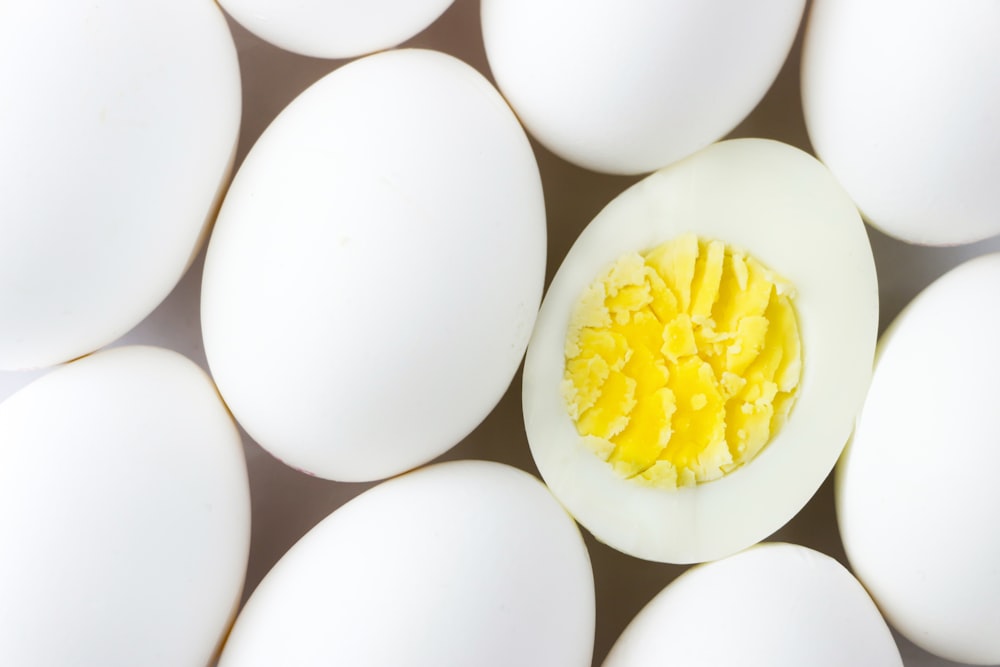
Photo by Mustafa Bashari on Unsplash
I tried for decades to get perfect boiled eggs. But I could never get the eggs to peel right. Then about 6 years ago I found an article about steaming them.
It works! They peel effortlessly every time. They are easier to time the degree that I want them cooked to.
Strat some water to boil in a covered pot. Let it get to a hard boil, you will see steam coming out from under the lid.
 I have had a set of these for 36 yea5rs and use them daily!
Using a net steamer place the eggs in it and quickly take off the lif and add the steamer to the pot.
Set your timer for 6 minutes for soft boiled, 10 minutes for hard boiled with a still translucent and bright yolk, or 12 to 15 minutes for cooked-through hard boiled.
Place the eggs in a bowl of ice water to cool. I do this in the sink so I can let the eggs fall in to it from a few feet up. This cracks the eggs and lets them break, letting water seep in between the cooked albumin and the shells. When ready, after a few minutes of letting the eggs chill, peel the eggs.
Asian Tuna Salad on a Bed of Nappa Cabbage
Posted: July 25, 2023 Filed under: Recipes | Tags: #delivery, #glutenfree, #healthyeating, #Lactosefree, #mealdelivery, #MillieBarnes, #nutritioncoaching, #Ortega, #pescatarian, #Riverside, #SanMarco, #soyfree. #freedelivery, #Springfield, #vegetarian, #weightloss Leave a comment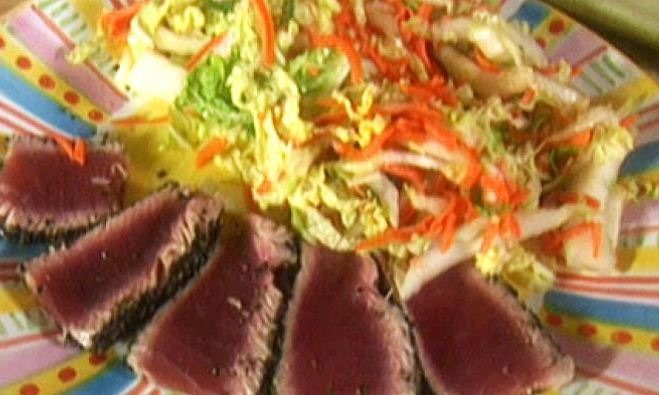
2 tablespoons lime juice
1 1/2 tablespoons fish sauce
11/2 t. Monk Fruit Sweetener or honey
1 teaspoon dark sesame oil
Coarse salt and cracked black pepper
1 medium Napa cabbage
1 bag shredded carrots
1/2 cup basil leaves, torn into quarters
1/2 cup mint leaves, torn
1/2 cup cilantro leaves, roughly chopped
4 tablespoons black and white sesame seeds
1 pound ahi tuna steaks
2 teaspoons extra-virgin olive oil
In a large salad bowl, whisk together lime juice, fish sauce, sugar, and sesame oil. Taste and adjust seasonings with salt and pepper. Cut cabbage in 1/2 lengthwise and slice into thin ribbons. Place cabbage, carrots, basil, mint, and cilantro in the bowl with the dressing. Toss to combine. Set aside.
Pour the sesame seeds out onto a plate. Press the tuna into the seeds on both sides, pressing gently so the sesame seeds stick.
Heat the olive oil in a 12-inch non-stick pan over medium high heat. Add fish to pan and cook until rare, about 2 minutes per side. Alternatively, cook until done to your likeness. Slice thin and distribute among 4 serving plates. Serve with a generous portion of Napa cabbage slaw.
Post Traumatic Stress Disorder: How Yoga and Physiotherapy Can Help in PTSD
Posted: July 22, 2023 Filed under: Health and Happiness Leave a comment
Bringing his expertise to the same, Dr Sumit Gupta PT, HOD- Department of Physiotherapy and Rehabilitation at Regency Health, highlighted that PTSD can also increase stress and anxiety leading to tension in the body but revealed how Yoga and physiotherapy is very helpful to prevent this condition:
1. So many time patient complaint pain. Physiotherapist set goals. Strengthening exercise, stability exercise, joint mobilisation, needling and motion exercise is help to reduce pain.
2. Breathing exercise – Physiotherapist can give their patient different breathing exercise (deep breathing, chest mobilisation, diaphragmatic breathing) which help to reduce stress or anxiety.
3.Anxiety-regular exercise is an effective method in management anxiety and stress follow a prescribe exercise plan will allow the body to release chemical that can help in reducing stress and anxiety.
He listed the benefits of regular exercise on PTSD symptoms as:
- A few positive results physiotherapy can have on your physical health including generate mobility and flexibility increase strength weight loss and improvement in cardiovascular health.
- Regular exercise can also have a positive effect on your mental health through the reduce the of depression and anxiety feelings.
A traumatic event can cause a person to experience post-traumatic stress disorder (PTSD), a mental health condition that is characterised by signs like anxiety, intrusive thoughts, nightmares and flashbacks. While therapy and medication are frequently used as traditional PTSD treatments, health experts insist that complementary modalities like Yoga and physiotherapy have shown promise in helping people manage their symptoms.
In an interview with HT Lifestyle, Dr Amit Deshpande, Founder and Director of Activist, shared, “Post-traumatic stress disorder (PTSD) is a debilitating mental health condition that can occur after experiencing or witnessing a traumatic event. Fortunately, Yoga and physiotherapy offer promising avenues for healing and managing PTSD symptoms. Yoga provides a holistic approach by combining physical postures, breathing exercises and meditation, helping to regulate the nervous system and reduce anxiety and stress.”
He gushed, “The mindful movements and deep breathing foster a sense of calmness and self-awareness, enhancing emotional resilience. Physiotherapy, on the other hand, focuses on restoring physical function and mobility through targeted exercises and manual therapy. It can address physical symptoms associated with trauma, such as muscle tension and pain. Additionally, both yoga and physiotherapy offer a safe and supportive environment, fostering a sense of community and connection, which can aid in the recovery process.”
Dr Rajeev Rajesh, Chief Yoga Officer at Jindal Naturecure Institute in Banglore, explained, “Yoga is a mind-body discipline with its roots in the ancient Indian subcontinent. It combines physical postures, breathing techniques and meditation. It has been discovered to be successful in lowering anxiety, enhancing sleep, and fostering general wellbeing. Yoga can give people with PTSD a safe place to re-connect with their body and process their trauma in a nurturing setting. Yoga’s physical asanas and deliberate breathing techniques work to control the autonomic nervous system, lowering hyperarousal and enhancing relaxation. Additionally, yoga’s emphasis on mindfulness encourages people to be in the present moment, which helps to lessen intrusive thoughts and improve self-awareness.”
He added, “On the other hand, physiotherapy focuses on enhancing functional movement and physical rehabilitation. Physiotherapy can help people with PTSD deal with the somatic symptoms, chronic pain, and other physical effects of trauma. Physiotherapy can assist people in releasing tension, restoring proper movement patterns, and improving body awareness through a variety of techniques like manual therapy, exercise, and body awareness training. Physiotherapy can indirectly reduce psychological distress and improve general wellbeing by addressing physical symptoms. Yoga and physiotherapy both provide holistic approaches to healing and can support existing PTSD treatments. It is crucial to remember that these methods might not be appropriate for everyone and should only be used under the supervision of trained experts. However, incorporating yoga and physical therapy into PTSD treatment plans can give patients more coping skills and tools to manage their symptoms and enhance their quality of life.”
Five Star Gazpacho
Posted: July 15, 2023 Filed under: Food and it's Impact on Our Health Leave a comment
Photo by Empreinte on Unsplash
Yield: 8 to 12 servings, about 1 quart
About 2 pounds ripe red tomatoes, cored and roughly cut into chunks
1 Italian frying (cubanelle) pepper or another long, light green pepper, such as Anaheim, cored, seeded and roughly cut into chunks
1 cucumber, about 8 inches long, peeled and roughly cut into chunks
1 small mild onion (white or red), peeled and roughly cut into chunks
1 clove garlic
2 teaspoons sherry vinegar, more to taste
Salt
½ cup extra-virgin olive oil, more to taste, plus more for drizzling
1) Combine tomatoes, pepper, cucumber, onion and garlic in a blender or, if using a hand blender, in a deep bowl. (If necessary, work in batches.) Blend at high speed until very smooth, at least 2 minutes, pausing occasionally to scrape down the sides with a rubber spatula.
2) With the motor running, add the vinegar and 2 teaspoons salt. Slowly drizzle in the olive oil. The mixture will turn bright orange or dark pink and become smooth and emulsified, like a salad dressing. If it still seems watery, drizzle in more olive oil until texture is creamy.
3) Strain the mixture through a strainer or a food mill, pushing all the liquid through with a spatula or the back of a ladle. Discard the solids. Transfer to a large pitcher (preferably glass) and chill until very cold, at least 6 hours or overnight.
4) Before serving, adjust the seasonings with salt and vinegar. If soup is very thick, stir in a few tablespoons ice water. Serve in glasses, over ice if desired, or in a bowl. A few drops of olive oil on top are a nice touch.
Prebiotics and Probiotics.
Posted: July 14, 2023 Filed under: Food and it's Impact on Our Health Leave a comment
Think of your gut microbiome as an intestinal garden, teeming with trillions of bacteria, viruses and fungi that play a crucial role in your health.
Whether the beneficial microbes in your gut are flourishing or getting crowded out by unwelcome guests largely depends on how well you’re taking care of them.
Scientists estimate that a typical person’s gut microbiota contains between 300 and 500 species of bacteria. Your gut microbiome is a complex ecological community, and the food that you feed it, the new species you invite, and the waste products they create all can affect your physical and mental health.
Taking probiotics are not really that effective. Probiotics don’t work for everyone. Your unique gene makeup, age, health, bacteria you already have in your body, and diet all affect how probiotics work. The dose isn’t correct (too few CFU). Also most of what you supplement does not make it past the stomach. But taking a supplement, which common sense tells us cannot be alive unless flash frozen and very carefully kept refrigerated. They are ineffective and can be harful if they reach the lower intestine and begin growing and can lead to an imbalance.
So what do you do?
It’s really pretty simple.
Americans eat mostly cooked or processed foods. Once you have heated or processed foods the enzymes that are present in that food are no longer alive. Enzymes are what help us break down the food into a form that we can actually absorb the nutrients from. Most Americans have poor gut health. When you look at the rate of diseases we have they are almost all self-inflicted. No one eats enough salads, no one needs enough fruit, very few people have raw food in any form along with the cooked food that they are eating. And that is the answer. When you have breakfast have some fresh fruit along with some coconut yogurt with it and then eat the normal breakfast that you would have. And it shouldn’t be cereal, it should be a high quality protein with perhaps some vegetables involved. For your other meals you want to have a salad or fruit before or after the meal.
If you look at most cultures and how they have have eaten for centuries you will see that pattern of eating raw food with every meal. My rule of thumb is you never eat cooked food would have something raw with it. I generally get up in the morning and have Turkish coffee accompanied by a banana. A little while later I have blueberries and coconut milk yogurt followed immediately by either an omelets with vegetables, or eggs cooked another ways along with some vegetables. Same thing with your other meals, avoid processed food, avoid grains which are very hard to break down, lean toward proteins that are easier to digest and are not hard on the colon such as Seafood, beans, or eggs. You can have fruit after a meal or a salad before the meal or vice versa and it’s going to give you the results you want by aiding your digestion, making sure that you are digesting your food effectively. Also remember the depression and other emotional issues are linked to brain health and there is a direct link between gut health and brain health. If you don’t believe me, try eating perfect for a week and notice how much happier you feel, how much better you sleep, how much more energy you have.
#mealdelivery, #pescatarian, #vegetarian, #Riverside, #Ortega, #SanMarco, #weightloss, #healthyeating, #MillieBarnes, #delivery, #lactosefree, #Glutenfree, #Springfield, #soyfree. #freedelivery, #NutritionCoaching
Shrimp and Fall Greens Gumbo
Posted: June 27, 2023 Filed under: Recipes | Tags: #delivery, #glutenfree, #healthyeating, #Lactosefree, #mealdelivery, #MillieBarnes, #nutritioncoaching, #Ortega, #Pescataian, #pescatarian, #Riverside, #SanMarco, #soyfree. #freedelivery, #Springfield, #vegetarian, #weightloss Leave a comment 
12 ounces clam juice
1 pound medium shrimp — cut in half
1 tablespoon olive oil
3/8 cup onion — chopped
3/8 cup green pepper — diced
1 tablespoon garlic — chopped
1/4 cup tomatoes — seeded, diced
2 large bay leaf
1/2 tablespoon dried thyme
1/2 teaspoon tabasco sauce
1/2 bunch kale — chopped coarsely
1 cup rice
1/2 bunch scallions — dia. slices
1 1/2 tablespoons file powder
Boil water, reserved shrimp shells and clam juice for 15 minutes. strain and reserve stock.
Sauté onions, peppers and garlic in white wine for 2 minutes, add tomatoes, bay leaves, thyme, tabasco and reserved stock. bring to a boil. reduce heat, simmer 15 minutes.
Add rice to soup and simmer 20 minutes. Then add kale greens to soup, simmer until greens are bright green, about 3 minutes. add shrimp, simmer 1 more minute. turn off heat, add file powder, season w/ salt and pepper and tabasco.
Smoked Eggplant Dip with Tahini and Lemon
Posted: June 6, 2023 Filed under: Recipes Leave a comment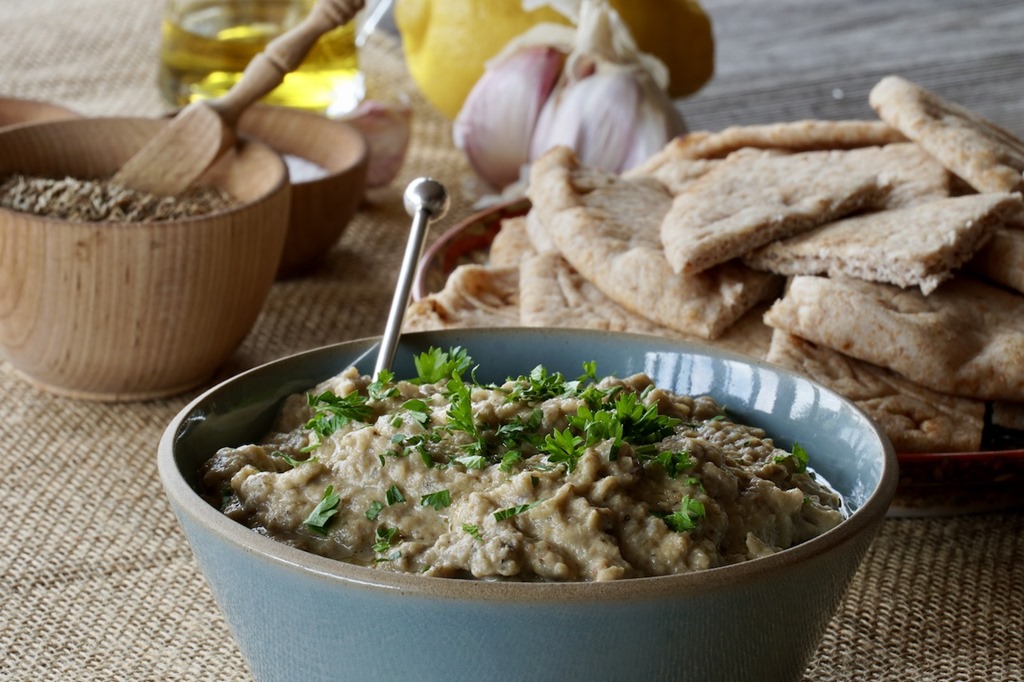
- 3 medium sized eggplant, washed
- 1 head of garlic, roasted
- ¼ cup organic tahini
- 1 tablespoon lemon juice
- 1 teaspoon cumin seeds, toasted and ground
- 1 tablespoon extra virgin olive oil
- 1 teaspoon smoked salt from natural sources (no liquid smoked flavor!)
- ½ teaspoon black pepper
- 1 teaspoon honey
- roughly chopped flat-leaf parsley for garnish
- drizzle of extra virgin olive oil
DIRECTIONS
- Preheat smoked to 275°F. Place eggplants into grill basket then transfer to smoker, barbecue or oven. Cook for 2 hours, or until skin and flesh soften.
- Trim tips off cloves of one head of garlic. Place onto a square of aluminum foil, drizzle with oil and add salt and pepper. Seal foil into tent shape and roast at 400°F for 45 minutes.
- Toast cumin seeds in a skillet on medium-high heat until fragrant and toasted. Allow to cool and then grind.
- Remove eggplant from smoker and cool for about 20 minutes.
- Remove garlic from oven, allowing it to cool. Open foil wrap and carefully squeeze or spoon the roasted cloves from the garlic skin into a bowl and gently mash.
- Transfer eggplant, mashed garlic, tahini and lemon juice into a bowl and stir together. Add cumin and stir again. Add salt and pepper to taste.
- Garnish with rough-chopped parsley and a drizzle of extra virgin olive oil.
7 ways to help extend the healthy years of your life
Posted: June 2, 2023 Filed under: Health and Happiness Leave a comment
“We’re living longer, but we’re kind of grinding our way through the last maybe 25% of our life with some form of health condition,” Macpherson says.
About 65% of people over the age of 60 are living with multiple health issues, he adds.
Here’s why Macpherson says our healthspan isn’t increasing at the same rate as our lifespan. Plus, seven ways you can help lengthen the healthiest years of your life.
Here are a few practices Macpherson encourages to add more years to your healthspan.
Don’t skip catching up with your doctor. Regularly check in and get blood tests annually to catch any potential health issues.
Ditch sugar. “We cause our body a lot of problems when it has to deal with too much sugar, and it ages us and affects our healthspan,” he says.
Maintain a healthy diet. Stick to a Mediterranean diet or plant-based diet, with meat occasionally for extra protein.
Sit less: “Sitting is bad, standing is good,” so consider a standing desk while you work, he suggests.
Exercise often. Walk every day if that’s all you can manage, but aim to exercise 30 minutes a day.
Remember to hydrate. “Generally healthy people” should drink four to six glasses of water each day, according to Harvard Health Publishing. Consult your doctor if you aren’t sure how much water you should be drinking daily.
Practice gratitude and mindfulness. “Gratitude, mindfulness and a great social circle, I think, can add years, if not a decade to your life,” says Macpherson.
Cocoa Flavanols May Boost Memory
Posted: May 30, 2023 Filed under: Food and it's Impact on Our Health Leave a comment
Coffee, berries, apples, grapes, nectarines, pears and cocoa are all good sources of flavonoids and some of these should be eaten daily. I personably drink coffee, green tea, and chocolate every day!
If your diet is low in flavanols — antioxidant compounds found in foods such as green tea, apples, berries and cocoa — adding 500 milligrams a day to your diet may slow and possibly improve age-related mental decline, according to a new study.
Age-related mental decline is typically subtle. The condition impacts thinking speed and the ability to sustain attention and causes issues with word-finding, and it should not be confused with Alzheimer’s disease and other dementias, experts say.
“Older adults consuming lower levels of food-borne flavanols scored less well in tests of hippocampal memory function than individuals consuming higher levels,” said Dr. Ian Johnson, emeritus fellow at the Quadram Institute in Norwich, a center for food and health research in the United Kingdom. He was not involved with the study. The hippocampus is a part of the brain that regulates learning, spatial navigation, and storage and consolidation of memory.
When those same people were given daily supplements with flavanols derived from cocoa, however, their performance on an age-related word-recall test improved, Johnson said in a statement. He was not involved in the study, which was published Monday in the journal PNAS Neuroscience.
Flavanols, also called flavan-3-ols, are compounds that help give fruits and vegetables their bright colors. Each plant may contain more than one type of flavanol, as well as necessary micronutrients that complement each other. That’s a key reason many nutritionists recommend “eating the rainbow” to get the most benefit.
All flavanols are bioactives, naturally occurring compounds that affect processes within the body. The Academy of Nutrition and Dietetics recommended in 2022 a daily intake of 400 to 600 milligrams of flavanols. The association cited studies that showed the compounds may reduce the risk of cardiovascular disease and diabetes.
Despite the fact that the study tested 500 milligrams of flavanols derived from cocoa, that does not mean you can get similar results from eating 500 milligrams of chocolate.
“What really doesn’t contain a lot of flavonoids are chocolates,” Kuhnle said.
In order for researchers to extract as many flavonoids from the dark cocoa as possible, the extraction processed was intensely “optimized” in the lab, Kuhnle explained.
“The best way to meet 500 milligrams a day is by consuming a range of different flavanol-containing foods,” he said.
Many foods do contain enough flavanols to meet that daily level, Kuhnle said, including berries, apples, grapes, nectarines and pears. Green tea is an excellent source — but only if you drink it.
“This is really about green tea, not green tea extract,” he stressed. “Extreme amounts of green tea extract (can) cause problems. People think, ‘Oh, if I’m on x, that’s fine, twice the amount of x is better, and 10 times is even better.’
“That’s one reason to always be cautious about supplements: It’s incredibly easy to increase amounts beyond what is sensible and beyond what is useful,” Kuhnle said.
In addition, when it came to optimizing levels of flavanols, there was “no advantage in going above these 500 milligrams and it’s achievable by diet, so there’s not really any need to go to supplements,” Kuhnle said.
7 Health Benefits Of Walnuts You Won’t Want To Miss Out On
Posted: May 30, 2023 Filed under: Food and it's Impact on Our Health Leave a comment
Zhu and Chaudhry both recommend eating an ounce of walnuts (about a handful) per serving, pointing to studies showing that a one-ounce serving is enoughto improve the quality of your diet and your intake of certain nutrients, like magnesium.
Compared to other tree nuts, walnuts are much higher in the plant source of omega-3 fatty acids,” says May Zhu, MBA, RD, LDN. These fatty acids can’t be made in our bodies—we get them from food—but are essential for brain health and cognition, as well as cardiovascular health.
And don’t toss the walnut skins aside. Huma Chaudhry, RD, LDN, adds that the skin of walnuts also contains high amounts of antioxidants that can “help fight inflammation and oxidative damage in the body.”
Walnuts are also an excellent source of copper, folic acid, and vitamins B6.
Benefits
Walnuts hold benefits from your head to your toes, helping support good health in your brain, heart, gut, and more. Here are their top science-backed perks of eating ’em:
They may benefit brain health.
“Walnuts contain nutrients such as healthy fats, antioxidants, and vitamin E, which all contribute to brain health by reducing oxidative stress and inflammation,” Zhu explains.
Studies suggest that the nutrients in almonds, hazelnuts, and walnuts could help prevent or even manage Alzheimer’s disease
“The plant compounds found in walnuts also have been shown to reduce inflammation and oxidative stress in the brain, reducing risk for brain disorders,” Chaudhry says. English walnuts (the most popular type) hold multiple including high amounts of polyunsaturated fatty acids, which benefit brain health. The polyphenolic compounds in walnuts reduce inflammation of brain cells and improve neurogenesis7, the formation of new neurons in the brain.
One study also discovered that regular consumption of nuts, in general, could be linked to a decreased risk for cognitive decline8.
They may benefit heart health.
“Consumption of walnuts has been linked most notably to supporting heart health,” Zhu says. This is because walnuts contain significant amounts of alpha-linolenic acid), which reduces the risk of cardiovascular disease. Eating walnuts instead of foods that have saturated fat could help lower the “bad cholesterol” (LDL) and raise your “good cholesterol” (HDL).
Another study has even linked10 walnut intake with reduced stroke rates. A group of participants that ate a Mediterranean diet including plenty of mixed nuts had a 49% reduction in risk of stroke compared with a lower-fat diet control group.
They can help to balance blood sugar.
Another of the best benefits of walnuts: Their combination of healthy fats, protein, and fiber can reduce blood sugar spikes and maintain balanced glucose levels between mealtimes.
One study on this topic looked specifically at walnut oil, indicating that consuming walnut oil could improve blood glucose levels11 in people with type 2 diabetes. Another (conducted on hyperlipidemic patients with type 2 diabetes) indicated that long-term walnut consumption could reduce fasting plasma glucose and insulin levels.
“The macronutrient combination in walnuts can increase satiety, keeping you full for longer and making it a diabetes-friendly snack,” Chaudhry says.
They may help improve sleep quality.
Walnuts naturally contain melatonin which plays a role in quality sleep. “Try swapping your melatonin gummies with a handful of walnuts as a bedtime snack,” Chaudhry suggests.
In addition to melatonin, walnuts may help improve your shut-eye thanks to their high magnesium content. A one-ounce serving contains 11% of your daily magnesium requirement. Magnesium is an essential mineral that helps your body relax, improving sleep quality. It also helps regulate GABA, a neurotransmitter that’s involved in promoting good sleep.
Finally, walnuts also contain tryptophan16—the same amino acid that’s in your Thanksgiving turkey. Your brain converts L-tryptophan into serotonin, which tends to make you feel sleepy17. These are a few reasons why walnuts may contribute to healthier sleep patterns.
They may help to promote longevity.
Recent research has shown that walnuts may help improve longevity, as well as helping you age more healthily and gracefully.
“Researchers from the Harvard T.H. Chan School of Public Health associated higher walnut intake to lower risk of death among older adults in the U.S.,” Chaudhry says. “The study linked five [or more] servings of walnuts per week to reduced mortality risk.
She notes that the group that ate more walnuts had a 14% lower risk of death from any cause and 25% less risk of death from cardiovascular disease, plus a gain in about 1.3 years of life expectancy (but it’s important to note that this study was funded by the California Walnut Commission).
And as we’ve already seen, walnuts support heart health and reduce the risk of cardiovascular disease19, which is one of the top causes of death20 in the U.S.
They may benefit gut health.
“Walnuts provide a dose of fiber, which is beneficial for regular bowel movements and supporting our good gut bacteria,” Chaudhry states. “The soluble fiber in walnuts can help feed the good gut bacteria in your large intestine and has been linked to reducing colon cancer risk.
In another California Walnut Commission-funded study, 194 healthy adults consumed 1.5 ounces of walnuts each day for eight weeks. They saw an increase in beneficial bacteria22 compared to when not eating walnuts. In a separate study, facilitators also concluded that walnut consumption affected the gut microbiome23.
They may improve metabolic health
Consuming nuts such as walnuts multiple times per week has been linked to less weight gain and a decreased risk for obesity. This goes hand-in-hand with a reduced risk of chronic disease, too.
Both animal and human studies have indicated that walnuts may help decrease the risk or the progression of conditions2 such as Parkinson’s disease, stroke, depression, cardiovascular disease, and type 2 diabetes. Walnuts can also lower your “bad cholesterol” and the phytomelatonin found in walnuts is being studied for its anticancer effects.


 Meal Delivery Service by Millie Barnes