Animal farming is an efficient use of land
Posted: August 22, 2009 Filed under: Food and it's Impact on Our Health Leave a comment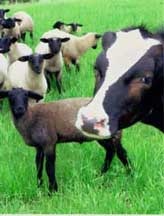 A year ago I started a square foot garden in my backyard. I had a compost pile already, but began bringing kitchen waste from the health food store deli I where I was a Chef. I mean huge amounts; black plastic bags full of lettuce, 3 gallon buckets almost everyday full of veggie waste. And seeds! I planted bell peppers from the seeds I got from the produce. Along with buying potting soil by the 40 pound bag, I was able to build up my soil, kinda. I needed fertilizer. I bought composted manure and along with buying organic fertilizers, I was able to start growing sweet potatoes, tomatoes, Swiss Chard.
Now bear in mind I am a newb at this, I haven’t grown any veggies since the early 80’s and quite frankly my ex did most of the work, I got to pick it and prepare it. So this time I got to see how it all worked, had to start really learning how. One thing that quickly struck me was that I was sick of buying dirt and fertilizer! So I tried worm farming and Bokashi composting. Not enough compost could be produced this way for me to get enough fertilizer out of it.
At the same time I was continuing studying how to radically green my lifestyle. I have always been a very serious environmentalist; never used paper towels, used cloth bags to shop, used cloth diapers and a clothesline with all 5 kids, never worn polyester clothing, used as little plastic in the kitchen as possible, never bought water in plastic bottles, taken short showers. But I wanted to do more. I insulated all my windows, went the bidet route when it came to toilet paper, began making everything I eat from scratch including mayonnaise, salad dressings.
Then I came across Joseph Jenkins book; “The Humanure Handbook”. It is available free on the web, so I dove in, built a sawdust toilet. Now I didn’t know if this was going to be something I would stick with, didn’t know what the ick factor would be…so I decided to try it a month and see. My kids howled, made fun of me, said mom was turning into a cat, using a litter box…we had much fun with it. But the bottom line is it was easy; no smells, easy to deal with. I buy wheat bran from the feed store; 50 pounds for 12 bucks. About the time I needed to empty the bucket, it was time to mow the yard…this gives me the cover material I need, along with food scraps and yard waste to do high heat, or Thermal, composting. This is the only way to create enough compost to grow my own veggies, make compost tea, build up my soil.
Which is exactly how it plays out on a farm. You need farm animals to keep from having to buy fertilizer! And it makes the most beautiful soil, light, fluffy, loamy dirt. Since I have no room for a cow, or goats or chickens..that leaves humanure; cheap, readily available.
AND BEST OF ALL?? I do not foul 3 gallons of drinking water every time I flush! That is awesome!
But the reason I started this rant is because of the big push every one on the net seems to be making to get people to turn to a vegetarian diet, saying it is green, that animal farming isn’t a good use of our land, that we can all eat grains (a horrible choice health wise, BTW!, see this article- Grain Based Diets Are Bad for Humans). Vegetarian Diets are not healthy for many reasons (see- Vegetarian Diet are Not Healthy For Humans). But the main point I want to make is that we are healthiest eating meat, and we do not have enough arable land to grow all the veggies and grains if that all people ate, there is not enough depth of nutrients. We need saturated fats and meat broths and grass fed meat to be healthy!
Read what Barry Groves, PhD, has to say on his website- Second Opinions- Exposing Dietary Misinformation.
Animal farming is an efficient use of land
The human population of this planet is now approaching six billion and, even if every country on Earth enforced a strict and effective birth-control policy today, it is estimated that the total population will climb to fifteen billion before stabilizing. The Earth’s total land area is 179,941,270 square kilometers (69,479,518 square miles). A little simple mathematics tells us that at present, on average, one square kilometer has to support just over thirty-three people. If all of it were cultivated, that would certainly be possible.
The argument fails, however, because not all of it is available for arable cultivation. The main environmental factors which determine plant development and distribution are climate and soil type. We can discount the whole of the unproductive continent of Antarctica, so that reduces the total by 13,335,740 square kilometers immediately. We can also discount, at least as far as arable farming is concerned, all other ice-covered areas, tundra, mountains, deserts, heath and moor land, areas covered by rivers, salt marshes and lakes, cities, roads, and railways; and to a large extent semi-deserts, savannah, rain forest, low-lying meadow land and areas liable to regular flooding. We have now discounted most of the Earth’s surface. In fact, only eleven percent of the land surface is farmed.
Almost all of the land we have just discounted does support grass or other plant life which we cannot utilize directly. We need a system which converts that grass into a form of food that we can eat. And we have one: much of the land we have discounted for arable use can be, and is, used for the raising of food animals. Take New Zealand, for example. Here we have a country of 269,000 square kilometers — larger than Great Britain — with a human population of 3 million, a sheep population of 42 million (see figure 1) and many cattle. When I was in New Zealand for three months in Spring 1999, I didn’t see one field of grain. It wasn’t surprising: as the ground is rarely flat and the volcanic rock on which New Zealand is built is very close to the surface, that country is quite unsuitable for the cultivation of grain (see figure 2). And the same applies to many other parts of the world.
At present one-third of the world’s population is starving. If we all became vegetarians, we would have no use for, and would stop farming, all the land that will support only food animals. But taking all the land that supports food animals, but cannot support arable farming, out of production is hardly likely to ease the problem. In many areas where animals are farmed, they are the only things which can be farmed. In these areas, therefore, animal farming is the most efficient use of the land.
The vegetarian may argue that land that is not cultivable at present can be made so, but it is an argument which has already been shown to be false. The situation with respect to land use is not static. As the population has increased this century, so the amount of land available for cultivation has decreased. Where deforestation has taken place to make way for cultivation, soils have been exposed to higher precipitation and temperatures (4) . These processes deplete the soil’s organic matter, the soils harden and turn to desert. In 1882, desert or wasteland covered an estimated 9.4 percent of the Earth’s surface. By 1952 that area had increased to nearly twenty-five percent. It is a growing trend and one which, once it has happened, is very difficult, if not impossible, to reverse.
In many areas with naturally low productive capability, irrigation is used to increase agricultural productivity. But irrigation carries with it the seeds of its own destruction. Semi-arid soils are characteristically salty. The irrigation water, from essentially the same area, is also usually saline. Without adequate drainage, the irrigation water seeps into the soil and raises the water table. This brings the underlying water nearer the surface where it evaporates more freely, leaving behind the salty chemicals. In time, the salts of sodium, magnesium and calcium clog the pores in the soil and leave a whitish bloom on the surface. This process not only destroys the soil structure so that yields fall, it leads eventually to a level of salinity where no plant can grow. Kovda estimates that between sixty and eighty percent of all irrigated land, that is millions of acres, is being transformed into deserts in this way.
Most of the world’s surface is not covered by land, but by the oceans and seas. At present, millions of tons of fish are caught or farmed each year. As well as not eating meat, many vegetarians don’t eat fish. If vegetarianism really caught on and everybody on the planet stopped eating fish, the two-thirds of the population who are not starving at present would soon join the third who are.
The British situation
The prosperous, well-fed United Kingdom has a total land area of some 88,736 square miles (229,827 sq km) and a population of 57,537,000 ( 1991 Census ). Arable and orchard farming occupy thirty percent while permanent meadow and pasture, which support food animals, covers fifty percent of the total area. But all of that is woefully insufficient — we still have to import one-third of the food that we need.
The UK’s major livestock production is sheep, which are reared in almost every part of the kingdom. If we all became vegetarians, the mountains of Wales and Scotland would become largely unproductive, as would the moorlands of central and northern England. We would not eat the 720,000 tons of fish caught each year — over 12.7kg (28 lbs) per head. If we all became vegetarians, how much more food would we have to import? and where would it come from? The USA and Canada, who are net exporters of grain, might seem to be the answer to the latter question, although our food import bill — already £6 billion per annum — would rise alarmingly. If they too became vegetarian, however, they too would need to import. No: if we all became vegetarians, make no mistake, we would starve.
A fishy problem
For many lacto-ovo-vegetarians, the killing of animals is a problem. On moral grounds some are tending to change to eating fish — although the logic whereby the killing of fish is considered correct if the killing of land animals is not, escapes me. They are encouraged in this change by the belief that the eating of fish is what has allowed the Japanese to live longer and that it is good for them. Wanting to be healthy themselves, they buy sea fish like cod, sea bass, red snapper and haddock. But these are not the ‘healthy’, omega-3-oil bearing fish that doctors are advising us to eat.
Fish stocks are declining. Cod used to be a cheap fish. It is presently £7.70 per kilogram, — over £2 more than farmed salmon. As prices reflect the laws of supply and demand, this can mean only one thing: there is a shortage of cod. Cod is not the only fish that is scarce around Britain, so are haddock, wild salmon and monkfish. It is the same story world-wide. The one fish which is plentiful now is the North-Sea herring. This does contain omega-3 oils and, with the mackerel, is good for us. It is also the cheapest fish on the market, yet the British have almost stopped eating it.
The fish for which we have rejected herring is tuna from the Pacific and other exotic species: tiger prawns from India and sailfish from the Caribbean. This change reflects a growing and disturbing trend. With the North Sea almost fished out and now highly regulated, third-world fishermen, hungry for foreign currency, are plundering their own declining stocks in other unregulated oceans.
With fish becoming increasingly difficult to catch in quantity, modern fishermen and their equipment are becoming increasingly sophisticated. Cornish fishermen are using four-mile-long drift nets to catch tuna in the northern Atlantic. The nets are called ‘walls of death’ because of the numbers of dolphins and other unwanted fish they catch. The Japanese fish for tuna with lines up to sixty-five miles long with thousands of baited hooks. In the North Sea, trawling does more damage than pollution.
Fish are very good at renewing themselves — if they are allowed to do so. But few will let them. Despite international agreements and quotas, in the northern seas, no-one, with the possible exception of Iceland, is managing their fish stocks properly and the problem of over-fishing is spiraling out of control.
Fishermen’s methods have been likened to farming. But they are centuries behind: where the farmer sows and reaps, the fisherman, like the primitive hunter-gatherer, only reaps. He does not use his resources nearly as efficiently as the land farmer. Without fish, we would be hard pressed in this island for sufficient high-quality food. We need fish, but we will only exacerbate the problem of over-fishing if we switch from meat to fish — from efficient animal farming to inefficient and wasteful fishing.
In conclusion, meat eaters must have sympathy for and agree with the animal rights campaigner where animals, which should be grazing in fields, are confined to pens and battery houses while their natural habitat is turned into golf courses and leisure grounds for us.
And paying farmers to let land lie fallow when it could safely support cattle or sheep, particularly while we are importing vast quantities of food, is madness.
It is legitimate to challenge this regime.
The only way to eradicate the forms of intensive farming which are so disliked, is to control and reduce the population and, hence, the need for such a system.
Not only will undertaking unnatural dietary practices not provide a solution, they are much more likely to exacerbate the situation.
The Western vegetarian at the moment is in a very privileged position. So long as not too many join him, he can afford to indulge his naïve dietary fads in a way that is denied to most of the people of this Earth. While he ponders on this fact, he might also apply himself to Kant’s Categorical Imperative which may be rewritten:
What would be wrong for all, is wrong for one.
Thought I would add these references the last time I wrote on this subject, some girl wrote me all irate because she said she assumed my work was satire because the every IDEA that Vegetarianism was bad for humans was ridiculous and she wanted references…
References
1. Social Surveys (Gallup Poll) Ltd. The 1988 Survey into Meat Eating and Vegetarianism. Commissioned by the Realeat Co. Ltd. 1988.
2. MORI/Sunday Times. Attitudes to Health and Diet 1989.
3. Beardsworth A., Keil T.. Health-related beliefs and dietary practices among vegetarians and vegans: a qualitative study. Hlth Educ J 1991; 50 (1): 38.
4. Kovda V. A.. Soil Preservation. In Polunin N. ed, The Environmental Future. Macmillan, London, 1972.
5. Lee R. B.. What hunters do for a living, or how to make out on scarce resources. In: Lee R. B., DeVore I., eds. Man The Hunter. Aldine, Chicago. 1968.
6. Gaulin S. J. C., Konner M.. On the natural diet of primates, including humans. In: Wurtman R. Y., Wurtman J. J., eds. Nutrition and The Brain. Vol 1, Raven Press, New York. 1977.
7. Bryant V. M., Williams-Dean G.. The Coprolites of Man. Scientific American, January 1975.
8. Hawkes J. G.. The Hunting Hypothesis . In: Ardrey R., ed. The Hunting Hypothesis . Collins, London, 1976.
9. Crawford M., Crawford S.. What We Eat Today . Spearman, London, 1972.
10. Leopold A. C, Ardrey R.. Toxic Substances in Plants and Food Habits of Early Man. Science, 1972
11. Stephen A. Whole grains — impact of consuming whole grains on physiological effects of dietary fiber and starch. Crit Rev Food Sci Nutr 1994; 34: 499-511.
12. Yudkin J.. Archaeology and the nutritionist . In: Ardrey R., ed. The Hunting Hypothesis . Collins, London, 1976.
13. Groves B A. The Cholesterol Myth . A Second Opinion publication, 19th revision, March 1999.
14. Callender S. T., Spray G. H.. Latent pernicious anaemia. Br J Haematol 1962; 8: 230.
15. Halstead J. A., Carroll J., Rubert S.. Serum and tissue concentration of vitamin B 12 in certain pathologic states. N Eng J Med 1959; 260:575.
16. Herbert V.. Vitamin B-12: plant sources, requirements and assay . Am J Clin Nutr 1988; 48: 852.
17. Miller D. R., Specker B. L., Ho M. L., Norman E. J.. Vitamin B-12 status in a macrobiotic community. Am J Clin Nutr 1991; 53: 524-9.
18. Chanarin I., Malkowska V., O’Hea A-M., Rinsler M. G., Price A. B.. Megaloblastic anaemia in a vegetarian Indian community. Lancet 1985; ii: 1168.
19. Freeland-Graves J.. Mineral adequacy of vegetarian diets. Am J Clin Nutr 1988; 48: 859.
20. Sanders T. A. B.. Micronutrients: vitamin B-12. Matern Child Hlth . 1992; 17: 19-20.
21. Dagnelie P. C., et al . Increased risk of vitamin B-12 and iron deficiency in infants on macrobiotic diets. Am J Clin Nutr 1989; 50: 818.
22. Herens M. C., Dagnelie P. C., Kleber R. J., Mol M. C. J., van Staveren W. A.. Nutrition and mental development of 4-5 year old children on macrobiotic diets. J Hum Nutr Diet 1992; 5: 1-9.
23. Lifshitz F., et al . Nutritional dwarfing in adolescents. Semin Adolesc Med 1987; 3 (4): 255.
24. Roberts I. F., West R. J., Ogilvie D., Dillon M. J.. Malnutrition in infants receiving cult diets: a form of child abuse. Br Med J 1979; 1: 296.
25. Kruger D. M., et al . Vitamin D deficiency rickets: report on three cases. Clin Orthop 1987; 224: 277.
26. Bindra G. S., Gibson R. S.. Iron status of predominantly lacto-ovo-vegetarian East Indian immigrants to Canada: a model approach. Am J Clin Nutr. 1986; 44: 643.
27. Galler J. R.. Malnutrition — a neglected cause of learning failure. Postgrad Med 1986; 80 (5): 225-8
28. Bradley P. J.. Deprivation in infancy or in adult life. Lancet 1991; 337: 1043.
29. Barker D. J. P.. The intrauterine origins of cardiovascular and obstructive lung disease in adult life. J R Coll Phys 1991; 25(2): 129.
30. Seidman D. S., Laor A., Gale R., Stevenson D. K., Danon Y. L.. Is low birthweight a risk factor for asthma during adolescence? Arch Dis Child 1991; 66(5): 584.
31. Stock M. B., Smythe P. M.. Does undernutrition during infancy inhibit brain growth and subsequent intellectual development? Arch Dis Child 1963; 38: 546.
32. Association between reported diet and all-cause mortality: 21-year follow-up on 27,530 7th Day Adventists . Am J Epidem 1984; 119 (5): 775.
33. Egold B., Laskar J., Wolf S., Putvin L.. The Roseto effect: a 50-year comparison of mortality rates. Am J Public Health 1992; 82: 1089-92
34. McCormick J., Elmore-Meegan M.. Maasai diet. Lancet 1992; 340: 1042-3.
35. McClellan W. S., Du Bois E. F.. Prolonged meat diets with a study of kidney function and ketosis. J Biol Chem 1930; 87: 651-668.
36. McCarrison, Sir Robert (with Sinclair, Dr. H. M.). Nutrition and Health . Faber & Faber, London, 1953
37. Thorogood M., Mann J., Appleby P., McPherson K.. Risk of death from cancer and ischaemic heart disease in meat and non-meat eaters . Br Med J . 1994; 308: 1667-70.
38. McKeigne P. M., Marmot M. G., Adelstein A. M., et al . Diet and risk factors for coronary heart disease in Asians in north-east London. Lancet 1985; ii: 1086-90.
39. Pauletto P, et al. Blood pressure and atherogenic lipoprotein profiles of fish-diet and vegetarian villagers in Tanzania: the Lugalawa Study. Lancet 1996; 348: 784-8.
40. Ness A R, Powles J W. Dietary habits and mortality in vegetarians and health conscious people: Several uncertainties still exist. Br Med J 1997; 314: 148.
41. Shibata H., Nagai H., Haga H., Yasumura S., Suzuki T., Suyama Y. Nutrition for the Japanese elderly. Nutr Health. 1992; 8(2-3): 165-75.
42. Holmberg L., Ohlander E. M., Byers T., Zack M., Wolk A., Bergstrom R., et al . Diet and breast cancer risk. Arch Intern Med 1994; 154: 1805-11.
43. Shultz T. D., Chew B. P., Seaman W. R.. Differential stimulatory and inhibitory responses of human MCF-7 breast cancer cells to linoleic acid and conjugated linoleic acid in culture. Anticancer Res . 1992; 12: 2143-5
44. Ip C, Scimeca J. A., Thompson H. J.. Conjugated linoleic acid. A powerful anticarcinogen from animal fat sources. Cancer. 1994; 74(3 Suppl): 1050-4
45. Franceschi S, et.al . Intake of macronutrients and risk of breast cancer. Lancet 1996;347:1351-6
46. Lutz W.J. The Colonisation of Europe and Our Western Diseases. Medical Hypotheses 1995; 45: 115-120
47. Vilhjalmur Stefansson. Cancer Disease of Civilization . Hill and Wang, New York, NY, 1960 .
48. Strachan D. P., Powell K. J., Thaker A., Millard F. J. C., Maxwell J. D.. Vegetarian diet as a risk factor for tuberculosis in immigrant south London Asians. Thorax 1995; 50: 175-80
49. McCaddon A., Kelly C. L.. Familial Alzheimer’s disease and Vitamin B-12 deficiency. Age and Ageing 1994; 23: 334-7.
50. Fallon S W, Enig M G. Newlife , May 1966.


 Meal Delivery Service by Millie Barnes