Debunking the Low-Fat Myth
Posted: June 2, 2009 Filed under: Food and it's Impact on Our Health, In The Kitchen with Millie- How To's Leave a commentIf you want to live a long, healthy life, forget about modern recommendations to eat like a rabbit and avoid fat. The best diet for man is the one we were eating for eons.
You have a natural desire for a diet rich in protein and fat. When you fuel your body with the foods for which it was designed, you will find that losing weight comes easier and faster and you will wake up with energy that will last the whole day.
The American Heart Association claims that the path to good health is a low-fat diet. This is exactly the wrong advice, and their "solution" has actually made the problem worse.
A low-fat diet is a prescription for losing vital muscle and turning your body into flab. When you eat low-fat, you neglect the most important nutrient, protein. Even worse, low-fat diets are loaded with the real saboteur of modern diets, processed carbohydrates.
 It’s time to put an end to counting calories and grams of fat. So now I am going to tell you:
- Why avoiding dietary fat is dangerous.
- Why carbohydrates increase your body fat.
- How protein makes you strong, lean, and disease-resistant.
- Why cholesterol is not the threat you’ve been told.
I’ve helped hundreds of people use this approach, and I’ve watched them make a remarkable transition to become lean, healthy, and disease-free.
There are certain fats that are essential to every cell in your body, which is why they’re called "essential" fatty acids. Your body cannot manufacture these fats. You must consume them in your diet or you will suffer disease. But there are many other reasons why low-fat intake can be detrimental. Fat is also critical to help your body absorb certain vitamins and nutrients – such as CoQ10 and vitamins A, D, E, and K – which cannot be properly absorbed without fat.
So, what are the origins of the modern dietary nightmare? About 10,000 years ago, people began to domesticate plants and animals. There was a gradual switch from hunting and gathering to farming and raising livestock. These methods could support a larger population, but quality was traded for quantity.
When humans made the switch from hunter-gatherers to farmers, their protein intake went down, while carbohydrate intake went up. And the incidence of malnutrition and disease began to rise.
Archaeologists can even identify the Agricultural Revolution in fossil records. Hunter-gatherer skeletons in Greece show the average height for men was about 5′9". Upon the advent of agriculture, the height of the average Greek man suddenly shrank to a mere 5′3".
The record of native people in the Illinois and Ohio River valleys also show the health consequences of agriculture. In an article for Discover Magazine, Jared Diamond elaborates on a study by the University of Massachusetts of 800 skeletons excavated there. He writes: ". . . when a hunter-gatherer culture gave way to intensive maize farming. . . the farmers had a nearly 50% increase. . . in malnutrition, a fourfold increase in iron-deficiency anemia. . . [and] a threefold rise in infectious disease."
The Over-Consumption of Carbohydrates Gets Worse
In 1977, a Senate Committee led by George McGovern released its "Dietary Goals for the United States." Without real evidence, it identified fat as the culprit. They didn’t know that native diets contained more fat than modern diets do.
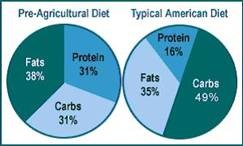
Information from The Paleo Diet (2002) by L. Cordain
The National Institutes of Health jumped on the "ban fat" wagon. In 1984, the NIH announced that Americans must cut their fat intake. The food industry quickly produced a slew of "low-fat" products. But without the tasty fat, the food produced was bland, and high amounts of sugar became a common additive. Americans replaced fat with refined carbohydrates and sugar.
The Real Cause of American Obesity
There is no question that Americans now face a health crisis. We’re too fat. But why? Any plausible answer would have to explain why rates of obesity were constant at about 13% through the 60’s and 70’s, and then suddenly began to rise. Today, 25% of the U.S. population is considered obese, while 70% of Americans are considered overweight. These rates began rising at the time the health authorities told us we must eat low-fat. There was an explosion not only of obesity, but also of related diseases like diabetes, hypertension, and heart disease.
The Growing Percentage of Overweight and Obese American Adults
Add to this mistaken low-fat theory the reality of economics, and you get a recipe for a health disaster. How much profit can you make selling an egg when everyone else can sell the exact same product? But carbs can be processed into proprietary blends. The mark-up can be much greater.
If we can divorce ourselves from the prejudice about dietary fat, it’s really quite simple. Your body controls fat building, and hormones are used to set the controls. The hormone that controls fat is insulin. And how much insulin do you secrete in response to a fat-laden meal? Zero. Insulin is secreted in response to carbohydrates, not fat. Eat more carbohydrates and you will secrete more insulin and build more fat, all other things being equal.
The Solution: Using Modern Science to Emulate the Past
The good news is that fixing this mess is not as hard as you might think. Follow a few simple rules for selecting your food, and you will be able to eat better-tasting foods, reduce your risk of disease, and feel more satisfied.
And don’t worry that eating meat is going to drive up your cholesterol. Recent studies have proven that the incorporation of lean grass-fed meat into the diet helps reduce bad LDL cholesterol and raise good HDL cholesterol levels. And it didn’t matter if it was white or red meat.
Your Simple Plan for Healthy Eating
- Make quality protein the centerpiece of every meal. This should include non-contaminated fish such as wild salmon, sardines, or young tuna, as well as grass-fed meats, poultry, and eggs.
- Eat a wide variety of herbs, leafy greens, and vegetables every day, and a moderate amount of fruit.
- Eat plenty of healthy fats. The best fats is coconut oil. Nuts, eggs, and grass-fed beef also have good fats. Use coconut oil for sautéing, searing and braising. Use raw butter for flavor and for baking., Use olive oil or coconut oil for dressings and mayonnaise. Avoid ALL vegetable oils.
- Avoid processed carbohydrates. You can make this simple: Don’t eat anything made from grains. Period.
The notion that all of us should consume lowfat diets with the same ratios of macronutrients is ridiculous. If you suffer from hypoglycemia or diabetes, or are prone to seizures, you will need more fat in your diet to keep blood sugar levels stable. If you want to lose weight, you will need to cut back on carbs. This will be easier to do if you eliminate a large portion of the carbohydrates and keep the fat percentage relatively high. If you are an athlete, farmer or laborer burning up large amounts of energy, you can eat more carbohydrates than the rest of us without gaining weight.
If you are eliminating most carbohydrate foods from your diet, then it is important to consume plenty of fat. Several researchers have reported that a diet of lean meat leads to nausea in three days, symptoms of starvation and ketosis in 7-10 days, severe debilitation in 12 days and possibly death in a few weeks. Vilhjalmur Stefansson lived for many years among the Eskimos and thrived in a diet that was 20 percent protein and 80 percent fat. When he and his colleagues tried to eat lean meat, they quickly developed diarrhea and a lack of energy.
We are a nation of severely malnourished people. Our cancer rates, heart disease, obesity, degenerative disease are all related to our very poor nutrition.
The latest research shows that we need to return to the traditional diets we have eaten for thousands of years, a diet dense in proteins, fats and lowered carbs. When the foods we eat are dense in nutrients, fewer calories are needed to maintain optimum health. Humans are not designed to exist on purified macronutrients, but need a wide variety of nutrients found in the proteins, carbohydrates and fats in real foods. In fact, animal fats are the most important of all.
Benefits of Animal Fats
Foods containing transfats sell because the American public is afraid of the alternative—saturated fats found in butter, palm and coconut oil, fats traditionally used for frying and baking. Yet the scientific literature delineates a number of vital roles for dietary saturated fats—they enhance the immune system, are necessary for healthy bones, provide energy and structural integrity to the cells, protect the liver and enhance the body’s use of essential fatty acids. Stearic acid, found in butter, has cholesterol lowering properties and is a preferred food for the heart. As saturated fats are stable, they do not become rancid easily, do not call upon the body’s reserves of antioxidants, do not initiate cancer, do not irritate the artery walls.
Your body makes saturated fats, and your body makes cholesterol—about 2000 mg per day. In general, cholesterol that the average American absorbs from food amounts to about 100 mg per day. So, in theory, even reducing animal foods to zero will result in a mere 5% decrease in the total amount of cholesterol available to the blood and tissues. In practice, such a diet is likely to deprive the body of the substrates it needs to manufacture enough of this vital substance; for cholesterol, like saturated fats, stands unfairly accused. It acts as a precursor to vital corticosteroids, hormones that help us deal with stress and protect the body against heart disease and cancer; and to the sex hormones like androgen, testosterone, estrogen and progesterone; it is a precursor to vitamin D, a vital fat-soluble vitamin needed for healthy bones and nervous system, proper growth, mineral metabolism, muscle tone, insulin production, reproduction and immune system function; it is the precursor to bile salts, which are vital for digestion and assimilation of fats in the diet. Recent research shows that cholesterol acts as an antioxidant. This is the likely explanation for the fact that cholesterol levels go up with age. As an antioxidant, cholesterol protects us against free radical damage that leads to heart disease and cancer. Cholesterol is the body’s repair substance, manufactured in large amounts when the arteries are irritated or weak. Blaming heart disease on high serum cholesterol levels is like blaming firemen who have come to put out a fire for starting the blaze.
Cholesterol is needed for proper function of serotonin receptors in the brain. Serotonin is the body’s natural "feel-good" chemical. This explains why low cholesterol levels have been linked to aggressive and violent behavior, depression and suicidal tendencies. Dietary cholesterol plays an important role in maintaining the health of the intestinal wall, which is why low-cholesterol vegetarian diets can lead to leaky gut syndrome and other intestinal disorders.
Putting together this information and applying it will help you heal and give you high clear energy for the rest of your life. It has allowed me to heal, get rid of allergies, and gain very high energy. People find their relationships improving, their sex lives get better, they return to that high, playful energy they had as a child.
I have a cookbook called In The Kitchen with Millie. It has 780 lactose, gluten and soy free recipes, and a 62 day meal. It is in software form, it lets you scale recipes and menu plans, gives nutrition analysis of each recipe and meal plan, lets you add a cookbook and recipes. Check it out here.


 Meal Delivery Service by Millie Barnes